- 152 pages
- English
- ePUB (mobile friendly)
- Available on iOS & Android
eBook - ePub
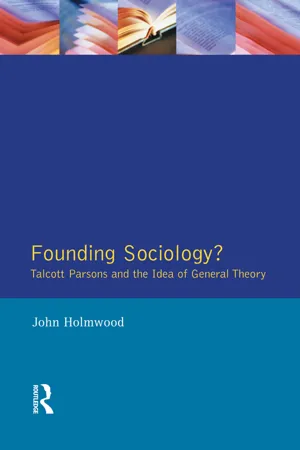
Founding Sociology? Talcott Parsons and the Idea of General Theory.
About this book
The theories of Talcott Parsons' are enjoying a revival in the world of sociology. Rather than following closely the complex original prose in an effort to explain the theory in its minutiae, Holmwood presents a highly readable non-technical critique of several of the strongest underlying sociological themes and shows how, although flawed in many respects, these themes have been recurring, in different forms, in the theories of those critical of his work.
Information
1
The Age of Sociology?
The work of Talcott Parsons has been subjected to sustained critical attack over the last few decades of sociological argument. These attacks were not directed at his work alone and, in the broader criticisms of professional social science, Parsons’s view of sociology came to be assimilated to a position which he had initially opposed. In consequence, throughout the period, Parsons’s theories have frequently been misrepresented and misunderstood. Yet, despite the almost universal hostility directed at his work, the current revival of interest in his theories is no mystery. The conditions in which he proclaimed his view of the role of sociology were similar to those currently associated with postmodernism. However, where these conditions, for many, seem now to presage the end of sociology, for Parsons they heralded a new ‘age of sociology’.1 In these circumstances, it is perhaps not so strange after all that those who are uneasy with the fragmentation (and nihilistic relativism) associated with postmodernism, should turn again to Parsons, or (where theorists retain their hostility to his approach) to positions which are not as far removed from his as they might suppose.
The Current Crisis
A sense of crisis is pervasive throughout current theoretical discussions in sociology. On the face of it, this is nothing new. Crisis-claims have been a perennial feature of sociological debates and, arguably, crisis is a necessary condition of sociology as an undertaking. After all, sociology is an activity in the societies of which sociologists are themselves members. Such an activity could only make sense where social relationships lack transparency and that lack of transparency constitutes a problem for people in the conduct of their lives. Nisbet makes the point well. According to him, historically, sociology is a product of the social dislocations that brought about the modem social order.2 Sociology, he argues, emerged in response to the collapse of old political regimes in Europe at the end of the eighteenth century in the face of the rise of industrialism and demands for democratic political representation. In these circumstances, when traditional relationships were being transformed, sociology gave meaning to new social arrangements, discovering the ‘order’ that underlay what, from a ‘traditional’ perspective, appeared to be mere ‘disorder’. Following Nisbet, Habermas argues that sociology has a special relation to crisis. “Sociology,” he writes, “became the science of crisis par excellence; it concerned itself above all with the anomic aspects of the dissolution of traditional social systems and the development of modem ones”.3
Invariably, talk of crisis was accompanied by claims for reconstruction and renewal, both socially and theoretically. Current discussions of crisis differ. Nowadays it appears that sociological theory has exhausted its potential for further insight and development. Seidman, for example, in a recent commentary on the state of sociological theory, writes that it, “has gone astray… unconnected to current research programs, divorced from current social movements and political struggles, and either ignorant of major political and moral public debates or unable to address them in ways that are compelling or even understandable by nontheorists.”4
Seidman’s judgements are not idiosyncratic. There does seem to be something particularly acute and distinctive about the current crisis in sociology. We do not lack social problems with which to engage. Turner and Wardell, for example, compare our current situation, where many Western societies are experiencing a crisis of the welfare state, with the problems of legitimacy exhibited by liberal states at the turn of the century.5 They suggest that our social crisis should have had the same motivating significance for us that the problem of solidarity in a liberal republic presented to Durkheim, for example, but they conclude that, patently, it has not. Like Seidman, they complain that, “the core of sociological thought is failing in its relations with audiences that are outside the walls of disciplinary sociology.”6 Current social problems, various commentators imply, are urgent and pressing, but, apparently, they are beyond sociological reconstruction, at least as sociology is currently constituted.
Yet only recently it had all seemed so different and promised so much more. If Seidman’s, or Turner and Wardell’s, comments seem despairing it is because the substance of their criticisms was first made several decades ago as a prelude to a transformation of social theory which would address the very flaws they are now identifying and, in the process, would contribute to social renewal. Indeed, Nisbet’s own interpretation of the historical conditions of sociology was itself part of that re-evaluation. It was indicative of a change in the way in which social theory was being addressed and it contributed to a more general sense that a shift in the substance of sociological theory, parallel to that earlier shift that Nisbet had analysed, was underway. The 1960s had seemed to mark a watershed in sociological theory where dominant paradigms of social science – what Atkinson called the ‘orthodox consensus’ – were being challenged by ‘radical alternatives’.7 We are now coming to the end of several decades of critical self-reflection which began in the 1960s and which have culminated in our current sense of an impasse.
Where social theorists had initially looked forward both to a new theoretical order and to a new social order, it seems that the current despair is a reflection of the failure of the promised transformation(s). In these circumstances, any current crisis is within and of sociology. Our crisis is our irrelevance to the current crisis of society, reflecting, perhaps, a change in the very nature of society and social problems. Indeed, it is the claim of many theorists of ‘postmodemity’ that modem society has changed and that its substance is beyond the categories of sociology.8 On this perspective, ‘social integration’ appears to be a sociological fiction and anomie a routine feature of postmodern social life. Ultimately, then, postmodernism offers the possibility that sociology is merely the discourse of modernity and with postmodemity comes not the continued requirement of sociology, but its displacement.9
Sociology as a Profession
Prior to the radical shift in sociological sensibilities that took place in the 1960s, the dominant perception was that Western societies had entered a period characterized by an ‘end of ideology’.10 The defining ideological conflicts of early capitalism – essentially, between a bougeois ideology of ‘radical individualism’ and a socialist ideology of ‘collectivism’ – had, it was argued, lost their relevance in the ‘mixed’ and affluent economies and pluralistic political systems of modem industrial societies. As one of the foremost commentators on these developments, Daniel Bell, argued, “in the Western world… there is a rough consensus among intellectuals on political issues: the acceptance of a Welfare State; the desirability of decentralised power; a system of mixed economy and of political pluralism. In that sense… the ideological age has ended.”11 For some commentators – though not, it must be stressed, for Bell himself – it seemed that, with the end of the ideological age, political discourse could be reduced to issues of technical and professional expertise and the determination of public opinion through mass media and advertising. This was convenient because a growing demand for social scientific expertise had, as part of the political policy process, sustained the growth and professionalization of social science (especially in the USA).
These conditions favoured a conception of sociology in terms of value-neutral technical competence, in contrast to the ideologically engaged inquiries of classical sociology. Sociologists, it seemed, need not (indeed, should not) articulate a public position, nor claim their significance in relation to any particular values. The knowledge produced by social inquiries, it was argued, was independent and value-free, objectively warranted and available as ‘expertise’ to whomsoever had a use for it. Thus, associated with the end of the ‘ideological age’, was the view that ‘ideology’ would be replaced by ‘science’ and that a scientific sociology could bring an accumulating knowledge of the social world. Sociology should be ‘post-classical’; like the natural sciences, it had progressed (or should have progressed) and left the ‘classics’ and their ‘ideological’ definition of issues behind.
According to this ‘positivistic’ view, the conceptual confusions and ideological controversies in which sociology was founded as a discipline would be dissolved. Like scientific knowledge in general, sociological knowledge can be left to accumulate. There was no place for a general theoretical undertaking, only piecemeal and gradual additions to knowledge through empirical research. On this understanding, then, there is a sharp distinction to be made between the history of sociology and its current task – between what Merton calls the ‘history’ and ‘systematics’ of sociological theory.12 If later additions to knowledge look less dramatic than any earlier contribution, it is only because they have become more specialized and dependent upon ‘institutional’ settings, rather than ‘personal’ creativity. Individually, we are less than our forebears, but collectively we are considerably more. Even great figures are left behind, dwarfed by the scope and scale of sociology’s progress.
Parsons did not share the positivistic definition of the sociological task with other ‘end of ideology’ theorists, and, in fact, his misgivings pointed to deficiencies in the project which were to dominate later discussions of social theory. Nevertheless, he did share their commitment to the professional status of sociology and he articulated a sophisticated justification of that status. In Parsons’s version of the ‘end of ideology’ thesis, for example, the professions, in general, play a crucial role in the resolution of the ‘individualism-socialism’ dilemma that had characterized the earlier phase of capitalist development.13 Despite their apparent monopoly of expertise, Parsons held that the corporate form of professional organization provided an ethical self-regulation of relations with clients such that any apparent monopoly operated in the general, public interest, rather than in the private interest of professionals themselves. In this way, he argued, the professions introduce an element of ‘disinterestedness’ into the organization of social activities against an earlier, predominantly commercial ethos of self-interest. These developments enabled a different understanding of the ‘utilitarian’, or self-interested, element itself, not as a basic human motive, but as a consequence of a particular type of social structure. Moreover, the social structure had changed to displace self-interest, without at the same time over-emphasizing the public activities of the state. The professions, then, were crucial in their role mediating the ‘individualism-socialism’ dilemma and had contributed significantly to the end of the ‘ideological’ age.
According to Parsons, the professions distinguished themselves from mere trades by virtue of the fact that their knowledge was based upon general university learning. The profession of learning was at the core of the professional complex and sociology, itself, had come of age into a new professional role. Parsons’s claims represent a heady mix. For him, the ‘end of ideology’ presaged the ‘age of sociology’.14 Disciplines such as economics and psychology had reached maturity during the period of early and developing capitalism, brought forth by the requirement on the part of public authorities to understand the nature of the new forms of economic activity and their human costs which had been unleashed by capitalism.15 With the transition to mature capitalism, Parsons argued, so problems of ‘scarcity’ recede to be replaced by the problems of ‘affluence’. Indeed, as with postmodern theorists now, the decline of ‘scarcity’ was associated by Parsons with the identification of ‘culture’ as a peculiarly significant dimension of mature modernity. For Parsons, this is the era of sociology which, while it overlaps with the ‘psychological’ and ‘economic’ era, involves the recognition that the complexities of large-scale, or ‘mass’, society require an analysis that goes beyond individual behaviour and, therefore, beyond the individualistic assumptions of economics and psychology. Unlike Nisbet and Habermas, then, it was Parsons’s claim that sociology derived its true force from the maturing of modem industrial society, rather than from the period of its birth (a claim which is implicit, for example, in the very status which Parsons attributed to the 1890–1920 generation of social theorists in his first major book, The Structure of Social Action (New York, Free Press 1937)).
Parsons was aware of tensions as the discipline of sociology confronted this new challenge of public relevance. The ‘European’ tradition in sociology had retained strong links with humanist social philosophy. However, this also meant that, implicitly, it was tied to a different, and less relevant, set of ideological issues than those that were emerging with mature, modem society. On the other hand, the ‘American’ tradition of sociology was tied to a pragmatic orientation to social problems, hostile to ‘over-intellectualized’ theory. The ‘technical’ sophistication of the discipline that had grown around this orientation, together with the hostility to theory, meant that it had distanced itself from any new public role. It was in this ‘gap’ between the ‘European’ and ‘American’ traditions that Parsons sought to define his own role, unifying them within the categories of a general theory which would thus provide a secure consensual basis for the discipline in its coming of age.
The security of this new basis proved short-lived. By the 1960s the dominant positivistic perspective on social issues had been shaken and displaced, but not by a new professional consensus. The post-war settlement had given way to division and new ideological conflicts. Indeed, almost simultaneously with the declaration of the ‘end of ideology’, other, more dissident, theorists were identifying the underlying contradictions of that ‘post-ideologi...
Table of contents
- Cover
- Half Title
- Title
- Copyright
- CONTENTS
- Acknowledgements
- Introduction
- 1 The Age of Sociology?
- 2 The Theoretical Impasse
- 3 The Idea of General Theory
- 4 The Action Frame of Reference
- 5 Structural-Functionalism, Theoretical Breakdown and the Embrace of Contradiction
- 6 A Marxist Alternative?
- 7 Action and Explanation
- Conclusion
- Index
Trusted by 375,005 students
Access to over 1.5 million titles for a fair monthly price.
Study more efficiently using our study tools.
Frequently asked questions
Yes, you can cancel anytime from the Subscription tab in your account settings on the Perlego website. Your subscription will stay active until the end of your current billing period. Learn how to cancel your subscription
No, books cannot be downloaded as external files, such as PDFs, for use outside of Perlego. However, you can download books within the Perlego app for offline reading on mobile or tablet. Learn how to download books offline
Perlego offers two plans: Essential and Complete
- Essential is ideal for learners and professionals who enjoy exploring a wide range of subjects. Access the Essential Library with 800,000+ trusted titles and best-sellers across business, personal growth, and the humanities. Includes unlimited reading time and Standard Read Aloud voice.
- Complete: Perfect for advanced learners and researchers needing full, unrestricted access. Unlock 1.5M+ books across hundreds of subjects, including academic and specialized titles. The Complete Plan also includes advanced features like Premium Read Aloud and Research Assistant.
We are an online textbook subscription service, where you can get access to an entire online library for less than the price of a single book per month. With over 1.5 million books across 990+ topics, we’ve got you covered! Learn about our mission
Look out for the read-aloud symbol on your next book to see if you can listen to it. The read-aloud tool reads text aloud for you, highlighting the text as it is being read. You can pause it, speed it up and slow it down. Learn more about Read Aloud
Yes! You can use the Perlego app on both iOS and Android devices to read anytime, anywhere — even offline. Perfect for commutes or when you’re on the go.
Please note we cannot support devices running on iOS 13 and Android 7 or earlier. Learn more about using the app
Please note we cannot support devices running on iOS 13 and Android 7 or earlier. Learn more about using the app
Yes, you can access Founding Sociology? Talcott Parsons and the Idea of General Theory. by John Holmwood in PDF and/or ePUB format, as well as other popular books in Social Sciences & Social Theory. We have over 1.5 million books available in our catalogue for you to explore.