
- 176 pages
- English
- ePUB (mobile friendly)
- Available on iOS & Android
eBook - ePub
Building School Culture One Week at a Time
About this book
Use Friday Focus memos to motivate and engage your staff every week, and help create a school culture focused on the growth of students and teachers. Easy to understand and implement, Friday Focus memos offer an effective and efficient way to improve student learning, staff development, and school culture from within. Written by educational consultant and former principal of two award-winning schools, Jeffrey Zoul, these memos focus on topics such as active learning, high expectations, gratitude, test preparation, and more. Zoul provides 37 teaching and learning memos, one for each week of the school year, for principals and other administrators to reproduce and circulate among their staff. Zoul prefaces each memo with stories from his experiences as a teacher, coach, and assistant principal in the K-12 levels. You can also write your own memos, with guidance on possible topics and teacher takeaways.
Information
1
Laying the Groundwork
The beginning of each new school year is an exciting moment in time for any educator; it is also a day of nearly unparalleled importance. During the first days of a new school year—and even before, as teachers and administrators plan during the summer and throughout any teacher preplanning inservice days—it is imperative that educators set expectations for future learning. Each new school year, students arrive on the first day of school exhibiting their very best behavior. Even those students with the most challenging backgrounds and checkered discipline histories will put forth what, for them, is their very best effort on the first day of school. Parents, too, typically approach the new school year with a positive attitude, anxious to meet their children’s teachers and eager to see their children succeed. It is of paramount importance that, as educators, we do whatever we can to capitalize on this once-a-year opportunity while we are still undefeated! We must remind each other of a seemingly trite, yet powerfully prophetic cliché: you never get a second chance to make a great first impression.
Educators must lay the groundwork for all that is to follow during the course of the next 179 school days, making preparations, building the foundation for learning, and anticipating events and obstacles sure to arise and that are better dealt with proactively rather than reactively. Most importantly, the principal and other school leaders must examine the existing school culture and decide as a group in what ways the current school culture is healthy and thriving, working to maintain and strengthen such cultural aspects by reminding all within the school community of these positive cultural norms. In addition, educators within the school must critically examine those aspects of the school culture in need of refinement, improvement, and revisioning in order to achieve a more positive, productive, and learning-focused school environment.
School Culture: Sharing Our Stories
As I mentioned in the introduction, Roland Barth’s “casual” definition, oft-repeated, is simply, “the way we do things around here.” He does, however, provide a more technical definition of school culture as “...a complex pattern of norms, attitudes, beliefs, values, ceremonies, traditions, and myths that are deeply ingrained in the very core of the organization. It is the historically transmitted pattern of meaning that wields astonishing power in shaping what people think and how they act” (2002, p. 7). The most critical component of this definition of school culture is shaping what people think and how they act. The reason that school culture is so vitally important to school improvement is that it gets at the very essence of improving any organization, which is not by changing or improving any specific school program, but by improving the performance of those working within the organization, shaping their thoughts and influencing their actions. High performing school communities accomplish this aim in a variety of ways and through a variety of vehicles relating to school culture. To consider the myriad aspects of school culture, each of which in some way impacts the performance of the people within the school setting, it might help to consider the following framework of school culture, created by Gerry Johnson (1992). Everything included on Johnson’s model of culture relates to the “paradigm,” which he places in the center and refers to as the set core beliefs which result from multiple conversations and which maintain the unity of the existing culture (Figure 1.1). Every specific aspect of this cultural web surrounding the central paradigm is a topic which can and should be addressed by the principal and other school leaders throughout the school year.
Figure 1.1. Johnson’s Culture Paradigm
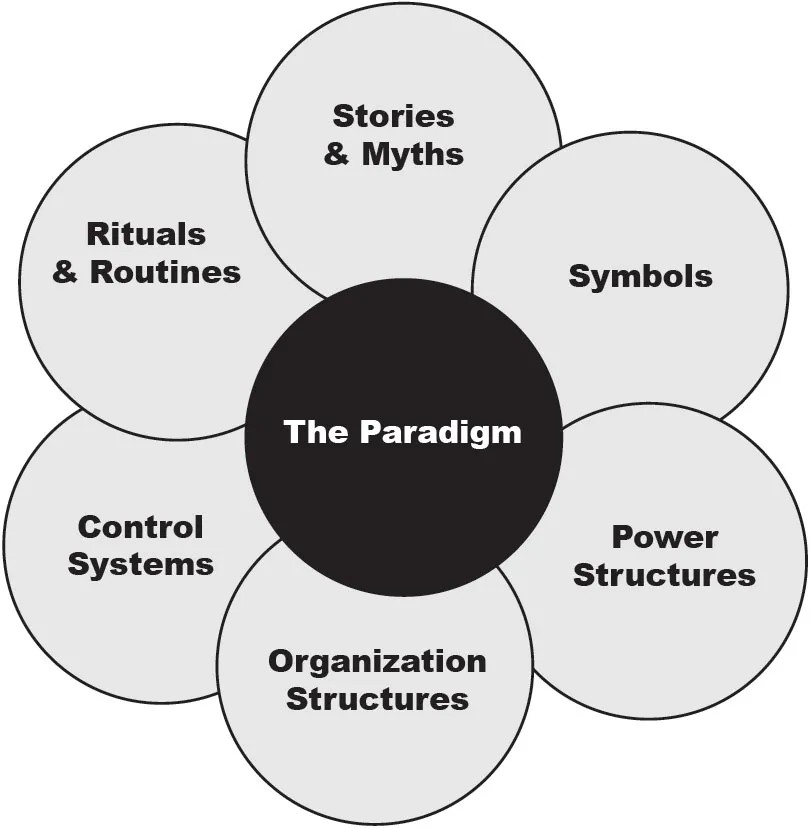
The weekly Friday Focus memo is an ideal vehicle for communicating important messages relating to these school culture components. Some of these cultural traits are more tangible than others, but each plays a vital role in shaping the thoughts and actions of each individual working at the school. The beginning of the school year is a good time to focus on issues more emotional in nature, likely falling under the category of “stories and myths” as opposed to more technical aspects such as “organization structures” or “control systems.” In any case, as we lay the groundwork for future success and, perhaps, impending change, it is important that at the outset of the new school year we begin clarifying core values and expectations and start establishing positive relationships such that those working with us will want to meet these expectations.
The First Friday
I believe it is important to share stories that illustrate how the work we are charged with as educators impacts those with whom we work. In sharing such stories, I draw on my own experience and highlight the experiences of specific teachers at the school who have even more moving stories about their personal and professional accomplishments. For the first Friday Focus of this school year, I sought to communicate simple, though powerful, stories and quotations that reflect the importance of our work as educators. As is usually the case in the weekly Friday Focus, I make reference, in a light-hearted way, to two veteran and excellent teachers. I also share the story of Mike Sloop, an eighth grade science teacher who had been named our school’s Teacher of the Year the preceding school year and went on to be selected as Teacher of the Year for the entire school system, comprised of over thirty schools.
In referencing this particular teacher, I write about my belief that his story is one of passion, persistence, and performance—three topics that we had talked about as a school community at length in recent years and topics I knew we would want to revisit and reinforce again throughout the current school year. By this point in time, our school had become celebrated as a school staffed with “passionate” teachers, gaining recognition throughout the district and across the state. “Teaching with passion” had become an oft-repeated phrase at our school, and every teacher knew that my closing to every e-mail I sent out—TWP—stood for “Teach with Passion.” In addition, as readers of the first Friday Focus book will likely recall, I always tried to incorporate this phrase into the final sentence of the weekly Friday Focus, relating it in some way to the week’s topic. “Persistence” is another word I wanted to emphasize as we began another year of teaching and learning together. Ours was a high-performing school, yet a significant percentage of our students were faced with a wide range of language, economic, family, and learning challenges. We prided ourselves on doing whatever it took to see that these students succeeded and reminded each other often that persistence was a virtue: We would not give up on our students or each other; regardless of the obstacles we would soon be faced with, urgency compelled us to move forward without accepting failure or excuses. In addition to “passion” and “persistence,” I wanted to emphasize the word “performance.” At the end of the day, we are all held accountable—increasingly and rightly so—in the world of education today. The teacher of the year whom I highlight below is a popular, enthusiastic, humorous, engaging fellow with an admirable zest for life who is well liked by his colleagues and students alike. More importantly, however, he is highly respected by all who know him. Part of this respect is based on the results he achieves each and every year with his students. His performance as a teacher whose students consistently managed to outperform predicted levels of achievement was widely known and hailed throughout our region. Passion. Persistence. Performance. Three P words that were already deeply ingrained in the very core of our school culture, yet words we needed to be reminded of as we began another year together. As is typically the case at the beginning of the school year, staff morale was high and we were excited about the days ahead. Yet, before long, typical frustrations would begin to arise and a collective focus on passion, persistence, and performance would help see us through the inevitable obstacles certain to present themselves—sooner, rather than later.
The teachers at our school had worked hard preparing for the first day of school. My goal in this Friday Focus was simply to thank them for their efforts, share a brief personal story, share a story about one of our most respected teachers, and remind them of the importance of our lofty, but incredibly difficult, task as educators. I should mention that the personal story I share in the Friday Focus below is one I first heard at a church I attended. Some may not be comfortable sharing such personal insights and it may even be inappropriate to do so, depending upon the school and school community in which one serves. At this point in my tenure at this particular school, it seemed an apt and comfortable way to illustrate the point I was trying to make. Of course, there are a multitude of stories each of us has accumulated to share with our colleagues. Educators reading this book must choose those which best fit the current school culture or which are most likely to cultivate the type of school culture they hope to create. What follows is the first Friday Focus sent out during a school year, to be followed by thirty-six additional such writings. To establish consistency, we sent the Friday Focus out via email (and/or posted on the school wiki) every Friday morning at the same time. Teachers began to anticipate these weekly writings and inevitably responded to them in some way later in the day or the following week.
Friday Focus!

Friday, August 15
You are not merely here to make a living. You are here to enable the world to live more amply, with greater vision, and with a finer spirit of hope and achievement. You are here to enrich the world. You impoverish yourself if you forget this errand.
— Woodrow Wilson
This week, as we prepared for our kids to arrive on Monday, several of you mentioned that you enjoyed the video presentation displaying motivational quotations relating to our noble profession of teaching and accompanied by musical selections that Bruce created and shared with everyone on Tuesday. Of the forty-eight quotes included, I think the one above most aptly sets the scene for the journey upon which we will all embark next week. No teacher at our school entered this idealistic career path to become wealthy, or because of the plush working conditions, or because of the generous monetary bonuses, or even because they just wanted the chance to hang with cool teachers like Joanie and Jody! Instead, each of us heeded this calling because: (1) we wanted to make a difference and (2) we felt that we had the capability to do so. As President Wilson suggests above, we are here to enrich the world, if not our stock portfolios. We enrich the world each day that we work to fulfill our school mission: teaching, inspiring, and motivating all learners at our school.
One way we teach, inspire, and motivate our kids and each other is through storytelling. During the past few years together, many of us have had the opportunity to exchange heartwarming stories of how something we did at our school has had a positive and lasting impact upon one of our students. Often, we were not even aware at the time that we had touched this young man or woman. Like Mike mentioned in his inspiring video presentation at our opening convocation, it is commonplace for our kids to accept our extra efforts without so much as a thank you. Yet years later, that apparent ingrate returns to thank us in what turns out to be a much more meaningful way, which lets us know that we have, indeed, made a difference. Again this year, every teacher at our school will lead with his or her personal vision. For many of us, that is simply doing good work that people will remember. It may not seem as if anyone will remember, but undoubtedly many will.
In introducing Mike to all teachers new to our school system last week, I stated something to the effect that, “Mike will now share just a bit of his own story, which is a story of passion, persistence, and performance.” Through our passion and persistence, we directly affect our students’ (and each other’s) performance. I am reminded of a story that a pastor included in the weekly bulletin one week at the church I attended while living on St. Simons Island. It was titled “Pushing Against the Rock.” Without going into all the biblical references, it was simply about a man who was commanded to continuously push against a large rock, which he did for many years with no immediately discernible results. After many years of apparent failure, the frustrated man questioned what he was doing wrong and why he had failed. The answer given to him was that he had not failed at all; his calling was to be obedient and faithful and he had exhibited trust in following through on this calling. In the end, he had developed a strong back, arms, and legs through his daily efforts and the rock was moved for him as a reward for his faithful efforts.
Like the man in this story, many of you have mentioned that you consider teaching your “calling,” not merely your job. Like the man in the story, many of you will not see the rewards of your daily toil on an immediate or frequent basis. Yet, in the end, you will grow stronger through fulfilling Woodrow Wilson’s charge to enrich the world. Just as importantly, so will your students—whether you or they notice it this ...
Table of contents
- Cover
- Title Page
- Copyright Page
- Table of Contents
- About the Author
- Free Downloads
- Index of CORE Themes
- Introduction
- 1 Laying the Groundwork
- 2 A Culture of Care
- 3 Standards for School Performance
- 4 Curriculum: An Action, Not a Thing
- 5 Active Learning
- 6 Background Knowledge: The Foundation
- 7 Differentiated Instruction Defined
- 8 Expecting the Best
- 9 Graphic Organizers
- 10 Differentiated Instruction Practices
- 11 Lesson Closure
- 12 A Collaborative Learning Culture
- 13 The Heart of Coaching
- 14 A Culture of Gratitude
- 15 A Community of Leaders
- 16 Making it Stick
- 17 Teaching Organization Skills
- 18 A Culture of Giving
- 19 Stretching the Culture for Powerful Learning
- 20 Creating a Vision
- 21 Homework Perspectives
- 22 Homework Practices
- 23 Tips for Teaching Reading, Part I
- 24 Tips for Teaching Reading, Part II
- 25 A Culture of Curiosity and Passion
- 26 Response to Intervention Basics
- 27 Principles of Great Teaching
- 28 The Importance of Teaching Procedures
- 29 A Culture of Change
- 30 Reinforcing Effort
- 31 Test Preparation
- 32 Team Values
- 33 A Culture of Learning, Laughing, Loving
- 34 Teacher Appreciation
- 35 It?s All About You
- 36 But It?s Not About You at All!
- 37 A Culture of Possibility
- References
Trusted by 375,005 students
Access to over 1.5 million titles for a fair monthly price.
Study more efficiently using our study tools.
Frequently asked questions
Yes, you can cancel anytime from the Subscription tab in your account settings on the Perlego website. Your subscription will stay active until the end of your current billing period. Learn how to cancel your subscription
No, books cannot be downloaded as external files, such as PDFs, for use outside of Perlego. However, you can download books within the Perlego app for offline reading on mobile or tablet. Learn how to download books offline
Perlego offers two plans: Essential and Complete
- Essential is ideal for learners and professionals who enjoy exploring a wide range of subjects. Access the Essential Library with 800,000+ trusted titles and best-sellers across business, personal growth, and the humanities. Includes unlimited reading time and Standard Read Aloud voice.
- Complete: Perfect for advanced learners and researchers needing full, unrestricted access. Unlock 1.5M+ books across hundreds of subjects, including academic and specialized titles. The Complete Plan also includes advanced features like Premium Read Aloud and Research Assistant.
We are an online textbook subscription service, where you can get access to an entire online library for less than the price of a single book per month. With over 1.5 million books across 990+ topics, we’ve got you covered! Learn about our mission
Look out for the read-aloud symbol on your next book to see if you can listen to it. The read-aloud tool reads text aloud for you, highlighting the text as it is being read. You can pause it, speed it up and slow it down. Learn more about Read Aloud
Yes! You can use the Perlego app on both iOS and Android devices to read anytime, anywhere — even offline. Perfect for commutes or when you’re on the go.
Please note we cannot support devices running on iOS 13 and Android 7 or earlier. Learn more about using the app
Please note we cannot support devices running on iOS 13 and Android 7 or earlier. Learn more about using the app
Yes, you can access Building School Culture One Week at a Time by Jeffrey Zoul in PDF and/or ePUB format, as well as other popular books in Education & Education General. We have over 1.5 million books available in our catalogue for you to explore.