Solar Photovoltaic Power Optimization
eBook - ePub

Solar Photovoltaic Power Optimization

Enhancing System Performance through Operations, Measurement, and Verification

  1. 148 pages
  2. English
  3. ePUB (mobile friendly)
  4. Available on iOS & Android
eBook - ePub

Solar Photovoltaic Power Optimization

Enhancing System Performance through Operations, Measurement, and Verification

About this book

This book focuses on the rapidly maturing solar photovoltaic (PV) industry, which is achieving an ever-increasing share of U.S. and global power production.

There is a growing need for all stakeholders – owners, maintenance technicians, utilities, and installers – to fully understand the operations and maintenance of PV systems, and how to monitor and diagnose systems post installation. Recognizing this need, this book covers monitoring and diagnostic techniques and technologies, including how to identify the causes of poor performance, and measure and verify power production. Drawing on global case studies, it details how to achieve optimal PV power output in the field through an overview of basic electrical, the solar PV module and Balance of System, and processes and software for monitoring, measurement, and verification. It also provides an overview of the North American Board of Certified Energy Practitioner's (NABCEP) new PV System Inspector credential, which will be outlined in the final chapter.

Equipping the reader with the knowledge and confidence required to maximize the output of solar PV installations, Solar Photovoltaics Power Optimization will be an essential resource for PV practitioners and students.
Frequently asked questions

Yes, you can cancel anytime from the Subscription tab in your account settings on the Perlego website. Your subscription will stay active until the end of your current billing period. Learn how to cancel your subscription.
No, books cannot be downloaded as external files, such as PDFs, for use outside of Perlego. However, you can download books within the Perlego app for offline reading on mobile or tablet. Learn more here.
Perlego offers two plans: Essential and Complete
  • Essential is ideal for learners and professionals who enjoy exploring a wide range of subjects. Access the Essential Library with 800,000+ trusted titles and best-sellers across business, personal growth, and the humanities. Includes unlimited reading time and Standard Read Aloud voice.
  • Complete: Perfect for advanced learners and researchers needing full, unrestricted access. Unlock 1.4M+ books across hundreds of subjects, including academic and specialized titles. The Complete Plan also includes advanced features like Premium Read Aloud and Research Assistant.
Both plans are available with monthly, semester, or annual billing cycles.
We are an online textbook subscription service, where you can get access to an entire online library for less than the price of a single book per month. With over 1 million books across 1000+ topics, we’ve got you covered! Learn more here.
Look out for the read-aloud symbol on your next book to see if you can listen to it. The read-aloud tool reads text aloud for you, highlighting the text as it is being read. You can pause it, speed it up and slow it down. Learn more here.
Yes! You can use the Perlego app on both iOS or Android devices to read anytime, anywhere — even offline. Perfect for commutes or when you’re on the go.
Please note we cannot support devices running on iOS 13 and Android 7 or earlier. Learn more about using the app.
Yes, you can access Solar Photovoltaic Power Optimization by Michael Ginsberg in PDF and/or ePUB format, as well as other popular books in Biological Sciences & Ecology. We have over one million books available in our catalogue for you to explore.

Information

1 The need for solar photovoltaic system operations and maintenance, and measurement and verification

History of the solar photovoltaic industry

The solar photovoltaic (PV) industry evolved in three stages. First, the fundamental science underpinning the industry was established in the 1800s and early 1900s. Next, the silicon PV cell was developed in the 1950s. Finally, low-cost manufacturing methods enabled solar PV to achieve grid parity, or cost equivalence, with conventional fossil fuel generators, making it a viable choice for investors and energy consumers today.

Stage 1: establishing the science

In 1839, 19-year-old Alexandre Edmond Becquerel, who later went on to become a world-famous French physicist, constructed the world’s first PV cell. The cell used silver chloride in a liquid acid solution and produced an electric current when light was shone on it, a reaction which is sometimes called the “Becquerel effect.” In 1876, William Grylls Adams and Richard Evans Day discovered that the PV effect could be produced in a solid, namely, solidified selenium. Soon after, in 1883, American inventor Charles Fritts coated selenium with a layer of gold, which achieved a power conversion efficiency of 1–2%.1 In 1905, Albert Einstein published a seminal paper on the photoelectric effect using quantum theory. Eleven years later, Robert Millikan’s experiments demonstrated the validity of Einstein’s theory. This led to Einstein winning the Nobel Prize in Physics in 1921 “for his discovery of the law of the photoelectric effect.”2

Stage 2: developing the silicon PV cell

In the early 1950s, Daryl Chapin, Calvin S. Fuller, and Gerald Pearson at Bell Laboratories developed the first modern solar PV cell using silicon (with 4% efficiency; they later achieved 11%).3 On April 25, 1954 in Murray Hill, New Jersey, they demonstrated their silicon solar module by using it to power a toy Ferris wheel and a radio transmitter. The first practical use of the technology was to power satellites in space, starting in 1958 with the Vanguard I, which used a small array (less than one watt) for its radios.4

Stage 3: low-cost manufacturing

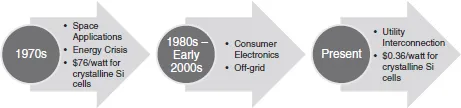
As shown in Figure 1.1, the unit price of a solar cell fell over time. In the 1970s, Dr. Elliot Berman, with help from Exxon Corporation, designed a production process that sharply reduced costs, slashing the price from $100 per watt to around $20 per watt. New practical uses were found for the silicon PV cell, such as powering remote sensors and navigation lights on offshore oil rigs. In 1973, the University of Delaware showed that solar energy could power a house. In 1978, NASA installed the first community PV system, which supplied electricity to 15 homes in the isolated Papago Indian Reservation in Arizona for water pumping and residential needs.
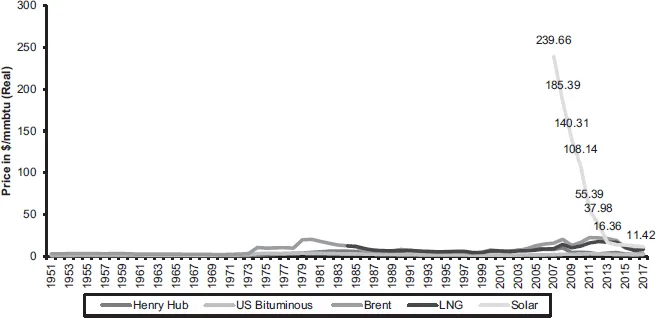
Solar energy took another major step forward in the early 1980s when the oil company Arco Solar built the first large-scale solar park in Hesperia, California, near Los Angeles. Opened in 1982, this solar park generated 1 megawatt, or 1,000 kilowatts, supplying the Pacific Gas & Electric (PG&E) Company with enough power for 2,000–2,500 homes. Until this point, the industry had only achieved 15% efficiency in harnessing energy from sunlight. However, this changed in 1992 when the University of South Florida unveiled a 15.9% efficient thin-film PV cell made of cadmium telluride.5 In the 1990s, as cell efficiencies rose and manufacturing costs declined, utilities began to take interest in PV systems. PG&E became the first U.S. utility to operate a large-scale PV system, a 500 kW array in Kerman, California. The early 2000s saw a rise in grid-tie systems for residential and commercial customers, and, as shown in Figure 1.2, by 2012 solar reached grid parity with conventional fuels.
Images
Figure 1.1The progression of manufacturing of solar PV cells from the 1970s to today.
Source: Author.
Images
Figure 1.2Achieving grid parity – solar PV’s rapid cost decline beginning in 2009 and current cost equivalence with conventional sources (price in $/mmbtu).
Source: Michael Parker and Flora Change, Bernstein. Data from EIA, CIA, World Bank.
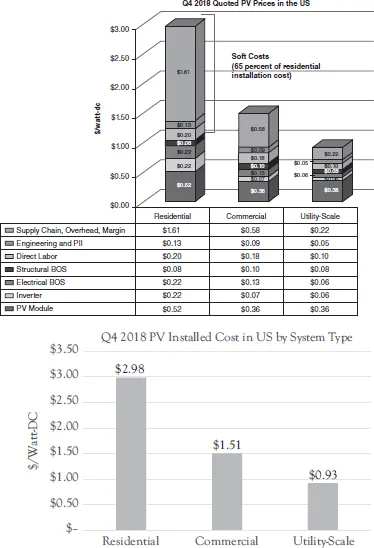
By 2016, solar cells could be manufactured as thin as paper using an industrial printer and with 20% efficiency, and a single strip could produce up to 50 watts per square meter.6 Figure 1.3 shows the dramatic cost reduction achieved in PV materials and manufacturing, yet soft costs remain high.
Images
Figure 1.3Q4 2018 installed PV prices in the U.S. by system size. The figure on the top shows that soft costs comprise 65% of residential installation cost. The figure on the bottom shows that economies of scale enable lower prices for commercial and utility-scale systems.
Source: Harness It: Renewable Energy Technologies and Project Development Models Transforming the Grid by Michael Ginsberg.
Data from Wood Mackenzie, Limited/SEIA U.S. Solar Market Insight Q4/2018®.
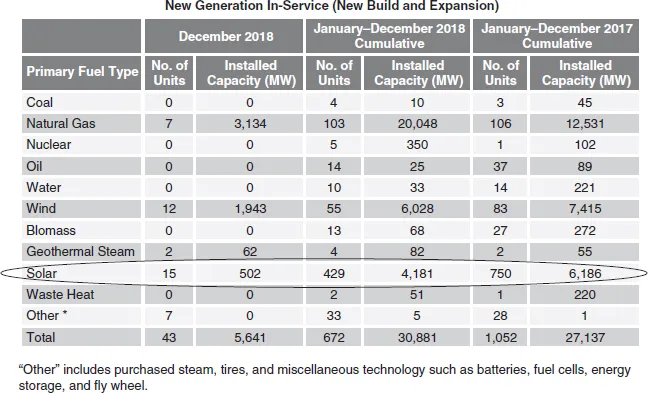
As of Q1 2018, the U.S. has 55.9 GW of total installed capacity, with 18% of all electricity in the U.S. coming from renewable sources and most new capacity from solar.7
Images
Figure 1.4Table showing the number of units and installed capacity of different energy sources in the U.S. installed in Q1 2018 vs Q1 2017. Solar was the third leading source of new capacity in the U.S. in 2018.
Source: Office of Energy Projects Energy Infrastructure Update for December 2018, Federal Energy Regulatory Commission.8,9

The importance of O+M and M+V

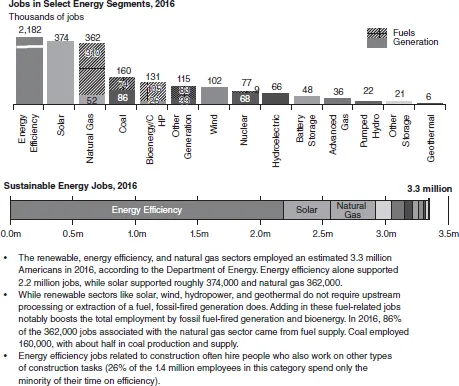
The rapid deployment of solar energy, both PV and concentrating solar power (CSP), has led to a correspondingly swift increase in employment in the sector. The number of employees who spent a portion of their time working on solar energy rose from 93,000 in 2010 to almost 350,000 in 2017 – about 250,000 (or 70%) of whom spent at least half of their time supporting the solar portion of their business.10 This rate of growth is more than nine times faster than employment growth in the overall U.S. economy.11
In 2017, solar energy workers represented about 40% of the total electric power generation workforce, which is more than the combined number of workers with fossil fuels (gas, coal, and oil) in electricity generation.12 While the heaviest concentrations of jobs in the U.S. are in California, Massachusetts, New York, Texas, Florida, and Arizona, employment is expanding rapidly throughout the U.S.13
Images
Figure 1.5Solar jobs in the U.S. were the second highest of all energy segments in the U.S. in 2016.
Source: Bloomberg New Energy Finance.
This trend is not limited to the U.S. Solar is emerging globally as one of the leading new sources of jobs. The International Renewable Energy Agency (IRENA) estimates the solar PV industry accounts for nearly 3.4 million jobs worldwide.14
Unlike fuel generators that require weekly or even daily maintenance, once installed, silent PV systems can be easy to forget. Aside from trackers, they are comprised of steady-state devices with no moving parts. However, PV O+M and M+V i...

Table of contents

  1. Cover
  2. Half Title
  3. Title
  4. Copyright
  5. Dedication
  6. Contents
  7. Acknowledgments
  8. Preface
  9. 1 The need for solar photovoltaic system operations and maintenance, and measurement and verification
  10. 2 Electricity and solar cell and system fundamentals
  11. 3 Tools and methodology for maintenance and troubleshooting
  12. 4 Tools and methodology for monitoring, measurement, and verification
  13. 5 Conclusion: the growing market for PV system inspectors
  14. Glossary
  15. Index