Comprehensive and accessible, Successful Research Projects provides a practical, research-based framework to help examine practice, solve problems and plan research effectively. With key practical tips throughout, it draws on examples from across disciplines and across the world ensuring best practice for those completing projects in the fields of science, health care, social sciences, arts and humanities as well as multi-disciplinary projects.
This book covers the key questions, challenges and solutions, exploring:
Organising time efficiently
Working effectively with colleagues
Getting the best out of a supervisor and understanding what help is available
Demonstrating good practice in academic writing
Differences between research projects at undergraduate and postgraduate levels
Staying motivatived and balanced in order to excel throughout the process
Ways to use research to help career planning
Providing the significant theories behind ways of managing projects, identifying important goals and solving problems, Successful Research Projects is the perfect companion for the busy student facing a postgraduate research project.
This is the companion guide to the second edition of Successful Research Supervision, a research-based practical framework for academics to examine and develop their effectiveness as supervisors. It helps supervisors to move their students towards the ultimate goal of being able to study independently in a thoughtful, coherent and efficient manner and is a go-to guide for both novice and experienced supervisors seeking to develop their practice.
The framework that underpins this book seeks to support postgraduates doing research by explaining the different approaches that you can choose from and blend together in order to be successful. I created it from an iterative research study looking at the behaviours and beliefs of effective postgraduate students and their supervisors, interpreted through a wide literature review. It can explain why your supervisors are asking you to undertake certain tasks and what lies behind some of the feedback they may be trying to give you. From extensive research with successful postgraduate students and their supervisors I have identified five conceptual ways of looking at your project. Once you have understood these you will have access to an approach to problem solving that you can use both for doing your research and for other life projects.
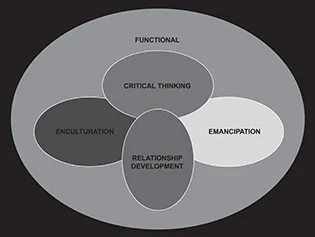
For most of this book the framework is depicted as a matrix, exploring each of the five approaches in depth. However, understanding how they link together is important to be able to design a holistic experience for undertaking research successfully. In Figure 1.1 I show the five approaches as a Venn diagram within the overarching functional framework. The functional framework includes the university regulations and project management tools without which no degree can be awarded. Enculturation refers to becoming a welcome member of the department; critical thinking refers to the analytical skills needed to depict and create knowledge; emancipation refers to the ability to make knowledgeable choices; and relationship development covers how to have good relationships with colleagues and supervisors. This book will help you master all of these approaches.
Chapter 2 helps you to understand the framework. Appendix 2 provides more detail about the theoretical base and the research behind it.
So you want to do some research? You want to do it well, probably as easily as possible and definitely within the time limitss you have set yourself.
On a practical level this book aims to help you by:
collecting together ideas on managing your time
demonstrating good practice in academic writing
identifying what help is realistically available to you from your supervisor
Figure 1.1 A map of the framework demonstrating the inter-relationships
clarifying some of the differences between research projects at undergraduate and postgraduate levels
listing some of the many other resources you might find helpful
helping you to keep balanced and flourish throughout the process
looking at ways to use your research to help your career planning.
How to use this book
If you are new to research, consider starting on Tasks 1–3 in Chapter 3. Reading this book from beginning to end in one go could give you intellectual indigestion. It is the product of over 20 years’ experience of being a research student, a supervisor and leading workshops for research students and supervisors. Scan the contents page for the sections you need now.
It is deliberately structured with lots of subheadings so that you can dip in and out of it as time goes by and according to the size of research project you are undertaking. For example, Chapter 3 is a good place for most people to start, but you may not want to read the section in Chapter 4 on ‘how do disciplines think’ until you are well into your research project.
If you are facing specific problems, look at the subheadings to see if any of them might include some helpful suggestions for you.
If you have any teaching responsibilities, or are coming from an education system that does not operate within the European Higher Education Area (EHEA) framework, you will find it helpful to identify some of the differences in doing research at undergraduate and postgraduate levels. You will find examples relating to research at different levels throughout the book.
How to make the effort of undertaking a research project worthwhile
A researcher is someone who can make a reasoned step into the unknown.
You may have intrinsic reasons for wanting to do research (perhaps a deeply held desire to uncover information and create new knowledge about a particular phenomenon), or extrinsic reasons (for example, a qualification to get a job). Either or both are fine, but understanding your motivation(s) for undertaking this project will help you to keep going if you find yourself getting confused by the amount of information you unearth (a common feeling, and an important stage to work through, because clarity will follow).
In this next section I explore what doing research means at different levels of higher education. It is important to get some feel for this because you may have done research as an undergraduate or master’s student and want to be clear about how to define the difference between your previous experience and the next level up. The following descriptions are taken from the European Higher Education Area’s 2018 publication of a Higher Education Qualifications Framework. At the time of writing there are 48 members and partners of the EHEA from Europe and beyond.
At the undergraduate bachelor’s level, students doing research have to demonstrate knowledge and understanding in a field of study that builds upon what is available in advanced textbooks, solve problems and create arguments that can be sustained by gathering relevant data. At master’s level, there is an additional requirement to be able to apply problem-solving techniques in new and unfamiliar environments and be able to form judgements with incomplete or limited information. At doctoral level there is an expectation that you will have made an original contribution that extends the frontier of knowledge. At every level there is an expectation that students are aware of social and ethical responsibilities. (These descriptions are abstracted from the EHEA Qualifications Framework, summarised in Table 1.1 at the end of the chapter.)
We know that all qualified researchers have important skills for life and are sought by employers. Doctoral graduates make a substantial contribution to business, academia, government, community, not-for-profit sectors and academia (Bryan & Guccione, 2018). We also know that doing research well is very hard work. Is doing any form of research going to be worth it for you?
I (Anne, the author) start from a biased position. I think that doing your own research offers the most wonderful opportunities. From smaller projects that give you licence to ask questions and gather material, to having an opportunity to be the person who knows the most about your topic and the ability to contribute original knowledge at a doctoral level, having good research skills enables us to learn how to start into something new.
At an undergraduate and master’s levels there may be no escape from your tutor’s expectations. The obligation to undertake a research project or write a dissertation is written into the curriculum of many courses, so if you want the qualification you will have to do it. The secret is to find a topic that is both meaningful and useful to you and achievable. At a doctoral level, it is what you have volunteered for. So the better question is ‘how can I make it worth it for me?’
Identifying the risks to be avoided
Failing to use research to plan your career. The financial advantages to your career of doing a master’s degree are clear, especially for women. Post-doctoral earning is not guaranteed but employment opportunities do generally increase with qualification (Casey, 2009). So it is vital to choose work on the most appropriate research question and use it to explore career options and create networks from the beginning. Even if you do not yet know what you want to do with the rest of your life, developing research skills and exploring all avenues will help you find out.
Not planning to maintain both mental and physical health. This has rightly gained a much greater public profile recently. How can we make sure that you are in the healthy 68 per cent of PhD students who (from a Belgian sample) avoided the risk of developing common psychiatric disorders (Levecque, Anseel, De Beuckelaer, Van der Heyden, & Gisle, 2017). Mental health is variously defined as the ability to work productively, maintain effective relationships and overcome adversity (Vailes, 2017, p. 26). It is important to plan to maintain some physical activity, healthy eating, social support, holiday and vacation breaks.
Inadequate or confusing supervision. Much of this book is aimed at helping you to get the best out of your supervisor(s), using the limited time you may have together to your advantage. Reports of toxic relationships with supervisors are thankfully in the minority, but if you find yourself in such a relationship turn to Chapter 10. The greatest risk comes from simply not being able to understand what the supervisor is trying to say or do. Decoding your supervision sessions is a key part of getting the most out of the precious time you have together and the framework introduced in Chapter 2 is intended to help you with this.
Maximising the benefits
Having said that there is no guaranteed career arising from doing research, interviews with doctoral graduates indicated that many did see advantages to their career development some five years after completion. Bryan and Guccione (2018) cite several examples (especially from STEM subjects) where their interviewees were certain that the research qualification they obtained was essential in them getting jobs and accessing consultancy work that would not have otherwise been open to them.
All their interviewees recognised that they had developed significant useful skills through doing their research, the most significant of which were abstract cognitive skills including critical thinking. This means that it is very important to be able to describe these skills in a way that employers will find compelling. Undertaking work placements is seen as an important avenue to be able to do this.
Being part of an active and supportive group or department can enhance a feeling of well-being and self-esteem, wherever you are. At its best, working within a group whose members have been recruited specifically for their intellectual skills offers an exciting environment that it is difficult to find the equivalent of elsewhere. Self-esteem is different to status. While students may start a course to get the qualification and post-nominals, it is rarely the title that is the most important element as time goes by. The feeling of achievement when a piece of work is submitted can be close to elation (even more when the assessment results are positive). At a doctoral level, it is a particularly hard-won feeling of elation and should be enjoyed. The increased self-confidenc...
Table of contents
Cover
Half Title
Title Page
Copyright Page
Dedication
Table of Contents
List of figures
List of tables
List of boxes
Preface
Acknowledgements
A note on terminology
List of abbreviations
1. Becoming a research student
2. A framework for analysing different approaches to doing research
3. Managing your project: A functional approach
4. Uncovering the implicit: Embracing enculturation
5. Thinking like an academic: Developing criticality
6. Finding your own way: Enabling emancipation
7. Creating and maintaining relationships
8. Using the framework to help your research
9. How to write like an academic
10. Dilemmas: When you disagree with your supervisor(s)
11. Preparing for your work to be examined
12. Looking to the future: Where next?
Appendix A: theoretical background: emergence of the framework
Appendix B: a summary of key practices in the disciplines abstracted from the Carnegie Initiative on the Doctorate (Golde & Walker, 2006)
Appendix C: critical thinking: key terms used in research
References
Index
Back
Trusted by 375,005 students
Access to over 1.5 million titles for a fair monthly price.
Study more efficiently using our study tools.
Frequently asked questions
Yes, you can cancel anytime from the Subscription tab in your account settings on the Perlego website. Your subscription will stay active until the end of your current billing period. Learn how to cancel your subscription
No, books cannot be downloaded as external files, such as PDFs, for use outside of Perlego. However, you can download books within the Perlego app for offline reading on mobile or tablet. Learn how to download books offline
Perlego offers two plans: Essential and Complete
Essential is ideal for learners and professionals who enjoy exploring a wide range of subjects. Access the Essential Library with 800,000+ trusted titles and best-sellers across business, personal growth, and the humanities. Includes unlimited reading time and Standard Read Aloud voice.
Complete: Perfect for advanced learners and researchers needing full, unrestricted access. Unlock 1.5M+ books across hundreds of subjects, including academic and specialized titles. The Complete Plan also includes advanced features like Premium Read Aloud and Research Assistant.
Both plans are available with monthly, semester, or annual billing cycles.
We are an online textbook subscription service, where you can get access to an entire online library for less than the price of a single book per month. With over 1.5 million books across 990+ topics, we’ve got you covered! Learn about our mission
Look out for the read-aloud symbol on your next book to see if you can listen to it. The read-aloud tool reads text aloud for you, highlighting the text as it is being read. You can pause it, speed it up and slow it down. Learn more about Read Aloud
Yes! You can use the Perlego app on both iOS and Android devices to read anytime, anywhere — even offline. Perfect for commutes or when you’re on the go. Please note we cannot support devices running on iOS 13 and Android 7 or earlier. Learn more about using the app
Yes, you can access Successful Research Projects by Anne Lee in PDF and/or ePUB format, as well as other popular books in Study Aids & Education General. We have over 1.5 million books available in our catalogue for you to explore.