eBook - ePub
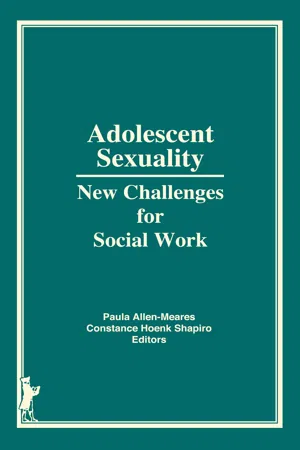
Adolescent Sexuality
New Challenges for Social Work
- 192 pages
- English
- ePUB (mobile friendly)
- Available on iOS & Android
eBook - ePub
About this book
Here is an invaluable resource to help professionals understand the broad range of issues and challenges that adolescents face as they grapple with their sexuality. This highly informative volume addresses the most compelling issues of adolescent sexuality. Sexual orientation, acquaintance rape, new social roles, and sexually transmitted diseases are among the numerous topics that social workers confront daily in helping adolescents define and seek solutions to their sex-related concerns. Adolescent Sexuality highlights the importance of innovative approaches and client empowerment in prevention and treatment programs for youth, particularly in this era of declining federal support. This timely volume reveals the reluctance of adolescents to confide in their families; therefore, experts offer valuable suggestions for social workers to strengthen and use community resources--the church, family planning agencies, schools, and support groups--to supplement the efforts of many families.
Information
CHALLENGES
Some Major Issues Regarding Adolescent Sexuality and Childbearing in the United States
Catherine S. Chilman
SUMMARY. Adolescent sexuality is a complex developmental process strongly affected by both familial and societal systems. Major research findings regarding adolescent coitus, contraception, and childbearing are summarized. More emphasis on the positive, rather than problematic, aspects of teenage sexuality is advocated as well as broadened social work roles in treatment, social action and research.
Some Basic Concepts
Adolescence
Adolescence is defined as that period in a person's life that stretches from the onset of puberty to young adulthood. Puberty refers to the first phase of adolescence when sexual maturation becomes evident. Entrance into young adulthood is less easily defined. For the purposes of this essay, however, age 18 will be used.
Adolescence is often seen as consisting of two major stages. The first stretches from the onset of puberty to about ages 14 through 16; psychologically, it is characterized by the push for independence from parents and attempts to resolve conflicts between the continuing need for childish dependence and the desire for a separate identity. The second stage is marked by the search for a mature identity, the quest for a mate, and the exploration of different sets of values and of occupational and other life goals. Throughout adolescence, sexuality is the major theme, as the young person grows toward womanhood or manhood, with the many roles and functions of becoming a feminine or masculine adult.
Human sexuality is often described as including the physical characteristics and capacities for specific sex behaviors, together with psychosocial learning, values, norms, and attitudes about these behaviors. This definition is broadened here to include a sense of gender identity and related concepts, behaviors, and attitudes about the self and others in the context of both the family system and the larger society. According to this definition, sexuality pervades virtually every aspect of the person's life. It is affected by the totality of what it means to be a male or female person; by one's past and present experiences and anticipations of the future; by one's stage of development and life situation; by one's physical-constitutional capacities and characteristics; by the kind of society in which one lives, as well as the historical background of that society with its particular views regarding adolescence and human sexuality over the generations (Chilman, 1983, 1988).
Needed: A Family and Societal Systems Approach
Most of the past and current practice, program, and research efforts regarding adolescent sexuality have focused on its problematic aspects, especially adolescent pregnancy and childbearing. These emphases have failed to pay sufficient attention to the important broader dimensions. For instance, as defined above, adolescent sexuality should be viewed as a central aspect of young people's overall development, within the systems of both their families and within the larger society.
It should also be viewed in terms of its positive potentialities as well as its problematic ones. There appear to be no generally accepted criteria for healthy adolescent sexuality. On the basis of considerable theory, research, and observation, I will suggest the following. Healthy sexuality includes gradual growth toward a clear sense of identity and toward an acceptance of the self as a valuable, valued young female or male. It includes a growing sense of personal and interpersonal competence as a sexual person, broadly defined. It also includes a general understanding of the psycho-biology of both sexes and of reproductive and family planning processes. The contribution of sexuality to fulfillment of the self and others should also be generally and increasingly understood. This includes the capacity to derive sexual gratification through individual and interpersonal activities in a relational context: a context that is characterized by freedom for self-expression within clearly defined limits. These limits include appropriate use of protection from unwanted pregnancies and sexually transmitted disease.
This definition may seem overly idealistic. Note that emphasis is placed on gradual growth towards these attitudes and behaviors as the young person moves from childhood to early adolescence to later adolescent stages to adulthood. In doing so the young person slowly leaves behind such well-documented characteristics of early adolescence as an uncertain sense of personal identity, low ego strength, narcissism, dependence on external rather than internal means of impulse control, poor capacity for responsible behavior and limited ability to foresee probable future outcomes of present actions (Loevinger, 1966; Kohlberg & Gilligan, 1972; Marcia, 1978; Elkind, 1967; Adelson, 1975; Erikson 1968; Chilman, 1983 and 1986).
It can be seen that healthy adolescent sexuality, as defined here, is unlikely to develop through sex education efforts alone, whether at home, church or school. Rather, such attitudes, feelings and behaviors more centrally develop gradually, from birth onward, in the context of both the family system and the larger society.
Family systems theory, as used here, views families as open ecological systems, heavily affected by multi-generational interpersonal dynamics as well as by interactions with the larger environment. Thus, the multi-generational experiences, values, beliefs, attitudes, and behaviors of each family member affect all family members in a host of overt and covert ways. Moreover, changing social, economic, and political conditions in the larger environment have multiple effects on families as they move through time. In turn, familial attitudes and behaviors have numerous effects on many aspects of the environment (Chilman, Nunnally & Cox, 1988).
The functioning of family systems (including the sexuality of their members) is also affected by family structure (such as one-parent, two-parent, never-married, divorced or remarried families), family size, number and spacing of children, and stage of family development such as mid-stage when children are adolescent and parents are middle-aged (Carter & McGoldrick, 1980). The sexuality of each family member, as defined earlier, is an important component in the development and behavior of each of these members including children and adolescents.
The multiple effects of the larger society vary from family to family and from individual to individual. This variation depends on many things including race, ethnicity, religion, socioeconomic status and place of residence. The dominant culture of today (1988) may be defined as chiefly materialistic, self-centered, hedonistic, competitive, and violent. The social revolution of the 1960s, which included an overdue sexual revolution swept away many outworn repressive norms. Starting as an equalitarian movement for improved community life, it shifted during the 1970s and even more so in the 1980s to a splintered society in which the private good became primary and the public good of little account. Traditional norms, beliefs, and values have been largely discarded and we have yet to evolve a new set of guidelines to take the place of the old ones. We are surrounded by threats of thermonuclear war; air and water pollution; mounting corruption in government, industry and business; and a pervasive mass media that becomes ever more unrestrained in its portrayal of violence and sex. Sexual activities are depicted as completely rewarding, with no mention made of possible pregnancies or sexually transmitted diseases; no mention made of the importance of contraception or of responsible committed human relationships. We also live in an insecure two-tier economy with rising riches for the fortunate and increasing poverty for others.
All of these trends are undermining such social institutions as families, schools, neighborhoods, communities, religious organizations, and the social fabric of businesses and industries. It is a society in which hope and trust are hard to come by. This society is apt to have a particularly adverse effect on adolescents who are just moving into the adult world and are becoming increasingly aware of the troubled, as well as tempting, society they are inheriting. All things considered, it seems remarkable that so many teenagers appear to do so well, rather than that a number of them get into various kinds of difficulty, including, in some instances, unplanned parenthood.
Although I have argued here that we should emphasize positive, rather than problematic, adolescent sexuality, it is appropriate to briefly review some of the salient aspects of behaviors leading to teen-age parenting along with its apparent consequences. This is partly because the topic is important, in itself, and partly because most of the research regarding adolescent sexuality is on this subject. Recent important studies are emphasized here.
Adolescent Parenthood
Trends
Contrary to widespread publicity and common assumptions, the nationwide birthrate for adolescent women declined more or less steadily between 1970 and 1984 (the last date for which birth statistics are available, 1988). In 1970, this rate was about 9% of all teenage women, but it had dropped to about 5.3% in 1982. The birth rate for black adolescent women in 1984 was twice as high as the rate for whites. However, the difference between the two races was smaller than it had been in earlier years. Although the birthrate and numbers of births declined between 1970 and 1983, the pregnancy rate rose somewhat. A 40% rate of abortion for teen pregnancies was a leading reason for the decline in births (Chilman, 1988).
The rate of nonmarital pregnancies and parenthood rose markedly between 1970 and 1983 from one third all births to adolescents in 1970 to more than one half in the early 1980s. Black adolescents were far more likely than whites to have nonmarital births: 89% of births to black adolescents compared to 45% of births to Hispanic teenage women and 34% to non-Hispanic whites in 1984. The chief reasons for these differences are discussed in a later section.
Incidence of Coitus
Rates of nonmarital intercourse among women, ages 15-19, increased sharply between 1967 (at the height of the social and sexual revolutions) and 1976. There was a slight decline in these rates between 1979 and 1982, perhaps reflecting a general national trend toward conservatism. In general, participation in intercourse rises with the young person's age, with about 5% of young women reporting intercourse experience before age 15 compared to nearly half by age 19 (Chilman, 1983; Zelnik & Kantner, 1980; Hayes, 1987).
Data for young men are less reliable than for young women for a variety of reasons, including the fact that it is more difficult for researchers to reach them. However, the best (albeit somewhat flawed) data available suggest that in 1979, by age 19, over three-fourths of white males and almost all black males had participated in coitus. By age 20, most unmarried men and women are sexually active and the earlier higher rates of males tend to disappear (Hayes, 1987).
Differences in rates between black and white teenagers are largely, if not completely, accounted for by differences in the socioeconomic status of the two groups, with far more black than white adolescents coming from families with low income and low educational-occupational status of parents. When controls are used for SES effects, rates of adolescent intercourse among young women of both races becomes quite similar (CDF Reports, April, 1988).
Adolescent sexual behaviors, like other characteristics and behaviors of young people, are highly variable, with large withingroup differences (Hayes, 1987; Chilman, 1983; Furstenberg et al., 1987). Sexually active adolescents differ among themselves in many ways, such as ages at sexual initiation; frequency of intercourse; kinds of activities; numbers of partners, nature of the total relationship; attitudes, feelings and reactions to the sex activity; apparent reasons for these activities; use or non-use of contraceptives; total life situation of adolescents within their families and the community; and so on.
If more researchers looked for variations within their data, rather than at over-all group averages alone, they would probably find a number of subgroups of adolescents for whom diff...
Table of contents
- Cover
- Half Title
- Title Page
- Copyright Page
- Contents
- Contributors
- Foreword
- Challenges
- Part Adolescent Sexuality in Rural and Urban America
- index
Trusted by 375,005 students
Access to over 1.5 million titles for a fair monthly price.
Study more efficiently using our study tools.
Frequently asked questions
Yes, you can cancel anytime from the Subscription tab in your account settings on the Perlego website. Your subscription will stay active until the end of your current billing period. Learn how to cancel your subscription
No, books cannot be downloaded as external files, such as PDFs, for use outside of Perlego. However, you can download books within the Perlego app for offline reading on mobile or tablet. Learn how to download books offline
Perlego offers two plans: Essential and Complete
- Essential is ideal for learners and professionals who enjoy exploring a wide range of subjects. Access the Essential Library with 800,000+ trusted titles and best-sellers across business, personal growth, and the humanities. Includes unlimited reading time and Standard Read Aloud voice.
- Complete: Perfect for advanced learners and researchers needing full, unrestricted access. Unlock 1.5M+ books across hundreds of subjects, including academic and specialized titles. The Complete Plan also includes advanced features like Premium Read Aloud and Research Assistant.
We are an online textbook subscription service, where you can get access to an entire online library for less than the price of a single book per month. With over 1.5 million books across 990+ topics, we’ve got you covered! Learn about our mission
Look out for the read-aloud symbol on your next book to see if you can listen to it. The read-aloud tool reads text aloud for you, highlighting the text as it is being read. You can pause it, speed it up and slow it down. Learn more about Read Aloud
Yes! You can use the Perlego app on both iOS and Android devices to read anytime, anywhere — even offline. Perfect for commutes or when you’re on the go.
Please note we cannot support devices running on iOS 13 and Android 7 or earlier. Learn more about using the app
Please note we cannot support devices running on iOS 13 and Android 7 or earlier. Learn more about using the app
Yes, you can access Adolescent Sexuality by Constance H Shapiro,Paula Allen-Meares in PDF and/or ePUB format, as well as other popular books in Social Sciences & Mental Health in Psychology. We have over 1.5 million books available in our catalogue for you to explore.