eBook - ePub
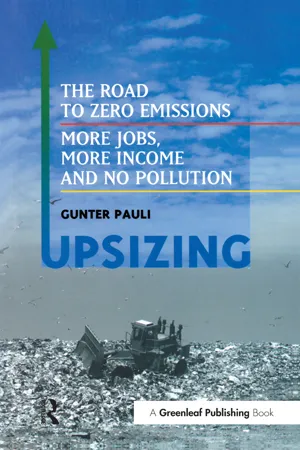
UpSizing
The Road to Zero Emissions: More Jobs, More Income and No Pollution
- 224 pages
- English
- ePUB (mobile friendly)
- Available on iOS & Android
eBook - ePub
About this book
"Zero emissions" has become a definitive term in the debate on sustainable development in the last few years. This radical book focuses on a world where the waste for one process can become the raw material for another – a cascade of materials once thought worthless supporting new products, new processes and new wealth – as industries that were previously considered unrelated cluster together. A world where new business will be created on an unprecedented scale. This is not just a theory: projects in the agro-industries, based on integrated biosystems, are already up and running in countries as diverse as Fiji, Namibia and Colombia and are fully described in the book, as is the lead given by Japan in terms of the adoption of the concept. In UpSizing, Gunter Pauli, founder of the Zero Emissions Research Initiative (ZERI), examines how the adoption of the Zero Emissions concept not only radically reduces pollution and waste but can contribute significantly to the generation of income and jobs – specifically for those that need them most: the rural poor in less developed countries.
Chapter 1
The Homo non sapiens
Those Who Should Know How to Create Jobs, Increase Productivity and Eliminate Pollution
Every politician and corporate executive should know that it is possible to improve the productivity of an enterprise, while generating more jobs and dramatically reducing pollution. This may appear a bold claim to the proponents of downsizing with their focus on the productivity of labour—how to produce more with less people. Management has taken pride in recent years in turning over higher and higher levels of capital per employee. The creation of wealth for shareholders is now equated with slashing jobs—as if labour productivity is the only type of productivity one could target. Yet, creating wealth for a few, while perpetuating poverty and misery for many (there will about one billion people looking for a job on this planet at the turn of the millennium) is neither ethical nor productive. In fact, the obsession with labour productivity and downsizing is an incomplete and inadequate drive towards competitiveness. It ignores, to a very large extent, the productivity of raw materials.
While there are several personalities arguing in favour of resource productivity today,1 the best role model for high levels of resource productivity is not hard to find. It is all around us. Nature already has the answers. It is time for our industrial engineers to wake up to the reality that production and processing methods should be based on first respecting, then emulating, nature. This is not a utopian pursuit, simply common sense. Humankind is the only species on the planet capable of generating waste no one wants: huge amounts of waste, often toxic and often harmful not just to human beings but to nature itself. It is a case of slow self-destruction.
Whoever said that they wanted dioxins? No one. On the contrary, a well-informed consumer would refuse to go near them. So why does industry continue to manufacture chlorinated plastics, which generate dioxins as a by-product? There is no buyer for this by-product. Similarly, no one offers a price for nuclear waste: indeed, those who generate this waste are prepared to pay a lot of money to anyone just for storing it, and there are few takers, a dwindling species. So why do governments and power industries continue to generate energy in this way? No one is in favour of the presence of heavy metals in our water, in the soil or in the air. So why does the car industry continue to produce metallic paints that discharge heavy metals into the atmosphere? The list can go on and on. When we seriously think about the amount of waste and toxins produced by industry, we begin to wonder: who designed it this way? It is not logical.
While the dangers of dioxins, asbestos, nuclear waste and heavy metals have been well documented, much adverse data on existing products and processes remains a secret from the consumer. The precautionary principle is much touted and yet rarely practised. One example is the case of optical brighteners in detergents. A whiter-than-white shirt is only possible when detergent-makers add a benzene-ring-based chemical. It attaches to the clothes and becomes energised in light, thus offsetting the greying of the shirt over time with a bluing colour, making it look brighter than white. But, if the buyer of the product does not know there are potentially toxic side-effects such as allergies, and when the manufacturer has no idea either—which is true, in some cases—then both are suffering from a lack of knowledge and understanding of the real impact of the industrial revolution on society.2
Adam Smith said in The Wealth of Nations, first published in 1776, that total and free access to information is a precondition for the functioning of the market system.3 Yet there was no free market of any information until the Internet arrived and penetrated 100 million households and businesses. And, as long as information about the detrimental impact of products and processes remains unavailable to the consumer, it is impossible for them to make intelligent decisions. As long as there is no information on how waste can be converted into value-added ingredients, it will not be possible for industry to imagine better ways of manufacturing. The arrival of the Internet can change all of that, making it impossible to remain uninformed. The time of the Homo sapiens is about to arrive.
But now, as the new millennium approaches, humankind is not the Homo sapiens it has pretended to be for over 5,000 years. Humankind still remains a Homo non sapiens. He—and it mostly has been a he—could not have known the adverse impacts of his activities—otherwise, he would have manufactured and produced in a totally different manner. Industry has often demonstrated that it neither knows what it is doing, nor cares, because its priorities are fast returns on investments and maintaining a focus on the core activities of the company.
The message of Up Sizing is that these core activities are not an end in themselves, as so many corporate strategists believe, but a beginning. There is a need for diversification and co-operation, for more from less, for UpSizing.
Zero Emissions and the Total Productivity of Raw Materials
To operationalise UpSizing, we must stop expecting the earth to produce more, but start doing more with what the earth produces. Less than 5% of agro-forestry output is effectively used, with, on average, some 95% discarded. If we adopted an economic system that used this 95%—even 100%—we would be able to satisfy as much as 20 times more material needs without expecting the earth to produce more. We would also have created a huge job-making machine, have made industries more productive and have eliminated huge waste-streams. We would be much nearer to a world of zero emissions.
If we adopted the methodology of Zero Emissions and Zero Waste (explained in detail later in this book), we would immediately see the start of the process of UpSizing. Why?
The Zero Emissions Research Initiative (ZERI) founded by the author at the United Nations University in Tokyo in 1994 has devoted its initial efforts to small-scale demonstration projects in order to provide replicable test cases for others to emulate. Success has been rapid and the experiences from pilot projects positive. A growing number of companies worldwide, including DuPont in the USA and Ebara Corporation in Japan, are now publicly committed to achieving the ultimate target of zero waste. The objective of ZERI is simple: to eliminate the concept of waste. When waste is created, it should be re-used as an input for another process in order to produce value-added. New businesses, producing new products and services, are born as industrial activities emulate nature and cluster around each other, the by-product of one becoming the raw material—the food—for another. The overall productivity of the economy is increased in terms of capital, labour and raw materials. Zero emissions is the ultimate and final objective, but UpSizing is the immediate result.
Consider the tree. This structure is not only cellulose, the base material for pulp and paper—our current core activity—but much more. The cellulose represents only 20% in the case of softwood and not more than 30% in the case of a hardwood.4 Yet today, the rest—mainly lignin and hemi-cellulose, euphemistically called ‘black liquor’—is considered waste, mainly incinerated, and recovered as a biofuel.
The hemicellulose—some 30% of the residue—is basically the food of the tree and, when hydrolysed (by adding hydrogen molecules), becomes a new biochemical, xylan, with hugely interesting properties.5 For example, when further processed it can produce a natural sweetener, xylitol, which is 50% sweeter than sugar, does not create plaque on teeth, and is low in calories. It does not take a marketing expert to appreciate that this is a saleable product waiting to be discovered.
Our major source of sugar is sugar cane, a plant that produces a sweetener that is widely used in food. However, it is well known that sugar is the main cause of dental plaque, leading to decay. In addition, this sweetener is high in calories. Sugar represents a mere 17% of the weight of the biomass of the sugar cane plant; the remaining 83% is discarded as ‘bagasse’6—the generic term for everything that is left after the sugar has been extracted. Bagasse is often incinerated and is therefore a contributor to global warming. Why is no one interested in the sugars from trees? Furthermore, why is there no interest in bagasse, a substance far more interesting than the small fraction singled out as the main commercial product.
For example: the fibre in the waste bagasse, representing almost 50% of the residual biomass, could be recovered in the form of organic cement additives, used as a strengthener when manufacturing cement board. Even better, the fibres could be used for the paper production instead of harvesting hardwoods which take at least 50 years to grow.7 Sugar cane yields quality fibres once a year: a huge improvement in efficiency. It could make sense to valorise sugar cane for its fibres, but only when it has been exploited for all its value-added. At the very least, biochemicals such as lipids, ethanol and furfural should be recovered and used.8 They provide great base materials for the manufacture of detergents, water softeners and even plastics—and these derivatives are highly biodegradable.
Moving back to the tree, lignin—the organic cement that holds the tree’s fibres together and which has a high calorific value—can also be extracted, prior to the production of cellulose, and used as a clean fuel. It can also be used as a natural glue9—an alternative to the synthetic glues called epoxies which require formaldehyde, a potentially carcinogenic compound—to convert waste fibres into fibre-board.10
Today we see sustainable forestry as a goal to aim for. Schemes such as the certification of sustainable forests by organisations such as the Forest Stewardship Council are gaining momentum and manufacturers and retailers are clamouring to be involved. But 70% of the raw material for pulp and paper is treated as waste, no matter how ‘sustainable’ the forestry management practices are. How sustainable is this? When major reforestation projects are undertaken and logging is carried out, a total use of biomass should be borne in mind. Biotechnology companies today are attempting to manipulate tree DNA and redesign seeds to produce a tree with more cellulose. While that is not necessarily such a bad idea, there remains little focus on how to take advantage of all the unused elements—a more profound challenge altogether. We need the engineers to develop the process technologies and the investors to make it happen. After all, producing three marketable products—from the cellulose, hemicellulose and lignin—instead of just one, thereby improving revenues, reducing pollution and creating jobs should not be too much of a hard sell.
The world in the late twentieth century is facing a number of crises. A major conference in Rome in late 1996 organised by the United Nations Food and Agriculture Organisation (FAO) confirmed that over 800 million people do not have access to the most basic needs in terms of food, water, energy, healthcare, shelter and jobs.11 And, while the earth’s population increases by around 80 million each year, a further challenge is how to respond to the shift in demand from a new emerging middle class. Asia alone is likely to add over the period 1990–2021 an estimated 400 million middle-class consumers to the world.12 Their appetites will have a pervasive effect on the world economy. Why?
These new middle-class consumers in Asia will have the purchasing power to buy what they want. For example, they will have a dollar a day to buy a newspaper. Great for the pulp and paper business. They will have the cash to buy a chicken four to five times a week, exploding the world market price for chicken feed. These middle-class consumers will be prepared to pay one dollar for a beer. That will secure a solid income for the barley farmers: for two dollars, the Americans expect a six-pack! If each Chinese person were to drink one extra beer per week, the whole harvest of barley from Australia would have to be purchased by the traders in Shanghai and Beijing just to satisfy demand. The purchasing power that Europe has built up over the previous century will be replicated in just one-third of the time. How should the world respond to that?
The developed and industrialised world, in particular Europe, has another problem to face: unemployment. The European Union has an official rate of joblessness of 1 0.9%. This has recently fallen slightly, but the situation remains critical. In some regions of Spain such as Andalucia, the rate is more than 32%. And, if one considers youth unemployment, the picture becomes even gloomier. In southern Italy, 66% of under-25s are unemployed in Campania. We have a generation for which society appears to have no use.13 If one includes those sent on training schemes, put on pre-pension at the prime age of 50, those who decide to become self-employed instead of under-employed in a useless job and those who will just withdraw from the job market altogether, probably one in four able people on the planet are being told that no one needs their intelligence, creativity, motivation and strong desire to work. Politicians, both nationally and supranationally, are talking at great length about solving unemployment-ironically at a time when downsizing is thriving as a corporate strategy.
It has become clear that, if business is to respond to the needs of society, without suffering from potential runaway inflation and excessive demand for products—a scenario in which consumers will compete heavily for very scarce resources—industry has to stop manufacturing in the way it has done for the past hundred years. Different products and different sources for the products that our societies crave must be tested and operationalised. This should not manifest itself as a plundering of biodiversity but as a rationalisation of the illogical agro-industrial practices long established. And there is so much to rationalise! At a time in our history when, because of global warming, the use of petrochemicals is being questioned, it is time to open our eyes to what nature can show us about the useful and usually renewable resources we discard.
Homo non sapiens and Environmental Management
Today, businesses in industrialised countries argue that many strategies are in place to improve environmental performance: cleaner production; responsible care programmes; the polluter pays principle; eco-efficiency; life-cycle analysis (LCA); and voluntary certification of their environmental management systems under ISO 14001. The current paradigm is one of incremental change. All the initiatives are moving in the right direction, but t...
Table of contents
- Cover
- Half Title
- Title
- Copyright
- Contents
- Acknowledgements
- Foreword
- Foreword
- Introduction
- 1. The Homo non sapiens: Those Who Should Know How to Create jobs, Increase Productivity and Eliminate Pollution
- 2. About Darwin and Entropy
- 3. The Principles of Generative Science
- 4. The Revolutions We Have All Been Waiting For
- 5. The Bottom Line: From Mushrooms to Earthworms
- 6. Productivity and jobs at Biorefineries
- 7. Free Trade and Wealth for All
- 8. The First Step and the Final Objective
- 9. The Methodology of UpSizing
- 10. Immune Management Systems
- 11. Early Success Stories: Las Gaviotas in Colombia, Montfort in Fiji, Tsumeb in Namibia, the Water Hyacinth in Africa and Gotland in Sweden
- 12. Japan Leads the Industrialised World in the Quest for Zero Emissions
- Epilogue: How to do More Faster?
- Annex 1: Fact Sheet on the Zero Emissions Research Initiative (ZERI)
- Annex 2: Original Concepts and Terminology
- Index
- By the Same Author
Trusted by 375,005 students
Access to over 1.5 million titles for a fair monthly price.
Study more efficiently using our study tools.
Frequently asked questions
Yes, you can cancel anytime from the Subscription tab in your account settings on the Perlego website. Your subscription will stay active until the end of your current billing period. Learn how to cancel your subscription
No, books cannot be downloaded as external files, such as PDFs, for use outside of Perlego. However, you can download books within the Perlego app for offline reading on mobile or tablet. Learn how to download books offline
Perlego offers two plans: Essential and Complete
- Essential is ideal for learners and professionals who enjoy exploring a wide range of subjects. Access the Essential Library with 800,000+ trusted titles and best-sellers across business, personal growth, and the humanities. Includes unlimited reading time and Standard Read Aloud voice.
- Complete: Perfect for advanced learners and researchers needing full, unrestricted access. Unlock 1.5M+ books across hundreds of subjects, including academic and specialized titles. The Complete Plan also includes advanced features like Premium Read Aloud and Research Assistant.
We are an online textbook subscription service, where you can get access to an entire online library for less than the price of a single book per month. With over 1.5 million books across 990+ topics, we’ve got you covered! Learn about our mission
Look out for the read-aloud symbol on your next book to see if you can listen to it. The read-aloud tool reads text aloud for you, highlighting the text as it is being read. You can pause it, speed it up and slow it down. Learn more about Read Aloud
Yes! You can use the Perlego app on both iOS and Android devices to read anytime, anywhere — even offline. Perfect for commutes or when you’re on the go.
Please note we cannot support devices running on iOS 13 and Android 7 or earlier. Learn more about using the app
Please note we cannot support devices running on iOS 13 and Android 7 or earlier. Learn more about using the app
Yes, you can access UpSizing by Gunter Pauli in PDF and/or ePUB format, as well as other popular books in Business & Business General. We have over 1.5 million books available in our catalogue for you to explore.