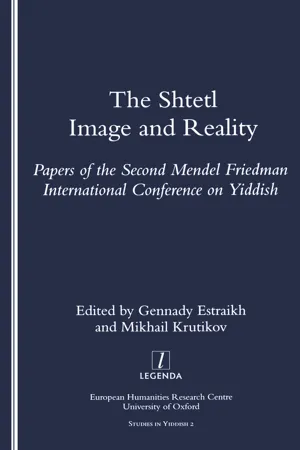
- 190 pages
- English
- ePUB (mobile friendly)
- Available on iOS & Android
eBook - ePub
About this book
"There is no possibility of entering the world of Yiddish, its literature and culture, without understanding what the shtetl was, how it functioned, and what tensions charged its existence. Whether idealized or denigrated, evaluated as the site of memory or mined for historical data, scrutinized as a socio-economic phenomenon or explored as the mythopoetics of a rich literature, the shtetl was the heart of Eastern European Jewry. The papers published in this volume - most of them presented at the second Mendel Friedman International Conference on Yiddish organized by the Oxford European Humanities Research Centre and the Oxford Institute for Yiddish Studies (July 1999) - re-examines the structure, organization and function of numerous small market towns that shaped the world of Yiddish. The different perspectives from which these studies view the shtetl trenchently re-evaluate common preconceptions, misconceptions and assumptions, and offer new insights that are challenging as they are informative."
Chapter 1
The Shtetl as Imagined Community
David G. Roskies
The small-town Jewish community of Eastern Europe—the shtetl—traces its line of march directly back to Creation.
MARK ZBOROWSKI AND ELIZABETH HERZOG, Life is with People
When the shtetl was still home to millions of Jews, it was described, if at all, as a state of mind. The most famous shtetlekh were not even locatable on any map: the fictional Tuneyadevke, Kasrilevke and Zlodievke as well as the shtedekh with similar names were probably somewhere in the Ukraine, to judge from the -evke suffix, but such as Kaptsansk could be just about anywhere, provided that the local population knew enough Yiddish to parse the name as 'Beggarsville', from the root, kaptsn. To reach Chelm, in the Lublin province of Poland, one certainly did not need a map, for it was known throughout the Ashkenazic world as a town of fools, twinned with its sister towns of Schildburg, Germany and Gotham, England,
The very concept of a map was foreign to the conceptual framework of the shtetl inhabitants, whether real or imaginary. Sholem Aleichem claimed that no one ever got lost in Kasrilevke, no matter how crooked the streets and narrow the alleyways, for Kasrilevke was the cradle-to-grave home of its happy paupers, who lived in a state of complete social integration ('The Town of the Litde People', 1901). When Benjamin the Third, the most famous native son of Kaptsansk, set out to find the Ten Lost Tribes, he went armed with nothing more than a beggar's bag and a medieval Hebrew travelogue (The Brief Travels of Benjamin the Third, 1878). Mendele Moykher Sforim, Benjamin's official chronicler, never bothers to tell us how he ever found them, for Mendele, too, is trapped within a magic circle, for Jews only.1
The physical destruction of the shtetl may have quickened the need to fix its contours on paper, but providing a map proved to be a daunting task. When the members of the First Felshteener Benevolent Association decided to publish a memorial volume—the second such yizker-bukh to be produced on American soil—the popular artist Notte Kozlovsky was commissioned to prepare a series of pictorial maps of their ravaged town. The sun is always shining on his quaint, bucolic, 'Bird's-Eye View' of Felshteen (Felshtin in Yiddish), the Jewish streets comfortably sandwiched between the spires of the Roman Catholic church in the east and the onion-shaped dome of the Eastern Orthodox church in the west. Still more fanciful—and poignant—is Kozlovsky's rendering of the Felshteener Association.2 Here, the Ukrainian shtetl, churches and all, descends in a cloud unto the cityscape of New York, home to the majority of Felshtiner, and what holds the two poles of existence together is a crowded meeting of the Felshteener Association, presided over by its president, Dr Jonah Baum. Behold: The Shtetl Transplanted and Resurrected.
After the Nazi Holocaust, when the production of yizker-bikher became a grassroots phenomenon unique in the annals of social history, maps were still the exception rather than the rule. Here is Avraham Roizman's and Nathan Sobel's memory-map of Luboml (Libivne in Yiddish) 'as it was in 1939'.3 No need to draw the map to scale, because none of the key memory-sites would still be there today: not the Trisker, Rizhiner, Radziner or Kotsker Hasidic houses of prayer, shtiblekh; not the shul, besmedresh, or ritual bath; not the hedarim, Talmud Torahs or secular Jewish schools. That the three (Jewish-owned) flour mills in town are misspelled 'Flower Mills' is further testimony, should such be needed, that Luboml exists nowhere but in the collective memories of its surviving sons and daughters. And therefore the map, approximate up to the year 1939, is scrupulous about the location of each killing field and 'Slaughter House', by means of which, three years later, the Germans turned Luboml into an apocalypse.
Since the actual inhabitants of the shtetl were capable of producing only a redemptive or martyrological map of their 'imagined community', it goes without saying that for subsequent generations of Jews, who knew the shtetl second-or third-hand, even sketchy and primitive maps were superfluous. No map could possibly render the metaphysical shtetl of their imaginings, as so lovingly inscribed in the opening line of Mark Zborowski's and Elizabeth Herzog's Life is with People (quoted as the epigraph to this chapter). The reception of this book, over the course of half a century, is itself a map of American Jewish attitudes to the shtetl.
Zborowski and Herzog received their 'seed money' from the Office of Naval Research, as part of the Columbia University Research in Contemporary Culture Project.4 Published in 1952, their reverential account of 'The Jewish Little-Town in Eastern Europe' all but covers its academic tracks. At a time, however, when none of the mainstream American Jewish movements was ready to stake a claim on Eastern Europe, Life is with People could not become a classic. Reform Jewry was still firmly wedded to the Biblical past, the font of monotheism and other 'universal' values. The Conservative movement read itself back to the Talmudic period, buttressed by Saul Lieberman's Hellenism in Jewish Palestine (1950). Mainstream Orthodox scholars, meanwhile, claimed Maimonides and the Jewish Middle Ages as their turf, a time when Halachic hegemony was unshakeable. In response to all of the above, Mordecai M. Kaplan invented Reconstructionism, seeking inspiration from Jewish modernity, and from Zionism in particular, with Yiddish and Yiddishism given but honourable mention. The only Jewish movements that placed Eastern Europe at their very centre were the Bund and Hasidism. The first had lost its raison d'être in the flames of the Warsaw ghetto; the second had not yet risen from the ashes.
A decade passed. On the heels of the Eichmann Trial came the paperback revolution, masterminded, on the Jewish front, by publisher Zalman Schockens son-in-law, the artist T. Herzl Rome. Among the first books he reissued as a Schocken Paperback in Jewish Life and Thought was Life is with People, with its subtitle changed from The Jewish Little-Town in Eastern Europe to The Culture of the Shtetl. And so it was that the word 'shtetl' entered into the American Jewish lexicon, its proof-text being a handsome paperback with a winsome drawing by Chagall on the cover.
In its 1960s reincarnation, Life is with People became an adolescent romance for third-generation American Jews, the kind of popular fiction one read when searching for one's identity. It told of a life that was anti-bourgeois, simple, down to earth. What's more, because this life seemed to stand still, it did not require any knowledge of history or geography, the very subjects that American teenagers are so poorly tutored in. There was just enough about sex, superstition and taboos to keep it interesting.
Once the book achieved this universal popularity, there came the inevitable backlash. A counter-myth was needed if the subject of East European Jewry were to stay alive. That is how my own work on the shtetl began, as a rebuttal to Zborowski and Herzog. Where the canonical shtetl was static and unchanging, the deconstructed shtetl emphasized the profound historical and ideological upheavals. Where the old shtetl was everywhere the same, the new was regionally specific. Where once it seemed as if the Jews existed in glorious isolation from the goyim, they were now portrayed in day-to-day contact and conflict with the Gentiles.
And so, The Shtetl Book, co-authored in 1975 with Diane K. Roskies,5 opens with a didactic map of the shtetl Tishevits, Polish Tyszowce. To replace Zborowski's and Herzog's timeless and goyimrein (Gentile-free) shtetl, I was determined to include both the churches and Christian domiciles. Easier said than done. Y. L. Peretz, who began his Impressions of a Journey through the Tomaszow Region (Bilder fun a provints-rayze, 1891) in Tishevits, made but passing reference to the local sheriff. For obvious reasons, the local Polish and Ukrainian populations did not enter into Yekhiel Shtern's Kheyder un besmedresh (1950)—the masterful ethnography of the traditional hedarim and study house of Tishevits. In Tishevits Register (Pinkes Tishevits, 1970), edited by Shtern's brother, Jacob Zipper, I found a very primitive map of the town, its rivers and seven bridges, but the only sign of Gentile life was the 'Church Garden', sandwiched between the Zeirei Zion clubhouse on Ustrov Street and the home of Messiah Ben Joseph.6 It was thanks to a chance encounter with Sholem Shtern, Yekhiel and Jacobs brother, that I was finally able to place the two Ukrainian churches, the Polish Catholic church, and the Gentile streets. With some difficulty, he also recalled that the pharmacy in the centre of town was run by a Catholic Pole. (When it came time to prepare the final version of the map, I still managed to misspell 'Ukrainian'.)
Next, I set out to map the streets. Since much of my narrative was based on Zipper's Between Rivers and Waters (Tsvishn taykhn un vasern, 1961), a fictional memoir about Tishevits on the eve of the First World War, I asked the author to improve upon my sketch. 'It is impossible', he wrote to me in Yiddish on 28 January 1974, 'to make a map of a shtetl with straight, symmetrical lines, because the streets were laid out as if they were crouching on top of each other, and with the very narrowest passageways leading from one to another, which are altogether impossible to restore based on memory alone'. Twenty years later, on my one and only visit to the town, the mayor of Tyszowce presented me with a map from the parish archives. The major streets were there, all right, but in the absence of the shul, the bathhouse, the various shtiblekh, or any Jewish landmark whatsoever, it turned out that I had been better served by the memory-maps of my Montreal informants.
Once its resident Gentiles had been reinstated and its crooked, narrow streets had somehow been sketched in, the model shtetl of Tishevits was ready to be launched. The overt agenda of The Shtetl Book was to rescue the shtetl as a unique social organism rooted in a specific time and place. To this end, the material was organized in what we would now call a post-modernist collage: bits and snippets of memoir, ethnography, fiction, song, sayings, drawings, diagrams, maps and period photographs. Each of its nine units had a polemical bent. The first was devoted exclusively to one town, 'The Shtetl Tishevits', in the Lublin province of Poland, to make the point that each and every shtetl was unique. The second unit, on Jewish cultural geography, challenged the homogenized, monolithic view of Eastern Europe. Here students learned about the Gefilte-Fish Line that once divided the Lithuanian north-east from the Polish south-west, Misnagdim from Hasidim. To counter the image of the shtetl as a Jewish mini-empire, the next unit described the complex and sometimes intimate relations between Gentiles and Jews, and learned to distinguish between landowner, porits, and peasant, Catholicism and Eastern Orthodoxy. To challenge the hallowed notion that shtetl Jews did nothing but study and pray—the subject of unit 6—the fourth unit foregrounded the 'Workaday Jews' (our translation of yidn fun a gants yor), and the seventh was given over entirely to games and entertainment. The eighth unit, innocently titled 'The Living and the Dead', was in many ways the most subversive, because it portrayed shtetl Judaism as folkways, customs, superstitions and other irrational manifestations—a far cry from the set of abstract ideas taught in your average Sunday school. The Shtetl Book, furthermore, was replete with unmerged Yiddishisms, strictly rendered according to the YIVO system, and even spoke in global terms about an imaginary place called Yiddishland.
There were good reasons to expect that such a revisionist approach would take, even in Jewish schools where Yiddish, superstition and the East European experience were anathema. For one thing, it was a time of ethnic revival in North America. If Black was beautiful, then so was the backwater, Yiddish-speaking shtetl. Alex Haley gave American Blacks the West African village of Juffure, and we gave American Jews the Polish shtetl of Tishevits. Since the purpose of pedagogy is to domesticate that which is strange, the books hidden agenda was to Americanize the shtetl.
A second hidden agenda was Diaspora Zionist. Most of what I knew, or thought I knew, about the shtetl had come from my Folkshule teachers, all of them born and bred in the shtetl. It was the experience of growing up in a Yiddish-speaking, Hebrew-praying and rapidly modernizing community that eventually turned them into Labour Zionists. Zionism for them was an attempt to resegregate the Jews within a secular polity. Shloime Wiseman, the principal and chief pedagogue of the Folkshule in Montreal, had this to say about the embedment of the shtetl in his own psyche:
We will forever search for the echo of chords sounded long ago that were never forgotten. Sounds, melodies, smells, and memories. What we thereby seek is both our childhood, lost irrevocably, and the total yidishkayt that was possible under certain conditions once prevalent in the small shtetl but impossible to reproduce here in the metropolitan American exile. That longing and unhappiness is an important psychic factor in our lives.
The lost paradise of the shtetl gave birth to Wiseman's curriculum of a maximalist yidishkayt.7 All those hours spent reading Mendele, Peretz, Sholem Aleichem and Asch were designed to instil in us, Canadian-born children, a sense of longing for something more authentic than the anaemic, fragmented Jewish life in metropolitan exile. And for one Folkshule graduate at least, Wisemans curriculum was a smashing success. From beginning to end, The Shtetl Book projected a proto-Labour-Zionist shtetl, by emphasizing those institutions that furthered the close interaction of Jews with other Jews and by attempting to harmonize Yiddish and Hebrew, the intellectuals and the folk.
Because pedagogy is of necessity parasitic, my didactic construct of the shtetl fed off what already existed in the pag...
Table of contents
- Cover
- Half Title
- Title
- Copyright
- Contents
- Contributors
- Preface
- 1 The Shtetl as Imagined Community
- 2 What Exactly Was a Shtetl?
- 3 The Podolian Shtetl as Architectural Phenomenon
- 4 Jewish Art between yidishkayt and Civilization
- 5 Berdichev in Russian Jewish Literary Imagination: From Israel Aksenfeld to Friedrich Gorenshtein
- 6 Shtetl Kuzmir: The Reality of the Image
- 7 Soviet and Kosher in the Ukrainian Shtetl
- 8 The Shtetl Theme in Sovetish heymland
- 9 Immigrants Mourning for a World Lost
- Index
Trusted by 375,005 students
Access to over 1.5 million titles for a fair monthly price.
Study more efficiently using our study tools.
Frequently asked questions
Yes, you can cancel anytime from the Subscription tab in your account settings on the Perlego website. Your subscription will stay active until the end of your current billing period. Learn how to cancel your subscription
No, books cannot be downloaded as external files, such as PDFs, for use outside of Perlego. However, you can download books within the Perlego app for offline reading on mobile or tablet. Learn how to download books offline
Perlego offers two plans: Essential and Complete
- Essential is ideal for learners and professionals who enjoy exploring a wide range of subjects. Access the Essential Library with 800,000+ trusted titles and best-sellers across business, personal growth, and the humanities. Includes unlimited reading time and Standard Read Aloud voice.
- Complete: Perfect for advanced learners and researchers needing full, unrestricted access. Unlock 1.5M+ books across hundreds of subjects, including academic and specialized titles. The Complete Plan also includes advanced features like Premium Read Aloud and Research Assistant.
We are an online textbook subscription service, where you can get access to an entire online library for less than the price of a single book per month. With over 1.5 million books across 990+ topics, we’ve got you covered! Learn about our mission
Look out for the read-aloud symbol on your next book to see if you can listen to it. The read-aloud tool reads text aloud for you, highlighting the text as it is being read. You can pause it, speed it up and slow it down. Learn more about Read Aloud
Yes! You can use the Perlego app on both iOS and Android devices to read anytime, anywhere — even offline. Perfect for commutes or when you’re on the go.
Please note we cannot support devices running on iOS 13 and Android 7 or earlier. Learn more about using the app
Please note we cannot support devices running on iOS 13 and Android 7 or earlier. Learn more about using the app
Yes, you can access The Shtetl by Gennady Estraikh in PDF and/or ePUB format, as well as other popular books in History & Jewish History. We have over 1.5 million books available in our catalogue for you to explore.