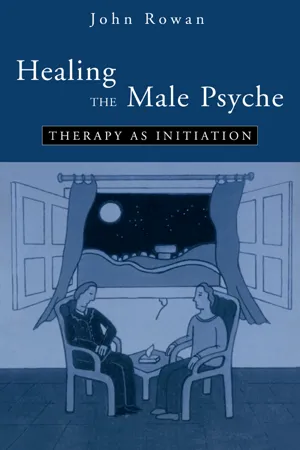
John Rowan argues that if men are to escape from their old roles and the new pressures of social uncertainty they need to be initiated into a new kind of masculinity, but that this process must be personal to each man. He explores how therapy can help or hinder the process of transformation. Written for men who are looking for a new way of understanding their predicament as well as psychotherapists and counsellors working with men, Healing the Male Psyche is packed with useful information and exercises and supported by a wide range of references.
- 296 pages
- English
- ePUB (mobile friendly)
- Available on iOS & Android
eBook - ePub
About this book
Information
Part I
MATERIA PRIMA AND NIGREDO
Right at the beginning you meet the ‘dragon’, the chthonic spirit, the ‘devil’ or, as the alchemists called it, the ‘blackness’, the Nigredo, and this encounter produces suffering(Jaffe 1979)
1
INTRODUCTION
MASCULINITY AS PAIN
Being a man today hurts. The old certainties (which perhaps never were all that certain anyway) about who we are and what we are about have shifted radically. We cannot any more take it for granted that we have a job for life. We cannot any more take it for granted that we shall be husbands and fathers. We cannot any more take it for granted that the environment will stay stable and predictable. It seems that we are expected to carve out a future from unpromising materials. lf we were free and responsible that would be all right; if we were unfree and irresponsible that would be acceptable too; if we were free and irresponsible that might be very nice for a while; but what we seem to be is unfree and responsible. And that is horribly uncomfortable. So it is not only the individual pains which come to every man which are an issue here: it is the social pain which comes from being a man in a society where strain has become normal.
PROBLEMATISING MEN AND THERAPY
This book is about men and therapy. It starts by saying that being a man is a problem today, and that therapy is a problem too. The reason why they are problematic is that both share a context of late crumbling patriarchy, and that patriarchy is itself problematic. (This is explained in detail in Chapter 2.) There is no assumption here that patriarchy is eternal or ahistorical — it is in process like any other social system — but it seems to be the major archetype of oppression in our time. It is the reason why any true postmodernism is impossible at the moment. Even though patriarchy has become unstable and unpredictable and fragmented in many ways, it still sets whatever standards there are left. It therefore needs to be taken seriously as the background to our whole investigation, and the source of many of the detailed problems in front of us.
PART OF THE PROBLEM AND PART OF THE SOLUTION
In the 1970s there was a saying ‘If you’re not part of the solution you are part of the problem’ which was quite a guilt-inducing message and not really very helpful. Now in the mid-1990s we can see that men are part of the problem and also part of the solution. It is men who hold most of the power positions in society — and just for this reason it is men who have to be involved in any radical change which is to take place. The question that is often asked when we talk of radical change is ‘Why should men give up their power?’, but it is not really a question of giving up power but of transforming it. Chapter 6 is all about this question. Having power is a good thing, which is why many people go around talking about empowerment as desirable. It goes wrong only when it becomes compulsive and unaware, so that people do not realise that they are being oppressive and even deny it hotly. In a confusing society, it is normal to be confused.
MASCULINE ROLE AS COMPULSIVE
There is much about the masculine role which has become compulsive. In Chapter 4 we shall see why this should be so. Of course the whole notion of gender roles has been criticised: after all, we do not talk about class roles or race roles. There is a suggestion of intentionality about the concept of a role: normally we take up roles, we play roles; and gender roles are not like this, because they are given. But the powerful theory of gender role strain put forward by Pleck (1995) is so useful that it seems worth while to talk in these terms, so long as we realise the limitations involved. The whole point is that these roles are not taken up intentionally — they are imposed by a patriarchal society which still specifies them and enforces them in the family, in the school, in the peer group, in the media and in many other ways. We are all taught that certain ways of being masculine are normal, and others are not. But when anything has become unaware and compulsive, therapy is useful in undoing the compulsion. We shall work through an example of this process in Chapter 3.
THE SOFT MALE
It is not enough to reverse or oppose the expected masculine role to deal with the problems associated with it. This would be just as compulsive as the original role itself. If we feel that the current role involves being aggressive, it does not help to be resolutely unaggressive. If we feel that the role entails being dominant, it does not help to refuse all dominance. All that these manoeuvres achieve is a kind of soft male who is no better than his opposite — just more confusing. Confusing because the masculine role is so poorly specified that reversing the main aspects of it leaves all sorts of straggly remnants round the edges which have not been noticed, riot been criticised. And so to the outside observer much of the ‘old Adam’ remains — the reversal is ‘willed’ rather than real, and hence inadequate and unconvincing. This is not a valid way of dealing with the problem, and we shall encounter something more useful and more usable in Chapter 9.
THE INITIATED MALE
For real change to take place in a man, what has to happen? I have struggled with this problem for many years now, ever since I joined my first men’s group in 1972. In a previous book (Rowan 1987) I argued that he would have to work on three levels: the conscious, the unconscious and the transpersonal. But now I feel that a more useful way of putting it is to say that he has to be completely initiated into a new way of being, unique to him. By initiation I mean something that affects a person at every level, and offers an all-round opportunity for transformation. And it now seems to me inescapable that only therapy has the power to do this, because only therapy explores the nooks and crannies of a man’s psychology in enough detail to leave nothing untouched in the end. But even then, not every type of therapy will do: and much of this book is about the variations within therapy — both individually and in groups — which make some types of it much more useful than others for the purposes of transformation.
THERAPY AS INITIATION
In Chapter 5 we shall see where psychotherapy came from, and how it developed. For therapy to be genuinely initiatory, it has to go beyond the adjustment favoured by the more medically oriented approaches. It has to go beyond the liberation favoured by the therapies of the 1960s. It has to deal with the soul. One of the main themes of this book is the male soul and how it is to be understood and approached and honoured.
The dynamics of initiatory change can also be provoked by any unexpected, dramatic event: accident, divorce, abortion, the death of a loved one, the loss of a career, an eruption from nature that destroys the shape of a life. All severe separations in life evoke the sense of initiation in the psyche and open a person to psychological and mythical territories of unusual depth. Initiation is the psyche’s response to mystery, great difficulties, and opportunities to change.(Meade 1993: 11)
It is a sad fact that many men, faced with such challenges, try to settle for a problem-solving approach which merely tries to put things back the way they were before. But in truth this is an opening, a way in to a new and different kind of life. In Chapter 8 we shall see exactly how this is done, and in Chapter 9 what comes out of the process.
Perhaps therapy is not the only way. It is a hard way to go. It would be nice if there were some other, easier way. But in spite of all my efforts over the years I have not yet found one. In this book we shall find therapy to be the great vision quest that is on every doorstep. It is the way of initiation that is available to all or most of us. And just because it is a way of initiation it is more demanding than we may at first imagine, as Joseph Jastrab tells us:
On a journey of this sort, every decisive victory is born out of an equally decisive defeat. And is more often the rule than the exception.(Jastrab 1994: 13)
He is talking about another kind of vision quest, but his words are relevant to us here. We wend our way through the opposites, the contradictions, the traps and the confusions with a sense of danger rather than a sense of safety. This book tries to offer guidance on the way through the labyrinth.
THERAPY AS A NEW SET OF SHACKLES
This means that we shall see, in a patriarchal context, that much of what passes for therapy in the world today is actually confirming the oppressive structure of society instead of questioning it. There are hidden pressures to conform within many forms of therapy today, and some of them are not so hidden. Instead of working towards initiation, which involves facing pain and dealing with it thoroughly, they avoid the pain, and instead try to close it off and deny it. As Alvin Mahrer puts it in his inimitable style:
Virtually every helping approach assists the person in achieving the above goals [of avoidance] by shifting to another operating potential, and thereby helping the person maintain his self, reduce the burgeoning bad feelings, and push back down the rising deeper potential. These are the aims of supportive therapies, crisis therapies, suicide prevention centres, and the whole enterprise of chemotherapeutic drugs and pills. These are the aims of custodial treatment, behavior therapies, ego therapies, milieu therapies and social therapies…. Programs of desensitization and token economy and deconditioning are the allies of the person in working effectively toward these goals. The war cry of all these approaches is the same: control those impulses, push down the insides, reduce the bad feelings, stop the threat, maintain the ego, push away the threat to the self, deaden the tension, guard against the instincts.(Mahrer 1989a: 367)
We shall have to explore the alternatives to this and see whether some other possibility exists, and in particular which forms of therapy can become a genuine initiation for men. Chapter 7 is all about this.
TWO MAJOR CONTRADICTIONS
So there are two major contradictions which we shall be dealing with in this book. One is the contradiction between the oppressive nature of the masculine role and the transformational possibilities within every individual man. The other is the contradiction between the oppressive nature of much therapy and the transformational possibilities within therapy.
THE ALCHEMICAL PROCESS
In dealing with all these dangers and contradictions, the framework of medieval alchemy seems very useful. As Jung (1980) has shown at length, the work of the alchemists was not very convincing as chemistry, but can help us very much in understanding the process of personal growth. I am not a Jungian, although I have been in Jungian psychotherapy, but what he and some of his followers have demonstrated seems to me to make a lot of sense in this context.
An alchemical framework has been used in Chapter 8 to outline the process of psychotherapy; but it has also been used to lay out the book as a whole. In alchemy there are ups and downs, successes and failures, triumphs and setbacks, changes in colour, and a constant attention paid to paradox, opposites and contradictions. And in this book there are ups and downs and all the rest of that. More than once we shall meet the blackness of the Nigredo, and more than once we shall meet the beauty of the Conjunctio.
INDIVIDUAL AND GROUP
Most of this book is about individual therapy, and what comes out of it. In Chapters 10 and 11 we look at how going through the process of initiation affects men in the world of work and in their relationships. But men’s groups are also very important, and Chapters 12 and 13 are devoted to an examination of what group work can and cannot do. It is in a group that a...
Table of contents
- Cover
- Half Title
- Title Page
- Copyright Page
- Dedication
- Table of Contents
- Part I Materia Prima and Nigredo
- Part II Fermentatio
- Part III Separatio
- Part IV Calcinatio
- Part V Albedo
- Part VI Conjunctio
- Part VII Mortificatio and Second Nigredo
- Part VIII Solutio and Third Nigredo
- Part IX Coagulatio
- Part X Sublimatio
- Part XI Rubedo
- Appendix Should I take on this client?
- Bibliography
- Index
Trusted by 375,005 students
Access to over 1.5 million titles for a fair monthly price.
Study more efficiently using our study tools.
Frequently asked questions
Yes, you can cancel anytime from the Subscription tab in your account settings on the Perlego website. Your subscription will stay active until the end of your current billing period. Learn how to cancel your subscription
No, books cannot be downloaded as external files, such as PDFs, for use outside of Perlego. However, you can download books within the Perlego app for offline reading on mobile or tablet. Learn how to download books offline
We are an online textbook subscription service, where you can get access to an entire online library for less than the price of a single book per month. With over 1.5 million books across 990+ topics, we’ve got you covered! Learn about our mission
Look out for the read-aloud symbol on your next book to see if you can listen to it. The read-aloud tool reads text aloud for you, highlighting the text as it is being read. You can pause it, speed it up and slow it down. Learn more about Read Aloud
Yes! You can use the Perlego app on both iOS and Android devices to read anytime, anywhere — even offline. Perfect for commutes or when you’re on the go.
Please note we cannot support devices running on iOS 13 and Android 7 or earlier. Learn more about using the app
Please note we cannot support devices running on iOS 13 and Android 7 or earlier. Learn more about using the app
Yes, you can access Healing the Male Psyche by John Rowan in PDF and/or ePUB format, as well as other popular books in Social Sciences & Mental Health in Psychology. We have over 1.5 million books available in our catalogue for you to explore.