- 223 pages
- English
- ePUB (mobile friendly)
- Available on iOS & Android
eBook - ePub
About this book
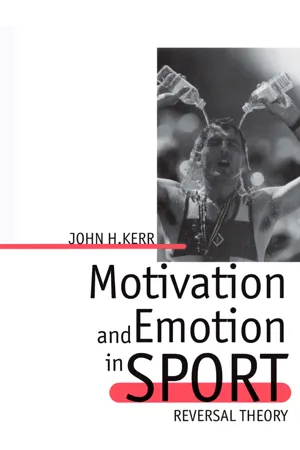
Why did Michael Jordan quit basketball and take up baseball? Why was Martina Navratilova so successful as a professional tennis player? These and many other questions about aspects of motivation and emotion in sport are addressed in this book which is newly available in paperback. Reversal theory's systematic conceptual framework allows a unique perspective for interpreting behaviour in sport contexts. Within each chapter, real-life examples are combined with research findings to provide an understanding of the emotional background and changes which accompany the individual's unique experience in sport. In addition, suggestions as to alications of reversal theory in new areas of sport psychology and the future direction of reversal theory-based sport research are outlined. For those interested in a truly insightful understanding of human behaviour in sport, this book will be required reading.
Information
1
Introduction
The sports pages of Saturday newspapers are often mundane. Most of the weekend sport is about to happen. Sports editors generally fill these pages with articles that either review what has happened in the previous week or speculate on the outcome of the coming weekend’s sports events. On Saturday 2 July 1994, the back page of one newspaper was far from mundane. It ran four major stories. One was based on rumours about the future plans of a world sports figure; a second concerned the expulsion of a star performer from a world sports competition; another concerned a lifetime ban for yet another top sports person; and a fourth focused on the climax of an outstanding career in sport. Two were stories of tremendous success, about performers in their prime, and the other two were sad stories of personal failure, which brought disgrace to the stars concerned.
The newspaper concerned happened to be The Japan Times, an English-language newspaper, which includes syndicated stories from other newspapers and press agencies in the US, Europe, and other parts of the world. It may just have been an editing coincidence that all four appeared on the same sports page, but these were four of the hottest sports stories in 1994. The contents of the stories contrasted sharply with each other and each raised different questions about the motivation of the top athletes concerned. To anyone interested in what motivates people in sport, that atypical back page and those four articles were especially fascinating.
The events reported in the newspaper and the questions they raise are worth examining. By doing so, the observer can begin to gain some insight into the complex and intriguing nature of the motivational processes involved in sports. Probably the best place to start is with the lead story on that Saturday in July.
Maradona Gets Boot from Cup
In June, the World Soccer Cup being played in the US was to be the scene of the downfall of one of the game’s stars. In an early Cup match Argentina were playing Nigeria. The star, Maradona of Argentina, had an exceptional game. The weather was hot and humid yet the 33-year-old Argentinian captain was still running and chasing around the field when other, younger players were showing the effects of fatigue. Argentina won the match 2–1. Five days later the story of the biggest scandal in World Cup history broke.
At a press conference it was announced that “Diego Maradona has violated the provisions of doping control regulations”. In spite of his denial, he was withdrawn from the Argentinian team and sent home.
Maradona had been one of two players chosen at random for a post-game urine sample. The procedure was that the sample was divided in two and the second sample was analysed only if the first proved to be positive for banned drugs. It later transpired that analysis of both the first and second samples indicated the presence of five illegal substances, including ephedrine, phenylpropanolamine, pseudo-ephedrine, non-pseudo-ephedrine, and methylephedrine. In The Japan Times (2/794, p.22) a member of FIFA’s executive committee, Michel d’Hooghe, a medical doctor, said:
Maradona must have taken a cocktail of drugs because the five identified substances are not found in any one medicine… It is absolutely scientifically proved that these products have a positive action on the central nervous system, increasing the player’s ability and physical action. That is absolutely certain.
Maradona spoke with Argentinian television in tears, telling, the viewers, “I did not take drugs and above all I did not let down those who love me”. He also told the Brazilian team doctor that, to counteract an allergy, he had taken Decidex and Naftizol, two medicines he bought in Argentina. However, according to the doctor, their effect would have been minimal.
People in Argentina were devastated. Their hero, whose name they had chanted after the victory over Nigeria, had disgraced the whole nation. Now, instead of playing in his twenty-second game in the World Cup finals, which would have been a new record, he was suspended and sent home, the villain of the piece. Argentina reached the last 16, but were eliminated from the World Cup by Romania. Later in August, Maradona was banned for 15 months and fined 20,000 Swiss francs by FIFA officials in Switzerland.
Maradona had first played for Argentina as a 16-year-old in 1977; he led them to World Cup victory in 1986 and in 1990 captained the team that lost in the final to West Germany. He had broken the world record in transfer fees three times. Maradona had been in trouble with the soccer authorities before for using cocaine. He tested positive after a game for Naples where he played from 1984–1991 and received a 15-month ban.
What could have caused Maradona to take such a huge risk? He must have known that players in the World Cup were being given random doping checks. Was it perhaps that he realised that his phenomenal skill, speed, and control, his complete mastery over both soccer ball and opponents, was not what it had been in previous World Cup competitions? Was this just an extension of his previous drug abuse? Someone who had been banned for cocaine use might, in circumstances of high pressure and national expectation, see the solution to his diminishing ability in taking stimulants. For one who had been at the pinnacle of soccer when he led his team to victory in 1986, was this the only means open to him for achieving his previous level of success?
Jordan Mum on Rumour He’ll Quit Baseball, Return to Bulls
Imagine you are at the height of your career as a professional sportsman and have led your team to three consecutive national championships. A fellow professional has described you as the most exciting, awesome player in the game today and a journalist has said you are the best and most influential player in the history of your sport. You make over $40 million a year and you can command more or less any salary you ask for from your sport. Just when it seems that absolutely everything is going for you, you decide to retire from the sport that has made you famous throughout the world to take up a sport you have not played since your high-school days. Impossible? Crazy irrational behaviour? Not at all. This story is true. The sportsman in question is Michael Jordan, star of the Chicago Bulls professional basketball team.
The previous summer he had made the decision to stop playing basketball and to start playing baseball. By the summer of 1994, Jordan had made remarkable progress and was playing baseball for the Birmingham Barons in the US, AA Southern League. There were frequent speculations during the summer of 1994 about his possible return from baseball to basketball. The reports all proved to be based on unsubstantiated rumours. Michael Jordan confirmed his departure from basketball with a last farewell exhibition game in Chicago on 9 September. The game was a sell-out, attracting more than 18,600 fans to Chicago stadium. Playing against other top basketball players and three of his former team mates in the game, Jordan’s team won by 187–150 points and he personally was successful with 24 out of 46 shots, scoring 52 points. In spite of being out of basketball for a year, Jordan showed all of his skill and ability, using his full range of reverse dribbles, drives and dunks, and layups. Jordan had proved that he could still perform at the top level1. What commonsense explanation or theory of motivation could account for him giving up all his success? Why had his strong intrinsic motivation (see e.g. Vancil, 1994) and the enormous extrinsic rewards not served to keep him playing basketball for longer?
Some of his post-game quotes (The Japan Times, 11/9/94, p.22) provide a clue as to why he may have made the decision:
It meant a lot to me. It’s given me a lot, and I think I’ve given it a lot. It’s mutual love and understanding. It’s time to move on.
I can still do this … I just don’t have to do it in front of 18,676. I can do it in any gym with any people I want. That’s a rare freedom.
The game of basketball has always been a part of me … I never said I’d stop playing the game, I just said I wouldn’t play organized basketball.
It seems that, in spite of still having a tremendous feeling for the game, Jordan felt somehow restricted by the constraints of organised basketball and all that that entails in contemporary professional sport. He talked about enjoying the freedom of playing when, where, and with whom he liked. In addition, he said, “It is time to move on”. As a player, he was recognised as being the best in basketball, but he had achieved everything there was to achieve, he needed a new challenge and that challenge was to be found in baseball (Vancil, 1994, p.84):
One thing I would like to do, either when I’m through playing or one of these summers when I do have free time, is play baseball. I haven’t totally dismissed that yet. I’d really like to go to a training camp, which I can’t do because it’s in the middle of our season, and give it a shot. I wouldn’t have to stay there long, but I’d really like to see if I could do it. I’m serious. I’d love to try. It’s an unfulfilled part of my life because I was never able to do what I wanted in college.
Harding Stripped of U.S. Title, Banned for Life by Skate Body
In July, a five-member disciplinary panel of the US Figure Skating Association took the US championship away from Tanya Harding and banned her from the association for life. It was a severe punishment for her part in the attack on her rival Nancy Kerrigan, which the disciplinary panel stated “evidence a clear disregard for fairness, good sportsmanship and ethical behavior”. In an attempt to make it easier for Harding to become US champion and qualify for the US Olympic team, her ex-husband and three accomplices plotted the attack on Kerrigan, the defending women’s champion.
On 6 January, a single assailant used a short black weapon to strike Kerrigan a savage blow to her right knee as she left the ice after practice at Detroit’s Cobo Arena. If the blow had been slightly lower it might have shattered her kneecap and put her future in skating in jeopardy. As a result of the injury, 24-year-old Kerrigan was forced to withdraw from the national championships which the US Figure Skating Association was using as trials for the Winter Olympics in Lillehammer, Norway, and Harding became national champion for a second time.
Harding’s attorney denied that she had any prior knowledge of the assault, but there was evidence enough to indicate to the panel that she not only had prior knowledge, but was also involved prior to the incident. Two of the attackers testified that Harding was in on the plot and she was named as an unindicted co-conspirator by a grand jury in Portland. Other evidence included bank and phone records, video evidence, and statements by two witnesses. In addition, Harding had previously admitted that she had conspired to hinder the prosecution of the attackers. The ban will prevent Harding from competing or coaching in any skating events authorised by the association. In effect, the career of a top-rank skater was finished.
It could have been that, even though Harding was skating better than she had for some time, she may have been aware that her closest rival was also performing extremely well. Kerrigan had won two competitions, the Piruetten in Norway and the AT&T Pro Am in Philadelphia, prior to the US championships. Could it have been fear of failure, fear of not qualifying for the Olympics and missing a chance of a medal, fear of being displaced by Kerrigan from the top of her sport, that drove Harding to such a desperate means of trying to eliminate her rival?
Navratilova One Win Shy of 10th Crown
In the world of women’s tennis, few players have come close to the achievements of Martina Navratilova since her career began in 1974. In a career with a record 165 doubles titles and 167 singles titles, she had already won nine Wimbledon Championships; in July 1994 she was battling to win her tenth. She progressed steadily through the draw until she played Gigi Fernandez in the semi-final. Fernandez, Navratilova’s friend and practice partner, known for her doubles play, has not been so successful in singles games. Nevertheless, tennis buffs were treated to an exciting and thrilling match, one of the best women’s games at Wimbledon for years. Navratilova won and went on to meet Conchita Martinez in the final. She told The Japan Times (2/7/94, p.22):
This is what I dreamed about. This is what I wanted—to go out in style. Win or lose, I’ll be going out in style. I’m going to enjoy the moment.
In the final, another game full of tension and emotion, she lost in three sets. Martinez became 1994 Wimbledon women’s champion. Martina Navratilova’s dream had not quite been fulfilled. A few months later she would play her last singles match at the Virginia Slims Championships at Madison Square Garden in New York. There she would bid farewell to singles tennis after a career spanning 22 years. After the game, in an emotional farewell, she was presented with a Harley-Davidson motorcycle and a banner, the first for a woman, was raised to hang in the Garden in her honour. It seems unlikely that her achievements will ever be surpassed. When asked what she thought her legacy to sport would be and what she would miss most (The Japan Times, 17/11/94, p.22), she said that she considered herself:
a consummate professional, giving it everything I had on court and off court,...
Table of contents
- Cover
- Half Title
- Title Page
- Copyright Page
- Dedication
- Table of Contents
- Preface
- 1. Introduction
- 2. Key elements in reversal theory
- 3. Into sport: Aspects of participation and preference
- 4. Skating on thin ice: The special attraction of dangerous sports
- 5. We are the champions!: Winning and losing in sport
- 6. Up for the match?: Experiencing arousal and emotion in sport
- 7. Get your retaliation in first: Aggression and violence in team contact sports
- 8. The feel good factor: Sport, exercise, and psychological well-being
- 9. Over the top?: Stress in competitive sports
- 10. Rethinking the script: Future directions in reversal theory sports research and practice
- Appendix A: Summary of studies investigating dominance in sport (Chapter 3)
- Appendix B: Summary of studies investigating dominance in risk sports (Chapter 4)
- Appendix C: Summary of studies investigating winning and losing in sports (Chapter 5)
- Appendix D: Telic Dominance Scale (TDS)
- Appendix E: Negativism Dominance Scale (NDS)
- Appendix F: Telic State Measure (TSM)
- Appendix G: Tension and Effort Stress Inventory (TESI)
- Author Index
- Subject Index
Trusted by 375,005 students
Access to over 1.5 million titles for a fair monthly price.
Study more efficiently using our study tools.
Frequently asked questions
Yes, you can cancel anytime from the Subscription tab in your account settings on the Perlego website. Your subscription will stay active until the end of your current billing period. Learn how to cancel your subscription
No, books cannot be downloaded as external files, such as PDFs, for use outside of Perlego. However, you can download books within the Perlego app for offline reading on mobile or tablet. Learn how to download books offline
We are an online textbook subscription service, where you can get access to an entire online library for less than the price of a single book per month. With over 1.5 million books across 990+ topics, we’ve got you covered! Learn about our mission
Look out for the read-aloud symbol on your next book to see if you can listen to it. The read-aloud tool reads text aloud for you, highlighting the text as it is being read. You can pause it, speed it up and slow it down. Learn more about Read Aloud
Yes! You can use the Perlego app on both iOS and Android devices to read anytime, anywhere — even offline. Perfect for commutes or when you’re on the go.
Please note we cannot support devices running on iOS 13 and Android 7 or earlier. Learn more about using the app
Please note we cannot support devices running on iOS 13 and Android 7 or earlier. Learn more about using the app
Yes, you can access Motivation and Emotion in Sport by John H. Kerr in PDF and/or ePUB format, as well as other popular books in Psychologie & Geschichte & Theorie in der Psychologie. We have over 1.5 million books available in our catalogue for you to explore.