- 208 pages
- English
- ePUB (mobile friendly)
- Available on iOS & Android
eBook - ePub
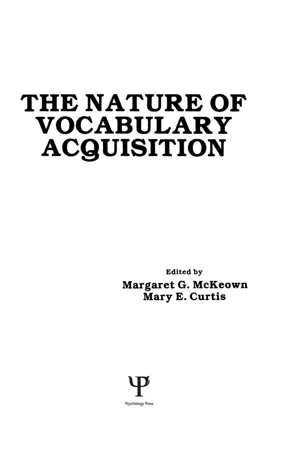
The Nature of Vocabulary Acquisition
About this book
First published in 1987. The purpose of this volume has been to move beyond a collection of the most recent studies in the area of vocabulary learning. The contributors, and researchers who, although they may differ in their views on vocabulary acquisition and instruction, acknowledge that many of the same questions motivate their work. These questions and the way they have addressed have been included in order to emphasize these underlying commonalities, with the hope the relationships among contrasting perspectives will become more apparent.
Information
I
HOW KNOWLEDGE OF WORD MEANINGS DEVELOPS
HOW KNOWLEDGE OF WORD MEANINGS DEVELOPS
1
Two Vocabularies for Reading: Recognition and Meaning
Two Vocabularies for Reading: Recognition and Meaning
Jeanne S. Chall
THE TWO VOCABULARIES
This chapter is concerned with two kinds of vocabulary important for reading—word recognition and word meaning. It treats how they develop over time, how they relate to the reading process, and how they relate to the teaching and learning of reading. It is also concerned with the changes that have taken place over the past several decades with regard to how each is best taught.
I begin with a brief overview of these two vocabularies. One way to view them is in Marshall McLuhan's terms — as the medium or the message. Word recognition may be thought of as the medium in the reading process, the medium that conveys the message, and word meaning as the message itself.
At the preliterate stage, before reading skills have been acquired, knowledge of words and their meanings is considerable. Lorge and Chall (1963) after analyzing the relevant studies on vocabulary size, estimated that 6 year olds, for example, know about 5,000 words. A more recent estimate is that 6 year olds know (i.e., understand and use) about 6,000 different words (Moe, 1974). Still others have claimed that first graders know 24,000 words (Seashore, 1947).
There has been a long controversy in the research literature, as well as in the popular press, as to the number of words known by first graders. Early estimates of the 1920s and 1930s based on samplings from abridged dictionaries, were that about 2,000 or 3,000 words were known by first graders. During the 1940s, based upon Seashore's (Seashore, 1947; Seashore & Eckerson, 1940) test that sampled words from an unabridged dictionary, estimates as high as 24,000 were reported for first graders. The analysis of the past research by Lorge and Chall (1963) found vocabulary sizes ranging from 2,000 to 24,000 for Grade 1. These great differences, they concluded, depended on the size of the dictionary sampled, how the words were tested, and the criterion used for knowing a word—whether common or uncommon meanings were tested. In general, the larger the dictionary sampled, the easier the test of “knowing”; and the more the test asked for common meanings, the larger the estimates. After considering these and other methodological issues in estimating vocabulary size, they concluded that estimates in the tens of thousands were probably too high, and that for first graders, an estimate closer to 5,000 was probably more valid than one of 24,000. The recent estimate of 6,000 by Moe (1974) based on use, gives confirmation to the lower rather than to the higher estimates.
Whether one accepts an estimate of vocabulary knowledge for first graders in the thousands or tens of thousands, the issue with regard to its role in the beginning reading process is essentially the same—those who speak the language in which they learn to read, whether children or adults, are much more advanced in their knowledge of word meanings than in their recognition vocabularies. It is the medium, not the message, that they must learn.
Indeed, it takes the typical child about 3 to 4 years, from Grade 1 to Grade 4, to learn to identify in print the 3,000 words and their derivatives known by about 80% of fourth graders (Dale & Chall, in press) —most of which they could already understand and use in Grade 1. An earlier start and better reading programs may make it possible for most children to recognize more than 3,000 words by the end of Grade 3. But we seem not to have yet found ways for typical 9 year olds to identify accurately, and with fluency, all the words they know from hearing and speaking—perhaps about 10,000. Thus the hurdle of the early years, for most children, is word recognition—the medium, not the message. Most children in the primary grades can understand thousands of words more than they can identify and decode.
For most children, at about Grade 4 or 5, a shift begins to take place. The kind of vocabulary that becomes the greater hurdle is word meaning—the message. Although some children in these grades may still be struggling with the medium (the recognition of words), most begin to struggle more with the message (the meanings of the words and ideas). The shift takes place when they can recognize most common words, and can decode others. But the materials they are required to read, content textbooks, for example, contain an ever greater number of words that are unfamiliar, rare, specialized, abstract, literary, and bookish. The shift also takes place in children's language. Up to age 10, the words they know are mostly concrete, and most of their definitions are concrete. At age 10 and later, they are able to define more abstract words, and their definitions tend to move from the concrete to the more abstract and general (Feifel & Lorge, 1950; Werner & Kaplan, 1952).
Thus, the primary grades may be characterized as overcoming a gap in word recognition, whereas the intermediate grades and beyond may be characterized as overcoming a gap in word meanings.
RECOGNITION VOCABULARIES
At least three positions have been held on the meaning/recognition gap in the primary grades. One position is that there is little or no gap — that words known by the child should create no hurdle in print. Thus, Bettelheim and Zelan (1981) in their book, On Learning to Read: The Child's Fascination with Meaning, are critical of American primers and beginning reading textbooks because their vocabularies are limited to the commonest hundreds while children know thousands of words. Others in the field of reading have argued in a similar manner (Goodman & Goodman, 1979; Smith, 1979). Basing their theories of beginning reading on the primary importance of language and meaning, or on motivation, they argue that the extensive meaning vocabularies of children when they first begin to read can and should make it possible for them to read any books containing words they know.
Word recognition, according to this position, is acquired best when it is acquired naturally, as in speech. Word recognition is best accomplished, they claim, with no formal instruction, except perhaps through the modeling by an adult who reads to the child. It is the child's search for meaning that “drives” him or her to recognize the printed words. Thus, word recognition is to be acquired only through context. Indeed, some who hold this position claim that it is the explicit teaching of children to recognize and decode words that leads to serious problems in these areas (Smith, 1979). This position has gone under various labels such as language-experience and more recently, a total language approach.
A second position is one exemplified in the most widely used basal reading programs published during approximately the 50 years from the early 1920s to the late 1960s. Although the word recognition/word meaning gap in beginning reading was often blurred, as in the earlier position, they did provide explicit instruction in learning to recognize words, mostly as whole words, and somewhat later and less explicitly, through word analysis. To facilitate the recognition of words in print, the number of words taught in the early readers was strictly controlled and they were repeated often. Also similar to the first position, there was strong reliance on meaning for acquiring the printed forms of words, thus the primary importance of context and of using stories with the commonest words in the child's meaning vocabulary. This position has also gone under various labels, including sight or whole word methods, or a meaning-emphasis.
A third position on the meaning/recognition gap is explicit recognition that such a gap exists, and that beginning instruction should be designed to overcome this gap as soon as feasible—usually through systematic teaching of the relationship between letters and sounds (decoding, phonics) along with or preceding the reading of stories.
This approach puts explicit and direct focus on early acquisition of the alphabetic principle (i.e., learning how and why words are spelled and how they are related to speech sounds). In modern versions there also is early reading of stories to facilitate transfer of decoding skills to reading words and stories. This approach is probably the oldest, historically, for teaching alphabetic languages (Matthews, 1966). This approach has been referred to by such labels as alphabetic-phonic, code-emphasis, or a phonics-first method. (For a fuller account of these three approaches, see Chall, 1967, 1983a.)
One or another of these positions has been used to teach children to read in the United States, as well as in other countries. Some seem to be preferred at some times and others at other times.
What is the research evidence on these three positions? Is one more effective than another? Syntheses of the research on these approaches completed during the late 1960s and subsequently confirmed in the 1980s (Anderson, Hiebert, Scott, & Wilkinson, 1985; Chall, 1967, 1983a; Perfetti, 1985) concluded that an early and explicit emphasis on the medium (on word recognition and decoding) was more effective for reading achievement, not only on tests of word recognition and oral reading, but on silent reading comprehension as well. This research brought changes in practice. Starting about the late 1960s, a greater emphasis was placed on teaching word recognition and decoding through earlier and more intensive decoding programs. This permitted earlier learning of word recognition, which further resulted in the use of more words in the basal readers — a loosening of vocabulary control.
MEANING VOCABULARIES
The study of meaning vocabularies is one of the oldest research interests of psychologists and educational researchers, with research activities on vocabulary very common during the 1920s to the 1950s (Dale, 1956). During the 1960s and 1970s, vocabulary research seemed to go into a decline. Then, in 1980, it began to take on a new excitement (Anderson & Freebody, 1981; Johnson & Pearson, 1984).
The earliest word meaning studies were concerned with the measurement of intelligence. In these, word meaning was found to have the highest correlation with verbal intelligence (Terman, 1916; Wechsler, 1949). The correlations were so high that most psychologists who have limited time to test intelligence use the vocabulary subtest, which consists of defining words of increasing difficulty and abstractness, as a substitute for the total verbal test score.
Studies of the factors in reading comprehension have also found consistently, from the 1920s to the present, that vocabulary meanings are the strongest factor in reading comprehension (Chall & Stahl, 1985; Thorndike, 1973–1974). Indeed, word meaning scores are so highly correlated with reading comprehension scores that a reading vocabulary test (word meaning) may be substituted for a paragraph meaning test.
Research on readability has also found, over the past 60 years, that vocabulary difficulty (as measured either by word familiarity, word frequency, word length in syllables or letters, abstractness of words, or difficulty of concepts) has the highest correlation with comprehension difficulty, more than syntax and other structural and organization factors (Chall, 1958; Dale & Chall, in press; Klare, 1963).
Learning and Teaching Word Meanings
Considerable research is available, also, on the learning and teaching of meaning vocabularies. A classic study by Gray and Holmes (1938) asked a question that is as timely today as it was then—whether wide reading or a program of direct vocabulary instruction was more effective for vocabulary development. They found, for fourth graders, that direct instruction resulted in significantly larger gains on tests of vocabulary and comprehension and in greater “interest and general command of ideas and words in group discussion” (p. 56). The positive effects of direct instruction were especially evident for the children of lower ability.
Subsequent research that tried to test the superiority of one type of direct vocabulary instruction over another began to run into some difficulties. In a review of these studies...
Table of contents
- Cover Page
- Half Title page
- Title Page
- Copyright Page
- Contents
- List of Contributors
- Introduction
- PART I: How Knowledge Of Word Meanings Develops
- Chapter: 1 Two Vocabularies for Reading: Recognition and Meaning
- Chapter: 2 Breadth and Depth of Vocabulary Knowledge: Implications for Acquisition and Instruction
- Chapter: 3 Vocabulary Testing and Vocabulary Instruction
- Chapter: 4 Cognitive Processes in Learning Word Meanings
- Chapter: 5 Learning Word Meanings From Written Context
- PART II: How Knowledge Of Word Meanings Can Be Promoted
- Chapter 6 Most Vocabulary is Learned From Context
- 7 Remembering Versus Inferring What a Word Means: Mnemonic and Contextual Approaches
- 8 Issues in the Design of Vocabulary Instruction
- 9 The Effects and Uses of Diverse Vocabulary Instructional Techniques
- 10 The Roles of Instruction in Fostering Vocabulary Development
- Author Index
- Subject Index
Trusted by 375,005 students
Access to over 1.5 million titles for a fair monthly price.
Study more efficiently using our study tools.
Frequently asked questions
Yes, you can cancel anytime from the Subscription tab in your account settings on the Perlego website. Your subscription will stay active until the end of your current billing period. Learn how to cancel your subscription
No, books cannot be downloaded as external files, such as PDFs, for use outside of Perlego. However, you can download books within the Perlego app for offline reading on mobile or tablet. Learn how to download books offline
Perlego offers two plans: Essential and Complete
- Essential is ideal for learners and professionals who enjoy exploring a wide range of subjects. Access the Essential Library with 800,000+ trusted titles and best-sellers across business, personal growth, and the humanities. Includes unlimited reading time and Standard Read Aloud voice.
- Complete: Perfect for advanced learners and researchers needing full, unrestricted access. Unlock 1.5M+ books across hundreds of subjects, including academic and specialized titles. The Complete Plan also includes advanced features like Premium Read Aloud and Research Assistant.
We are an online textbook subscription service, where you can get access to an entire online library for less than the price of a single book per month. With over 1.5 million books across 990+ topics, we’ve got you covered! Learn about our mission
Look out for the read-aloud symbol on your next book to see if you can listen to it. The read-aloud tool reads text aloud for you, highlighting the text as it is being read. You can pause it, speed it up and slow it down. Learn more about Read Aloud
Yes! You can use the Perlego app on both iOS and Android devices to read anytime, anywhere — even offline. Perfect for commutes or when you’re on the go.
Please note we cannot support devices running on iOS 13 and Android 7 or earlier. Learn more about using the app
Please note we cannot support devices running on iOS 13 and Android 7 or earlier. Learn more about using the app
Yes, you can access The Nature of Vocabulary Acquisition by M. G. McKeown,M. E. Curtis in PDF and/or ePUB format, as well as other popular books in Personal Development & History & Theory in Psychology. We have over 1.5 million books available in our catalogue for you to explore.