eBook - ePub
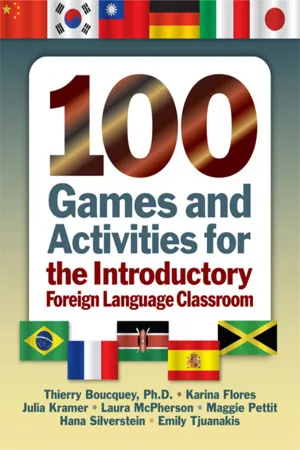
100 Games and Activities for the Introductory Foreign Language Classroom
- 160 pages
- English
- ePUB (mobile friendly)
- Available on iOS & Android
eBook - ePub
100 Games and Activities for the Introductory Foreign Language Classroom
About this book
Stimulating, engaging, and effective, the games and activites in this book offer your students alternatives to learning by rote or performing drills. This book makes it easy for you to develop their linguistic functions through active learning. The specific skills and vocabulary taught in each game or activity is highlighted, as are the easy-to-follow instructions, helpful charts, worksheets and other visuals.
Information
1
Animals and Their Habitats

Animal Collage
Topic
♦ Animals and their habitats
♦ Verb to be (from)
Materials
♦ Plain white paper (1 sheet per student)
♦ crayons, pens, or markers
♦ A few large poster sketches of different animal habitats (rainforest, ocean, desert, forest, house, etc.)
♦ Tape
Objectives
To reinforce animal and habitat vocabulary through art while incorporating the verbs to be (from) or to live (in)
Instructions
Pass out pieces of plain white paper to the students. Ask them each to make a simple drawing of an animal, choosing from the animals they have studied in class. When the students are finished with their drawings, students individually come to the front of the room, hold up their drawings, and announce their animals and the habitats in which they live. For example, to use the verb to be (from), the student holds up the drawing of a frog and say, “The frog is from the rainforest.” After announcing this, the students tape their animals on the appropriate habitat poster. Continue until all the animals are in their appropriate habitats, creating a beautiful animal collage that can be displayed in the classroom or disassembled so the students can keep their animal drawings and label them.
Note
If there is not enough time for students to come up individually, call them up by habitat. For example, say, “All the animals of the ocean come to the front.” Then the students can still announce their animals but save time by not announcing the habitats.
Jungle Safari
Topic
♦ Animals
Materials
♦ Pictures of approximately five jungle animals
Objective
To learn about jungle animals
Instructions
Before class, tape the pictures in various places in the classroom. You are the tour guide and the students are tourists on this jungle safari. Lead them carefully around the room, as if stepping over vines and around trees, while the students try to spot the animals taped up around the room. Whenever they find a picture, the group circles it and repeats the animal’s name, making the total physical response (TPR) noises and associated movements.
Note
This can also be a desert safari, a mountain trek, a farm visit, and so on, depending on the target culture.
Sounds on the Farm
Topic
♦ Farm Animals and Their Sounds
Materials
♦ Animal cards (1 per student)
Objectives
To reinforce the farm animal sounds specific to the target culture and use animal vocabulary
Instructions
To create the animal cards, draw or print out small images of the animals, with many on each page and multiple copies of each animal. Cut the page(s) of animals so that each card has one animal on it. The perceived sounds of farm animals vary between languages and regions. Search the Internet for any target culture’s animal sounds that are unfamiliar.
After a lesson on farm animals and their sounds, pass out an animal card to each student. When the teacher asks, “What sounds do the farm animals make?” each student stands up and begins making the animal sound that corresponds to their animal. Students try to find their animal family by making their sound; for example, a chicken make its sound to find all the other chickens. When the animals have grouped into their families, the teacher tells the animals to stop making their sounds. The teacher asks each family one at a time, “What sound do you make? What animal are you?”
Examples
In our Spanish class, the students who received a rooster animal card made the sound, quiri quiri quiri, but each language had its own variation of the rooster sound: cock-a-doodle-doo (English), cocorico (French), kokekokkoo (Japanese), kickeriki (German), kukru:ku: (Hindi), kukelekuu (Flemish).
Note
Make sure the students keep their animal card hidden once they start making sounds so that they cannot cheat by showing it to the other students.
Trouble on the Animal Farm
Topic
♦ Animals
Objective
To gain an understanding of the types of animals found within a country that speaks the target language
Instructions
Have the students sit in a circle. Modeling the game Duck-Duck-Goose, students play either the part of an escaped animal or the farmer trying to corral the animal back to the farm. Choose a student to begin the game by standing up and choosing an escaped animal to play. Next, have the remaining seated students in the circle make that animal’s sound. After they have all made the sound, the animal begins to walk around the circle saying the animal name when touching a sitting student on the head. On reaching the student selected to be the farmer, the animal must then call out the name for farmer and make it back to the farmer’s seat in the circle without being tagged by the farmer. The student playing the farmer could also be a zoo keeper, rancher, explorer, or si...
Table of contents
- Cover
- Title Page
- Copyright Page
- Acknowledgments
- Contents
- Introduction
- 1 Animals and Their Habitats
- 2 Body Parts and Clothing
- 3 Colors and Numbers
- 4 Commands and Directions
- 5 Culture
- 6 Date and Time
- 7 Family and the Home
- 8 Food
- 9 Language
- 10 Personal Descriptions
- 11 Weather, Travel, and Geography
- 12 Review (Any Topic)
- Index
Trusted by 375,005 students
Access to over 1.5 million titles for a fair monthly price.
Study more efficiently using our study tools.
Frequently asked questions
Yes, you can cancel anytime from the Subscription tab in your account settings on the Perlego website. Your subscription will stay active until the end of your current billing period. Learn how to cancel your subscription
No, books cannot be downloaded as external files, such as PDFs, for use outside of Perlego. However, you can download books within the Perlego app for offline reading on mobile or tablet. Learn how to download books offline
Perlego offers two plans: Essential and Complete
- Essential is ideal for learners and professionals who enjoy exploring a wide range of subjects. Access the Essential Library with 800,000+ trusted titles and best-sellers across business, personal growth, and the humanities. Includes unlimited reading time and Standard Read Aloud voice.
- Complete: Perfect for advanced learners and researchers needing full, unrestricted access. Unlock 1.5M+ books across hundreds of subjects, including academic and specialized titles. The Complete Plan also includes advanced features like Premium Read Aloud and Research Assistant.
We are an online textbook subscription service, where you can get access to an entire online library for less than the price of a single book per month. With over 1.5 million books across 990+ topics, we’ve got you covered! Learn about our mission
Look out for the read-aloud symbol on your next book to see if you can listen to it. The read-aloud tool reads text aloud for you, highlighting the text as it is being read. You can pause it, speed it up and slow it down. Learn more about Read Aloud
Yes! You can use the Perlego app on both iOS and Android devices to read anytime, anywhere — even offline. Perfect for commutes or when you’re on the go.
Please note we cannot support devices running on iOS 13 and Android 7 or earlier. Learn more about using the app
Please note we cannot support devices running on iOS 13 and Android 7 or earlier. Learn more about using the app
Yes, you can access 100 Games and Activities for the Introductory Foreign Language Classroom by Thierry Boucquey,Laura E. McPherson,Laura McPherson in PDF and/or ePUB format, as well as other popular books in Education & Education General. We have over 1.5 million books available in our catalogue for you to explore.