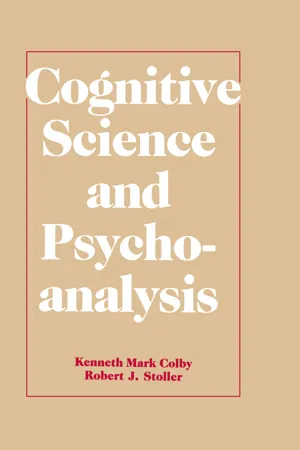
Exploring the connections between cognitive science and psychoanalysis, the authors indicate that a potentially fruitful relationship can exist between the two fields. The book examines this relationship, concluding that psychoanalysis can contribute to a science of the mind when it flows into a more effective science and technology such as cognitive science.
As viewed by the authors, cognitive science is "a new, lively field, full of novel concepts and methods about the mind." This is sharply contrasted with their opinion of psychoanalysis as a discipline which must change and consider such important problems in the study of the mind such as fantasies and feelings.
Colby and Stoller do not specify how psychoanalysis must evolve, but they do make suggestions for future research. They believe that they are "exercising the prerogative of tribal elders, pass(ing) the task along to the next generation."
- 176 pages
- English
- ePUB (mobile friendly)
- Available on iOS & Android
eBook - ePub
Cognitive Science and Psychoanalysis
About this book
Information
1
Introduction
S*: We wish, in this book, to think through some relations between two fields that are concerned with the mind–cognitive science and psychoanalysis. We intend to examine how they might be connected and contribute to one another.
To model something as complex as the mind, cognitive inquiry must use ideas of many fields, among others, psychoanalysis, because of its concern with feelings, fantasies, desires. To measure the gaps we must cross, consider our first words, “we wish.” One could write a history of each discipline in which the question of aims and desire was the crucial issue forming those disciplines; yet the two histories would almost never overlap.
We are biased. We view cognitive science as a new, promising, lively field, full of novel concepts and methods about the mind, whereas psychoanalysis is and thinks of itself (at least four days of the week) as being in the doldrums. In this volume, we examine that difference in enthusiasm to show why it exists, what its effects are, and what we guess the future might hold. In regard to the theory of psychoanalysis, we take the position that it is not, as often alleged, a totally dead duck. It stands as a label for a number of ideas about mind that have a history extending indefinitely into the past and a future extending indefinitely forward, the present label “psychoanalysis” dropping away while aspects of it continue to progress. Like other fields of inquiry, the concepts and ideas of psychoanalysis will become something different: new facts and ideas will produce new theories and models that will draw from, but not be identical with, aspects of classical psychoanalysis. Many psychoanalytic ideas are fruitless and will disappear. Others will have continuing value for a cognitive science that can improve, transform, or replace psychoanalytic theses. In this regard, we shall focus on the question, dear to psychoanalysts, whether psychoanalysis is a science.
In arguing that psychoanalysis is not a science, we shall show that few scholars studying this question get to the bottom of the issue. Instead, they start by accepting, as do psychoanalytic theorists, that the reports of what happens in psychoanalytic treatment–the primary source of the data–are factual, and then they lay out their interpretations of the significance of facts for theory. We, on the other hand, question the status of the facts.
We limit the dimensions of this study. First, we leave out much of what cognitive science and psychoanalysis are about, for example, how each performs its daily work or how their inquirers deal with computational systems or psychoanalytic patients. Second, we are concerned mainly with improving ways to model the mind, a conceptual rather than an empirical task. We side with Ziman (1978), who said:
The most sincere account that we can give of the attempt to build a science of human behavior… emphasizes ignorance rather than reliable knowledge. More specifically, however, to make a rational assessment of our ignorance on a particular topic-to identify enigmas and formulate consensible questions–is itself an important scientific activity, (p. 148)
Our purpose is not to discuss plans for inventing replicas of a person, such as a machine that learns, plays chess like a human, speaks, understands language, thinks, or desires. We are considering only computational models that will simulate aspects of mind sufficiently for us, by continuously improving the model, to understand more accurately how the mind works.
Grünbaum (1983, 1984), has in the last decade or more investigated the claims of psychoanalysis to be a science. He has examined these claims intensively from many angles: the pronouncements of Freud and his followers; whether psychoanalytic theories can ever be tested; whether data gathered in treatment can be used to do anything more than corroborate; the thesis (in disagreement with Popper, 1971) that some analytic ideas can be examined and refuted in the clinical situation; the efforts of experimentalists to verify psychoanalytic ideas; the hermeneuticists’ reformation; errors in the logic of psychoanalytic arguments.
We believe Grunbaum’s examination is more advanced> more sophisticated than psychoanalysis warrants. Grunbaum’s oversight is his generosity in accepting analysts’ claims that what they report as happening actually happened and only then battering the conclusions they derive therefrom. An example of his charitableness about the data is his disagreeing with Ricoeur (1974), who insists that “psychoanalysis does not satisfy the standards of the sciences of observation, and the ‘facts’ it deals with are not verifiable by multiple, independent observers.… There are no ‘facts’ nor any observation of ‘facts’ in psychoanalysis but rather the interpretation of a narrated history” (p. 186). (We, on the other hand, agree with Ricoeur, at least on this point that what is reported are “not facts.”)
When Grünbaum turns to discussing the data, he says that “‘clinical data’ are here construed as findings coming from within the psychoanalytic treatment sessions” (Laudan, 1983, p. 172). But “insofar as the credentials of psychoanalytic theory are currently held to rest on clinical findings, as most of its official spokesmen would have us believe, the dearth of acceptable and probatively cogent clinical data renders these credentials quite weak” (pp. 173-4). Our position is even more sharply negative: It is not the dearth of but the impossibility of getting inspectable observations agreed on by others that wrecks the scientific pretenses of psychoanalysis. The problem is not “that data from the couch ought to be discounted as being inadmissibly contaminated” by such effects as suggestibility (p. 175) but, even worse, that we can never know what the data from the couch are. Psychoanalytic evidence is hearsay, first when the patient reports his or her version of an experience and second when the analyst reports to an audience. Given that problem, the rest of Grunbaum’s arguments for and against psychoanalysis as science are premature if not superfluous.
Farrell (1981), on the other hand, is constantly alert to the flaw in “the material of the case.” For instance, regarding Freud, he says, “No notes are, or ever could be, anything like a full account of what happened. Reference to [his] posthumously published notes shows us that… they were to a large extent abstracts from and summaries of what happened” (p. 58). Or, “The impact which a patient makes on [an analyst] is typically so great and so immediate that it strikes him as absurd and downright ignorant to suggest that, in his reports, he is ‘doctoring’ or ‘filtering’ or ‘reconstructing’ what the patient is giving him” (p. 60). Or, “The [case] material is artefact-infected” (p. 129). (And we join those not thrilled by psychoanalysts’ claims that each psychoanalytic treatment is an experiment, as that word is used in science. We find it honorable enough–no mean contribution to knowledge–that a psychoanalysis can be an exploration, an intense observation of a unique human creature.)
We can only agree with Wallerstein (1986) that Ricoeur’s “‘confirmatory constellation,’ i.e. the criteria of coherence, of inner consistency, and of narrative intelligibility” (p. 421) can hardly a science make. However, Wallerstein, in his papers on psychoanalysis as science, does not use our criterion of reliable data as a sine qua non of science. Though we believe the vignettes that make up psychoanalytic case reports are myths and metaphors that may contain powerful truths, he is optimistic “that there is sufficient warrant” to believe that with their data analysts can be “loyal to the canons of objective scientific method” (p. 446). We prefer Peterfreund’s (1986) position: “I believe that if psychoanalysis is to be taken as a serious science and if its conclusions or findings are to be assigned any truth value, its practitioners will have to stop reporting without supporting evidence and without specifying the nature of the process that generated the findings claimed” (p. 132).
Let us say I experience a patient’s affect as intense. (And, for this example, let us put aside the problem that, were you there, you might interpret that affect not as “intense” but as “forced” or “histrionic” or as a substitute for another–hidden–affect.) Now, writing about it, I choose not “intense,” but “primitive” or “narcissistic”. Can you see how, out of your reach, I have shifted a clinical description to one that aims toward theory proving? Or insult concealed by scientific vocabulary? (“Homosexuals suffer from primitive affects such as narcissistic rage, which makes them borderline personalities.”)
Colby and I believe a whole other system of inquiry and testing is needed. Science is composed of many parts and processes that by themselves are not science. A hunch is not a science, nor is a guess, nor is an interpretation, nor is a reconstruction, nor even is a clue. A theory is not a science, nor are several theories, nor even a system of theories. A hypothesis is not a science, nor is a series of hypotheses. A model or constellation of models is not a science. Even when you link all those into one construction–”an explanatory edifice”–you do not have a science, though each is a part of science. For without the final ingredient-dependable, manipulable, shared data–you still may end up with a religion, an ethical system, one of the humanities, art criticism, a Weltanschauung, or a practice, such as astrology or alchemy. Psychoanalysis fails in the task of modeling the mind scientifically and has always failed since Freud wrote his first words. Our suggestion is that a scientific theory of mental activity lies instead in the direction of cognitive science.
We know how long it can take for an idea to have its effect. Here is Nagel in 1959 speaking to the deaf ears of psychoanalysts:
Although in the interview the analyst is supposedly a “passive” auditor of the “free association” narration by the subject, in point of fact the analyst does direct the course of the narrative. This by itself does not necessarily impair the evidential worth of the outcome, for even in the most meticulously conducted laboratory experiment the experimenter intervenes to obtain the data he is after. There is nevertheless the difficulty that in the nature of the case the full extent of the analyst’s intervention is not a matter that is open to public scrutiny, so that by and large one has only his own testimony as to what transpires in the consulting room. It is perhaps unnecessary to say that this is not a question about the personal integrity of psychoanalytic practitioners. The point is the fundamental one that no matter how firmly we may resolve to make explicit our biases, no human being is aware of all of them, and that objectivity in science is achieved through the criticism of publicly accessible material by a community of independent inquirers.… Moreover, unless data are obtained under carefully standardized circumstances, or under different circumstances whose dependence on known variables is nevertheless established, even an extensive collection of data is an unreliable basis for inference. To be sure, analysts apparently do attempt to institute standard conditions for the conduct of interviews. But there is not much information available on the extent to which the standardization is actually enforced, or whether it relates to more than what may be superficial matters, (pp. 49-50)
C: Cognitive science is the systematic inquiry into aspects of the human mind amenable to explanation by way of a computational analogy. William James (1890) took psychology to be the science of mental activity. In the first volume of his Principles, he opened with:
Psychology is the Science of Mental Life, both of its phenomena and their conditions. The phenomena are such things as we call feelings, desires, cognitions, reasonings, decisions and the like: and, superficially considered, their variety and complexity is such as to leave a chaotic impression on the observer.
Almost 100 years later, we still do not have a science of these phenomena. Psychoanalysis was a good try that failed, and behaviorism, suffering a mindless blindness to, and evasion of, the phenomena in question, did not try at all. Cognitive science contributes to a scientific psychology through the construction of computational models whose processes are assumed to be analogous to those unknown mental processes that produce and direct human behavior. The models satisfy a theory of the patterns or regularities of the phenomena. A theory is a system of concepts and hypotheses specifying the design of an ideal system intended to apply to real empirical systems.
The concepts and hypotheses of the theory stem from many sources, including the folk psychology used to describe the phenomena in everyday language terms. Another source is the two-millenia philosophy of mind, some of which Freud rewrote as psychoanalysis and tried to apply to clinical problems. Our position is that some “psychoanalytic” ideas are still live, programmable options for cognitive science, especially in instances of extreme deflection from the ideal mental system that come to the attention of the clinician.
S: It is the responsibility of writers to help their readers, either with explicit instructions or by indirection, to know how to read them. Let me therefore describe problems inherent in our making this book, in the hope that once manifest they will improve our chances of being understood.
Colby and I are different in personality. He has a scientist’s mind; I do not. I enjoy the clinical, especially practicing psychoanalysis as treatment; he has long since moved from there. He writes in a clear, impersonal, scientific style; I try to make my writing seem as if I were talking. I enjoy being unendingly immersed in psychoanalysis and even thrive on despairing of it. Colby attacks problems directly and pries them open with logic and vast knowledge, confident that in time the apparent muddle of mind-at-work will be transformed into specifiable rules; I think that, in time, he and those like him will do so but that I am not one of them: Colby loves chess and plays it well; I never even learned the rules.
So it is odd when two different types nonetheless find themselves in agreement. And when it comes time to write down our agreements–no more just sitting in the office and yelling enthusiastically at each other–problems in writing styles arise that must be resolved and at the same time not hidden, since the differences in style reflect differences in approach, content, and the weighing of significance. Can the two of us, then, maintain our individuality–it is part of the content of what we say–and not leave readers confused?
Our second big problem in the writing is our audience. If we write for cognitive scientists, then we each must pick a style and language that honors that audience; if we are talking primarily to psychoanalysts, we must speak in a different way. Yet both styles must convey the same main ideas. If we want to aim at both audiences, still other techniques of writing must be used. If we imagine there are others out there who deserve our concern–philosophers of science, psychologists, astrophysicists, chefs, bookbinders–then still other problems in writing must be solved. And the solutions are required at every moment, in the choice of each word and in the form of each sentence-With two such different people as Colby and me, and with even a minimum of two such different audiences as cognitive scientists and psychoanalysts, we certainly have our problems. So we use these few words now to keep our audience from being jarred by our disparities.
A final orientation. We make our choices on how and what to write with the idea that most of our readers will be cognitive scientists, philosophers of science, their students, and informed laymen.
We begin first with our views of what current cognitive inquiry is about and then fill out the above-mentioned claims about interfield relations between cognitive science and psychoanalysis.
Note
* When one of us has written a section, his initial will be attached; when both, both initials. But each author has edited every word and added a few of his own. In the case of impasse, the original writer wins.
2
Science and Cognitive Inquiry
Knowledge is that part of ignorance that we arrange and classify.
–A. Bierce
Science has a firm determination not to persist in error if any exertion of hand or mind can deliver us from it.
–Medawar
C: If we take the stand that psychoanalysis is not a science, we might then reasonably be asked, What is science? It is not so easy these days to say what science is.
Consider a few one-sentence textbook descriptions and prescriptions–Science is the systematic and rational study of nature. The aim of scientific inquiry is to solve problems set by scientific fields using scientific methods and principles of rationality. Scientific inquiry uses theories, observations, experiments, and measurements to arrive at and extend reliable knowledge about the world. Scientists deduce empirical consequences from hypotheses, and if such consequences are true, the hypotheses are accepted as true. Science involves metaphysics, theories, data, aims, and methods, all of which evolve over time.
More slogans. Science runs on consensibility (agreement about meanings of terms) and consensus regarding truth (Ziman, 1978). Science seeks to make true statements about the universe. Scientific knowledge accumulates and arrives at ever-closer approximations to reality. Scientific inquiry produces public records of information and opinion that a...
Table of contents
- Cover
- Title
- Copyright
- Acknowledgement
- Contents
- 1 INTRODUCTION
- 2 SCIENCE AND COGNITIVE INQUIRY
- 3 PRELIMINARIES
- 4 MERITS AND SHORTCOMINGS OF PSYCHOANALYSIS
- 5 OUR-SCIENCE: NO REPORTABLE DATA
- 6 OUR-SCIENCE: DATA ON THE ABSENCE OF DATA
- 7 OUR-SCIENCE: THE OBSERVING-INSTRUMENT
- 8 OUR-SCIENCE: THE TESTS ANALYSTS OFFER
- 9 FOLK PSYCHOLOGY
- 10 HOMUNCTIONALISM
- 11 HOMUNCULOSIS
- 12 COMPUTATIONAL PSYCHOLOGY
- 13 DEFLECTIONS
- 14 CONCLUSIONS
- REFERENCES
- INDEX
Trusted by 375,005 students
Access to over 1.5 million titles for a fair monthly price.
Study more efficiently using our study tools.
Frequently asked questions
Yes, you can cancel anytime from the Subscription tab in your account settings on the Perlego website. Your subscription will stay active until the end of your current billing period. Learn how to cancel your subscription
No, books cannot be downloaded as external files, such as PDFs, for use outside of Perlego. However, you can download books within the Perlego app for offline reading on mobile or tablet. Learn how to download books offline
Perlego offers two plans: Essential and Complete
- Essential is ideal for learners and professionals who enjoy exploring a wide range of subjects. Access the Essential Library with 800,000+ trusted titles and best-sellers across business, personal growth, and the humanities. Includes unlimited reading time and Standard Read Aloud voice.
- Complete: Perfect for advanced learners and researchers needing full, unrestricted access. Unlock 1.5M+ books across hundreds of subjects, including academic and specialized titles. The Complete Plan also includes advanced features like Premium Read Aloud and Research Assistant.
We are an online textbook subscription service, where you can get access to an entire online library for less than the price of a single book per month. With over 1.5 million books across 990+ topics, we’ve got you covered! Learn about our mission
Look out for the read-aloud symbol on your next book to see if you can listen to it. The read-aloud tool reads text aloud for you, highlighting the text as it is being read. You can pause it, speed it up and slow it down. Learn more about Read Aloud
Yes! You can use the Perlego app on both iOS and Android devices to read anytime, anywhere — even offline. Perfect for commutes or when you’re on the go.
Please note we cannot support devices running on iOS 13 and Android 7 or earlier. Learn more about using the app
Please note we cannot support devices running on iOS 13 and Android 7 or earlier. Learn more about using the app
Yes, you can access Cognitive Science and Psychoanalysis by Kenneth Mark Colby,Robert J. Stoller in PDF and/or ePUB format, as well as other popular books in Psychology & Clinical Psychology. We have over 1.5 million books available in our catalogue for you to explore.