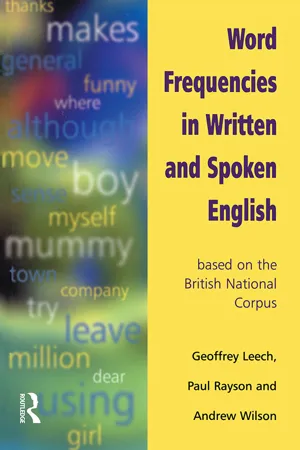
Word Frequencies in Written and Spoken English is a landmark volume in the development of vocabulary frequency studies. Whereas previous books have in general given frequency information about the written language only, this book provides information on both speech and writing. It not only gives information about the language as a whole, but also about the differences between spoken and written English, and between different spoken and written varieties of the language. The frequencies are derived from a wide ranging and up-to-date corpus of English: the British National Corpus, which was compiled from over 4,000 written texts and spoken transcriptions representing the present day language in the UK. The book is based on a new version of the corpus (available from 2001) providing more accurate grammatical information, which is essential (for example) for distinguishing words like leaves (noun) and leaves (verb) with different meanings. The book begins with a general introduction, explaining why such information is important and highlighting interesting linguistic findings that emerge from the statistical analysis of the British National Corpus vocabulary. It also contains twenty four 'interest boxes' which highlight and comment on different aspects of frequency - for example, the most common colour words in English in order of frequency, and a comparison of male words (e.g. man) and female words (e.g. woman) in terms of their frequency.
eBook - ePub
Word Frequencies in Written and Spoken English
based on the British National Corpus
- 320 pages
- English
- ePUB (mobile friendly)
- Available on iOS & Android
eBook - ePub
Word Frequencies in Written and Spoken English
based on the British National Corpus
About this book
Information
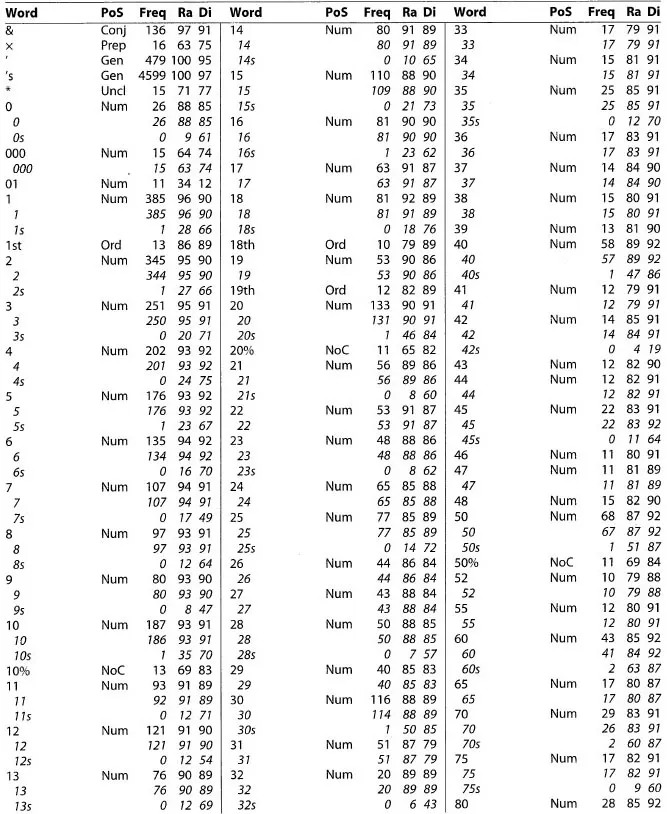
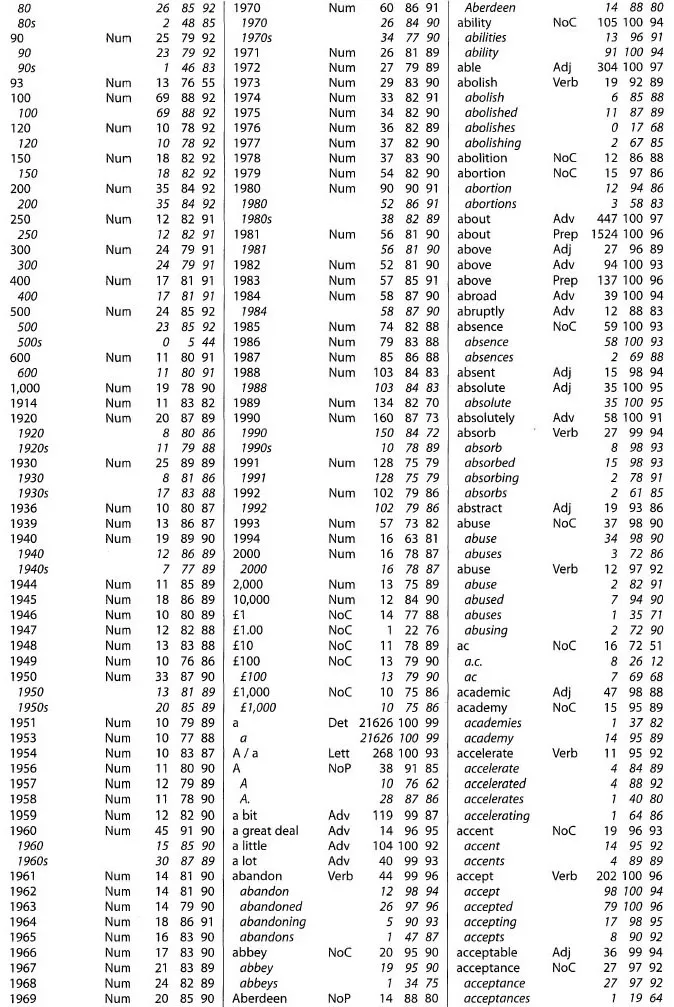
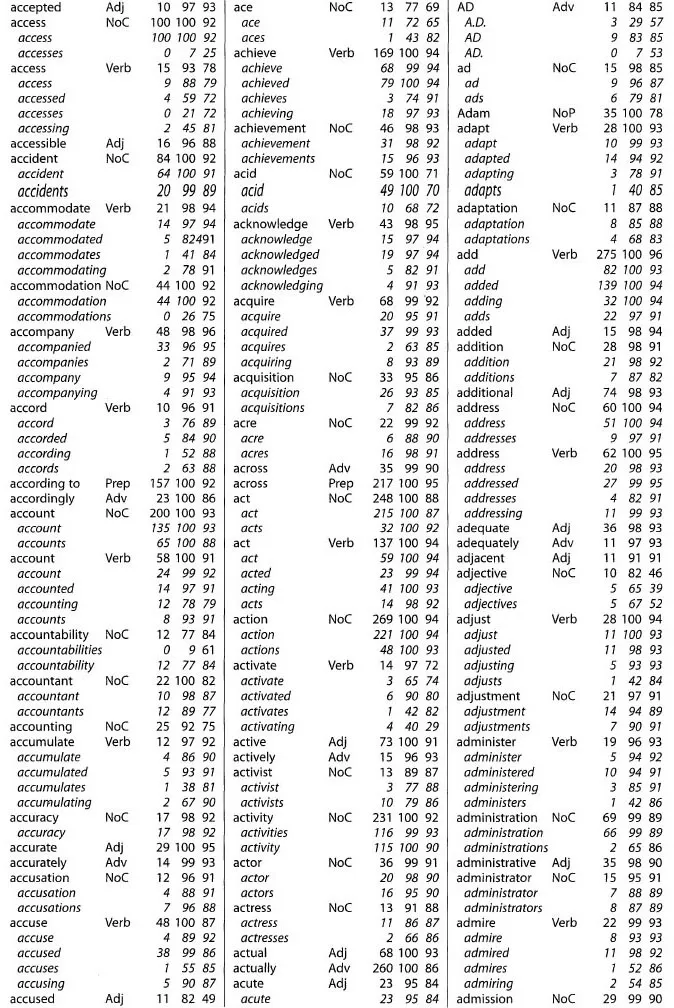
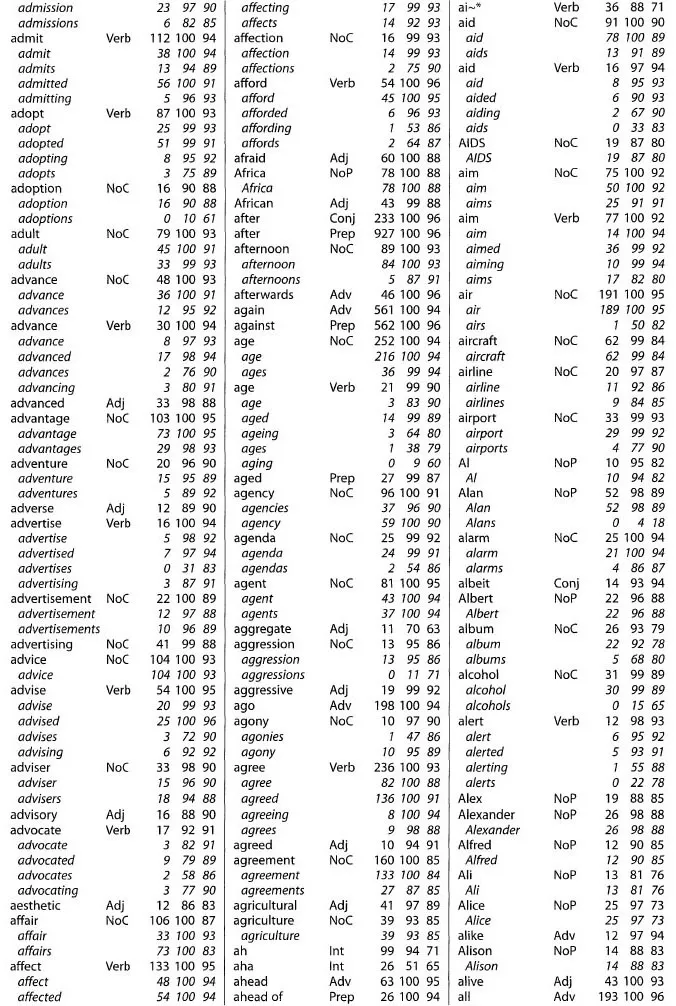
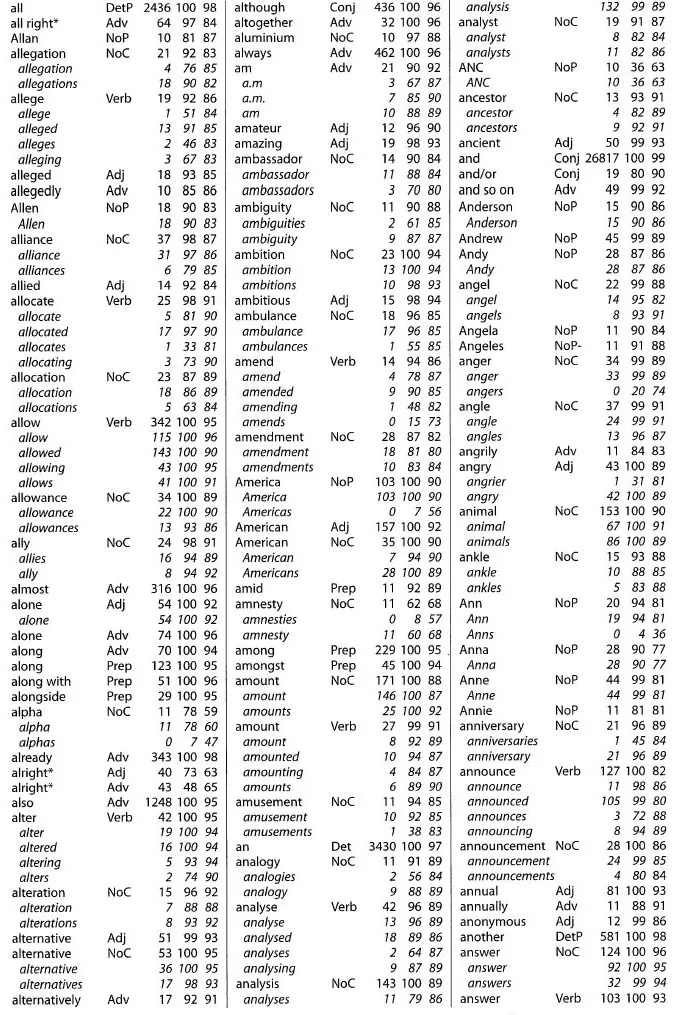
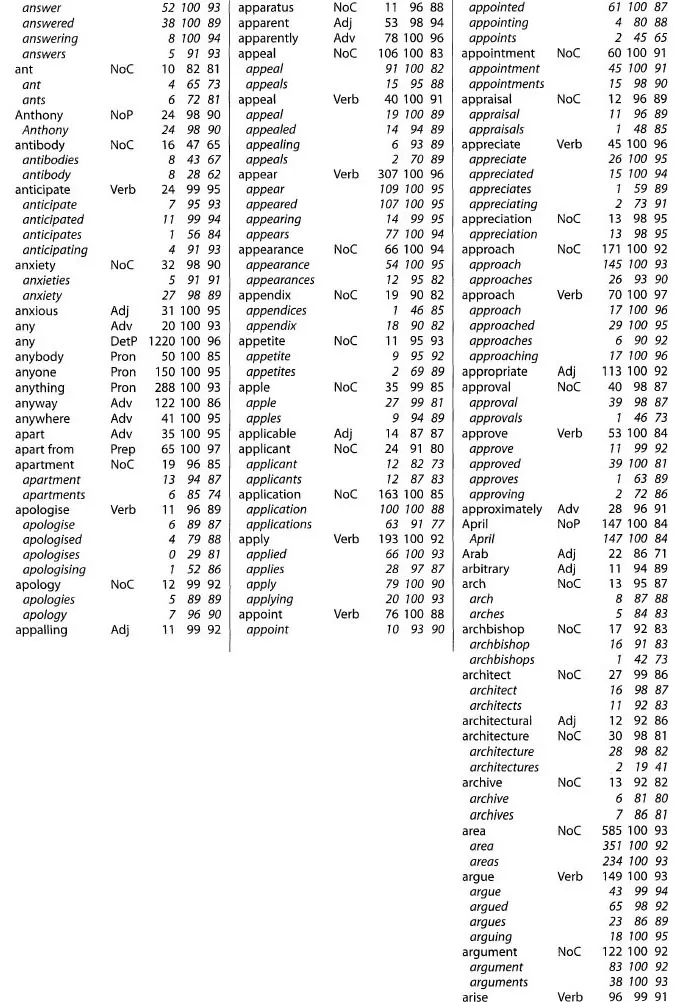
List 1.1. Alphabetical frequency list for the whole corpus (lemmatized)
Word | = | Word type (headword followed by any variant forms)—see pp. 4–5 |
PoS | = | Part of speech (grammatical word class)—see pp. 12–13 |
Freq | = | Rounded frequency per million word tokens (down to a minimum of 10 occurrences of a lemma per million)—see p. 5 |
Ra | = | Range: number of sectors of the corpus (out of a maximum of 100) in which the word occurs |
Di | = | Dispersion value (Juilland’s D) from a minimum of 0 to a maximum of 100. |
A selection of antonyms
Adjectives are often paired with another adjective as antonyms. The most common combination of antonyms is new (1154 per million) and old (648 per million), but in this case there is also a third term, young (379 per million) which contrasts with old when referring to living beings. Other common pairs of antonyms are (frequencies per million words):
good | 1276 | bad | 264 |
high | 574 | low | 286 |
large | 471 | small | 518 |
early | 353 | late | 302 |
long | 392 | short | 177 |
big | 338 | little | 306 |
full | 289 | ...
Table of contents
- Cover
- Half Title
- Title Page
- Copyright Page
- Table of Contents
- Symbols and abbreviations
- List of interest boxes
- Foreword
- Explanatory notes on words marked * in the lists
- Introduction
- 1. Frequencies in the Whole Corpus (Spoken and Written English)
- 2. Spoken and Written English
- 3. Two Main Varieties of Spoken English Compared
- 4. Two Main Varieties of Written English Compared
- 5. Rank Frequency Lists of Words within Word Classes (Parts of Speech)
- 6. Frequency Lists of Grammatical Word Classes (based on the Sampler Corpus)
Trusted by 375,005 students
Access to over 1.5 million titles for a fair monthly price.
Study more efficiently using our study tools.
Frequently asked questions
Yes, you can cancel anytime from the Subscription tab in your account settings on the Perlego website. Your subscription will stay active until the end of your current billing period. Learn how to cancel your subscription
No, books cannot be downloaded as external files, such as PDFs, for use outside of Perlego. However, you can download books within the Perlego app for offline reading on mobile or tablet. Learn how to download books offline
Perlego offers two plans: Essential and Complete
- Essential is ideal for learners and professionals who enjoy exploring a wide range of subjects. Access the Essential Library with 800,000+ trusted titles and best-sellers across business, personal growth, and the humanities. Includes unlimited reading time and Standard Read Aloud voice.
- Complete: Perfect for advanced learners and researchers needing full, unrestricted access. Unlock 1.5M+ books across hundreds of subjects, including academic and specialized titles. The Complete Plan also includes advanced features like Premium Read Aloud and Research Assistant.
We are an online textbook subscription service, where you can get access to an entire online library for less than the price of a single book per month. With over 1.5 million books across 990+ topics, we’ve got you covered! Learn about our mission
Look out for the read-aloud symbol on your next book to see if you can listen to it. The read-aloud tool reads text aloud for you, highlighting the text as it is being read. You can pause it, speed it up and slow it down. Learn more about Read Aloud
Yes! You can use the Perlego app on both iOS and Android devices to read anytime, anywhere — even offline. Perfect for commutes or when you’re on the go.
Please note we cannot support devices running on iOS 13 and Android 7 or earlier. Learn more about using the app
Please note we cannot support devices running on iOS 13 and Android 7 or earlier. Learn more about using the app
Yes, you can access Word Frequencies in Written and Spoken English by Geoffrey Leech,Paul Rayson,Andrew (All Of Lancaster University) Wilson in PDF and/or ePUB format, as well as other popular books in Personal Development & Linguistics. We have over 1.5 million books available in our catalogue for you to explore.