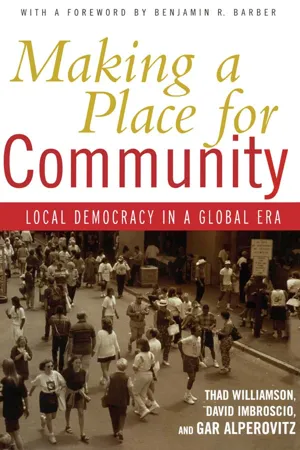
When pundits refer to the death of community, they are speaking of a number of social ills, which include, but are not limited to, the general increase in isolation and cynicism of our citizens, widespread concerns about declining political participation and membership in civic organizations, and periodic outbursts of small town violence. Making a Place for Community argues that this death of community is being caused by contemporary policies that, if not changed, will continue to foster the decline of community. Increased capital flow between nations is not at the root of the problem, however, increased capital flow within our nation is. Small towns shouldn't have to hope for a prison to open nearby and downtown centers shouldn't sit empty as suburban sparwl encroaches, but they do and it's a result of widely agreed upon public policies.
eBook - ePub
Making a Place for Community
Local Democracy in a Global Era
- 424 pages
- English
- ePUB (mobile friendly)
- Available on iOS & Android
eBook - ePub
Making a Place for Community
Local Democracy in a Global Era
About this book
Information
PART I
THE TRIPLE THREAT TO COMMUNITY AND DEMOCRACY
INTRODUCTION
part I spells out the nature of the triple threat to community and democracy in the United States. Chapter 1 discusses specific mechanisms by which the marriage of free trade ideology to an increasingly integrated global economy threatens the economic underpinnings of community and the possibility for substantial community-level democratic self-governance in the United States—the nation that according to conventional analysis has the most to gain from a globalizing economy. Chapter 2 focuses on the problem of internal capital mobility: Not only do most large-scale shifts in production from one community to another commonly result in social and economic waste, these shifts are actively encouraged by federal policy as well as state and local-level subsidies aimed at attracting mobile corporate capital. The ongoing “war between the states” for jobs is examined in some detail, and we explore possible remedies for the job-chasing phenomena (both short- and long-term). Chapter 3 examines the various ways in which suburban sprawl has impacted the health of American communities. In this chapter we also direct attention to the public policies that have contributed to the growth of sprawl and discuss specific approaches which could help contain or reverse outward, unplanned development.
Each of these problems are complex and daunting and worthy of full-length studies in themselves. Our aims are, first, to examine the main issues and mechanisms at stake, with particular reference to the impact of each on community economic stability and community democracy; and second, to offer an overview of how a range of leading analysts currently think about each issue. In the process, we attempt also to suggest a sense of the depth— indeed, the systemic roots—of each problem. Although the logic of each topic necessarily takes us into quite specific detail, we believe that understanding the impact of globalization, internal capital mobility, and sprawl on communities all point to a common conclusion: The need for a coherent, multi-faceted policy agenda aimed at stabilizing the economic basis of American communities.
CHAPTER 1
GLOBALIZATION AND FREE TRADE
perhaps the most widely discussed of the major threats facing American communities at the outset of the new century is globalization.
Debate about globalization—what it is, whether it represents something new or is just a continuation of past trends, who benefits from the process, and who loses—has produced a massive amount of literature in recent years, both in the popular press and within academia. It is not our goal here to provide a comprehensive review of each of the various strands of discussion. Rather, the following analysis is intended to serve as a primer on the issues globalization raises for the fundamental topic of this book: how to nurture, sustain, and enhance local community economic stability in the United States. In our view, the direct impact of globalization on community economic stability, though substantial, is as yet not nearly as severe as some activist critics on both the left and the right would imply. However, the current trajectory of globalization contains at least one very grave threat to the future of local community stability—namely, reduced legal capacity of localities to shape their own economic destinies. Describing this threat as well as several other related ways that globalization and international economic volatility may impact American communities is the primary task of this chapter. The discussion necessarily will also touch on other issues, including the link between global economic integration and international economic development and the role of multilateral financial institutions such as the World Bank and the IMF.
What exactly is globalization? How does it matter for communities? Very little academic research to date has focused, directly and explicitly, on the relationship between globalization and community economic security in the United States. Instead, discussion of these questions during the 1990s largely focused on two issues: the impact of increased trade and corporations' new global reach on wages and inequality in developed countries (especially the United States), and whether the globalization process is on balance a healthy development in terms not only of economic well-being but also of environmental and social concerns. The latter question has been the focal point of an often polemical three-way debate among activists and journalists portraying globalization as a uniquely harmful development in world affairs, economists and a handful of serious journalists who insist that the costs of globalization have been overstated and are in any case outbalanced by the purported benefits of an increasingly integrated world economy, and those who argue that both the positive and negative effects of globalization have been overblown and that the chief obstacles to more equitable, egalitarian, social-democratic-style economic policies remain in the realm of domestic politics, not in a shifting global environment.
What effect does the process of economic integration have upon local-level communities?
It is often assumed in popular discussion that increased globalization means that economic activity either no longer is nor can in the future be tied to particular communities. If this were the case, the agenda of this book— stabilizing economic activity in local communities—would face a markedly uphill battle, even if the political obstacles to forwarding a place-respecting agenda could be overcome. But this is not the case. In fact, more economic activity in the United States economy is now inherently local—at the same time that more economic activity is tied to trade and global economic activities.
We can begin to grasp this paradox by considering the countless professions and services that remain almost entirely unaffected by international trade in any direct sense: think of carpenters, doctors, schoolteachers, plumbers, local government employees, gardeners, custodial workers, barbers, and construction workers. Economist Thomas Michael Power of the University of Montana calculates that “[A] bout 60 percent of U.S. economic activity is local and provides residents with the goods and services that make their lives comfortable. … Almost all local economies are dominated by residents taking in each others wash.”1 Moreover, this figure has steadily increased, not decreased, in the postwar era, largely due to growth in retail and wholesale sales, services, financial and real estate, and state and local government as a percentage of all economic activity.2
Using a different estimation technique, Wim Wiewel and Joseph Persky found that during the 1980s, the proportion of economic activity within communities aimed at serving local markets actually increased in the forty-five American metropolitan areas (MSAs) with population greater than 1 million (as of 1989). Whereas in 1969 42.6 percent of economic activity was local in these MSAs, that proportion rose to 45.3 percent in 1979 and 49.2 percent in 1989. That increase is due to the “deindustrialization of urban areas, a steady expansion of local consumer services, and the considerable growth of the local public and health sectors.” Wiewel and Persky add, “The economies of large metropolitan areas in the United States are now more locally oriented than ever.”3
This is the case even though, as Wiewel and Persky acknowledge, some types of services—in particular, producer services, services that meet the needs of businesses—became more tradable over the course of the 1980s. The upward change in services traded outside the locality, however, is more than offset by the baseline increase in services and decline in manufacturing. Wiewel and Persky stress that, in fact, “large cities have long been centers of service employment. The manufacturing city, that strained product of late-nineteenth-century transportation and production technologies, is perhaps more of an historical anomaly than the standard.”4 While follow-up studies to Wiewel and Persky s analysis need to be undertaken, their logic strongly suggests that in all likelihood urban economies continued to become more local in the 1990s as manufacturing continued to decline—even though the percentage of service activity traded outside the locality also very probably increased over the decade. The growing exposure to global trade thus has occurred in tandem with an increase in the degree to which economic activity in the United States has become more localized.
It is thus fair to ask whether the stakes in the free trade debate may have been exaggerated by free trade advocates—-even as the negative economic effects of globalization upon American workers and communities may also have been overstated by some activist critics. Only 12.2 percent—less than one-eighth—of the goods and services produced in the United States in 1999 were sold abroad.5 As Robert Dunn Jr. of George Washington University writes, Americans “should not believe that further trade liberalization will either produce large increases in U.S. incomes or impose large costs on American unskilled workers. U.S. trade restrictions have already been reduced to such low levels that there is not much more to either accomplish or fear in this area.”6 Indeed, a recent rough estimate by Dean Baker of the Center for Economic Policy Research suggests that removing all remaining tariff barriers in the United States would generate at most a $10 billion net gain in aggregate economic welfare—in a $10-trillion-plus economy7 From the perspective of this study, the larger point is that the economic loss from reasonable restraints on trade adopted in the interest of sustaining community economies would also not be cataclysmic—and might be a price worth paying in order to nurture democratic self-governance. Given the impact of economic dislocations on community and on community democracy, there is much to the judgment offered by political scientist John Dryzek: “Irrespective of any positive economic benefits of free trade (and even these may appear only in the aggregate, at the expense of large losses to particular categories of people), almost all the implications for democratic control are negative.”8
CAPITAL MOBILITY AND THE CRISIS OF FREE
TRADE IDEOLOGY: THE THEORETICAL CRITIQUE
The conventional theoretical argument for free trade holds that free mobility of goods across borders permits each country to specialize in areas of “comparative advantage,” resulting in increased welfare for all. The nineteenth-century classical economist David Ricardo put it this way: “Two men can both make shoes and hats and one is superior to the other in both employments; but in making hats he can only exceed his competitor by one-fifth or 20 percent, and in making shoes he can exceed him by one-third or 33 percent. Will it not be for the interest of both that the superior man should employ himself exclusively in making shoes and the inferior man in making hats?”9
Adherence to Ricardo s doctrine of comparative advantage has led many economists to suggest that barriers to trade protecting inefficient local industries are economically foolish and would impose welfare costs on consumers. However, the simple translation of nineteenth-century insights from Ricardo into blind support for free trade ignores how dramatically the world has changed—and in particular, it ignores the mobility of capital. Former World Bank economist Herman Daly and coauthor John Cobb drove this point home with considerable force in their 1989 book For the Common Good by carefully examining Ricardo's paradigmatic example of trade between England and Portugal. Ricardo posited a situation in which England required 100 workers to produce a given amount of cloth and 120 workers to produce a given amount of wine, whereas in Portugal cloth could be produced with 90 workers and wine with only 80 workers. Ricardo noted that by concentrating all its production in wine, Portugal could actually end up with more cloth (via trade with England) than it could if it shifted some of its production to cloth—even though Portuguese production of cloth was more efficient than English production.
Daly and Cobb offered the following striking observation about Ricardo s story: As Ricardo himself noted, the comparative advantage principle works only because capital is assumed not to move across borders. Given free, relatively costless mobility of capital between England and Portugal, English capitalists could profitably choose to produce both cloth and wine in Portugal, making use of the absolute advantage enjoyed by Portugal in both goods (and creating massive unemployment in England). Indeed, if capital were totally mobile, there would be no reason in this example for it to remain in England, since both wine and cloth could be produced more cheaply abroad. Ricardo did not have to worry seriously about this possibility, believing that for various reasons capitalists were reluctant to move abroad: “These feelings, which I should be sorry to see weakened, induce most men of property to be satisfied with a low rate of profits in their own country, rather than seek a more advantageous employment for their wealth in foreign nations.”10
Daly and Cobb thus reach the ironic conclusion that were Ricardo, the apostle of free trade, alive today, he would not be a free trader—or, at least, not nearly so unambiguous about the benefits of comparative advantage as its advocates of today. Simply put, the world today is one in which the input of capital can be and is moved across borders; “trade” does not consist simply of different countries' capitalists competing in product markets on the basis of comparative advantage. Rather, investments are regularly made across borders as capitalists seek not only comparative but absolute advantage. When they do so, as Ricardo understood, they weaken the home economy. Indeed, a world of unrestrained capital mobility and free trade in product markets logically implies either heavy unemployment in higher-cost, higher-wage nations or a sharp reduction in wages in such nations so that they can remain competitive. To be sure, as we discuss in Chapter 2, we do not yet live in a world of truly seamless capital mobility—not all forms of capital are completely mobile and footloose. But capital mobility ...
Table of contents
- Cover
- Half Title
- Title Page
- Copyright Page
- Table of Contents
- Acknowledgments
- Foreword
- Preface Toward the Reconstruction of American Community and Democracy
- Introduction The Case for Community Economic Stability: Economics and Political Economics
- Part I The Triple Threat to Community and Democracy
- Part II Place-Based Policy Alternatives
- Part III Place-Based Economic Structures
- Part IV The Global Context
- Conclusion Political-Economic Policies for the Next Stage of Democratic Development
- Appendix Resources for Rebuilding
- Notes
- Index
Trusted by 375,005 students
Access to over 1.5 million titles for a fair monthly price.
Study more efficiently using our study tools.
Frequently asked questions
Yes, you can cancel anytime from the Subscription tab in your account settings on the Perlego website. Your subscription will stay active until the end of your current billing period. Learn how to cancel your subscription
No, books cannot be downloaded as external files, such as PDFs, for use outside of Perlego. However, you can download books within the Perlego app for offline reading on mobile or tablet. Learn how to download books offline
Perlego offers two plans: Essential and Complete
- Essential is ideal for learners and professionals who enjoy exploring a wide range of subjects. Access the Essential Library with 800,000+ trusted titles and best-sellers across business, personal growth, and the humanities. Includes unlimited reading time and Standard Read Aloud voice.
- Complete: Perfect for advanced learners and researchers needing full, unrestricted access. Unlock 1.5M+ books across hundreds of subjects, including academic and specialized titles. The Complete Plan also includes advanced features like Premium Read Aloud and Research Assistant.
We are an online textbook subscription service, where you can get access to an entire online library for less than the price of a single book per month. With over 1.5 million books across 990+ topics, we’ve got you covered! Learn about our mission
Look out for the read-aloud symbol on your next book to see if you can listen to it. The read-aloud tool reads text aloud for you, highlighting the text as it is being read. You can pause it, speed it up and slow it down. Learn more about Read Aloud
Yes! You can use the Perlego app on both iOS and Android devices to read anytime, anywhere — even offline. Perfect for commutes or when you’re on the go.
Please note we cannot support devices running on iOS 13 and Android 7 or earlier. Learn more about using the app
Please note we cannot support devices running on iOS 13 and Android 7 or earlier. Learn more about using the app
Yes, you can access Making a Place for Community by Thad Williamson,David Imbroscio,Gar Alperovitz in PDF and/or ePUB format, as well as other popular books in Politics & International Relations & Development Economics. We have over 1.5 million books available in our catalogue for you to explore.