Philosophers and therapists have long theorised about how psychological mechanisms for love, jealousy, anxiety, depression and many other human characteristics may have evolved over millions of years. In the dawn of the new insights on evolution, provided by Darwin's theories of natural selection, Freud, Jung and Klein sought to identify and understand human motives, emotions and information processing as functions deeply-rooted in our evolved history. Despite this promising start and major developments in modern evolutionary psychology, anthropology and sociobiology, the last fifty years has seen little in the way of therapies derived from an evolutionary understanding of human psychology. The contributors to this timely book illuminate how an evolution focused approach to psychopathology can offer new insights for different schools of therapy and provide a rationale for therapeutic integration.
Genes on the Couch brings together respected clinicians who have integrated evolutionary insights into their case conceptualisations and therapeutic interventions. Various psychotherapy schools are represented, and each author provides illustrative examples of the interventions used. Specific topics addressed include the nature of evolved mental mechanisms; regulation/dysregulation of internal processes; attachment and kinship in therapy; the importance of internalising warmth as a therapeutic goal; kin selection and incest avoidance; co-operation and deception in social relations; difficulties in working with certain male clients; gender differences in therapy and the roles of shame and guilt in treatment.
Providing up-to-date summaries of recent thinking in this increasing important but diverse area, Genes on the Couch will be of interest to psychotherapists, psychiatrists and a wide range of mental health professionals.
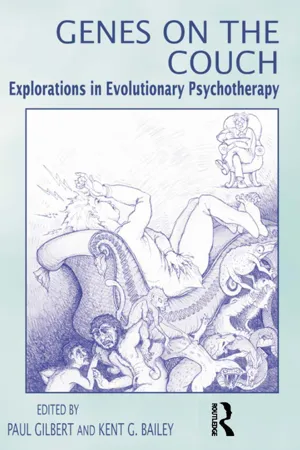
eBook - ePub
Genes on the Couch
Explorations in Evolutionary Psychotherapy
- 376 pages
- English
- ePUB (mobile friendly)
- Available on iOS & Android
eBook - ePub
Genes on the Couch
Explorations in Evolutionary Psychotherapy
About this book
Information
Evolutionary Psychotherapies
4
Evolutionary Psychoanalysis
Toward an adaptive, biological perspective on the clinical process in psychoanalytic psychotherapy1
Daniel Kriegman
This chapter takes a somewhat provocative position in response to the fact that psychoanalysis has lost much of its popularity with the general public and especially with evolutionary biologists. There are many reasons for this decline. An unfortunate one is the increasing ‘medicination’ of modern societies’ responses to psychological problems. Part of the loss of popularity that psychoanalysis has suffered, however, is well deserved, as psychoanalysts have developed some rather fanciful metapsychological notions that have then been reified (Holt, 1989). Claims that these notions are based on ‘objective’ clinical ‘facts’ that only analysts and their patients have access to have contributed to the ridicule that has been directed at psychoanalysis for being unfalsifiable (Popper, 1963) or for having no more of an objective base than religions or the Loch Ness monster (Torrey, 1992; Masson, 1990; Eysenck, 1972; cf. Kriegman & Solomon, 1985b; Bornstein & Masling, 1994). In essence, we are told by such critics that the psychoanalyst is wearing clothes that only the emperor and his court can see. Furthermore, there is evidence of damage that can be caused when analysts insist that their patients don this imaginary clothing.
Yet, an enormous amount of effort, work, clinical data, and careful study of the human psyche has occurred in the psychoanalytic field. Before we empty the enormous quantity of dirty bathwater, wouldn’t we be wise to make a search to see if there is a baby in it? Not only would I suggest that we will find a living baby, I would also suggest that the baby has nearly drowned and is in desperate need of evolutionary biological resuscitation. Let us turn now to look at how evolutionary biology may be applied to psychoanalysis for this purpose. We can do this by first asking the question: how should we act as part of our patient’s environment to have maximal impact as a therapeutic agent?
The classical, Freudian model
In the classical psychoanalytic model, Freud envisioned a central organizing agent, the ego, at the heart of a tripartite psychological system. The ego has to manage pressures that cause it to experience three different types of anxiety. These pressures emanate from the other two parts of the psyche, the id (causing instinctual anxiety) and the superego (causing moral anxiety), as well as from reality (causing realistic anxiety). The ego is forced to engage in compromise operations – namely, the defence mechanisms which operate largely unconsciously using repression as their primary tool – in order to manage these powerful, conflicting pressures. The analyst’s goal is to make the ego aware of its predicament and its defensive system of compromise operations. Without such awareness (insight), the ego blindly repeats self-destructive and useless actions. If aspects of this system can be brought within the ego’s awareness, then new, more productive compromises can be arranged. Because instincts (wishes, desires) conflict with both social pressures and realistic dangers, they must be repressed and thus comprise the largest part of the unconscious forces operating on the ego. The goal is to enable the unconscious instincts to enter consciousness sufficiently so that the ego can better master the compromise solutions it must manage while maximizing the adaptive expression of one’s desires and wishes. In treatment, this is accomplished through interpretations in which the analyst – after listening very carefully to the patient’s free associations – informs the patient about what is really going on, i.e., what unconscious mental processes and impulses are the true motives and intentions behind the patient’s self-deceptive conscious experience. In the Freudian interpretations that evolutionists are fond of ridiculing, patients are told some of the most blatantly absurd things about their psyches, their intentions, and their motives (Daly & Wilson, 1990; Kriegman & Slavin, 1989; cf. Slavin & Kriegman, 1992). But more of this later.
The technique Freud eventually settled upon for uncovering the unconscious was the basic rule. The basic rule consists of the patient communicating everything he or she becomes aware of without any form of censorship. Freud then began to notice the tremendous difficulty patients had in acknowledging a whole range of feelings they had about the therapist and certain topics. Some of the most difficult of these were angry critical feelings, shameful sexual and aggressive wishes, disappointment, longings to be cared about, longings to be treated as special, etc. When strongly encouraged to talk about everything including these terribly embarrassing and frightening feelings without censorship in a relationship that consisted of four to five regular meetings every week, the patient began to have a strange experience. The therapist took on a role unlike that of any other person in the patient’s life. Given the normal constraints of human life, no one is ever allowed into (or makes the investment of time and attention necessary to enter) another’s inner experience to such a great degree. No one – not even our closest relatives and lovers – gets to hear everything. No one gets a chance to come this close to stepping inside of our shoes and seeing what it is really like to have our own unique experience.
The power of a relationship as the therapeutic agent for insight, change, and growth
Freud then noticed that the intense relationship that formed was coloured by unique factors in each patient’s circumstances. Each intense relationship that developed was different while each had a reliable internal consistency. As the relationship became the central vehicle of the treatment, the unique colorations and the stable patterns of relating they engendered were termed ‘transference’. Psychoanalysis became transference analysis. Since that time, almost all innovations in psychoanalytic theory and technique have been comprised of new theories about human relatedness (Greenberg & Mitchell, 1983). For example, current psychoanalytic theory is far less dominated by symbolic sexual interpretations. There is now far more focus on the meaning of relatedness, the therapist’s role in the relationship, and other relational issues. But all too often, psychoanalytic treatment – operating outside of the context of a valid scientific view of human nature – is now dominated by strained, at times untenable, interpretations about relationships.
Evolutionary basis of sociality
We know that humans are extremely social creatures, possibly the most social creatures of all. We know that humans are the most neotanized species with the longest period of childhood dependency in close kin environments. Finally, it is clear that the explosive growth of the human brain had little to do with technology; the human brain developed into its current form long before complex technological innovation occurred. The human brain developed as a powerful social ‘computer’ that evolved to deal with the incredible complexity of kin and reciprocal relatedness and conflict in a relatively reliable tribal web of social connections. This complex task provided the selective pressure that led to the evolution of our empathic capacity (Kriegman, 1988, 1990). An in-depth sense of another’s experience gives us a foundation for predicting the other’s behaviour (What will they do? Are they reliable?) and for sensing both how and when to try to influence others. Our psyches appear to be complicated social computers designed to comprehend complex mental states (largely through the use of empathic perception) in order to navigate through a complex sea of intratribal conflict and mutuality that occurs in a larger context of intertribal conflict (Kriegman & Kriegman, 1997).
What an irony it is that some academic, behavioural, evolutionary psychologists and biopsychiatrists actually attempt to ‘turn off’ this marvellous device! Academic psychologists claiming that only their approach safeguards objectivity eschew the attempt to perceive complex mental states through empathy/introspection and try to replace it with complicated, numerical, statistical analyses of isolated bits of behaviour (see Kriegman, 1996a, 1998a for fuller discussions of this problem). Some behaviourists continue to insist that human experience is an epiphenomenon that can be ignored in the study of actions (behaviour). Modern biopsychiatrists not only increasingly question the usefulness of engaging in a long-term empathic exploration of the meaning of another’s experience, they can go much further and – sometimes without considering the value or meaning of such experience in an individual’s life – attempt to chemically ‘adjust’ experience by shutting down troublesome parts of it or by ‘turning up the volume’ on other parts. In their own attempt to ground their new discipline in science and to separate it from the ‘touchyfeely’, quasi-religious ways in which many view psychotherapy – and especially psychoanalysis, for some of the reasons outlined above – some evolutionary psychologists have relegated these powerful tools (the therapeutic relationship and the empathic immersion in another’s experience) to the periphery of psychotherapy. (Although there are other evolutionists who are attempting to integrate empathic understanding with adaptive analyses, e.g., Bailey, Wood & Nava, 1992.)
If the view of the human psyche that I am suggesting is correct, from an evolutionary–psychoanalytic viewpoint, intentionally ignoring the data obtainable through the use of the most sophisticated and exquisite perceptual device ever produced – the human empathic capacity that may be our most impressive evolutionary achievement – seems like a highly misguided strategy. In addition, the failure to tap into the power of the relationship when dealing with such a fundamentally relational creature is potentially quite limiting. In general, relationships and their quality are central in human psychological functioning. Kohut (1984) referred to the impact of certain crucial elements of human relatedness on the psyche as the equivalent of oxygen’s importance to the body. Humans in solitary confinement often go insane. The greatest threat – possibly even greater than death itself – is to be shamed, to be cut off from the tribe. The greatest cause of suicide in physically healthy people is shame and hopelessness about being loved, accepted, and/or respected. Disrespect, as in ‘are you dissin’ me?’ and ‘road rage’ can often lead to deadly confrontations.
Thus, evolutionary biology suggests that the most powerful tool in shaping and reshaping human experience and behaviour is powerful, intimate, and involving relationships. Unfortunately, most psychotherapies, including some evolutionary approaches, either forgo the exploitation of this potent intervention or try to use its power to manipulate the patient in a manner that the therapist determines is in the patient’s best interests. That is, some evolutionary therapists intentionally attempt to ignore the relationship altogether and focus instead on identifying maladaptive patterns of behaviour in order to use an evolutionary understanding to educate and guide the patient. At other times, they intentionally attempt to manipulate the patient using the relationship and the authority the therapist claims for having a truer, more accurate evolutionary understanding of the patient’s psychological and social world.
This latter trend is reminiscent of authoritarian psychoanalytic ‘treatments’ in which ‘resistant’ patients were told the truth about their psyche by the psychoanalyst who knew what was ‘really’ going on. If evolutionary biology teaches us anything, however, it should teach us that views of reality are highly likely to represent the actual world accurately only when it is in the best interest of the organism to have such an accurate view, i.e., when a rock is hurtling towards one’s head. When we are dealing with social reality, the notion that the human mind is designed to see things accurately is naive indeed (Trivers, 1976; cf. Kriegman, 1996a, 1998a). It is thus extremely dangerous for a therapist of any persuasion to assume that they can see accurately what is best for another better than the other can. After all, the evolved psyche is an ‘organ’ for representing and promoting one’s own interests conceptually (knowledge, beliefs), emotionally, and behaviourally. The notion that therapists’ psyches (which were designed to view reality in a manner that maximizes their interests) can generally represent patients’ interests more accurately than patients’ psyches (which were designed to do the same for the patients and their interests) is completely out of sync with an evolutionary view. Evolutionary biology suggests that – unless this outcome is carefully guarded against – judgements of what is best for another are highly likely to be in the judger’s best interests. This may explain much of the problem that was faced by authoritarian psychoanalysis. It would be a terrible mistake to replace one such flawed system with a new evolutionary ‘authority’.
The use of the extraordinary power of an intensive analytic relationship has fallen into disrepute because of what has occurred when psychoanalysts have tried to use it while operating with misleading biological suppositions – suppositions that range from the partially correct, through the naive and wrong, to the absurd – about the aims and goals of human psychological functioning, that is, assumptions about human nature2. It is partly in response to the shady history of relationship-focused psychotherapy, that some non-analytic, evolutionary psychotherapies tend to limit the use of the relationship to teaching, advising, manipulating (to convince, inspire, motivate, urge), and suggesting strategies for action, etc. Meanwhile, psychoanalysis has continued to try to utilize the empathic mode of data gathering in order to tap deeply into an unusually involving and powerful human relationship. For some troubled individuals, herein lies both their greatest hope and gravest danger.
Evolutionary biology as a guide to theory and practice
We can apply evolutionary biology to psychoanalysis in two major ways. First, we can use the evolutionary perspective to help us with our theoretical understanding of the human psyche. Ideas that are inconsistent with what we know about the evolution of all mammalian behaviour must be questioned at least, and in most cases discarded. Second, and more importantly for clinicians, these evolutionary perspective modifications and clarifications of analytic theory have direct implications for a theory of clinical practice, especially if we attempt to construct and enter into the intimate human relationships that may provide the most powerful vehicles for therapeutic change. One overriding principle of evolution is that each of us is designed to operate in the best interest of our own genetic material. Psychoanalysis is a relationship between two unrelated individuals in which, to a great extent, the therapist has enormous power over the patient. Evolutionary theory tells us that it is likely that such power will be used to further the best interests of the one who holds the larger share of power (the therapist) and that the pursuit of such interests may sel...
Table of contents
- Cover Page
- Half Title page
- Title Page
- Copyright Page
- Contents
- List of Contributors
- Acknowledgements
- Section I Theory and Principles
- Section II Evolutionary Psychotherapies
- Section III Special Issues
- Section IV Overview and Concluding Comments
- Author Index
- Subject Index
Trusted by 375,005 students
Access to over 1.5 million titles for a fair monthly price.
Study more efficiently using our study tools.
Frequently asked questions
Yes, you can cancel anytime from the Subscription tab in your account settings on the Perlego website. Your subscription will stay active until the end of your current billing period. Learn how to cancel your subscription
No, books cannot be downloaded as external files, such as PDFs, for use outside of Perlego. However, you can download books within the Perlego app for offline reading on mobile or tablet. Learn how to download books offline
Perlego offers two plans: Essential and Complete
- Essential is ideal for learners and professionals who enjoy exploring a wide range of subjects. Access the Essential Library with 800,000+ trusted titles and best-sellers across business, personal growth, and the humanities. Includes unlimited reading time and Standard Read Aloud voice.
- Complete: Perfect for advanced learners and researchers needing full, unrestricted access. Unlock 1.5M+ books across hundreds of subjects, including academic and specialized titles. The Complete Plan also includes advanced features like Premium Read Aloud and Research Assistant.
We are an online textbook subscription service, where you can get access to an entire online library for less than the price of a single book per month. With over 1.5 million books across 990+ topics, we’ve got you covered! Learn about our mission
Look out for the read-aloud symbol on your next book to see if you can listen to it. The read-aloud tool reads text aloud for you, highlighting the text as it is being read. You can pause it, speed it up and slow it down. Learn more about Read Aloud
Yes! You can use the Perlego app on both iOS and Android devices to read anytime, anywhere — even offline. Perfect for commutes or when you’re on the go.
Please note we cannot support devices running on iOS 13 and Android 7 or earlier. Learn more about using the app
Please note we cannot support devices running on iOS 13 and Android 7 or earlier. Learn more about using the app
Yes, you can access Genes on the Couch by Paul Gilbert, Kent G. Bailey, Paul Gilbert,Kent G. Bailey in PDF and/or ePUB format, as well as other popular books in Psychology & Mental Health in Psychology. We have over 1.5 million books available in our catalogue for you to explore.