eBook - ePub
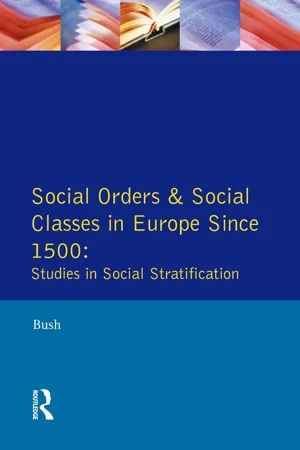
Social Orders and Social Classes in Europe Since 1500
Studies in Social Stratification
- 276 pages
- English
- ePUB (mobile friendly)
- Available on iOS & Android
eBook - ePub
About this book
This pioneering survey evaluates the notions of class and order throughout European history since 1500. After a general theoretical section on the concept of orders and class, the book provides discussions and case studies of the nobility, the clergy, the middle classes and the rural and urban proletariat. The studies are drawn from all over Europe, from early modern Castile to late Tsarist Russia. Contributors include Peter Burke, Stuart Woolf, A A Thompson and Joseph Bergin.
CHAPTER ONE
The language of orders in early modern Europe
Peter Burke
University of Cambridge
Une hiérarchie sociale, après tout, est-elle jamais autre chose qu’un système de représentations collectives, par nature mobiles? (Marc Bloch)
It was in 1966 and 1967 that two rival conferences on the subject of social stratification were held in Paris and Saint-Cloud, organised respectively by Roland Mousnier and Ernest Labrousse. Labrousse concentrated on orders and classes, Mousnier included castes as well.1 However, as in the case of industrialisation, coming later has its advantages. Today, a discussion on the subject of orders can make use of some first-rate studies published since 1967, notably Georges Duby’s well-known book Les Trois Ordres, particularly interesting on the political context in which the idea was formulated, and an important (if less celebrated) study of ‘priests warriors and peasants’ by Ottavia Niccoli.2
More important still, we can take advantage of a shift in the theory of social stratification over the last generation, a linguistic turn which involves taking the creativity of language and metaphor more seriously than used to be the case. Instead of viewing language as a mere ‘reflection’ of social reality, recent sociological and anthropological theory stresses the role of images, models (or ‘collective representations’, as Durkheim called them) in constituting the social order they purport to describe. It is for this reason that any critique of the concept of ‘order’ needs to be introduced by some reflections on the history of the concept, and on the intellectual package of which it forms a part.
It may be useful to tell this story backwards. One might begin with a book recently published by Ernest Gellner, Plough, Sword and Book, a brilliant discussion of the structure of world history, in terms of the division of labour between production, coercion and cognition. However, like the celebrated Indo-Europeanist the late Georges Dumézil, Gellner is concerned more with the three functions than with the particular social groups who perform them.3
Hence a more useful point at which to start may be the work of Roland Mousnier, who has devoted so much of his life to arguing that the old regime in general and France in particular must be seen as a ‘society of orders’, as distinct from one of classes or castes.4 This chapter makes a number of criticisms of Mousnier. Today he is in danger of becoming a historiographical villain or, at any rate, an Aunt Sally, so it may be worth saying, before going any further, that Mousnier’s argument about orders has had the great virtue of forcing us all to clarify our ideas about old regime society.
Mousnier has two main sources of inspiration: seventeenth-century lawyers, notably Charles Loyseau, and twentieth-century sociologists, notably Bernard Barber (whose study, Social Stratification, had itself drawn on Mousnier’s work in its brief discussion of ‘Estate Society’), but going back behind him to the functionalist school of Talcott Parsons and behind Parsons to Emile Durkheim.5
Parsons and his followers accepted the essential contrast between two types of social structure, class society and estate society (Ständische Gesellschaft), offered by German sociologists, notably Max Weber and Ferdinand Tönnies, in the years around 1900. In class society, so the theory goes, social opportunities are determined by the market; that is status and power follow wealth. In estate society, on the other hand, wealth and power follow status; social opportunities are determined by style of life, social estimation or ‘status honour’ (Ständische Ehre).6 Unlike classes, Stände are communities with legal definitions and legal privileges. Here as elsewhere in Weber’s work (the debate over protestantism and capitalism, for example) we can see him reacting to – and to some extent against – the ideas of Marx, in this case not so much turning them on their head as limiting the area in which they apply.
In the German-speaking world, historians such as Otto Hintze and Otto Brunner drew on this sociological theory of estate society decades before Mousnier. Hintze, for example, neatly defined estate society as a society based on the principle of inequality before the law.7 This domestication of sociology by German historians was all the easier because the sociologists concerned had themselves drawn on an earlier generation of legal and administrative historians. Max Weber was a man of an extraordinarily wide historical culture, concealed by his antipathy towards footnotes. Particularly important for him was the German tradition of legal history, although he adapted this tradition to his own purposes. A name which recurs in Weber’s Economy and Society is that of Gierke.
It was Otto von Gierke who coined the phrase ‘estates constitution’ (Ständische Verfassung). He thought of estates and corporations in organic terms as moral or legal personalities with their own Ständesgeist, in other words esprit de corps.8 Gierke was a leading member of the so-called ‘historical school of law’, a group whose ‘organic’ view of society and the state was formulated in conscious reaction against the ‘mechanical’ and rationalist views which they associated with the Enlightenment, individualism, utilitarianism, political economy and capitalism.9
In their reaction against these tendencies, the conservatives revived (or better, appropriated and transformed) the social vocabulary of the old regime, notably the idea that society is divided into ‘orders’ or ‘estates’ each of which performs a necessary function. A key figure in this reaction was the Prussian Freiherr von Stein. Stein stressed the division of the German people into ‘corporations’ including the three estates of nobility, citizens and peasants, and argued that ‘each estate has its own sense of honour’ (Jeder Stand hatte seine Ehre).10
In early modern Europe, as is well known, the traditional tripartite image of society continued to be employed, despite the fact that the nobility did less and less fighting, while the protestants, from Luther onwards, denied that the clergy formed a separate estate. At the beginning of the period, Dudley’s Tree of Commonwealth, written c.1509, divided the commonwealth into ‘clergy, chivalry and commonalty’.11 At the end of the period, in the year of the French Revolution, the abbé Sieyès devoted a polemical pamphlet to a vindication of the third estate and a critique of the other two.12 The model was employed in eastern as well as in western Europe. The Kronika polska of Stryjkowski (published in 1582) explained the origin of the three estates in terms of division of labour among the sons of Noah. The descendants of Sem pray, the descendants of Japhet fight, and the descendants of Ham work.13 The image took visual as well as literary forms, such as the early-sixteenth-century German woodcut showing the tree of the estates, peasants at the bottom, pope and kings at the top; or the prints published at the beginning of the French Revolution showing the first and second estates riding on the back of the third.14
In the Middle Ages, from the time of King Alfred onwards, it became increasingly common to divide society into those who prayed, fought or worked the land – orant, pugnant, laborant. 15 Georges Duby has described in detail the political and social context of this model, introduced into France in the eleventh century by bishop Adalberon and others. However, the idea that society is divided into three main groups goes back much further in European or even Indo-European history.
In Rome, the term ordo meant something like ‘social group’ and was used to refer to senators, equestrians and plebs. Incidentally, Charles Loyseau was well aware of this fact and his treatise on orders discusses ancient Rome in detail as well as modern France. Behind Rome, we find the Greeks. Plato distinguished philosophers, soldiers and workmen, arguing that each of these groups corresponded to one of our three faculties – reason, anger and appetite. Behind Plato, we find ancient India. In the ancient Indian Laws of Manu, those who pray, the Brahmins, are placed first; those who fight, the Kshatriyas, come next; then come the Vaisyas and Sudras, who engage in trade and husbandry respectively. Four groups (or varna) instead of three, but the parallel is clear.16 We should not forget what the Greeks owed to the culture of ancient India.17
We must be careful not to make the tripartite image appear more clear or sharp in the minds of contemporaries than it actually was.
In the first place, the model was normative rather than purely descriptive, at least for some of its users. It was recognised that actual social groupings might conflict with this model, but these anomalies were condemned on occasion: witness the fourteenth-century English sermon in which the preacher declared that ‘God made the clergy, knights and labourers, but the devil made the burghers and usurers’.18 The quotation illustrates not only the hostility to moneylending common among the friars, but also Mary Douglas’s well-known generalisation that we perceive whatever...
Table of contents
- Cover
- Half Title
- Title Page
- Copyright Page
- Table of Contents
- Preface
- 1 The language of orders in early modern Europe Peter Burke
- 2 The concept of class William M. Reddy
- 3 An anatomy of nobility M.L. Bush
- 4 Between estate and profession: the clergy in Imperial Russia Gregory L. Freeze
- 5 Between estate and profession: the Catholic parish clergy of early modern western Europe Joseph Bergin
- 6 The middle classes in late Tsarist Russia Charles E. Timberlake
- 7 From 'middling sort' to middle class in late eighteenthand early nineteenth-century England John Seed
- 8 Tenant right and the peasantries of Europe under the old regime M.L. Bush
- 9 Deferential bitterness: the social outlook of the rural proletariat in eighteenth- and nineteenth-century England and Wales K.D.M. Snell
- 10 Order, class and the urban poor Stuart Woolf
- 11 A people and a class: industrial workers and the social order in nineteenth-century England Patrick Joyce
- 12 Myths of order and ordering myths William Doyle
- 13 Class and historical explanation Huw Beynon
- Suggestions for further reading
- Notes on contributors
- Index
Trusted by 375,005 students
Access to over 1.5 million titles for a fair monthly price.
Study more efficiently using our study tools.
Frequently asked questions
Yes, you can cancel anytime from the Subscription tab in your account settings on the Perlego website. Your subscription will stay active until the end of your current billing period. Learn how to cancel your subscription
No, books cannot be downloaded as external files, such as PDFs, for use outside of Perlego. However, you can download books within the Perlego app for offline reading on mobile or tablet. Learn how to download books offline
Perlego offers two plans: Essential and Complete
- Essential is ideal for learners and professionals who enjoy exploring a wide range of subjects. Access the Essential Library with 800,000+ trusted titles and best-sellers across business, personal growth, and the humanities. Includes unlimited reading time and Standard Read Aloud voice.
- Complete: Perfect for advanced learners and researchers needing full, unrestricted access. Unlock 1.5M+ books across hundreds of subjects, including academic and specialized titles. The Complete Plan also includes advanced features like Premium Read Aloud and Research Assistant.
We are an online textbook subscription service, where you can get access to an entire online library for less than the price of a single book per month. With over 1.5 million books across 990+ topics, we’ve got you covered! Learn about our mission
Look out for the read-aloud symbol on your next book to see if you can listen to it. The read-aloud tool reads text aloud for you, highlighting the text as it is being read. You can pause it, speed it up and slow it down. Learn more about Read Aloud
Yes! You can use the Perlego app on both iOS and Android devices to read anytime, anywhere — even offline. Perfect for commutes or when you’re on the go.
Please note we cannot support devices running on iOS 13 and Android 7 or earlier. Learn more about using the app
Please note we cannot support devices running on iOS 13 and Android 7 or earlier. Learn more about using the app
Yes, you can access Social Orders and Social Classes in Europe Since 1500 by M. L. Bush in PDF and/or ePUB format, as well as other popular books in History & European History. We have over 1.5 million books available in our catalogue for you to explore.