eBook - ePub
The Social Economy of Single Motherhood
Raising Children in Rural America
- 272 pages
- English
- ePUB (mobile friendly)
- Available on iOS & Android
eBook - ePub
About this book
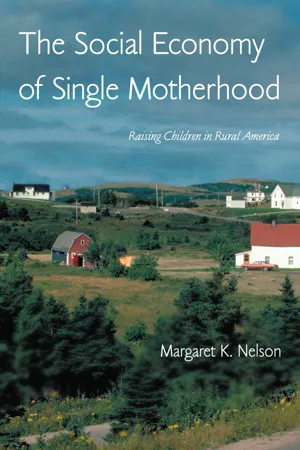
Margaret Nelson investigates the lives of single, working-class mothers in this compelling and timely book. Through personal interviews, she uncovers the different challenges that mothers and their children face in small town America--a place greatly changed over the past fifty years as factory work has dried up and national chains like Walmart have moved in.
Information
1
THE CONTEXT OF SINGLE MOTHERS' LIVES1
THE MATERIAL WORLD
When I attended summer camp in Vermont as a child, one of the facts I knew about the place I came to love was that it held within its borders more cows than people. While that is no longer the case—Vermont now boasts slightly more people than cows—the rural image still prevails.2 A “Made in Vermont” label sells products because it reminds us of a long lost way of life—of “intact” families roused by the rooster; of men, women, and children getting breakfast on the table and putting hay in the stalls; of waits for the yellow school bus; of maple syrup; of barn-studded fields; of white churches in valleys; and of rolling hills leading to green mountains.3
If the school buses, churches, valleys, fields, hills, and mountains of Vermont remain, there are now fewer cows and barns, and contemporary families are more likely to be getting children to day care and making their way to offices, factories, and stores than they are to be making maple syrup or feeding the cows. As was the case in many rural areas, Vermont went through a round of industrialization in the second half of the twentieth century which by the 1970s resulted in a greater portion of the labor force being employed in manufacturing than in agriculture. As was also the case in many rural areas, Vermont then went through a round of deindustrialization whereby those new manufacturing jobs were replaced by jobs in the service sector.4 As a result of that restructuring, the distribution of Vermont's labor force mirrors that of the U.S. labor force as a whole, with few jobs in agriculture, forestry, fishing, hunting, and mining (Vermont, 3%, United States, 1.9%); few jobs in manufacturing (Vermont, 15.1%, United States, 14.1%); and many service jobs (Vermont, 44.5%, United States, 42%).5 For many this change has yielded far less predictable employment and a far less secure financial position than was possible in 1980.
Women in the Vermont Economy
Employment Options
Women's jobs are distributed differently from those of men in the Vermont economy of the early twenty-first century: As is the case for women everywhere, service jobs of all types are the single most common industry category followed (at some distance) by trade. Together, these two industries account for almost two-thirds (60.9%) of Vermont's female labor force, as opposed to less than half—45.6 percent—of the male labor force, 73 percent of employed single mothers in the state, and 86 percent of the employed women in this study.6
Although these are generally low-paying industries in Vermont, as they are everywhere, Vermont women are “lucky” relative to women in other states insofar as their earnings are high in comparison with those of their male counterparts. In 2001, among those who worked full-time, Vermont women's median weekly earnings ($509) were 82 percent of men's earnings ($622); in the United States as a whole, women's median weekly earnings ($511) were 76 percent of men's earnings ($672).7 But, as these figures suggest, Vermont's wages are low: In 2001 Vermont workers had, on average, wages that were 83 percent of the national median.8
Single mothers in Vermont, like those elsewhere, work hard to earn these wages. Although employment outside the home is the modal experience for all mothers, single mothers in Vermont now slightly exceed married mothers both in their rates of labor force participation (84% vs. 80%) and among those who are employed in the hours they devote to paid work (an average of 33 hours per week vs. an average of 30 hours per week). The comparable figures in the United States are labor force participation rates of 81.4 percent for single mothers versus 73.2 percent for married mothers and work weeks of 33.9 hours for single mothers versus 33.7 hours for married mothers.9
Single mothers also have to work hard simply to sustain their labor force involvement. With the exception of the unpaid provisions for family leaves offiered through the 1993 Family and Medical Leave Act, neither federal nor state provisions support the formation and continuation of family life. As a result, individual workers can only depend on the benefits their employers provide.10 Health insurance, paid vacations, and sick leave are crucial for all workers: Without these benefits, for all their best intentions, even married couples with children find it difficult to keep both adults employed.11 These difficulties are compounded for single parents because they cannot share the costs of employment or divide the penalties of missing work when they or their children are sick.12 Consider twenty-four-year-old, never married, Kitty Thompson. Now that her daughter is four years old, Kitty is employed full-time outside the home. But she explained that her attempts to join the labor force with a young child failed repeatedly:
I didn't [work steadily] when [my daughter] was really young. It was always every six months I would have to get a new job, because I would miss work too much because of her asthma, because of court [re. child support], or she was running a high fever and day care wouldn't take her. So that was a very big struggle for me.
Women who had steady employment when married indicated that their work/family conflicts intensified when they became single mothers and, in turn, gave rise to new reliance on their children and on others in their social networks.13 A recently divorced thirty-three-year-old mother of four sons ranging in age from six to thirteen, Melissa Henry leaves her children alone for an hour each morning as she sets off for work and she asks the older ones to help the younger ones get dressed and ready for the school bus; she also allows these children to return home to an empty house each afternoon, and she asks them to do more chores than they did before their father left. When she puts in overtime on Saturday mornings, Melissa leaves her children with family members and friends. Twenty-nine-year-old Anne Davenport's challenges are compounded by the young age of her children. When she was married Anne worked evenings at her commission-sales job, and, before his alcoholism rendered him unreliable, left her two preschool-age children in her husband's care. Once she separated from him, Anne struggled to come up with alternative appropriate arrangements: “[It's hard] getting used to not having somebody else there,” she explained.14
Kitty, Melissa, and Anne all want and need to work outside the home, and all of them feel the pinch between the demands of employment and the needs of their children. In Kitty's case, her child's needs briefly “won out” and she relied on welfare for a few years. In Melissa's case, a workbased strategy of survival sometimes jeopardizes her own conceptions of what it means to be a good mother to her children and it sometimes exacerbates her feelings of dependence on others. Anne experiences all of these problems: She now relies on welfare to supplement her income, which is reduced both because of her husband's absence and because she cannot now work as much as she did before her divorce; she sometimes worries about the competence of the teenagers with whom she leaves her sons when she goes to her evening job; and she finds herself calling on her parents far more oft en than she did when she was married.
Child Care and Transportation
For all of these women, as for their peers, finding and making adequate arrangements for child care are unending struggles.15 The increased labor force participation of all women, the rise in single-parent families, and the new stipulation that welfare recipients seek employment, have put enormous pressure on the existing supply of day care.16 Waiting lists, especially for very young children, can be as long as two years (by which time the children are no longer quite so young).17 Locating care poses special problems for a woman like Anne who does not work regular daytime hours, and for a woman like Melissa, who works most weekends.18 Women in these types of situations are likely to fall back on less formal arrangements. Susan Barrows, who is twenty-one and has never been married, may be exercising her preference for care by relatives when she leaves her two-year-old son with her parents as she goes off to her evening job as a waitress.19 But Susan has few other options and when she relies on her parents, she incurs another set of ongoing obligations.
The cost of child care compounds these difficulties. Day care expenses for one child can run to more than $400 per week.20 Some single mothers find, quite simply, that they cannot afford to work outside the home: Anne Davenport's good friend Joan Meyer, a mother of three children, said two years after her divorce, “I would like to be out working, but working for me is almost impossible because of the day care costs. And so I'm like in limbo.” Child care subsidies do exist for those who are poor, and in Vermont subsidies are available on a sliding scale for those with incomes below $31,031.21 These subsidies, however, rarely cover the full cost of care.22 And when women like Anne, Melissa, and Susan rely on teenagers, friends, and relatives to watch their children, the possibility of getting any state reimbursement is precluded.
If child care discussions peppered the conversations we had with single mothers, talk about transportation was oft en the main dish. It came up when the women talked about their criteria for acceptable jobs, which they wanted to be within easy commuting distance, and when they talked about getting young children to day care and older children to and from school and after-school activities. In short, transportation is a major hassle for single mothers regardless of their employment status, and like child care, it draws them into informal arrangements with, and frequently dependence on, others.23
Because there is virtually no public transportation in Vermont (outside of the more urban areas), there is no easy or inexpensive solution to this challenge. Transportation costs in Vermont can run to more than $250 a month, even though the overall cost of living in the state is comparatively low.24 Rural women also have to contend with the unpredictable expense of car repair, especially if they have old cars. Two women, each very recently separated from her partner, made specific reference to these troubles as having cast into disarray their efforts to survive in straitened circumstances: “My car got fixed last week and that was $145”; “Well, just a couple of months ago I had an $850 bill for new brakes and brake pads and stuff , so that really took a chunk out [of my budget].” Two other women, both newly off welfare assistance and trying to make ends meet in the absence of the grants offered by the state's welfare-to-work program (called Reach Up), also cited these expenses as the item most likely to disrupt their careful budgeting: “I needed money more than once [and] it all had to do with my car breaking down, money for repairs”; “I would like to have food stamps bu...
Table of contents
- Cover
- Half Title
- Title Page
- Copyright Page
- Dedication
- Table of Contents
- Acknowledgments
- Introduction
- Chapter 1 The Context of Single Mothers' Lives
- Chapter 2 Negotiating Reciprocity
- Chapter 3 Accounting for Welfare
- Chapter 4 Building and Rebuilding the Family
- Chapter 5 Falling in Love (Again)
- Conclusion
- Notes
- Bibliography
- Index
Trusted by 375,005 students
Access to over 1.5 million titles for a fair monthly price.
Study more efficiently using our study tools.
Frequently asked questions
Yes, you can cancel anytime from the Subscription tab in your account settings on the Perlego website. Your subscription will stay active until the end of your current billing period. Learn how to cancel your subscription
No, books cannot be downloaded as external files, such as PDFs, for use outside of Perlego. However, you can download books within the Perlego app for offline reading on mobile or tablet. Learn how to download books offline
Perlego offers two plans: Essential and Complete
- Essential is ideal for learners and professionals who enjoy exploring a wide range of subjects. Access the Essential Library with 800,000+ trusted titles and best-sellers across business, personal growth, and the humanities. Includes unlimited reading time and Standard Read Aloud voice.
- Complete: Perfect for advanced learners and researchers needing full, unrestricted access. Unlock 1.5M+ books across hundreds of subjects, including academic and specialized titles. The Complete Plan also includes advanced features like Premium Read Aloud and Research Assistant.
We are an online textbook subscription service, where you can get access to an entire online library for less than the price of a single book per month. With over 1.5 million books across 990+ topics, we’ve got you covered! Learn about our mission
Look out for the read-aloud symbol on your next book to see if you can listen to it. The read-aloud tool reads text aloud for you, highlighting the text as it is being read. You can pause it, speed it up and slow it down. Learn more about Read Aloud
Yes! You can use the Perlego app on both iOS and Android devices to read anytime, anywhere — even offline. Perfect for commutes or when you’re on the go.
Please note we cannot support devices running on iOS 13 and Android 7 or earlier. Learn more about using the app
Please note we cannot support devices running on iOS 13 and Android 7 or earlier. Learn more about using the app
Yes, you can access The Social Economy of Single Motherhood by Margaret Nelson in PDF and/or ePUB format, as well as other popular books in Social Sciences & Gender Studies. We have over 1.5 million books available in our catalogue for you to explore.