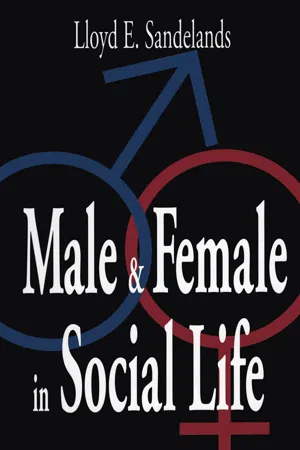
Sex is a theoretical puzzle because it is much older than we are. A primary fact of biology, sex has defined society from nearly the beginning of life on earth, and as a result we cannot see its effects in our lives in evolutionary comparisons with near primate or mammalian relatives. Sex is a puzzle, too, because it is often misconstrued in social science. It is not, as many social scientists believe, a mere feature of a person, like hair or skin color. Rather it is a part played in the life of the species. This propensity to view sex as a personal feature has kept social science from seeing how sex figures in the social life of the species. Male and Female in Social Life presents a theoretical framework to describe how sex (the division of our species between male and female) brings life and order to society. It argues that sex is the mainspring of social life and it tells us the most about social dynamics and forms. The book centers on five chapters that describe four "moments" of human social life. Following an introduction, chapter 2 begins with the first moment of social life - unity of the species. Chapter 3 examines the second moment of social life - division of the species. Chapter 4, citing play of the sexes as the third moment, shows that sex is the main play of the species and thereby the main basis of social life. Chapters 5 and 6 describe the fourth moment - order of the species, which includes the most basic arrangements of human society, including female mate choice, male contest, female care of the young, sorority and fraternity, family and bureaucratic organization. These later chapters present a threepart theory of social order based on the play of the sexes, while then offering evidence in support of this theory by showing how disruptions and distortions in the play of the sexes in the recent history of the United States have brought compensating changes in social life. The book concludes with a summary of the book's main points and with directions for further inquiry. The volume raises thoughtful, long overdue questions about current trends in our culture that minimize or efface sex differences. It will be of interest to academics both in the social sciences and in the humanities while at the same time appealing to a more general audience.
- 220 pages
- English
- ePUB (mobile friendly)
- Available on iOS & Android
eBook - ePub
Male and Female in Social Life
About this book
Information
1
Introduction
This book is about sex: about what sex means in our lives. This book tells an old story about males and females. Males compete to woo, females wait to choose. It is a story to describe the dynamics and the forms of our social lives. It is a story to describe why and how we play. It is a story to describe why and how we establish pair bonds, families, male and female groups, status hierarchies, and divisions of labor. It is a story to put at the center of a science of social life.
Images
Leave it to the immersed reflections of artists, rather than the sterile dissections of social scientists, to bring sex to light. Aristophanes tells Plato in ‘The Symposium” what love is: Love is the urge to reunite what Zeus tore asunder when he split a hermaphroditic human race into male and female halves.
And so, gentlemen, we are all like pieces of the coins that children break in half for keepsakes—making two out of one, like the flatfish—and each of us is forever seeking the half that will tally with himself. The man who is a slice of the hermaphrodite sex, as it was called, will naturally be attracted by women—the adulterer, for instance—and women who run after men are of similar descent—as, for instance, the unfaithful wife....
Now, supposing Hephaestus were to come and stand over them with his tool bag as they lay there side by side, and suppose he were to ask, Tell me, my dear creatures, what do you really want with one another? And suppose they didn’t know what to say, and he went on, How would you like to be rolled into one, so that you could always be together, day and night, and never be parted again? Because if that’s what you want, I can easily weld you together, and then you can live your two lives in one, and, when the time comes, you can die a common death and still be two-in-one in the lower world. Now, what do you say? Is that what you’d like me to do? And would you be happy if I did?
We may be sure, gentlemen, that no lover on earth would dream of refusing such an offer, for not one of them could imagine a happier fate. Indeed, they would be convinced that this was just what they’d been waiting for—to be merged, that is, into an utter oneness with the beloved.
And so all this to-do is a relic of that original state of ours, when we were whole, and now, when we are longing for and following after that primeval wholeness, we say we are in love. For there was a time, I repeat, when we were one, but now, for our sins, God has scattered us abroad, as the Spartans scattered the Arcadians. Moreover, gentlemen, there is every reason to fear that, if we neglect the worship of the gods, they will split us up again and then we shall have to go about with our noses sawed asunder, part and counterpart, like the basso-relievos on the tombstones. And therefore it is our duty one and all to inspire our friends with reverence and piety, for so we may ensure our safety and attain that blessed union by enlisting in the army of Love and marching beneath his banners....
But what I am trying to say is this—that the happiness of the whole human race, women no less than men, is to be found in the consummation of our love, and in the healing of our dissevered nature by finding each his proper mate. And if this be a counsel of perfection, then we must do what, in our present circumstances, is next best, and bestow our love upon the natures most congenial to our own.1
Aristophanes’ strange tale resonates to modem ears. We recall Zeus’ punishment when thinking our true love our better half. And remembering the original joy of the race, we feel whole in his/her arms.
James Brown, proclaimed “Godfather of Soul,” sings of a man’s world made for woman. In his hit song co-written with Betty Newsome titled “It’s a Man’s, Man’s, Man’s World” he finds that man struggles and strains not for himself but for woman’s love and the welfare of children. No woman, no life, no point.
This is a man’s world. This is a man’s world
But it wouldn’t mean nothing, nothing
Without a woman or a girl.
But it wouldn’t mean nothing, nothing
Without a woman or a girl.
You see, man made the cars
That take us over the road
Man made the train
To carry the heavy load
Man made the electric lights
To take us out of the dark
Man made the board for the water
Like Noah made the ark.
That take us over the road
Man made the train
To carry the heavy load
Man made the electric lights
To take us out of the dark
Man made the board for the water
Like Noah made the ark.
This is a man’s, man’s, man’s world
But it wouldn’t meaning nothing, nothing
Without a woman or a girl.
But it wouldn’t meaning nothing, nothing
Without a woman or a girl.
Man thinks about a little bitty baby girl
And a baby boy.
Man make them happy
Cause man made them toys
And after man make everything
Everything he can
And a baby boy.
Man make them happy
Cause man made them toys
And after man make everything
Everything he can
You know that man makes money
To buy from other man.
To buy from other man.
This is a man’s world,
But it wouldn’t mean nothing, nothing, not one little thing,
Without a woman or a girl.
But it wouldn’t mean nothing, nothing, not one little thing,
Without a woman or a girl.
He’s lost in the wilderness
He’s lost in bitterness
He’s lost, lost,...
He’s lost in bitterness
He’s lost, lost,...
And Thurber and White (1929) joke about an opposing current of change in women’s liberation that wastes away the differences that intrigue the sexes. They find modern man and woman comically stranded upon a barren island of sexual equality.
So matters went. Man, we have seen, had begun to develop himself so that he would be attractive to Woman, and in doing so had made Woman of doubtful attraction to him. He had become independent. He had become critical. He had become scared. Sex was awakening and it was all Man could do to keep from laughing.
Woman, on her part, saw dimly what was going on in the world. She saw it through the sweet haze of Dream. She caught glimpses of it in the mirror of her Narcissistic soul. Woman was at the crossroads. She had many ways open to her, but she chose one: she chose to imitate Man. At a time when sex was in transition, she had the bad judgment to begin a career of independence for herself, in direct imitation of her well-meaning mate. She took up smoking. She began to earn money (not much, but some). She drank. She subordinated domesticity to individuality—of which she had very little. She attained to a certain independence, a cringing independence, a wistful, half-regretful state. Men and women both became slightly regretful: men regretted that they had no purple tail to begin with, women that they had ever been fools enough to go to work. Women now “understood life,” but life had been so much more agreeable in its original mystery. (Pp. 99-100)
Here then are three images of sex in social life—images of the origins of love, of the meaning of life, and of the comedy of modernity. I take my cue from these and other images to look at social life through the focusing lens of sex. But in taking my cue I come to sex not as an artist concerned primarily for its feeling, but as a scientist concerned primarily with its structure and dynamism. I want to describe how sex defines our life together.
A Philosophical Challenge
Science seeks our social life in evolutionaiy comparisons, either to primates like us, such as the chimpanzee and baboon, or to homi-nid species more like us still. Such comparisons hint at sex’s role in social life.2 In sexual dimorphism (particularly the fact that males are generally larger and stronger than females) we imagine a basis for patriarchal society. In sex differences in reproductive strategy (particularly the fact that males compete for access to choosy females) we imagine a basis for male status-seeking and for female solidarity and social sensitivity. And in sex differences in reproductive investment (particularly the fact that females put more time and energy into offspring than males) we imagine a division of labor which orients males outside the group to tasks of hunting and defense and orients females inside the group to tasks of raising offspring and keeping peace.
I use the word “imagine” in talking about sex in social life because that is what we have to do. Our evolutionary comparisons do not reach back far enough to tell us about sex. Present almost from the beginning of life on earth, sex is far older than hominid, primate, or even mammalian phylogeny. Sex is so much a part of the fabric of life, and we are so removed from its origins and effects, that we strain to see its importance. Our evolutionary comparisons are not deep enough to find important differences and are not tuned to detect similarities. Our method thus blinds us to sex’s deep and abiding influence upon vertebrate, mammal, primate, and hominid life. We have come into the room late to hear the last few words of evolution’s epic tale, having long ago missed the crucial part about sex. Our challenge is philosophical. We need a framework of ideas to think about sex in human social life. With this book I seek such a framework.
Ernst Mayr (1991) called life “one long story.” It is one very long story. It is a story of the planet and indeed of the cosmos, a story with no discernible beginning and perhaps no end. Life grew from particular conditions of matter and energy. It is the tallest of tales—of cosmology, geology, chemistry, biology, anthropology, and psychology—of which we know only the barest outlines. We know that organic chemistry came with a soup of inorganic matter, temperature, and lightning. We know that the first living cells came with chains of simple proteins. We know that nucleated cells came with symbiosis of procaryotic cells. We know that sex came along as a variation on cellular reproduction. We know that frolicsome play took the field with mammals with brains that needed time to mature. And we know that self-dealing consciousness announced itself only with the veiy highest primates. This tale is too tall to tell in any single book. In this book, I tell a shorter story about how sex, one of evolution’s oldest and greatest innovations, plays out in human social life. Mine is not a typical story of evolution that describes the appearance of a particular life form in terms of its adaptive fitness relative to rival forms. Rather, it is a stoiy that describes how a single feature of our species life—sex—makes the dynamics and forms of our social life.
Compounding the philosophical challenge before us are two further facts of evolution that uniquely frustrate accounts of our social life. One is reflective consciousness. Unlike the social life of most animals, which can be traced to thoughtless biochemical processes, our social life is complicated by our thinking about it. We live among symbols and meanings that sometimes matter to us as much as our importuning bodies. Another, related to the first, is individuality. Our thinking takes a life of its own—a life of mind. Thinking for ourselves, we live as individuals unbeholden to the group or species. Thus, our humanity is twofold, made of two distinct orders of life—one of the species and expressed in sexual biology, the other of the individual and expressed in the free and lively use of ideas. Where an individual life develops, it is an alternative to species life. Reflective consciousness and individuality mean that our social life is not the genetically coded action pattern of other animal species (compare bees, or fish, or birds), but instead a series of games played by partly self-motivated players. Our social life is wildly more various and extensive. We enact innumerable games in which players play innumerable roles.3 This creates conflicts between species needs and individual wants that are unprecedented in the natural world. We are the only animal to think about, question, and sometimes refuse biology.
These two further facts of evolution make it difficult to parse and reconcile the contributions of biology and culture to our social life. Our social life has both a biological aspect evolved over tens if not hundreds of millions of years and a cultural aspect evolved over perhaps the last 2 or 3 million years, mainly the last 100,000 years with the rise of language, and acutely in the last 3,000 years of Western civilization. It is silly to say social life is fixed in the genes and therefore not in our power to modify. It is no less silly to say social life is but a moment of culture and therefore completely in our power to modify. Such assertions make good copy and invite raucous controversy for those spoiling for a fight, but add little insight. In this book I describe human social life as a play of biology that echoes in culture. I begin with and emphasize biology because that is the part of social life most shortchanged in our thinking today.
The Argument
This book builds upon two evolutionary principles, visible throughout the cosmos. One is growth through differentiation of form. Things grow by differentiation, by which the whole divides and disperses its activities to specializing parts, thereby enhancing its efficiency and welfare. A tree, for example, reaches as fully as possible into the sky above and ground below to take what it needs. An integral and balanced whole throughout, it grows by elaboration, as root divides from root, limb from limb, and branch from branch. The tree is the model par excellence of evolution—be it that culminating in the material diversity of the periodic table of elements, or the organic diversity of flora and fauna, or the psychic diversity of feeling and idea—which is why its image figures powerfully in our thinking about evolution. When we turn specifically to human evolution, we find sex an early and basic branching. The sexes are big limbs that divide the trunk of the species and that must balance to maintain the working integrity of the species. We should be grateful for the division and its differences. In division goes life—viva la differance.
A second evolutionary principle, related to the first, is involution of the whole in parts. Parts take on the character of the whole. This happens even while, and indeed because, parts branch from one another. In taking a definite place among the others, each part speaks for the whole. We tear a branch from a tree and find a model of the whole. The branch has its own life—it sprouts, grows, dies, and falls—but could not live but for its connection to the whole, on which it depends for root sustenance. In just this way, each of the sexes claims a separate existence and life while taking its place with its opposite in a sturdy unity of the species. As elementary divisions of the whole, the sexes require and anticipate each other. In each there is evidence of the other. In each there is a basis for the other. The sexes “know” how to relate because they have never not related. They “understand” one another at basic levels of design and function because they evolved as the design and function of a single organism.
These companion principles—of growth by differentiation and of involution of the whole in parts—attest to the main fact and sine qua non of evolution, that unity reigns throughout. From the big bang forward, from earliest cosmos to latest development of mind and culture, evolution has been one incomprehensibly massive detailing of the cosmos. Though we are pitifully imperfect observers, unable to keep hold of the whole, we can find it in the parts. In Wordsworth’s wonderful turn of phrase, despite our murderous dissections, there is in each part always “a brooding presence of the whole.”
I argue that sex—a fact far older than we—is the mainspring of our social life and the factor that tells us the most about its dynamics and forms. The basic forms of our social life—of female care of young, female mate choice, male competition and hierarchy, same-sex grouping, family, individual, and bureaucracy—enact a reproductive regime in which males come together to compete for access to females who come together to support male competition and to nurture young. Males scrap and claw to be superior in status hierarchies, but almost always according to rules of fair play known and abided by all. Females jostle for resources to conceive, harbor, give birth, nurse, and nurture offspring, usually while sharing responsibilities and load. Males enjoy the power of superior size and statusseeking ambition. Females enjoy the power of reproductive centrality and mate choice. Together the sexes define an unconscious logic of complementary capacities, orientations, and powers. This logic of sex, I argue, is also the logic of social life. Sex produces and reinforces social life, which redounds to produce and reinforce sex. Feminist critics of modem society are firmly put to say that men and women take their cues from an already formed social world. However, these critics are on shakier ground when they conclude on this basis that social arrangements are no more than cultured conventions.4
I state the argument that social life is sex boldly for two reasons. First, raised eyebrows invite conversation. Ideas advance by active questioning that airs differences. Second, putting the argument boldly makes clear the conditions for rejecting it. I make two testable claims: (1) sex is a precondition of human social life; and (2) the primary features of human social life—its dynamism and organization—are implied by the strategy a...
Table of contents
- Cover
- Half Title
- Title Page
- Copyright Page
- Acknowledgments
- Preface
- 1 Introduction
- 2 Unity
- 3 Division
- Again, Images
- A Singular Moment of One Long Story
- The Great Divide
- Unity in Difference
- 4 Play
- 5 Order
- 6 Pathos
- 7 Conclusion
- 8 Notes
- 9 References
- 10 Index
Trusted by 375,005 students
Access to over 1.5 million titles for a fair monthly price.
Study more efficiently using our study tools.
Frequently asked questions
Yes, you can cancel anytime from the Subscription tab in your account settings on the Perlego website. Your subscription will stay active until the end of your current billing period. Learn how to cancel your subscription
No, books cannot be downloaded as external files, such as PDFs, for use outside of Perlego. However, you can download books within the Perlego app for offline reading on mobile or tablet. Learn how to download books offline
Perlego offers two plans: Essential and Complete
- Essential is ideal for learners and professionals who enjoy exploring a wide range of subjects. Access the Essential Library with 800,000+ trusted titles and best-sellers across business, personal growth, and the humanities. Includes unlimited reading time and Standard Read Aloud voice.
- Complete: Perfect for advanced learners and researchers needing full, unrestricted access. Unlock 1.5M+ books across hundreds of subjects, including academic and specialized titles. The Complete Plan also includes advanced features like Premium Read Aloud and Research Assistant.
We are an online textbook subscription service, where you can get access to an entire online library for less than the price of a single book per month. With over 1.5 million books across 990+ topics, we’ve got you covered! Learn about our mission
Look out for the read-aloud symbol on your next book to see if you can listen to it. The read-aloud tool reads text aloud for you, highlighting the text as it is being read. You can pause it, speed it up and slow it down. Learn more about Read Aloud
Yes! You can use the Perlego app on both iOS and Android devices to read anytime, anywhere — even offline. Perfect for commutes or when you’re on the go.
Please note we cannot support devices running on iOS 13 and Android 7 or earlier. Learn more about using the app
Please note we cannot support devices running on iOS 13 and Android 7 or earlier. Learn more about using the app
Yes, you can access Male and Female in Social Life by Lloyd E. Sandelands in PDF and/or ePUB format, as well as other popular books in Social Sciences & Gender Studies. We have over 1.5 million books available in our catalogue for you to explore.