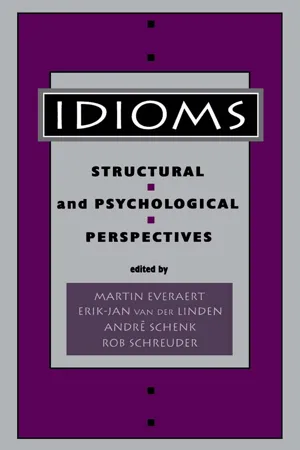
Idioms have always aroused the curiosity of linguists and there is a long tradition in the study of idioms, especially within the fields of lexicology and lexicography. Without denying the importance of this tradition, this volume presents an overview of recent idiom research outside the immediate domain of lexicology/lexicography. The chapters address the status of idioms in recent formal and experimental linguistic theorizing. Interdisciplinary in scope, the contributions are written by psycholinguists and theoretical and computational linguists who take mutual advantage of progress in all disciplines. Linguists supply the facts and analyses psycholinguists base their models and experiments on; psycholinguists in turn confront linguistic models with psycholinguistic findings. Computational linguists build natural language processing systems on the basis of models and frameworks provided by theoretical linguists and, sometimes psycholinguists, and set up large corpora to test linguistic hypotheses. Besides the fascination for idioms that make up such a large part of our knowledge of language, interdisciplinarity is one of the attractions of investigations in idiomatic language and language processing.
eBook - ePub
Idioms
Structural and Psychological Perspectives
- 336 pages
- English
- ePUB (mobile friendly)
- Available on iOS & Android
eBook - ePub
Idioms
Structural and Psychological Perspectives
About this book
Information
1 | The Flexibility of French Idioms: A Representation with Lexicalized Tree Adjoining Grammar |
SYNTAX AND SEMANTICS OF FRENCH IDIOMS
Numerous studies in linguistics and psycholinguistics have clearly established a continuum between idiomatic expressions and more literal ones as regards both semantic analyzability and syntactic flexibility. Contrary to simplifications such as Bresnan (1982) or Gazdar, Klein, Pullum, and Sag (1985), idioms cannot be divided into two sets: fixed idioms (not subject to any syntactic rule) and flexible idioms (presumably subject to all rules).
I study here French sentential (or verbal) idioms, drawing on the extensive listings of Gross (1989). I first examine their semantic properties and their syntactic flexibility, and I show that most of their syntactic variations can be explained under a noncompositional analysis. I then present a formalization of this analysis within Lexicalized Tree Adjoining Grammars (TAGs).
Semantic Analyzability
Idioms are usually defined as semantically simplex on the following grounds:
Many idioms are intuitively nontransparent: Their meaning is hard to guess without a special context or previous exposure,
Substitution of a synonym for an idiomatic part does not preserve the idiomatic meaning of the expression. For example, in the French idiom manger ses mots ‘to mumble’ (lit. to eat one’s words), one cannot replace mots with paroles without losing the idiomatic meaning: # manger ses paroles.1 Some idiomatic expressions allow for certain substitutions of semantically related elements (cf. Nunberg, Sag, & Wasow (1993): add fuel to the flame/fire; throw NP to the lions/wolves), but usually there are unpredictable restrictions. One has, in French, the two idiomatic expressions perde la tête/la boule ‘to get mad’, se creuser la tête/la cervelle/les méninges to think hard’ but not # perdre la cervelle or # se creuser la boule.
An idiomatic part cannot be used with the same meaning outside the idiomatic expression. If one takes, for example, the French idiom perdre les pédales ‘to get confused’ (lit. to lose the pedals), the NP les pédales cannot be used with any other verb and still retain its idiomatic meaning: # Quelles pédales! This contrasts with the behavior of light verb constructions or metaphors, where the abstract or figurative meaning of the noun is usually compatible with a number of different verbs (e.g., to keep/lose one’s temper).
Psycholinguistic studies have shown that the idiomatic meaning is accessed directly, with no prior computation of a literal interpretation, and is usually processed faster than the literal one (cf. Gibbs (1985); Swinney & Cutler (1979)).
This traditional definition has been challenged, for example by Nunberg (1978) and Wasow, Sag, and Nunberg (1983) for English, and by Ruwet (1983) for French. These authors claimed that many idioms are in fact analyzable and should be assigned an internal semantic structure. They presented the following arguments:
Parts of idioms can be modified, either by adjectives or by relative clauses; and the consequent semantic modification may be local. Thus to leave no legal stone unturned is not necessarily the same as to leave no stone unturned legally.
Parts of idioms can be quantified, with a possible local interpretation as well. Thus to touch a couple of nerves does not mean to touch a nerve a couple of times.
Parts of idioms may be emphasized through topicalization, and this would not make sense if the emphasized part were semantically vacuous: Those strings, he wouldn’t pull for you.
Parts of idioms can be omitted in elliptical constructions (such as VP-deletion): My goose is cooked but yours isn’t.
It is clear that idiomatic expressions form a heterogeneous class, and that not all of them are truly noncompositional. However, Wasow et al.’s proposal raises a number of questions. As noted by the authors themselves, the representativity of the examples mentioned was not checked (with dictionary or corpus study). My study of French verbal idioms has shown that most of them do not behave in this way.
A second problem, also noticed by the authors, is that no clear rules for idiomatic interpretation were given. Compositional idioms are not necessarily transparent, and idiomatic parts do not usually have their literal meaning. The reader is left with the claim that idioms are derived from their parts “in conventionalized but not entirely arbitrary ways. The mechanisms governing this meaning transfer are complex and poorly understood.” The authors proposed the notion of partial function, but, as noticed by van der Linden (1989), the notion of partial argument should also be defined in order to prevent beans (as ‘secret’) to combine with any verb other than spill.2 As suggested by van der Linden for the idiom spill the beans, analyzability should be distinguished from compositionality, and the possible distribution of meaning over its parts is better viewed as a property of the idiom itself (as a whole) and not as a property of its parts. One should not associate the NP beans with the meaning ‘secret’ directly, because it does not have this interpretation with any verb other than spill. The complex meaning (divulge (secret)) is associate with the whole idiom.
Syntactic Flexibility
It has often been noticed that idiomatic expressions are much less exceptional syntactically than they are semantically. Most of them follow regular syntactic patterns and observe the same morphological properties as nonidiomatic expressions. They conform to regular agreement patterns (e.g., subject-verb agreement), to which they may add specific agreement constraints, as in long agreement between the subject and the possessive determiner of an idiomatic complement:
(1) a. Jean a cassé sa pipe le mois dernier.
(lit. Jean has broken his pipe last month.)
‘Jean has kicked the bucket last month.’
(lit. Jean has broken his pipe last month.)
‘Jean has kicked the bucket last month.’
b. Tu ne vas pas tarder à casser ta pipe un de ces jours!
(lit. You will soon break your pipe.)
‘You’ll soon kick the bucket!’
(lit. You will soon break your pipe.)
‘You’ll soon kick the bucket!’
c. Nous casserons tous notre pipe un jour.
‘We’ll all kick the bucket one day.’
‘We’ll all kick the bucket one day.’
Idioms may obey the general syntactic rules of the language, and this behavior has been used as an argument for transformations in the generative literature. The extensive listings of French idioms by Gross (1989) (comprising over 20,000 verbal and sentential idioms) have shown that frozenness is the exceptional case (for example, with proverbs such as easy come, easy go) and syntactic flexibility, the general one. Adverbial insertion, for example, is almost always possible between idiomatic parts. As noted by Gross, about half of the V-NP French idioms allow for passive.
I first consider the application of some syntactic transformations (or lexical rules) to the idiomatic expressions and then look at the insertion of adnominal modifiers on idiomatic complements.
Application of Syntactic Transformations (or Lexical
Rules) to French Idioms
It is well known that not all syntactic rules apply to every idiom, and general constraints have been proposed. For English idioms, Fraser (1970) ruled out clef ting, topicalization, and conjunction reduction for all idioms and proposed a hierarchy for the application of gerund nominalization, particle movement, dative shift, and passive and action nominalization. For French, Abeillé and Schabes (1989) distinguished rules that preserve the lexical integrity of all idiomatic parts (e.g., passive, raising, topicalization, clefting) and those that do not (pronominalization, Wh-question), predicting only the first type to be available for idioms. Schenk (1992, 101) distinguished, among sy...
Table of contents
- Cover
- Half Title
- Title Page
- Copyright Page
- Table of Contents
- Introduction
- 1. The Flexibility of French Idioms: A Representation with Lexicalized Tree Adjoining Grammar
- 2. Imaging Idiomatic Expressions: Literal or Figurative Meanings?
- 3. Specialization and Reinterpretation in Idioms
- 4. En Bloc Insertion
- 5. Idiomaticity and Human Cognition
- 6. Idiomatic Expressions and Their Role in the Organization of Topic Transition in Conversation
- 7. The Boundaries of the Lexicon
- 8. Phrasemes in Language and Phraseology in Linguistics
- 9. Semantics of Idiom Modification
- 10. The Syntactic Behavior of Idioms
- 11. The Activation of Idiomatic Meaning
- 12. You Don't Die Immediately When You Kick an Empty Bucket: A Processing View on Semantic and Syntactic Characteristics of Idioms
- 13. Idiomatic Blocking and the Elsewhere Principle
- Author Index
- Subject Index
Trusted by 375,005 students
Access to over 1.5 million titles for a fair monthly price.
Study more efficiently using our study tools.
Frequently asked questions
Yes, you can cancel anytime from the Subscription tab in your account settings on the Perlego website. Your subscription will stay active until the end of your current billing period. Learn how to cancel your subscription
No, books cannot be downloaded as external files, such as PDFs, for use outside of Perlego. However, you can download books within the Perlego app for offline reading on mobile or tablet. Learn how to download books offline
Perlego offers two plans: Essential and Complete
- Essential is ideal for learners and professionals who enjoy exploring a wide range of subjects. Access the Essential Library with 800,000+ trusted titles and best-sellers across business, personal growth, and the humanities. Includes unlimited reading time and Standard Read Aloud voice.
- Complete: Perfect for advanced learners and researchers needing full, unrestricted access. Unlock 1.5M+ books across hundreds of subjects, including academic and specialized titles. The Complete Plan also includes advanced features like Premium Read Aloud and Research Assistant.
We are an online textbook subscription service, where you can get access to an entire online library for less than the price of a single book per month. With over 1.5 million books across 990+ topics, we’ve got you covered! Learn about our mission
Look out for the read-aloud symbol on your next book to see if you can listen to it. The read-aloud tool reads text aloud for you, highlighting the text as it is being read. You can pause it, speed it up and slow it down. Learn more about Read Aloud
Yes! You can use the Perlego app on both iOS and Android devices to read anytime, anywhere — even offline. Perfect for commutes or when you’re on the go.
Please note we cannot support devices running on iOS 13 and Android 7 or earlier. Learn more about using the app
Please note we cannot support devices running on iOS 13 and Android 7 or earlier. Learn more about using the app
Yes, you can access Idioms by Martin Everaert,Erik-Jan van der Linden,Andr‚ Schenk,Rob Schreuder,Robert Schreuder,Andr' Schenk in PDF and/or ePUB format, as well as other popular books in Personal Development & History & Theory in Psychology. We have over 1.5 million books available in our catalogue for you to explore.