- 204 pages
- English
- ePUB (mobile friendly)
- Available on iOS & Android
eBook - ePub
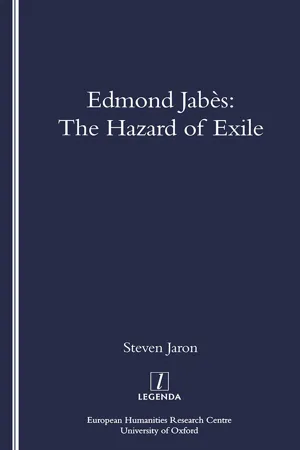
Edmond Jabes and the Hazard of Exile
About this book
"For a man who no longer has a homeland, writing becomes a place to live (Theodor Adorno). The Jewish writer Edmond Jabes, born in Cairo in 1912, wrote explicitly from the perspective of exile once he arrived in France after the Suez crisis. However, Jaron argues, exile was a predominant theme even before Jabes left Egypt. He brings to light the author's associations with other francophone writers in Egypt, especially those affiliated with the Surrealists, but shows that metropolitan France exerted a greater pull. Drawing on unpublished archival and rare printed sources, Jaron examines how Jabes opposed anti-Semitism during the 1930s, and later placed the Shoah at the heart of his acclaimed ""Livres des Questions"" (1963-73)."
Information
Chapter 1
Judaism in the Margin
... Ah! Je voudrais,
Je voudrais n'être pas Français, pour pouvoir dire
Que je te choisis, France, et que dans ton martyre,
Je te proclame, toi que ronge le vautour,
Mon unique patrie et mon unique amour.
Je voudrais n'être pas Français, pour pouvoir dire
Que je te choisis, France, et que dans ton martyre,
Je te proclame, toi que ronge le vautour,
Mon unique patrie et mon unique amour.
VICTOR HUGO
Becoming French, for Georges Cattaui, was a matter of choice. When he began his Dévotion à l'image (1919) with an epigraph from Hugo, he did not indicate that the quotation was taken from Ά la France', from L'Année terrible (December 1870). The education of his Egyptian readers had trained them to recognize the poem from which the lines were excerpted. He and his readers (the book was published in Cairo by the Institut français d'archéologie orientale) shared a knowledge and affection for France that made such annotations unnecessary and even undesirable; an annotation would have fixed its meaning in a particular time and place, and would have denied its hoped-for, transcendent message. As thoughtful heirs to the Enlightenment, these out-of-place Third Republic Egyptians believed that to be French was a privilege which carried with it the duty to advance social equality. The dead whom Cattaui lamented, those of the Great War, were set on a par with the patriotic Communards who fell defending Paris in the Franco-Prussian war.
Born in Paris in 1896 but raised in Cairo by his family, which had been well-established in the Egyptian-Jewish community for generations, Georges Cattaui belonged at once to two countries that shared a single language, French, and furthermore, he embodied two cultures, French and Egyptian, in his writing. In temperament, however, he veered, as his quotation from Hugo and the poetry that follows it attest, towards a Third-Republican France, and he espoused the alleged universalistic values claimed by the culture which grew there. Once established in France in the early 1920s, he wrote several studies of Proust, while befriending Jewish writers such as André Spire and Catholic humanists such as Jacques and Raïssa Maritain. In 1926, he himself quietly became a Catholic.1
Georges Cattaui's Egyptian francophilia reflects the diffusion of French Enlightenment values into the Middle East. Love of France was not at all rare during and after the turn of the nineteenth century among subjects of the Ottoman empire, many of whom had ancestry in points bordering the Mediterranean littoral and the Levant including Greece, Italy, North Africa, Syria and Lebanon, Malta and Turkey.2 Its origins can be traced to Napoleon s grand Expédition en Egypte begun in 1798, although the Ottoman influence, whose twilight in Egypt coincided with the outbreak of the Great War and its conflict with Britain, cannot be ignored. In the mid-nineteenth century the internal push to modernize Egypt, felt most strongly during the reigns of Mohammed Ali (1805—48) and the Khedive Ismail (1863-79)—who observed, perhaps ironically, that after the completion of the Suez Canal in 1869 'l'Egypte n'est pas en Afrique; elle fait partie de l'Europe'3—was followed and reinforced by the colonization of the country by the British (1882—1936). The enormous financial debt incurred during the construction of the Canal and from the Khedive's extravagant inauguration ceremonies enabled Britain to buy the majority of the shares of the Suez Canal Company, thus helping to ensure the colonization of Egypt. That the subject of the 'section scolaire' of the Jeux floraux d'Egypte in 1933 was a discussion of the Khedive's saying, 'Mon pays n'est plus en Afrique; nous faisons partie de l'Europe', further attests to the currency of Eurocentrism in inter-war Egypt among the French-speaking population. And while the effort to modernize produced a sometimes ignominiously destitute and volatile social backdrop to the cultural and political achievements of the late nineteenth and early twentieth centuries, Georges Cattaui knew only its opulence.
Raised in an environment which mixed French and Egyptian culture, individuals such as Georges Cattaui experienced what I call an internal uprooting, by which I mean an existential sense of exile and displacement that is not necessarily related to political expulsion. Cattaui himself was not banished from Egypt; in fact, he found himself a comfortable position in the political and economic life of the country and later, as a diplomat, in Europe. His artistic vision, predicated on an internal uprooting, was the result of a tension between his native language and culture, on the one hand, and his homeland, on the other. It may be viewed as a not so subtly constituted amalgam of the Oriental and the Occidental, both of which he absorbed at one remove from the source, as in translation.
To begin a study of Edmond Jabès's literary development with a discussion of a member of the Cattaui family is not fortuitous, first because the Cattauis were the most prominent Jewish family in Egypt for the century that runs from the end of the reign of Mohammad Ali to the dissolution of the francophone community beginning in the middle of the twentieth century, and secondly, because Edmond Jabès eventually married into it. The Cattauis counted themselves among the most wealthy and influential Jews in modern Egypt, and they contributed widely to the economic development of the country from the late nineteenth century through the mid-1950s. The first railways were laid and the first modern factories built by their companies (such as Delta Land Development) or by those of their business partners, the Mosseris, Suareses, Curiéis and Rossis. Notables from the family who were active in culture and the arts, in addition to Georges, were Maurice Cattaui, an architect who helped construct the central Jewish synagogue of Cairo (Shari Sha'ma'im) in 1905, and the composer Hector de Cattaui (a brother of jabès's mother-in-law), whose obituary was written by Jabès.4 Edmond Jabès became a member of the Cattaui family upon his marriage to Arlette Cohen in 1935,5 in the synagogue designed by Maurice Cattaui. Arlette Cohens mother, Edith Cohen née Cattaui, was the daughter of one of the family patriarchs, Moïse de Cattaui pasha, who was the president of the Cairo Jewish community until his death in 1924.6
Our subject is the origins of Edmond Jabès's artistic vision. Whence did it come? If we are to seek a reasonable response to this question, then we must examine the Egypt of the inter-war period where he was schooled and came of age and, in particular, the combination of cultural and historical forces that shaped his thinking and writing as an adult. At that time the country numbered some 180,000 minority or non-Egyptian residents—Greeks, Italians, British, Maltese—of whom some 51,500 were Jews and among whom French was used in family, educational and social situations; a minority among minorities. The total number of Jews rose through 1947 when the population reached 65,600, about 42,000 of whom lived in Cairo, although by 1956—7 the number fell to some 5,000 to 10,000 souls, who were subject to Egyptian nationalization laws,8 A l'époque, le quartier à majorité européenne où j'évoluais—celui du commerce et des affaires—avait à peine les dimensions du quartier de l'Opéra à Paris', Jabès explained to the writer Marcel Cohen (DZ, 33). Jabès s Cairo was a fraction of the size that one might expect from such a complex cultural and linguistic crucible. Arabic was of course the most widely spoken language there, although Italian, English, Armenian and Greek could also be heard among its inhabitants.9 Jabès himself grew up within the Egyptian linguistic diversity in a French-speaking home in the affluent Garden City section of Cairo, which was part of the city's recent plan for urban renewal and expansion. After the turn of the century, the Jabès family, with other newly wealthy Jews who had acquired capital through banking and in the cotton trade, moved to Garden City from the haret el yahud, Cairo's medieval Jewish quarter. 'Jusqu'au lendemain de la révolte d'Arabi Pacha, en 1882,' wrote Fernand Leprette, an inspector of French schools in Cairo until 1956, 'à peu près toute la communauté israélite du Caire a vécu au haret el yahud. [...] Puis, quelques Juifs s'enhardirent à s'installer à Coubrah, à l'Abassieh et au Daher et, de là les plus chanceux, les plus aisés, gagnèrent Kasr el-Doubra et Garden City où ils occupent de somptueuses demeures.'10 Since the 18 80s and the revolt of Orabi pasha against the British colonialists, at which time Edmond Jabès s paternal grandfather chose Italian nationality, the Jabès family had been exempt from laws of Egyptian taxation by the Capitulations.11 Like many of Egypt's cosmopolitan Jewish population, they took annual holidays in France. In fact, it was on a return journey from Marseille to Alexandria in October 1929 that Edmond, 17 years of age, first met Ariette Cohen, two years younger. Immediately after his marriage, Edmond Jabès moved to the home of Ariette's affluent parents on the island of Zamalek. Jabès described it, perhaps echoing Leprette, as 'une demeure somptueuse, les oiseaux pour fenêtres' (Jbmd, 281). By the late 1930s, Edmond and Arlette had moved to their own apartment, also in Zamalek, where they remained until their departure from Egypt.12 With regard to religion, nationality, legal status and language, the Jabès family was set apart from but not excluded from the Muslim, Arabic-speaking Egyptian majority.
It would be inaccurate, then, to claim that visits to France broadened the cultural horizons of francophone Egyptian youths like Georges Cattaui or Edmond Jabès since their cultural view was already oriented, by family and schooling, in the direction of the Hexagon. Moreover, the enchantment that ancient Arabic culture exerted on the imagination of the young Jabès was similarly determinative. Here, at the age of 20 and dreaming of poetry, he confesses:
Très jeune encore, les scrutant dans mon livre d'histoire où ils étaient reproduits en photographie, je rêvais à des poèmes sur papyrus que les poètes anciens d'Arabie, au mur de la Kaaba, exposaient, afin que les chefs des tribus et les savants de toutes les contrées venus en pèlerinage les emportent avec eux et les chantent et les propagent sous leur tente. Le poème offert ainsi aux yeux de l'étranger, celui-ci, s'il ne le transformait pas chez lui après l'avoir lu, ou le plus souvent, seulement écouté, du moins le situait-il dans une atmosphère propre à son tempérament. Le long cri du poète s'amplifiait de bouches en bouches, chacun retenant de lui, un seul ou deux vers qui le caractérisait en général, et vrai miracle de poésie, se construisait d'une strophe choisie et arrangée, un poème suggéré.13
Though born and raised in Egypt, as a boy Jabès imagined himself a foreign child, a child of the 'savants de toutes les contrées venus en pèlerinage' (perhaps not dissimilar to Champollion reading the Rosetta Stone) who had come to hear the desert poetry of ancient Arabian poets. A comparison of this quotation from Jabès s youth with another from a book written in France some thirty-five years later, demonstrates the tenacity ancient Egypt exerted on him:
Je me souviendrai toujours d'un bas-relief du temple d'Abydos où l'on voyait le dieu Horus et le dieu-soleil Rê, unis dans un même corps sous le nom de Réharakhti, Horus de l'Horizon, donnant à respirer à Ramsès II, pharaon considéré comme une incarnation du dieu Horus, le 'Ankh', symbole de vie. Ce signe qui représente, dans l'ancienne Egypte, la vie éternelle, je rêvais de l'introduire par la plume dans le vocable et de manière à ce que le sang de chaque lettre en soit chargé, enrichi. (LQ I, 40-1)
When in Paris Jabès writes of the archaeological ruins that form the history of ancient Egypt, the verb he uses is in the future tense, 'Je me souviendrai', followed by 'toujours'. Through the medium of memory, his own past is thereby placed in an eternal present. Still more, when one reads the early and later passages side by side, one discerns an intriguing parallel between them. Eerily similar expressions, such as 'je rêvais à des poèmes sur papyrus' (1932) and 'la vie éternelle, je rêvais de l'introduire par la plume' (1967), and 'les poètes anciens d'Arabie' (1932) and 'dans l'ancienne Egypte' (1967), attest to a sustained fascination and self-identification with Egyptian antiquity and, more generally, with the Orient. Studied carefully, then, the writings of jabès's Paris period form a continuity with those of the Cairene years—not simply...
Table of contents
- Cover
- Half Title
- Title
- Copyright
- Dedication
- Contents
- Abbreviations
- Acknowledgements
- Introduction
- 1 Judaism in the Margin
- 2 A Still-Born Poet
- 3 'La Patrie de l'humain'
- 4 Exile Confirmed
- 5 On Not Belonging
- Bibliography
- Index
Trusted by 375,005 students
Access to over 1.5 million titles for a fair monthly price.
Study more efficiently using our study tools.
Frequently asked questions
Yes, you can cancel anytime from the Subscription tab in your account settings on the Perlego website. Your subscription will stay active until the end of your current billing period. Learn how to cancel your subscription
No, books cannot be downloaded as external files, such as PDFs, for use outside of Perlego. However, you can download books within the Perlego app for offline reading on mobile or tablet. Learn how to download books offline
Perlego offers two plans: Essential and Complete
- Essential is ideal for learners and professionals who enjoy exploring a wide range of subjects. Access the Essential Library with 800,000+ trusted titles and best-sellers across business, personal growth, and the humanities. Includes unlimited reading time and Standard Read Aloud voice.
- Complete: Perfect for advanced learners and researchers needing full, unrestricted access. Unlock 1.5M+ books across hundreds of subjects, including academic and specialized titles. The Complete Plan also includes advanced features like Premium Read Aloud and Research Assistant.
We are an online textbook subscription service, where you can get access to an entire online library for less than the price of a single book per month. With over 1.5 million books across 990+ topics, we’ve got you covered! Learn about our mission
Look out for the read-aloud symbol on your next book to see if you can listen to it. The read-aloud tool reads text aloud for you, highlighting the text as it is being read. You can pause it, speed it up and slow it down. Learn more about Read Aloud
Yes! You can use the Perlego app on both iOS and Android devices to read anytime, anywhere — even offline. Perfect for commutes or when you’re on the go.
Please note we cannot support devices running on iOS 13 and Android 7 or earlier. Learn more about using the app
Please note we cannot support devices running on iOS 13 and Android 7 or earlier. Learn more about using the app
Yes, you can access Edmond Jabes and the Hazard of Exile by Steven Jaron in PDF and/or ePUB format, as well as other popular books in Languages & Linguistics & Languages. We have over 1.5 million books available in our catalogue for you to explore.