eBook - ePub
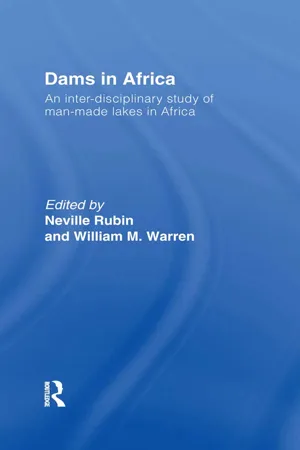
Dams in Africa Cb
An Inter-Disciplinary Study of Man-Made Lakes in Africa
- 200 pages
- English
- ePUB (mobile friendly)
- Available on iOS & Android
eBook - ePub
Dams in Africa Cb
An Inter-Disciplinary Study of Man-Made Lakes in Africa
About this book
First published in 1968. The present volume originated in a seminar which was conducted at the School of Oriental and African Studies of the University of London during the 1965-66 academic session. With the possible exception of railways, there have been no projects in Africa of comparable size and implications to the giant dams, involving as they do such un-paralleled commitment of resources, with corresponding social, political and legal consequences. Some of these consequences have been considered in the essays presented here, both in the specific context of particular projects and as in the more general context of comparative surveys, by experts who were (with two exceptions) present at the seminar.
Information
CHAPTER I
A Geographical View
A Geographical View
R. J. HARRISON CHURCH
FEW of man's modifications of the landscape can initiate such profound physical, economic and social changes as dams. They regulate and enlarge rivers to make them serve man's general thirst for water, or his more specific needs of irrigated agriculture and power. In most cases there are also subsidiary benefits in, for example, health, navigation and tourism.
There is some confusion corncerning the terms ‘barrage’ and ‘dam’. The former is rarely used in the United States of America, but elsewhere it denotes a structure which does not provide complete water control, as does a dam, but raises the level of a river to such a height that the irrigable area is ‘commanded’ by (i.e. can all be watered from) the new level of the river. A dam may store water to its capacity, and may also produce power, permit irrigation, or serve other needs.
Africa presents certain advantages for the construction of dams; it also has some severe disadvantages and problems, although most of these apply equally to all tropical or equatorial areas. Africa is, in general, an ancient continent, and so is composed of some of the world's most ancient rocks. These have been subjected to many cycles of uplift and erosion. Africa is, in consequence, a continent of plateaux, each with usually well-marked edges. Rivers fall over these, and such sites may provide points for power dams, as they have in western Angola, as they could do in the Kouilou gorge of the Niari river in Congo (Brazzaville) or in the long gorge of the lower Congo, especially in the Inga rapids. It is said that the power potential of these is equal to all that so far developed in the U.S.A., or to over 40 per cent of all world power potential.
Another relevant geological phase was that of the mid-Cretaceous to Tertiary period when the rift valley system was formed. Within its valleys are many rivers and lakes, while the rifting also caused the diversion eastwards of the Zambesi1. The continent is so old that the drainage pattern has inevitably been subjected to many changes by capture or diversion. Many rivers are plainly ‘multiple’ ones e.g. the Nile, Niger, Congo and Zambesi. As such, they inevitably have many breaks of slope, or sites for possible dams or barrages, such as the Portes d'Enfer of the upper Congo. These rapids lie at the point of capture of the upper Congo (or Lualaba) by the middle Congo, when the Lualaba could no longer flow into the Nile system, consequent upon the development of the rift valley system and its associated volcanism, which blocked the outlet. Africa is not short of suitable sites for dams, although many are in rather inaccessible places. Rather does Africa lack the technological, economic and political conditions to encourage the construction of dams.
Again because Africa is so old, it has many hard and largely impermeable rocks. These may ‘rot’ superficially and so give rise to constructional problems (as with the Guma Dam, south of Freetown, Sierra Leone), but such rocks usually provide a firm ‘anchor’ for a dam and good building material. On the other hand, run-off is rapid, and so rivers rise quickly and with dangerous force, the more so as rainfall is mostly seasonal in Africa.
Likewise because of the hardness of most African rocks, the rivers (the Nile excepted) carry little silt, so that siltation is not a problem, except for the Nile dams. It is especially the Blue Nile which carries so much fine silt from the younger and softer volcanic rocks of Ethiopia, which there cover the ancient basement complex. Silt accumulation in Nile dams reduces their life and storage or power capacity, while the silt is lost to farmers. To counter it, the old Aswan and the new High Dam store water only after the first floods (which are heavily silt-laden and refertilise certain areas) have passed. With the completion of the Aswan High Dam, the Nile dams will be holding back some 10 of the 13 million tons of silt Egypt previously received annually2, but that is part of the price for vastly enlarging the area, period and effectiveness of irrigation. Fertilisers (which will be made more cheaply by power from the Aswan High Dam) can make good most of this loss.
The Congo, alone of the major rivers, has a remarkably even régime, with a flow ratio of only 1:3. This is because the river and its major tributaries straddle the equatorial zone, with a fairly evenly distributed rainfall. The White Nile has a similar character; it is the Blue Nile that causes the wide fluctuations of the Nile proper.
Most African rivers have very uneven régimes, so that their depth and speed of flow are subject to great fluctuation, like normal tropical rivers. Thus the flow ratio of the Zambesi is 1: 13, and that for the Nile in Egypt 1: 17. So dams must necessarily be high to form large retaining lakes to regularise flow whatever the season. On the other hand, such large expanses of water are subject to heavy losses by evaporation, especially in South-Central Africa, the Sudan, Egypt and North-West Africa, where water is most precious.
The rift valley areas of Africa, and also the southern Cameroon, Accra (Ghana), Dakar (Senegal), Moroccan and Algerian areas, as well as most African islands, are prone or could be prone to earthquakes, so that dams in these areas are subject to this hazard. To minimise it, dams in such areas should have a clay core with rock fill of increasing size on either side; the Volta Dam at Ako-sombo is of this type3. On the other hand the Kariba Dam is of the concrete arch type, although it lies within an area of faults4. ‘One such major fault runs parallel with and near to the bed of the river in the vicinity of the dam site. The country flanking the river on both sides is traversed by a complicated pattern of faults. There is conjecture as to what effects may be caused by the loading of the earth's crust at this site, with the weight of the enormous volume of water contained in the Kariba lake. It is known, for instance, that when the Boulder Dam was built in the U.S.A. the weight of water caused the earth's crust to “bend”. At Kariba, the Director of Federal Trigonometrical and Topographical Surveys has initiated a study of the behaviour of the earth's crust’5.
In its early days Lake Kariba experienced severe growth of Salvinia auriculata, and of Pistia stratiotes which upset fish and impeded fishing and boats, as it has on the Congo River. At Kariba the problem has greatly diminished as former vegetation in the lake area has decayed and been removed, so increasing the movement of wind and water on the lake surface. Rather more care was taken in the prior removal of vegetation in the valley of the Volta in Ghana.
THE PURPOSE OF DAMS
There are the fairly obvious technical purposes of dams— headwater and flood control (important on the Nile and Orange rivers), water supply for man and animals (of increasing importance in dry Africa), for irrigation, power, or a combination of one or more of these. Governments are usually interested in other major effects of the construction of dams, such as the acquisition of new labour skills, and the diversification of economies and standards of living after the dams are completed. These can occur in industry, in new methods and products of agriculture, in subsidiary benefits such as transport, fishing and recreation and, not least, in the improvement of existing production. Governments must decide whether money spent on building a dam is better used than on some totally different development of its environment e.g. transport, whether one large or several small dams are to be preferred, and whether expenditure is to be strictly economic or partially or wholly regarded as expenditure on social welfare. Some African governments also view dams as prestige projects, to be numbered with an embassy in Washington.
The cost of a dam will be determined very largely by the site and its geological character. Accessibility will greatly affect it; thus the Kariba and the Kainji (Nigeria) dams were built in remote areas, while the Volta and Owen Falls dams were constructed at accessible sites. The character of the river bed and valley sides will largely determine the amount of excavation required, and the type of dam which may be built, while the régime of the river will greatly affect the nature and amount of diversion and control works required to permit construction of the dam.
A decision must also be taken as to whether a dam shall be multi-purpose or not. This is obviously the ideal, but the costs may not justify it. Water impounded for power from one dam is usually needed throughout the year, especially in the early schemes, while irrigation water may be required only seasonally. Many of the best sites for power production (as in Angola) lie at the limit of very narrow coast plains, where the possibilities for irrigation are few. They are also minimal in the gorge immediately below the Kariba Dam, rather more promising but not ideal in the Accra Plains below the Akosombo Dam on the Volta, and considerable only in the wider coastal plains of Mozambique, South Africa and Morocco. It may sometimes be possible to add a purpose or facility to a scheme; thus the Sennar Barrage was originally built for irrigation but has since been raised and otherwise modified to produce power as well.
Without being multi-purpose in design a hydro-electric scheme may have varied consequences, since its power can be used to run irrigation pumps, improve the productivity of agriculture, develop agricultural processing, mining, industry, transport and other activities. To a lesser extent this is also true of irrigation or water reservoir dams, since they may greatly improve the efficiency and variety of agriculture, but the effects are obviously narrower in scope if not also in monetary terms.
As well as the possibility of constructing multi-purpose dams, we may note the increasing tendency towards the comprehensive development of valleys under one authority, such as the Volta River Authority, the Awash Valley Authority, and the Orange River Development Scheme. Furthermore, the Niger has been the subject of an international convention since 1885, which was replaced by another in 1963. The Gambia and Senegal valleys, and the Chad Basin, are now the subject of such agreements6, while the Nile is governed by the Egypt-Sudan Nile Waters Agreement of 1959, which replaced the Anglo-Egyptian Nile Waters Agreement in 1929. The Zambesi is likewise governed by international agreements.
DAMS FOR IRRIGATION
Most African barrages and dams have been built for the needs of irrigation, although the famous dams of recent years have been built mainly for power. The Nile still has the greatest number of dams and barrages of any African river, because of pressure on land in Egypt and partly because many of the Nile's riverine peoples have long been accustomed to the use of its waters for irrigation—albeit by simple means.
The earliest barrage schemes (the first was in 1861) were designed to extend the season of irrigation from the months of flood-retreat to those of mid- and late-summer. These barrages had to be supplemented by dams if at first early summer, and, still more, if all-year irrigation was to be provided. So the first Aswan Dam was constructed in 1902, raised in 1912 and 1934, and is now being largely supplanted by the Aswan High Dam four miles upstream. Where only one crop could formerly be grown in Egypt, three or four may now be raised annually, and this over an area many times larger than before. Egypt and the Sudan have been utterly transformed; between 1913 and 1963 there was a 100 per cent increase in Egypt's population and a 20 per cent increase in the irrigable area. The Aswan High Dam should achieve another such transformation. Another two million acres will become available for irrigation, while power resources will be trebled to the great advantage of new industrial development and location, and cheaper and additional mining.
Meanwhile, the Sennar ...
Table of contents
- Cover
- Half Title
- Title Page
- Copyright Page
- Table of Contents
- List of Maps
- Preface
- Chapter I A Geographical View
- Chapter II What an Economist Wants to Know About Dams
- Chapter III Resettlement
- Chapter IV The Volta Dam: Its Prospects and Problems
- Chapter V Legal Problems of the Volta Dam
- Chapter VI The Impact of the Owen Falls Hydro-Electric Project on the Economy of Uganda
- Chapter VII The High Dam at Aswan and the Politics of Control
- Chapter VIII Harnessing the Orange River
- Chapter IX International Legal Aspects of the Kariba Project
- Chapter X Outline Programme for Hydro-Electric Development in West Africa to 1980
Trusted by 375,005 students
Access to over 1.5 million titles for a fair monthly price.
Study more efficiently using our study tools.
Frequently asked questions
Yes, you can cancel anytime from the Subscription tab in your account settings on the Perlego website. Your subscription will stay active until the end of your current billing period. Learn how to cancel your subscription
No, books cannot be downloaded as external files, such as PDFs, for use outside of Perlego. However, you can download books within the Perlego app for offline reading on mobile or tablet. Learn how to download books offline
Perlego offers two plans: Essential and Complete
- Essential is ideal for learners and professionals who enjoy exploring a wide range of subjects. Access the Essential Library with 800,000+ trusted titles and best-sellers across business, personal growth, and the humanities. Includes unlimited reading time and Standard Read Aloud voice.
- Complete: Perfect for advanced learners and researchers needing full, unrestricted access. Unlock 1.5M+ books across hundreds of subjects, including academic and specialized titles. The Complete Plan also includes advanced features like Premium Read Aloud and Research Assistant.
We are an online textbook subscription service, where you can get access to an entire online library for less than the price of a single book per month. With over 1.5 million books across 990+ topics, we’ve got you covered! Learn about our mission
Look out for the read-aloud symbol on your next book to see if you can listen to it. The read-aloud tool reads text aloud for you, highlighting the text as it is being read. You can pause it, speed it up and slow it down. Learn more about Read Aloud
Yes! You can use the Perlego app on both iOS and Android devices to read anytime, anywhere — even offline. Perfect for commutes or when you’re on the go.
Please note we cannot support devices running on iOS 13 and Android 7 or earlier. Learn more about using the app
Please note we cannot support devices running on iOS 13 and Android 7 or earlier. Learn more about using the app
Yes, you can access Dams in Africa Cb by Neville Rubin,William M. Warren in PDF and/or ePUB format, as well as other popular books in Social Sciences & Environment & Energy Policy. We have over 1.5 million books available in our catalogue for you to explore.