- 119 pages
- English
- ePUB (mobile friendly)
- Available on iOS & Android
eBook - ePub
About this book
From their inception, video games quickly became a major new arena of popular entertainment. Beginning with very primitive games, they quickly evolved into interactive animated works, many of which now approach film in terms of their visual excitement. But there are important differences, as Arthur Asa Berger makes clear in this important new work. Films are purely to be viewed, but video involves the player, moving from empathy to immersion, from being spectators to being actively involved in texts. Berger, a renowned scholar of popular culture, explores the cultural significance of the expanding popularity and sophistication of video games and considers the biological and psychoanalytic aspects of this phenomenon.Berger begins by tracing the evolution of video games from simple games like Pong to new, powerfully involving and complex ones like Myst and Half-Life. He notes how this evolution has built the video industry, which includes the hardware (game-playing consoles) and the software (the games themselves), to revenues comparable to the American film industry.
Information
Part 1
Theoretical Concerns
1
Video Games:
A Popular Culture Phenomenon
“Each successive generation of video games has become more technologically sophisticated, more realistic, and more violent. The newest wave of video games, based on CD-ROM technology (the same technology people use for music recordings and computer software), is, in fact becoming more like film and television than what we traditionally expect of a video game. This is a major evolutionary step beyond the simple graphics of the classic Space Invaders arcade game so popular fifteen or twenty years ago, or the tiny animated cartoon figures of the Nintendo system that have dominated the video game market in recent years.”
—Eugene F. Provenzo, Jr. (Steinberg and Kincheloe, eds. 1997: 104)
In this book I deal with video games, a popular entertainment phenomenon (with a focus on adventure or action-adventure video games) in terms of their social, psychological, and cultural significance. I also consider the size of the video game industry, new developments in video game player technology, and how video games have affected story telling—and in this regard, compare narratives in print and video games. To accomplish these goals, I do the following things:
- I consider what video games are and how they relate to play;
- I discuss whether video games are an art form or a new medium,
- I say something about the nature of narrativity;
- I examine the role video games play in the lives of young children, and discuss how to analyze their cultural significance;
- I offer a bio-psycho-social analysis of the video game phenomenon;
- I analyze four of what are generally considered to be the most important adventure video games of recent years: Myst, Riven, Tomb Raider, and Half-Life.
- I support my analyses by using quotations from many experts and authorities in the field.
A News Event of Significance for Gamers
On October 26, 2000, Sony introduced its PlayStation 2 video game machine in the United States—a device that it believes will revolutionize home entertainment. Sony considers the PlayStation 2 (also known as the PS2) a “Trojan horse,” that will be purchased as a video game player but will eventually change the way Americans entertain themselves in general. That is because the PlayStation 2, which sells for $299, also can play DVD films, music CD-ROMs, and video games that were purchased to be played on the PlayStation 1. (Sony is losing around one hundred dollars on each console sold in the United States, but will make up its losses on the consoles from its profits on the video games and in licensing fees.) The PlayStation 2 also has a port for a hard drive and another port that will enable it to support a highspeed Internet connection. It will also, when add-ons are developed, let its owners make music mixes and edit their own digital movies.
There are some questions about whether the Sony PlayStation 2 can actually become the center of household entertainment in America. But even if it doesn’t, it will unquestionably be a major force in the video game industry. We must remember that Sony is building on an enormous base: there are estimates that the Sony PlayStation 1 is found in one out of every six households in the United States. (Sony has sold something like 27 million PlayStation 1 consoles here in the United States and 75 million worldwide.) I will discuss the different consoles used to play video games, which compete with the PS2, in more detail later in the book.
Most Americans are well aware of the existence of video games. There are occasionally articles about new video games in newspapers and the New York Times regularly carries a feature on new video games every Thursday in its “Circuits” section. There are also articles on the industry and various games in magazines such as Time and Newsweek, and there are many magazines devoted to video games, and hundreds (if not thousands) of Internet sites on every conceivable aspect of video games.
Many video game companies have their own sites where you can find a great deal of information about specific games. If you take interactivity as one of the main constituents of video games, there are also a number of interactive image-less fiction narratives, what might be thought of as an elite art form version of the video game without animated characters. So, there is a continuum of games that covers everything from relatively crude “bang-em-up” wrestling games to ingenious science fiction and adventure games to postmodern avant-garde novels.
Are Video Games an Art Form or a New Medium?
There is some confusion about what video games are. Are they an art form with many different genres, similar in nature to the novel, or some kind of new medium? There are decent arguments that can be made for both positions. Video games are interactive, but there are other texts and media that are interactive, so I don’t think interactivity means that video games should be considered a new medium—unless interactivity is enough to qualify anything as a new medium. The novel is an art form using the medium of print (but now also, with the development of e-books, electronic media) that has many different genres—everything from genre stories such as mysteries and science fiction stories to non-formulaic, non-genre stories about individuals and their relationships. Thus, there is a wide spectrum of novels— everything from tough guy mysteries like Mickey Spillane’s /, the Jury to James Joyce’s Ulysses. I would like to suggest that video games are probably best understood to be similar to the novel in that there are many different genres of video games; both novels and video games are, then, from my perspective, art forms.
The term computer game covers a range of forms, including violent action games, role-playing and narrative games, erotic and frankly pornographic applications, card games, puzzles and skill-testing exercises, and educational software. Some of these forms are clear repurposings of early games. … Computer games are delivered on a variety of platforms … in all their forms and with all their modes of delivery, digital games illustrate the commodification of the computer. (2000, 89)
When scholars write about video games, they often use the term “form” to discuss them. For example, Jay David Bolter and Richard Grusin write, in their book Remediation: Understanding New Media, The authors use the term remediation to deal with the ways in which new media refashion prior media forms. This concept may help us understand how to categorize video games.
Another author, Eugene F. Provenzo, also uses the term “form” in dealing with video games. He writes in his essay “Video Games and the Emergence of Interactive Media for Children” (in Steinberg and Kinchloe, 1997, 103):
I argue here that video games represent a new frontier for media in our culture. Video games are a complex and rapidly evolving form—one that most parents and adults pay relatively little attention to.
Authors use the term “form” because there are so many different genres of video games. Just having different genres, however, is not a proof that we are dealing with an art form. Media such as film, radio, and television also have many different genres, so there is a logic to arguing that video games are a new medium. I would suggest that because video games are played on television screens or computer monitor screens, and thus use an “old” medium, it makes sense to think of video games as art forms. The issue is not, from my point of view, a terribly important one. What is most important is that we analyze video games and try to understand their impact on the people who play them and on society at large.
We can think of each video game as a text, a work of popular art that is created collectively (like films and television programs). Video games are created by teams of writers, artists, musicians, and various kinds of other technicians. In critical parlance works of art are called “texts,” to make it easier for writers and scholars to talk about them without having to name them or describe them every time. These video games are created by authors (teams of writers and artists) and are created in a particular society, directed toward a specific audience, and played on a familiar medium—the television screen or computer monitor screen.
We can see these relationships better by putting them into a chart of what I call the focal points involved in analyzing mass mediated texts.
Let me deal with these focal points in a bit more detail. A video game is distributed on different kinds of devices that contain software such as CD-ROMs, cartridges, or DVD disks. The software is, in my scheme of things, the work of art, or in this case, the specific game. For example, there are five CD-ROMs needed to play Riven. A particular game is created for a specific audience—gamers who like certain kinds of game. Thus, some gamers love sports video games, others like simulations, others like action-adventure video games, and so on. Of course those who create and manufacture a video game always hope that players who like other kinds of games might be induced to purchase the game they have created and play it, also.
Figure 1.1 Focal Points in the Study of Texts
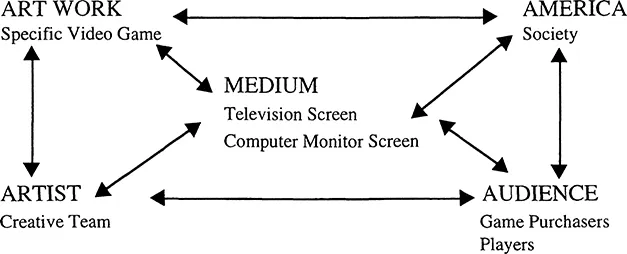
The video game is created and manufactured in some society and often reflects, in subtle and sometimes not easily recognized ways, the beliefs and value systems of the society in which it is made. These values are filtered through the personalities, social class, beliefs, and values of those who actually design and create the game. This means that works of art, in all media, always contain elements of the personalities and life experiences of their makers and also of the societies in which their makers grew up. Video games are played in many countries, so they have to also relate to the interests of players all over the world. For example, many popular video games are created in Japan but are popular in the United States and in many other countries. Video game makers must keep in mind the nature of their audiences— in particular how old the players will be—and their particular interests.
Finally, the art work/text/video game is transmitted by some medium. In the case of video games, as their name suggests, video games are played on video display monitors—either on television sets that are hooked up to game playing consoles or on computer video display monitors in the case of PC video games.
I mentioned, earlier, that there are particular audiences for video games. That explains why there are many different genres or kinds of video games. If you take an art form such as the popular novel, you see that there are many different genres of popular fiction, such as detective novels, science fiction novels, romance novels, spy novels, western novels, and adventure novels.
The same applies to video games; there are many different genres of video games such as action adventure, sports, science fiction, simulations, and role-playing.
It is difficult, at times, to assign a particular genre to a video game because in recent years video game designers have mixed genres together, in the same way that many novelists have. As Michael Brown, an editor at CNET’S Gamecenter (HYPERLINK http:// www.gamecenter) explained to me in an e-mail message:
Categorizing computer and video games is becoming increasingly difficult, because in an effort to build unique games, developers are blurring genres together. It used to be that in an “action” game, you’d run around and blow things up. In a role-playing game, you’d go on quests and develop your characters’ skills along the way. But now there are action-RPGs, like System Shock 2, and adventure-action games, like Mask of Eternity. It’s a good thing for gaming, but it does make our jobs more difficult when we try to categorize games. (Feb. 8, 2000)
Trying to decide which genre a given game should be put in is worth doing, since it tells us something about the nature of the game, but we must keep in mind that as in other kinds of texts, sometime a game has elements of several different genres in it. For example, many games are combinations of action and adventure or adventure and role playing, though usually one of the two blended genres is dominant.
I think it makes good sense to think of video games as a kind of text that comes in many different genres and blended genres—and thus as an art form—rather than seeing video games as a new medium. There are many video artists who use video to make texts of all kinds, some of which are very avant garde. These texts are not games, however.
New Technologies Make a Difference in Video Games
So the medium of video is not the only important thing as far as understanding what video games are. The important thing, from my point of view as a popular culture critic, is to analyze the video game phenomenon and certain important video games and see what they tell us about ourselves. What has happened is that as the technology of video games has evolved, from diskettes to CD-ROMs and DVD disks, the nature or power of the games has changed considerably. The technical quality of the images and sounds in these games has improved to such a point that it can be suggested that they represent something relatively new in the entertainment world—interactive narrative texts with multi-dimensional characters. These texts now have the capacity to involve players to an extent unknown in earlier days, ...
Table of contents
- Cover Page
- Halftitle Page
- Title Page
- Copyright Page
- Content Page
- Preface
- Acknowledgments
- Part 1 Theoretical Concerns
- 1 Video Games: A Popular Culture Phenomenon
- 2 Narratives in the Electronic Age
- 3 Video Games as Cultural Indicators
- 4 A Bio-Psycho-Social Perspective on Video Games
- Part 2 Analyzing Representative Games
- 5 Myst, Riven, and the Adventure Video Game
- 6 Lara Croft and the Problem of Gender in Video Games
- 7 Half-Life and the Problem of Monsters
- 8 Conclusions
- Bibliography
- Index
Trusted by 375,005 students
Access to over 1.5 million titles for a fair monthly price.
Study more efficiently using our study tools.
Frequently asked questions
Yes, you can cancel anytime from the Subscription tab in your account settings on the Perlego website. Your subscription will stay active until the end of your current billing period. Learn how to cancel your subscription
No, books cannot be downloaded as external files, such as PDFs, for use outside of Perlego. However, you can download books within the Perlego app for offline reading on mobile or tablet. Learn how to download books offline
Perlego offers two plans: Essential and Complete
- Essential is ideal for learners and professionals who enjoy exploring a wide range of subjects. Access the Essential Library with 800,000+ trusted titles and best-sellers across business, personal growth, and the humanities. Includes unlimited reading time and Standard Read Aloud voice.
- Complete: Perfect for advanced learners and researchers needing full, unrestricted access. Unlock 1.5M+ books across hundreds of subjects, including academic and specialized titles. The Complete Plan also includes advanced features like Premium Read Aloud and Research Assistant.
We are an online textbook subscription service, where you can get access to an entire online library for less than the price of a single book per month. With over 1.5 million books across 990+ topics, we’ve got you covered! Learn about our mission
Look out for the read-aloud symbol on your next book to see if you can listen to it. The read-aloud tool reads text aloud for you, highlighting the text as it is being read. You can pause it, speed it up and slow it down. Learn more about Read Aloud
Yes! You can use the Perlego app on both iOS and Android devices to read anytime, anywhere — even offline. Perfect for commutes or when you’re on the go.
Please note we cannot support devices running on iOS 13 and Android 7 or earlier. Learn more about using the app
Please note we cannot support devices running on iOS 13 and Android 7 or earlier. Learn more about using the app
Yes, you can access Video Games by Arthur Asa Berger in PDF and/or ePUB format, as well as other popular books in Social Sciences & Media Studies. We have over 1.5 million books available in our catalogue for you to explore.