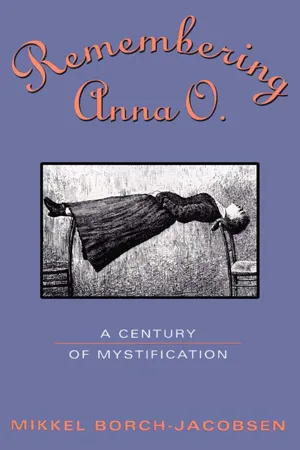
Remembering Anna O. offers a devastating examination of the very foundations of psychoanalytic theory and practice, which was born with the publication of Breuer and Freud's Studies on Hysteria in 1895. Breuer described the case of Anna O., a young woman afflicted with a severe hysteria whom he had cured of her symptoms by having her recount under hypnosis the traumatic events that precipitated her illness.
Drawing on the most recent Freud scholarship and on long-secret documents, Borch-Jacobsen demonstrates, however, that Anna O. (Bertha Pappenheim) was never cured by Breuer's "talking cure" and that both Breuer and Freud knowingly falsified the historical record. Borch-Jacobsen points out the numerous inconsistencies in Breuer's account that suggests that Anna O.'s symptoms were simulated to meet Breuer's theoretical expectations and that her famed "reminiscences" were in fact fictitious memories induced by Breuer in the course of a hypnotic treatment.
- 126 pages
- English
- ePUB (mobile friendly)
- Available on iOS & Android
eBook - ePub
About this book
Information
CHAPTER ONE

Our Myth
Every society has its therapeutic myths, meant to explain why we fall ill and why we get well, and our society is no exception. To be sure, we no longer imagine that our ills are caused by spirits or evil omens, nor do we believe any longer in curative powers derived from the laying on of hands or from magical formulas. But we are quick to believe that certain troubles, which we call psychological or psychosomatic, are due to traumatic events in our personal histories, and that by recounting these events to a doctor we will cure ourselves of their effects. It is necessary, we believe, to name the ill, narrate it, make the evil speak, in order to be rid of it. This idea is hardly new. Far from it: it stems from the Christian practices of confession and exorcism, by way of the Protestant “cure of the soul.” But with the “medicalization of confession” set in motion by Freud, it became one of the most widely accepted notions of our psychoanalytic century, now drawing to a close.1 Who has any doubt nowadays that our past is the key to our present, and that by articulating this past, verbalizing it to a therapist, we can divest ourselves of its debilitating weight? Memory liberates, narration heals, history redeems: this idea seems to us so constitutive of what we call psychotherapy (in the widest sense) that we have forgotten what Freud’s immediate precursors understood by this word—namely, a therapy based on the “suggestive” speech of the doctor, and not at all on the speech of the patient.2 So natural does this idea seem to us that we freely apply it to the therapeutic myths of other societies, viewing those myths as primitive or crude forms of psychotherapy, never stopping to wonder what makes our native theory so superior to theirs.
But why, after all, must I recount my life story instead of having a shaman pull some object out of my body? Why are my demons necessarily memories or inner obsessions instead of external spiritual entitites?3 Why should the cause of my symptoms be sought in the past instead of in a curse put on me by some rival? And why in my past instead of in my family’s or my clan’s, or in some mythical lineage? The fact is, we rarely bother to ask such questions. And even when we do, we usually respond, just like other native informants, with stories that supposedly justify our systematized beliefs. The details of these stories may vary endlessly, but the ur-pattern is always the same: “One day, X said y to Z, and, lo and behold, his symptom disappeared for good.” Here, we recognize the story that Josef Breuer told about the spectacular cure of Fräulein Anna O., his patient: “It was in the summer during a period of extreme heat, and the patient was suffering very badly from thirst; for, without being able to account for it in any way, she suddenly found it impossible to drink. She would take up the glass of water she longed for, but as soon as it touched her lips she would push it away like someone suffering from hydrophobia. […] This had lasted for some six weeks, when one day during hypnosis she grumbled about her English lady-companion whom she did not care for, and went on to describe, with every sign of disgust, how she had once gone into that lady’s room and how her little dog—horrid creature!—had drunk out of a glass there. The patient had said nothing, as she wanted to be polite. After giving further energetic expression to the anger she had held back, she asked for something to drink, drank a large quantity of water without any difficulty and woke from her hypnosis with the glass at her lips; and thereupon the disturbance vanished, never to return.”4
This, to be sure, is still a far cry from the tales of childhood “seduction” that Freud would obtain from his patients between 1896 and 1897, and farther yet from the sensational accounts of incest and satanic ritual abuse that have become all the rage lately among American therapists. Right here, however, in this rather innocuous account of Anna O., is where the idea was born that “hysterics suffer mainly from reminiscences,”5 as Breuer and Freud state in Studies on Hysteria, and that these traumatic memories can be “talked away”6 under hypnosis. Of course, this sturdy theory soon underwent a number of metamorphoses: Freud reconceptualized Breuer’s indeterminate “trauma,” first as an actual sexual assault suffered in early childhood, then as a fantasy having to do with perverse infantile sexuality, and finally as a fantasy of Oedipal origin. As for cathartic hypnosis, it was abandoned in favor of the method of so-called free association, which itself gradually came to be recentered on the analysis of resistances and of the transference. But none of these reshufflings ever called the fundamental, seminal idea into question: that to remember is to heal. Heal from what? From the amnesia that “dissociates” the psyche, from the forgetting that breaks the continuity of my history and therefore keeps me from being my self. Ever since (and because of) Anna O.’s miraculous cure, forgetting has ceased to be a simple lapse of memory and has become, under various names—“dissociated consciousness,” “the unconscious,” “repression”—the supreme form of remembering, and the very key to our identity as subjects.
Freud himself said this quite overtly in 1917: “This discovery of Breuer’s is still the foundation of psychoanalytic therapy. The thesis that symptoms disappear when we have made their unconscious predeterminants conscious has been confirmed by all subsequent research, although we meet with the strangest and most unexpected complications when we attempt to carry it through in practice.”7 Are we much more advanced now that a hundred years have gone by since the publication of Studies on Hysteria? Apparently not, to judge by the spectacular comeback, in the United States, of the traumatic-dissociative etiology of neurosis, with its parade of “traumatic memories” abreacted under hypnosis. And even if the theorists of “recovered memory” do refer to Janet more than to Breuer or Freud, it is clear that their utter trust in remembering, with its “integrative” power, takes us more directly back to Anna O.’s “talking cure” than to the suggestive manipulation of memories practiced by the author of Psychological Automatism.8 Consider this description of “trauma work” in Judith Herman’s recent book: “In the second stage of recovery, the survivor tells the story of the trauma. […] This work of reconstruction actually transforms the traumatic memory, so that it can be integrated into the survivor’s life story. […] Out of the fragmented components of frozen imagery and sensation, patient and therapist slowly reassemble an organized, detailed, verbal account, oriented in time and historical context. […] The ultimate goal […] is to put the story, including its imagery, into words.”9
Are things very different at the other end of the Freudian spectrum, among the Lacanians and the American narrativists (such as Roy Schafer and Donald Spence)? Aware of the reconstructive and “hermeneutic” character of memory (and taking a lesson from Freud’s difficulties in this area), they no longer believe in the “historical truth” of memories obtained on the analytic couch. Lacan, referring directly to the “talking cure” of Anna O. and to “the discovery of the pathogenic event dubbed the traumatic experience,” said this as long ago as 1953: “If this event was recognized as being the cause of the symptom, it was because the putting into words of the event (in the patient’s ‘stories’) determined the lifting of the symptom. […] The fact remains that in the hypnotic state verbalization is dissociated from prise de conscience [awareness], and this fact alone is enough to require a revision of the conception of its effects. But why is it that the doughty advocates of the behaviorist Aufhebung do not use this as their example to show that they do not have to know whether the subject has remembered anything whatever from the past? He has simply recounted the event. But I would say that he has verbalized it, […] that he has made it pass into the verbe, or, more precisely, into the epos by which he brings back into present time the origins of his person. […] I might as well be categorical: in psychoanalytic anamnesis, it is not a question of reality, but of truth, because the effect of full speech is to reorder past contingencies by conferring on them the necessities to come.”10
In other words, what matters is not the factual (reproductive, constative) accuracy of the memory but only the narrative (productive, performative) truth of the story through which the subject constructs his or her history, for the benefit of the analyst. As Donald Spence puts it, “The truth [of the narrative] lies more in the present and future than in the past. We are primarily interested in the effect it produces rather than in its past credentials. […] Associations and interpretations, as they are inserted into the developing narrative, become true as they become familiar and lend meaning to otherwise disconnected pieces of the patient’s life. The very process that allows the analysts to understand the disconnected pieces of the hour, when extended and amplified, enables the patient to gradually see his life as continuous, coherent and therefore meaningful.”11
The fact remains that Lacan, like his contemporary narrativist counterparts, continues to make “the completeness of the cure,”12 as he called it in 1953, dependent on narrative speech—that is, on the production, whether we like it or not, of a history and a memory. For Lacan and the narrativists, anamnesis and remembering are still the foundation and the “source of therapeutic progress,”13 even if these are conceived of as dialectical or “intersubjective” reconstruction and not simply as the photographic reproduction of trauma: “What we teach the subject to recognize as his unconscious is his history—that is to say, we help him to perfect the present historicization of the facts that have already determined a certain number of the historical ‘turning points’ of his existence.”14 And again: “It is certainly this assumption of his history by the subject, in so far as it is constituted by the speech addressed to the other, that constitutes the ground of the new method that Freud called psychoanalysis […] in 1895.”15
Myths are notoriously thick-skinned, and here we have a fine example. It may be true that the cure of Anna O. consisted—partly—in her relating “memories” to Breuer, but it is just plain untrue that this treatment ever got rid of her symptoms. This fact became well known in 1953, when Ernest Jones revealed it publicly in the first volume of his biography of Freud,16 and it has since been amply corroborated by the painstaking research of Henri Ellenberger, Albrecht Hirschmüller, Ellen Jensen, and Peter Swales, among many others.17 No one today can remain unaware that the treatment of Anna O. (whose real name was Bertha Papp...
Table of contents
- Cover
- Half Title
- Title Page
- Copyright Page
- Table of Contents
- Acknowledgments
- Chapter One Our Myth
- Chapter Two The 1895 Case History
- Chapter Three Kreuzlingen
- Chapter Four Constructions
- Chapter Five The 1882 Report
- Chapter Six Carl Hansen
- Chapter Seven Retrospective Hallucination
- Chapter Eight Simulation
- Appendix I What Did Freud Tell Marie Bonaparte?
- Appendix II A Letter from Hanna Breuer to Ernest Jones
- Appendix III Catalepsy and Mesmerism: Moriz Benedikt
- Index
Trusted by 375,005 students
Access to over 1.5 million titles for a fair monthly price.
Study more efficiently using our study tools.
Frequently asked questions
Yes, you can cancel anytime from the Subscription tab in your account settings on the Perlego website. Your subscription will stay active until the end of your current billing period. Learn how to cancel your subscription
No, books cannot be downloaded as external files, such as PDFs, for use outside of Perlego. However, you can download books within the Perlego app for offline reading on mobile or tablet. Learn how to download books offline
Perlego offers two plans: Essential and Complete
- Essential is ideal for learners and professionals who enjoy exploring a wide range of subjects. Access the Essential Library with 800,000+ trusted titles and best-sellers across business, personal growth, and the humanities. Includes unlimited reading time and Standard Read Aloud voice.
- Complete: Perfect for advanced learners and researchers needing full, unrestricted access. Unlock 1.5M+ books across hundreds of subjects, including academic and specialized titles. The Complete Plan also includes advanced features like Premium Read Aloud and Research Assistant.
We are an online textbook subscription service, where you can get access to an entire online library for less than the price of a single book per month. With over 1.5 million books across 990+ topics, we’ve got you covered! Learn about our mission
Look out for the read-aloud symbol on your next book to see if you can listen to it. The read-aloud tool reads text aloud for you, highlighting the text as it is being read. You can pause it, speed it up and slow it down. Learn more about Read Aloud
Yes! You can use the Perlego app on both iOS and Android devices to read anytime, anywhere — even offline. Perfect for commutes or when you’re on the go.
Please note we cannot support devices running on iOS 13 and Android 7 or earlier. Learn more about using the app
Please note we cannot support devices running on iOS 13 and Android 7 or earlier. Learn more about using the app
Yes, you can access Remembering Anna O. by Mikkel Borch-Jacobsen in PDF and/or ePUB format, as well as other popular books in Psychology & Mental Health in Psychology. We have over 1.5 million books available in our catalogue for you to explore.