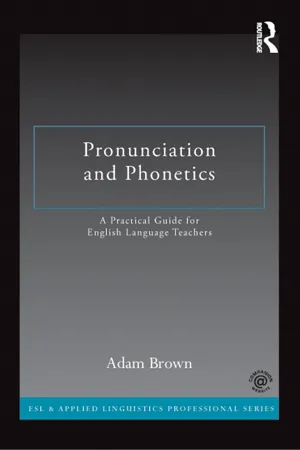
This engaging, succinct text is an introduction to both phonetics and phonology as applied to the teaching of pronunciation to English language learners. Section 1 selectively covers the main areas of phonetics and phonology, without going into any area in more depth than the average English language teacher requires or that the average English language teacher trainee can handle. Section 2 focuses on practical issues related to learners and how they learn languages, and what represents good practice in terms of classroom activities for pronunciation—including aspects such as targets, motivation and priorities. The chapters end with activities to help the reader understand concepts. Section 3 provides innovative sample activities which put into practice the theoretical points covered in the first two sections, answers to the various exercises, recommended further reading (both print and non-print), a glossary of technical phonetic terms, and a bibliography of works on pronunciation teaching. The text is accompanied by a Companion Website with audio recordings of model pronunciations and audio material relating to the activities.
- 312 pages
- English
- ePUB (mobile friendly)
- Available on iOS & Android
eBook - ePub
About this book
Information
Section 1
Phonetics
1 Introduction
If you can speak, you can do anything.
Sir Winston Churchill (1874–1965), British prime minister
Learning objectives
At the end of this chapter, you will be able to
• define the terms phonetics, phonology, pronunciation and phonics
• list the segmental and suprasegmental features of English pronunciation
• draw a hierarchy of functional units of pronunciation.
Introduction
The purpose of this book is to equip readers with what they need in order to teach the pronunciation of English. As pronunciation is one of the skills involved in learning any language, some of this overlaps with what is covered in general courses for English language trainee teachers. However, pronunciation is often poorly covered in such courses.
The coverage in this book is very selective. That is, only those aspects of the technical side of phonetics that have strong implications for English pronunciation teaching are handled. Many other aspects have deliberately been omitted, but can be found in general books on English phonetics (see the Resources section).
First, however, we need to define four terms relating to the whole field: phonetics, phonology, pronunciation and phonics.
Phonetics
In a sentence, phonetics can be defined as the scientific study of all aspects of the spoken form of language. There are several important terms in this definition:
• Scientific: Phonetics is scientific in the sense that it is objective rather than subjective. That is, phoneticians describe the sounds of languages in an unbiased, dispassionate way. In contrast, many lay people speak in a prejudiced way about the sounds of their language. Very often, this takes the form of preferring aspects of their own pronunciation over those of anyone else’s accent, and trying to impose their own thoughts on others. Thus, they tell people how they think a language ought to be pronounced, rather than describing how it actually is pronounced. Such people are prescriptive, while phonetics is a descriptive subject.
• Language: Notice that language is used here, rather than a language. By language, we mean the human ability to communicate, that underlies all human languages. Although much of phonetics has historically been concerned with English, the study of the sounds of an ‘exotic’ language spoken by only a few speakers is no less valid.
• Spoken form: Language, the human ability to communicate, may be manifested in different ways (or mediums). By far the most common are the spoken medium and the written medium. Others exist, such as Braille, a tactile medium. Both the spoken and written mediums have a productive and perceptive form. This gives us the categories of writing, reading, speaking and listening, often referred to by language teachers as the four skills (see Table 1.1).
Table 1.1 The four language skills
Written medium | Spoken medium | |
Production | Writing | Speaking |
Perception | Reading | Listening |
• All aspects: When we speak to someone, there are three distinguishable phases of the communication process:
1 The speaker uses his/her vocal organs (lungs, vocal cords, tongue, lips, etc.) to produce sounds. This aspect is known as articulatory phonetics.
2 The sounds are vibrations of air particles (sound waves), that travel from the speaker’s mouth to the listener’s ear. The technical study of these vibrations is known as acoustic phonetics.
3 The sound waves reach the listener’s ear, travel along his/her ear canal and cause the ear drum to vibrate. This movement is transmitted to the brain and ultimately interpreted. This aspect is known as auditory phonetics.
While all three aspects belong to the field of phonetics, only the first (articulation) is of real relevance in language teaching.
Phonology
Articulatory phonetics thus describes the way humans use their vocal organs to produce speech sounds. Phonology, on the other hand, describes the way these sounds function in particular languages. For instance, we can describe two sounds as follows:
• For the [ph] sound, the two lips come together blocking air from escaping through the mouth. Air does not escape through the nose either. The vocal cords are not vibrating. When the lips are opened again at the end of the sound, there is a burst of air (known as aspiration) before the vocal cords start vibrating for the vowel sound that usually follows.
• The same thing happens for the [p=] sound, except that, when the lips are opened, the vocal cords start vibrating immediately for the following sound (usually a vowel). While [p=] is not an official symbol of the International Phonetic Association (IPA), it is a useful way of explicitly showing lack of aspiration, and is used by writers such as Wells and Colson (1971).
Notice that there is no mention of any particular language in the above descriptions. We are simply saying that if you make those movements with your vocal organs, we can use that symbol to repres...
Table of contents
- Cover
- Half Title
- Title Page
- Copyright Page
- Table of Contents
- Symbols for English sounds
- Preface
- SECTION 1 Phonetics
- SECTION 2 Pronunciation teaching
- SECTION 3 Sample exercises
- Resources
- Glossary
- References
- Index
Trusted by 375,005 students
Access to over 1.5 million titles for a fair monthly price.
Study more efficiently using our study tools.
Frequently asked questions
Yes, you can cancel anytime from the Subscription tab in your account settings on the Perlego website. Your subscription will stay active until the end of your current billing period. Learn how to cancel your subscription
No, books cannot be downloaded as external files, such as PDFs, for use outside of Perlego. However, you can download books within the Perlego app for offline reading on mobile or tablet. Learn how to download books offline
Perlego offers two plans: Essential and Complete
- Essential is ideal for learners and professionals who enjoy exploring a wide range of subjects. Access the Essential Library with 800,000+ trusted titles and best-sellers across business, personal growth, and the humanities. Includes unlimited reading time and Standard Read Aloud voice.
- Complete: Perfect for advanced learners and researchers needing full, unrestricted access. Unlock 1.5M+ books across hundreds of subjects, including academic and specialized titles. The Complete Plan also includes advanced features like Premium Read Aloud and Research Assistant.
We are an online textbook subscription service, where you can get access to an entire online library for less than the price of a single book per month. With over 1.5 million books across 990+ topics, we’ve got you covered! Learn about our mission
Look out for the read-aloud symbol on your next book to see if you can listen to it. The read-aloud tool reads text aloud for you, highlighting the text as it is being read. You can pause it, speed it up and slow it down. Learn more about Read Aloud
Yes! You can use the Perlego app on both iOS and Android devices to read anytime, anywhere — even offline. Perfect for commutes or when you’re on the go.
Please note we cannot support devices running on iOS 13 and Android 7 or earlier. Learn more about using the app
Please note we cannot support devices running on iOS 13 and Android 7 or earlier. Learn more about using the app
Yes, you can access Pronunciation and Phonetics by Adam Brown in PDF and/or ePUB format, as well as other popular books in Languages & Linguistics & Education General. We have over 1.5 million books available in our catalogue for you to explore.