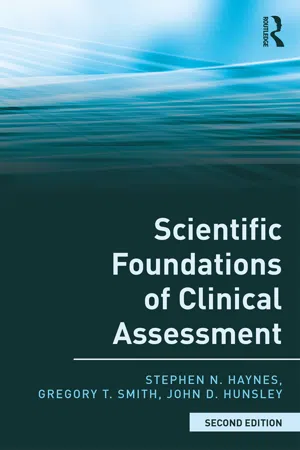
Scientific Foundations of Clinical Assessment is a user-friendly overview of the most important principles and concepts of clinical assessment. It provides readers with a science-based framework for interpreting assessment research and making good assessment decisions, such as selecting the best instruments and measures and interpreting the obtained assessment data. Written in a direct and highly readable fashion, with plenty of clinical examples that illustrate the relevance of psychometric principles and assessment research, this text is one every professional and graduate student needs to read. The second edition is expanded and fully updated, and includes additional coverage of the principles and methods of developing new assessment instruments.
eBook - ePub
Scientific Foundations of Clinical Assessment
- 314 pages
- English
- ePUB (mobile friendly)
- Available on iOS & Android
eBook - ePub
Scientific Foundations of Clinical Assessment
About this book
Information
Chapter 1
Introduction to the Scientific Foundations of Clinical Assessment
Introduction
Clinical assessment lies at the heart of psychological services and has many essential applications. It is necessary to identify and specify a client’s1. behavior problems and goals and to examine the degree to which a client’s behavior problems are consistent with diagnostic criteria. It is also used to identify the events, behaviors, and contexts that affect a client’s problems and treatment goals, and to select and design the best intervention strategies for the client. The evaluation of the process and outcome of clinical interventions is another important application, even though it is one of the least frequent applications of clinical assessment (Wright et al., 2017). Youngstrom et al. (2017) emphasized the essential, sequential interactions between clinical assessment and treatment: Assessment guides problem identification, which in turn guides further assessment of problems and influential variables, which in turn guides case formulation and treatment planning.
There are many approaches to clinical assessment and we advocate an important guiding principle throughout the book – clinical assessment will provide information that is most valid and useful when it is firmly based on principles of clinical science (i.e., evidence-based assessment). In this chapter we introduce the basic concepts and methods associated with the scientific foundations of clinical assessment. Subsequent chapters consider these concepts and methods in greater detail (see Text Box 1.1 for comments on the scientific method).
Clinical Assessment as One Application of Psychological Assessment
Psychological assessment is the systematic measurement of a person’s behaviors2 and variables associated with variance in those behaviors, as well as the judgments based on those measurements. It includes the entire assessment process such as the assessment strategy, the plan of action for deriving measures, and the assessment methods (such as interviews and observations) that are part of that strategy. Psychological assessment also includes the specific assessment instruments that are used and measures derived from those instruments and the targets (e.g., behavior problems and goals, causal and correlated variables, and contexts for behavior) of assessment. An important component of psychological assessment is the assessor’s judgments, such as diagnosis, case formulations, and estimates of treatment outcome, that are guided by the assessment data. Throughout the book we promote and document how the goals of psychological assessment can best be approached by applying scientific principles to the selection of strategies, methods, instruments, and measures, and the clinical judgments based on them.
Psychological assessment is applied in many domains, such as forensic, educational testing and placement, personnel selection; and intellectual, cognitive, and neuropsychological evaluation. To illustrate the diversity of psychological assessment applications, Hersen (2014) published a three-volume set of edited books on psychological assessment that covered the areas of intellectual/neuropsychological, behavioral, and personality assessment. In 2014, the American Psychological Association published a three-volume 100-chapter edited book, Testing and Assessment in Psychology, on the theory, issues, methods, and foci of psychological assessment (Geisinger, 2013).
The goal of clinical assessment is to provide information to help answer important questions that arise in a clinical context. Questions addressed in clinical assessment can include: (1) What are a client’s concerns, behavior problems, and treatment goals?; (2) What affects the onset, intensity, severity, and duration of a client’s problems or affects the client’s goal attainment or the success of an intervention program?; (3) How do a client’s problems affect his or her quality of life and the quality of life of persons in the client’s life?; (4) What is the best way to help a client – what interventions are most likely to reduce the client’s behavior problems, enhance his or her quality of life and happiness, and achieve treatment goals?; (5) What are the outcomes of a client’s treatment or a program’s interventions and what variables affect those outcomes?; (6) How can treatment gains be maintained over time and in the face of the inevitable challenges and stressors the client will confront? In sum, the ultimate goals of clinical assessment are the selection, design, and evaluation of treatments that reduce clients’ behavior problems and help them achieve their treatment goals. A good illustration of the range of these assessment activities is provided in A Guide to Assessments that Work by Hunsley and Mash (2018), which contains 27 chapters covering the clinical applications of psychological assessment to health-related problems, couple distress and sexual disorders, schizophrenia and personality disorders, substance-related and gambling disorders, anxiety-related disorders, mood disorders, and attention-deficit and disruptive behavior disorders.
Text Box 1.1 Scientific Methods
We repeatedly stress in this book that clinical assessment strategies, methods, instruments, measures, and judgments should be based on the best available scientific evidence. By scientific evidence, we mean that they should have undergone rigorous objective development and repeated empirical testing on the degree to which they are congruent with theoretical predictions. Ultimately, the degree to which a measure is supported by scientific evidence refers to the degree to which it has undergone systematic and repeated observation, measurement, and experimentation, formulation, testing, and modification.
In clinical assessment this evidence derives from principles and methods that are the topic of subsequent chapters – evidence about the robustness, validity, applicability, and sensitivity of clinical assessment measures. Consequently, clinicians should consider carefully the evidence that supports the validity and utility of all elements in the clinical assessment process when they select assessment strategies and interpret findings from clinical assessment and clinical assessment research.
There is a strengthening emphasis on scientific evidence-based assessment. For example, Arbisi and Beck edited a special section in 2016 of Clinical Psychology: Science and Practice on evidence-based assessment, Jensen-Doss edited a special section in 2015 of Cognitive and Behavioral Practice on evidence-based clinical decision-making, and Hunsley and Mash edited a book in 2018 on evidence-based Assessments That Work.
As we have already emphasized, and will continue to emphasize throughout this book, the guiding principle of this book is that clinical assessment is most effective when based on principles of scientific inquiry and inference.3 Clinical assessment strategies are most beneficial to clients when they provide measures that are precise, sensitive to change, minimally inferential, well-validated for a particular assessment purpose and client, have well-documented sources of true and error variance, and are appropriately interpreted by the clinician. Failure to follow a science-based clinical assessment strategy can adversely affect clinical judgments and diminish the outcome of intervention efforts with a client. Consider the adverse effects on a client who has reported symptoms of depression if the clinician uses measures of depressive symptoms that emphasize mood or anxiety aspects and do not target important cognitive or behavioral aspects that are central to the client’s concerns. In such a case, intervention efforts with the client would likely be misdirected and treatment benefits diminished.
The Importance of Measurement in Clinical Assessment
Measurement is the foundation of the scientific method, clinical science, and clinical assessment. Science-based measurement strategies are essential to improving our understanding of behavior and the factors that affect it. Without the ability to precisely measure clinically important phenomena such as mood, physical activity, blood glucose levels, traumatic events, or obsessive thoughts, we could not precisely identify and monitor a client’s behavior problems, goal attainment, or the variables that affect them. Nor could we evaluate and improve the outcomes of our clinical interventions.
In nomothetic clinical research, which usually involves multiple persons with similar behavior problems, we measure variables that could help to account for important differences across persons. Why do some adolescents, but not others, start using drugs? Why are some persons who experience chronic pain impaired in their daily activities whereas others with the same pain level are able to continue their daily activities?
Precise measurement is also necessary to understand how and why behavior changes over time, settings, and contexts. Why are some but not other adolescents who show early signs of bizarre thinking ultimately diagnosed as having schizophrenia as adults? Why are some children more physically aggressive at school than at home? What life events and contexts increase the likelihood of a client’s panic attacks or manic episodes?
Nomothetic studies help the clinician decide what assessment strategies might provide the most valid and useful data with a particular client and what sources of error might be associated with the assessment process and its outcome measures. They also suggest what signs and symptoms to look for in the assessment process and how a client’s multiple behavior problems might be interrelated. Especially important for designing clinical case formulations and treatment design, nomothetic research provides guidance about what variables might be affecting a client’s behavior problems and attainment of treatment goals and outcomes. Clinical research studies based on nomothetic data also help the clinician decide which assessment methods, instruments, and measures are most valid and useful for a particular client.
Thus, an important principle of clinical assessment is that the clinician must be well-grounded in the scientific findings relevant to the methods and focus of the assessment. Clinicians who are unfamiliar with the psychopathology and treatment research relevant to their clients, or with the psychometric evidence relevant to their assessment strategies, place their clients at risk and may be violating guidelines for ethical practice that are in place in many professional associations.
With this clinical science background to guide clinical assessment strategies, the clinician often supplements nomothetic-based strategies with individualized assessments (i.e., idiographic assessment4) with clients. Idiographic assessment strategies are implemented to specify unique aspects of a client’s behavior problems and treatment goals, factors that influence both, and the functional relations5 among them. The information derived in this clinical assessment process affects the ultimate clinical judgments stemming from the assessment. A client experiencing distressing mood fluctuations might, for example, be asked to monitor mood several times a day with a smartphone app for several days in order to identify events associated with the mood changes. A client with posttraumatic stress disorder (PTSD) symptoms might be asked to complete a weekly checklist of his or her specific symptoms. To be most useful, both nomothetic and idiographic clinical assessment strategies should provide valid, accurate, relevant, sensitive, and comprehensive measures of problems, putative causal relations, and intervention processes and outcomes.
The scientific foundations of clinical assessment address four domains discussed throughout this book: (1) the nature of behavior problems and of the causal variables that affect them; (2) treatment research; (3) psychometrics, the study of the psychometric characteristics of measures; and (4) the clinical judgments that are derived from the information obtained during the clinical assessment process.
The Importance of Scientific Foundations for Clinical Assessment
To highlight the importance of scientific foundations, Text Box 1.2 outlines important judgments that are made during clinical assessment. Each category of judgment involves multiple component judgments. For example, diagnosis involves judgments about: (1) a client’s behavior problem signs and symptoms; (2) symptom rate, severity, duration, and time-course; and (3) factors associated with these dimensions. Diagnosis also involves judgments about the degree to which the client’s signs and symptoms match the inclusion and exclusion criteria of a diagnostic category. Clinical case formulation involves multiple judgments such as the specification of a client’s behavior problems and treatment goals, the relative importance of behavior problems, the type and direction of functional relations among behavior problems and the mediating, moderating, and other causal variables that affect those problems. To reiterate the main point here – measurement is the foundation of each clinical judgment: If judgments are informed by measures with insufficient supportive validity evidence, the quality of services a client receives will be diminished. If the best available evidence-based assessment strategies and measures are not used, the person, couple, classroom, or institution will not receive the best available services.
Text Box 1.2 The Importance of Science-Based Clinical Assessment: Judgments That Are Guided by Data From Clinical Assessment
• Diagnosis: The process of assigning a psychiatric label(s) to a person based on the degree to which the person’s signs and symptoms conform to standardized diagnostic criteria.
• Professional referral and consultation: Evaluating the need to seek assessment or treatment services from other professionals.
• Problem identification and specification: The...
Table of contents
- Cover Page
- Half Title
- Title Page
- Copyright Page
- Dedication
- Table of Contents
- Preface
- 1 Introduction to the Scientific Foundations of Clinical Assessment
- 2 Reliability of Clinical Assessment Measures
- 3 Validity of Clinical Assessment Measures
- 4 Applying Psychometric Evidence to Clinical Judgments
- 5 How to Evaluate Commonly Used Statistical Methods and Outcomes in Clinical Assessment Research
- 6 The Contributions of Factor Analysis to Clinical Assessment
- 7 The Utility of Science-based Clinical Assessment
- 8 The Conditional and Dynamic Nature of Psychometric Evidence
- 9 Using Data from Multiple Sources in Clinical Assessment
- Appendix: The Importance of Content Validity in the Development of Clinical Assessment Instruments
- Glossary of Clinical Assessment Terms and Concepts
- References
- Index
Trusted by 375,005 students
Access to over 1.5 million titles for a fair monthly price.
Study more efficiently using our study tools.
Frequently asked questions
Yes, you can cancel anytime from the Subscription tab in your account settings on the Perlego website. Your subscription will stay active until the end of your current billing period. Learn how to cancel your subscription
No, books cannot be downloaded as external files, such as PDFs, for use outside of Perlego. However, you can download books within the Perlego app for offline reading on mobile or tablet. Learn how to download books offline
Perlego offers two plans: Essential and Complete
- Essential is ideal for learners and professionals who enjoy exploring a wide range of subjects. Access the Essential Library with 800,000+ trusted titles and best-sellers across business, personal growth, and the humanities. Includes unlimited reading time and Standard Read Aloud voice.
- Complete: Perfect for advanced learners and researchers needing full, unrestricted access. Unlock 1.5M+ books across hundreds of subjects, including academic and specialized titles. The Complete Plan also includes advanced features like Premium Read Aloud and Research Assistant.
We are an online textbook subscription service, where you can get access to an entire online library for less than the price of a single book per month. With over 1.5 million books across 990+ topics, we’ve got you covered! Learn about our mission
Look out for the read-aloud symbol on your next book to see if you can listen to it. The read-aloud tool reads text aloud for you, highlighting the text as it is being read. You can pause it, speed it up and slow it down. Learn more about Read Aloud
Yes! You can use the Perlego app on both iOS and Android devices to read anytime, anywhere — even offline. Perfect for commutes or when you’re on the go.
Please note we cannot support devices running on iOS 13 and Android 7 or earlier. Learn more about using the app
Please note we cannot support devices running on iOS 13 and Android 7 or earlier. Learn more about using the app
Yes, you can access Scientific Foundations of Clinical Assessment by Stephen N. Haynes,Gregory T. Smith,John D. Hunsley in PDF and/or ePUB format, as well as other popular books in Psychology & History & Theory in Psychology. We have over 1.5 million books available in our catalogue for you to explore.