![]()
Chapter 1
Basic Principles of Behavior
What You Will Learn
Learning Objectives:
In this chapter you will learn the basic principles of behavior. First and foremost is the essential basic principle that underpins the entire text— that the focus is on positive behavior. This essential principle supports engaging students in learning. You will learn that there is a clear link between behavior and learning and the use of reinforcement and punishment to increase appropriate behaviors.
You will gain a basic understanding of Least Restrictive Behavioral Interventions (LRBI) and Positive Behavioral Interventions and Supports (PBIS) as we focus on learning/teaching rather than behavior.
A basic understanding of the legal basis for behavior management, including professional standards for teachers and paraprofessionals, will help you know where you are recognized in this area.
Our Aim Is Positive Behavior
When we hear teachers and other school personnel talking about behavior in schools, it is amusing to note that it is most often bad or inappropriate behavior that they are referring to. The term “managing behavior” somehow has come to mean managing difficult or inappropriate behavior, and the examples that most readily come to mind are the students whose behavior is a cause for concern. However, any action can be considered a behavior— good or bad, better or worse. Practically all of our actions and mannerisms can be considered behavior.
Of greater relevance here is whether we merely react to negative behaviors that have already occurred— a defensive posture, where we are just waiting for students to misbehave so we can take corrective action and make things right— or whether we take a more proactive stance, prepare for the best rather than the worst scenario, and preempt negative behavior by concentrating our efforts on promoting positive behavior.
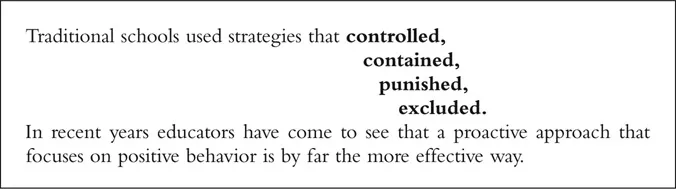
When confronted with negative student behavior, the old traditional schools used strategies that controlled, contained, punished, and excluded as a way to deal with students with behavior problems. Fortunately, in recent years educators have come to see that a proactive approach that focuses on positive behavior is by far the more effective way to manage both appropriate and inappropriate behavior. By being proactive, we set high expectations and show that we believe students can succeed in reaching those expectations. If we can encourage positive behavior in our students, we automatically reduce inappropriate behavior. We do not ignore inappropriate behavior, but it is not our primary focus.
What Is the Link Between Behavior and Learning?
In the Introduction we talked about the classroom as a place where the primary business is— or should be— teaching and learning. The role of the teacher— and you share this role as a paraprofessional— is to teach; students come to school to learn. You will already know that there are a wide variety of different methods available to teachers (and we will discuss this further in Chapter 3), but the most effective methods are those that present relevant and interesting material geared to the students’ individual abilities. This type of teaching is much more likely to engage students and promote on-task behavior.
Engaging Students in Learning
To consider student behavior in the classroom without looking at instructional activities would be a grave error. Students must have something to engage in if they are to also have appropriate behavior. Take, for example, a student who is often out of his seat, moving away from his desk, and roaming about the classroom. A teacher or paraprofessional could have him sit in his chair to practice sitting.
But what will he do to enhance his learning while he is sitting? To merely practice sitting on a chair serves no purpose. Learning requires having something to do— such as completing a math assignment, reading a book, writing, or drawing. It makes sense to see if he can remain seated while solving math problems, for example, and writing the answers. But this is something of a chicken-and-egg situation: Which comes first— the good sitting or the engagement with the task? The math task gives him a reason for sitting and also enables him to engage with the task. But if the task is uninspiring or has no relevance for the student, he has no incentive to sit and engage with it.
On the other hand, when a learning activity is by its very nature engaging— or presented in an engaging way— the student will want to sit and engage with it. Solve the issue of engaging work, and you solve the issue of sitting.
It also is sensible to include the student in setting goals for this type of engagement. “Tom, I’m going to see if you can stay in your seat while you complete these math problems. How long do you think you can remain seated?” (Student gives an estimate of 10 minutes.) “Yes, I think 10 minutes is a reasonable goal. Would you like me to set the timer?” Research studies have shown that students are more likely to achieve their learning and/or behavior goals if they participate in developing them. They also put more effort into achieving those goals and show more interest.
The Goldilocks Principle
Teaching and learning activities are the reason for school. Yet, if the learning activity is too difficult or too easy, the student can quickly become bored or frustrated and disengage from the activity— and be likely to leave the activity, get out of the chair, and move about the room. We could think of this as the Goldilocks Principle.
If you’re familiar with the fairy tale, you’ll know that when Goldilocks visited the house belonging to the family of three bears, she tried the stools, the beds, and the porridge. Father Bear’s bed was too hard, his stool was too high, and his porridge was too hot. Mother Bear’s bed was too soft, her stool was too short, and her porridge was too cold. But Baby Bear’s bed was “just right”— as were his stool and his porridge. And why were they just right? They were just right because Baby Bear’s needs and preferences matched Goldilocks’s needs and preferences. So too with our students— the learning activities we present for them must meet their abilities (or needs) and preferences to be engaging. Too difficult, and the student will quickly disengage. But likewise, if the activity is too simple and lacks challenge, students will quickly become disinterested.
Easy? Difficult?
How do you know if the activity is too easy or too difficult for the student? One of the best ways to find the answer to that question is to ask the student about the assignment. Pose questions such as, “Can you show me where you are on the assignment?” “What will you do next?” “Do you need help in figuring out that answer?” Through these types of questions, the student can show you what he is doing, where he is in the process, and what he plans to do next. Careful observation and listening to the answers to these questions provide you with a means to identify where and how he is challenged by the concepts— if he is flying through the work because it is too easy, or whether or not he is stumped.
Work Is Too Easy
Some students may complain to you or the teacher that the work is simple, easy, or stupid. These are warning signs that signal you should closely observe how the student tackles the activity. You will note that the work is too easy if the student rushes through the assignment— finishing it accurately and much more quickly than most of the other students.
When work is below the students’ achievement level they may engage for a while, but if it continues to be too easy they disengage and find other things to do. This lack of interest in starting or completing the assignment often leads to daydreaming, to getting out of the chair and moving about the classroom, and potentially to more generally disruptive behaviors.
Work Is Too Difficult
Determining that the work is too difficult is not always as easy to spot. The student may not be willing to tell you it is too hard for him, to avoid potential embarrassment. He may, however, say, “This assignment is stupid,” or “I just don’t like it.” Close observation may show that he dives into the assignments with enthusiasm but quickly becomes discouraged. He may drop his pencil and get out of the chair to move away from the work, thus escaping the activity. Other unwanted behaviors may follow, such as interrupting or teasing neighbors who are working. The student is no longer engaged in learning and his classmates are stopped from learning, too.
Paramount to appropriate behavior is to have engaging learning activities for students. If you identify the activities that are too difficult for the student— or too easy— consult with the teacher for the guidance that can be given to remedy the situation.
Just Right!
When the work is not too difficult and not so simple that the students feel they are wasting time, they will engage in learning.
Make sure the student understands each assignment (what to do), how it is to be done (e.g., handwritten), and the expectation for achievement (e.g., at least 80% correct). Verify that he has the prerequisite skills leading up to this assignment. For example, in order to find the coordinates on a map, a student must first have the prerequisite skills of knowing latitude and longitude. These proactive measures will help to facilitate student engagement and ensure that tasks set are “just right.”
Verify students have the prerequisite skills, then
Teach students
- What to do.
- How it is to be done.
- The expectation for achievement.
Behavior Theory— What Makes It Happen?
In this section we briefly take you through some historical perspectives of behavior, so that you can better understand how ideas have developed— in a variety of different fields of study— and how they have influenced what we do in schools today. As you read about the different perspectives, take note of those that you recognize as being part of the different behavioral approaches you’ve experienced.
An American psychologist named B. F. Skinner developed a theory of behavior from studying animals such as pigeons and rats. He placed pigeons and rats in special boxes that had buttons in them. If the animal pressed the button, the animal received food. Skinner found that an animal that was rewarded with food became much more likely to push the button again. He also found that giving the animals something they didn’t like made them less likely to push the button. This research continued and became the basis for his theory of behavior, known as Operant Conditioning.
B. F. Skinner had based his work on the experiments of Pavlov, who had observed what he referred to as a “conditioned” response in animals. Pavlov is well known for his experiment with dogs. When he consistently rang a bell before feeding a dog, the dog soon began to anticipate the food and salivate just on hearing the bell— even if food wasn’t then produced. Pavlov measured the amount of saliva the dog produced and was able to “condition” the salivating response of the dog using a number of different noises and objects. That is, under a particular condition (the bell or other noise, or even the appearance of the lab assistant who fed the dog), the dog produced saliva because he anticipated food once he heard the bell or saw the lab assistant. This was a natural, physiological behavior— a spontaneous response— in the dog, and we must bear in mind that neither Pavlov nor Skinner was thinking in terms of education or classrooms. They were more interested in behavior as a general concept.
Before we go on to consider Skinner’s Operant Conditioning as it relates to education, can you think of ways in which students are “conditioned” to behave in certain ways, just because of what they see and hear? Take a moment to think about this. You’ll find some examples in the nearby box. We’ve left a couple of lines for you to add other actions and responses.
Conditioned Responses in Students
| When: | This Is What They Do: |
| Students hear the bell for the end of recess … | they move toward the school door or line up. |
| The school bus stops at the school door … | the students get off the bus. |
| ________________________ | ________________________ |
| ________________________ | ________________________ |
The theory of Operant Conditioning focuses on making behaviors more or less likely to reoccur. Essentially, when a person does something (the behavior), he or she receives a consequenc...