eBook - ePub
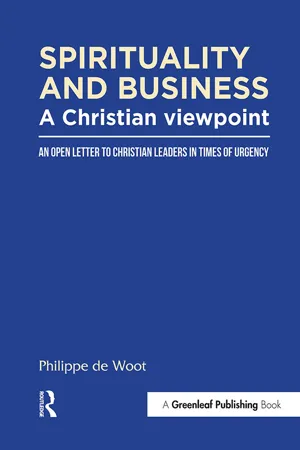
Spirituality and Business: A Christian Viewpoint
An Open Letter to Christian Leaders in Times of Urgency
- 102 pages
- English
- ePUB (mobile friendly)
- Available on iOS & Android
eBook - ePub
Spirituality and Business: A Christian Viewpoint
An Open Letter to Christian Leaders in Times of Urgency
About this book
Are the demands placed on 21st-century business leaders compatible with Christian values? Is it possible to act ethically and be socially responsible within a global system driven by economic demands? This important book explores the current conflict between spirituality and corporate leadership and asks challenging questions of business leaders and decision-makers.
Information
Chapter 1
On the Edge of the Abyss or the Threat of Unreason
See, I offer you today life and good, death and misfortune... I offer you life or death, the blessing or the curse. Choose therefore life so that you and your descendants may live... If you do not obey the Lord your God (if you do not give an ethical dimension to development) you will be cursed in the city and cursed in the country. Your basket and your kneading trough will be cursed. The fruit of your womb will be cursed, and the crops of your land, and the calves of your herds and the lambs of your flocks... The Lord will send on you curses, confusion and rebuke in everything you put your hand to until you are destroyed and come to sudden ruin, until he has destroyed you from the Land you are entering to possess. The sky over your head will be bronze, the ground beneath you iron... The Lord will cause you to be defeated before your enemies... He will afflict you with madness, blindness and confusion of mind... (Deuteronomy, 28:15-28)
By disassociating economic activity from politics and ethics, we are doing the wrong thing.
Blinded by the brilliant achievements of our economic system, we do not see that insanity looms over us and that once again barbarity threatens us.
Systemic drifts and deviations
All recent analyses of our development model revealed major dysfunctions and unintended effects that call into question its long term effectiveness and legitimacy. But it is necessary to push the sole economic analysis further to show the extent of the crisis that threatens us and the urgency of significant reform.
The company being the archetype of economic and technical creativity, it was long believed that its action automatically served the Common Good thanks to the virtues of the market and of its famous “invisible hand”. Nowadays, this belief is clearly called into question.
Globalisation, the advances in technological sciences and the lack of global regulation confer the power to act without precedent upon the economic system. It exerts this power according to its own criteria: profitability, competitiveness, market share. In the absence of global regulation, this approach tends to become dominant and imposes a development model on us that has no other purpose than its own effectiveness and dynamism. Led by instrumental logic alone, this model becomes more and more ambiguous and paradoxical: never has our ability to create richness been so great and never has the number of poor people been so high; never has our scientific and technical knowledge been so broad and never has the planet been so threatened; never has the need for economic governance been so compelling and never have nation states been so disarmed.
All the while ensuring economic growth, unprecedented in human history, our model races on, pollutes, excludes, and brings about incidences of domination, social injustice and deconstruction.
It begs the question whether the current model is still politically and morally acceptable without profound changes.
We may even ask ourselves if we have completely blinded ourselves to the failings of this, if we are party to these overall malfunctions and whether they lead us towards the irrational.
Our model generates systemic risks which are not clearly desired, which are difficult to measure if not to anticipate, and whose consequences can jeopardise the social balance, the methods of control and regulation, the institutions and the planet itself. We are in a high risk society that requires us to force ourselves to question, and to take more responsibility to invent new methods of regulation and governance.1
Does a Christian vision of the company not oblige us to become aware of the fact that this system, despite its brilliant achievements, is reaching its limits and could lead us into up against a brick wall? The explosion of the financial bubble has shown how fragile it was, how little we knew and how devastating the effects could be on the weakest.
All too often, we take refuge behind the simplistic argument that our model is the best possible and that all others have shown their inability to generate wealth as effectively. It has flaws but they can be corrected, and moreover it continues to improve, etc ...
A Christian leader among the most committed, worthy of the greatest admiration and who seeks more than most leaders to correct the human foibles of our model, however, writes this:
The only thing of which I am convinced is that the system of the market economy is the best that man had been able to develop. So, if there are weaknesses today, that are indeed less than that at the time of Karl Marx, we only have one choice, and that is to continue to improve it.2
He does so and it is fundamental and it is wonderful. But our system which becomes global, does it not, on a worldwide scale, have infinitely more defects than at the time of Marx? Some companies, it is true, have been humanised, but the system as a whole ...?
As well as a genuine commitment in the company, should we not make a more objective and radical criticism of the system itself if we want the Christian commitment to further influence its transformation? Should we not have the courage to call things by their name rather than risk being locked into an optimism that could be misleading?
This is what we have tried to illustrate in the following lines.
Folly watches over us...
There is a kind of folly that the Furies unleash from Hell each time that they release their snakes and toss the ardour of war to the hearts of mortals, the insatiable thirst for gold...
The other kind of folly bears no similarity... It arises each time that a sweet illusion liberates the soul of its tiresome worries.3
Surely the first folly is to have disassociated the economic activity from politics and ethics? And by that, to have locked ourselves in the sweet illusion of "unidimensional thought"?
Economic globalisation is advancing faster than global governance. It escapes the nation states and gradually imposes its logic on the entire planet. This delay in economic policy leads to a sort of public helplessness to drive real development strategy and to democratically debate societal issues of globalisation. It is as if it was binding on States, not even leaving them the freedom to choose the type of market economy which suits their countiy. Thus the Anglo-Saxon model, more financial and less social, tends to gain ground on a more human model, like the social market economy or Rhineland model.4
Our economic model operates according to the logic of means and not ends: it involves maximising the use of rare resources and the resulting profits. This system is amoral. It does not, in itself, give any indication other than that of solvent markets. Without an ethical or political framework at the global level, it is only guided by its instrumental logic. Under the respectable appearance of dynamism and efficiency in a world open to changes, liberal globalisation also hides a radical ideology. It involves, quite simply, an all too absolutist belief in the efficiency of the markets and of an almost visceral distrust in respect of public intervention and international regulation of economic relations. What a mistake it is to think of the market economy as a self-regulating process that automatically contributes to the Common Good! It also entails a truncated conception of the role of the company of which, according to Milton Friedman, the only social responsibility would be the enrichment of the shareholder.
This, as we see every day, drives the actors in the system to behave unreasonably while the economic theory presents them as rational beings.
What madness to believe that globalisation could smoothly disperse this market logic to the entire planet, without talcing sufficient account of political, cultural and institutional differences, a bit like a steamroller!
The image of the Kingdom is the bearer of another globalisation, that of the universality of human destiny, that of St Paul, where there is neither Greek, nor Jew, and when, according to St Matthew "all nations will be gathered before Him". However, it must be clear, that today globalisation means the universalisation of capitalist market relations, that which Paul VI called the imperialism of money (Popularum Progressio), where the strongest win, where profitability is the dominant logic, where shareholder interests preside over the basic needs of Mankind, where the function of the economy deviates from its meaning, that of providing the basis for the physical, cultural and spiritual development of all human beings around the world, to become solely the production of an added value and finally, where a minority accounts for more than 80% of global income, while hundreds of millions of human beings live in poverty.5
Is another folly not to have left finance to dominate the economy and subordinate entrepreneurship to the vagaries of speculation? Irrational exuberance is just one recent example of this.
Financial capitalism overlooks the real economy now and leads it in a speculative race where money serves to create more money without investing in the production of goods or of services which are useful to people,
The requirement of return, financial in origin, first infiltrated the whole of the economy to then become omnipresent in society and even in the culture of daily life. This development has today led Western societies to a paradoxical situation where they have lost their freedom because their present is actually constrained by the requirements imposed by their own financial future, such as has been articulated by the architects of loanback pensions and proposed by the advocates of “shareholder value”. This “bright future” is proving to be as fanciful as if it were proposed by the communist utopia.6
With speculation bearing on the spirit of the company, we let ourselves slide towards a casino economy where behaviours become, all too often, those of greed and excess: delusional requirements of profitability and growth, dishonesty over figures, dishonesty over products (f...
Table of contents
- Cover
- Title
- Copyright
- Acknowledgements
- Contents
- PREFACE
- INTRODUCTION
- CHAPTER 1: On the edge of the abyss or the threat of unreason
- CHAPTER 2: A new corporation, a new spirit
- CHAPTER 3: New hearts
- ABOUT THE AUTHOR
- INDEX
Trusted by 375,005 students
Access to over 1.5 million titles for a fair monthly price.
Study more efficiently using our study tools.
Frequently asked questions
Yes, you can cancel anytime from the Subscription tab in your account settings on the Perlego website. Your subscription will stay active until the end of your current billing period. Learn how to cancel your subscription
No, books cannot be downloaded as external files, such as PDFs, for use outside of Perlego. However, you can download books within the Perlego app for offline reading on mobile or tablet. Learn how to download books offline
Perlego offers two plans: Essential and Complete
- Essential is ideal for learners and professionals who enjoy exploring a wide range of subjects. Access the Essential Library with 800,000+ trusted titles and best-sellers across business, personal growth, and the humanities. Includes unlimited reading time and Standard Read Aloud voice.
- Complete: Perfect for advanced learners and researchers needing full, unrestricted access. Unlock 1.5M+ books across hundreds of subjects, including academic and specialized titles. The Complete Plan also includes advanced features like Premium Read Aloud and Research Assistant.
We are an online textbook subscription service, where you can get access to an entire online library for less than the price of a single book per month. With over 1.5 million books across 990+ topics, we’ve got you covered! Learn about our mission
Look out for the read-aloud symbol on your next book to see if you can listen to it. The read-aloud tool reads text aloud for you, highlighting the text as it is being read. You can pause it, speed it up and slow it down. Learn more about Read Aloud
Yes! You can use the Perlego app on both iOS and Android devices to read anytime, anywhere — even offline. Perfect for commutes or when you’re on the go.
Please note we cannot support devices running on iOS 13 and Android 7 or earlier. Learn more about using the app
Please note we cannot support devices running on iOS 13 and Android 7 or earlier. Learn more about using the app
Yes, you can access Spirituality and Business: A Christian Viewpoint by Philippe de Woot in PDF and/or ePUB format, as well as other popular books in Theology & Religion & Business Ethics. We have over 1.5 million books available in our catalogue for you to explore.