eBook - ePub
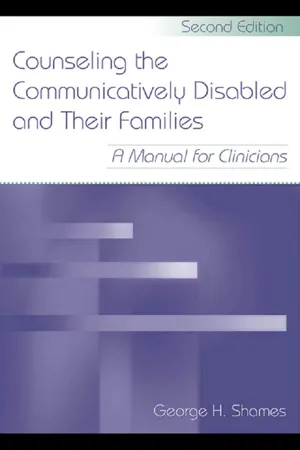
Counseling the Communicatively Disabled and Their Families
A Manual for Clinicians
- 200 pages
- English
- ePUB (mobile friendly)
- Available on iOS & Android
eBook - ePub
About this book
Counseling the Communicatively Disabled and Their Families: A Manual for Clinicians, Second Edition, written by George H. Shames, emphasizes the development of specific interviewing and counseling skills for speech-language pathologists and audiologists, which is a requirement of ASHA's clinical certification standards.
The book offers a clear, basic definition of counseling, then builds a picture of the multidimensional role of counseling in speech-language pathology and audiology using anecdotal references to clinical cases.
Among the changes in the Second Edition, Dr. Shames, a licensed speech-language pathologist as well as a licensed clinical psychologist, has expanded the theoretical overviews that ground the "learning by doing" skill development feature of this updated edition.
Practicing clinicians and students in communication disorders programs, in addition to social workers and clinical psychologists, will find this book invaluable to their training as focused, helpful evaluators and counselors of the communicatively disabled. It will also apply to training in other contexts and circumstances wherein counseling is appropriate.
Information
1
Introduction
The purpose of this book is to help Speech and Language pathologists and audiologists learn the basics of counseling as it relates to communication problems.
It can be used either as a textbook for a formal class in Interviewing and Counseling, or as a manual for self-learning.
The specific behaviors and tactics considered are also applicable across the broad spectrum of diverse problems where group and individual counseling are appropriate.
Rarely do we enter into anything at its very beginning or exit at its conclusion. In any endeavor we may undertake we quickly realize that many others have been there before us and many others will be there after us, addressing the same or similar issues. With each ensuing layer of attention there is a resulting direct influence on what follows, and thus a direct bearing on the content and nature of this book.
There is Rogers (1942,1979) for his original thinking and development of Client-Centered Therapy, and his ideas concerning warmth, empathy, genuineness, self-discovery, and self actualization; Rotter (1966), for his concepts of internal and external locus of control, which underlie so much of the basic thinking and research on counseling; Carkhuff and Berenson (1976) for their delineation of the special roles of helper and helpee and for their behavioral orientations for dimensionalizing the process of interviewing; Strupp (1962,1972) for his writings about trust and love and the significance of the initial impact of the therapist on the total outcome of therapy; Matarazzo, Phillips, Wiens, and Saslow (1965) for defining the parameters of the interview and for their research on the significance of silence and therapist talking time during the interview; Truax (1967, 1972) for his research on the measurement of empathy and on the patient-thera-pist interaction; Ivey (1983) for his concepts of intentionality and the need to develop a repertoire of counseling skills; and Ivey and Authier (1978) for their ideas about how one might dimensionalize and integrate learnable behaviors into an effective set of interviewing and counseling skills.
A special acknowledgement is due to Ivey and Authier (1978) for emphasizing that interviewing and counseling can only be learned by doing; and to Skinner (1953) for his principles of reinforcement, which we will readily see enhance our understanding of the dynamics of the strengthening and weakening of thoughts, beliefs, and behaviors. These processes appear to function for both the client and the counselor through their verbal and nonverbal feedback to each other during interviews.
These are only a few of the many people who deserve acknowledgment. I have tried to note these many influences as much as possible and as space permits. I can only ask forgiveness from those who have been omitted.
There are many more whose research and ideas have influenced the content of this book. For those readers and scholars who are interested in a larger sample of the history of thought, theory development, and research, on the subject of counseling, we refer you to Microcounseling, by Ivey and Authier, to The Dynamics of Interviewing, by Kahn and Cannell, and to The Anatomy of Psychotherapy, by Lennard and Bernstein. They provide a more pervasive consideration of these many contributors than we have space for in this manual.
We realize that we enter in midstream, and can only hope that what we do with this brief clinical application manual may make things better for those who follow. It is this desire to reach those of you who wish to learn how to counsel the communicatively handicapped that has influenced the content, the organizational design, and the suggested strategies contained in this book.
Some of this book deals with specific interviewing and counseling behaviors, including their form and rationale as well as optimal timing for use during an interview. Attention is also given to how to learn and practice these skills so that they become a part of one’s counseling repertoire. Other parts of the book deal with developing certain holistic attitudes and behaviors that may characterize the entire interview, and learning how to communicate these holistic attitudes to the client. The learning of these skills and attitudes is enhanced if they are considered one at a time, sometimes quite separate and independent of one another, and then are gradually integrated into the clinical interview.
The attitudes, behaviors, and communication of the counselor are the three underlying themes that are the central core of this book. Each of these categories of counselor characteristics targets two basic concepts. One is “focus on the client,” which is both attitudinal and behavioral, and which demands the subordination of one’s self. The other concept is “intentionality,” which implies maximizing the counselor’s control over what he or she does during a counseling interview, and minimizing his or her accidental, random, and nondeliberate behaviors.
These concepts of “focus” and “intentionality” will come up repeatedly in the progression of material that is presented. As you will see, they are the key for the development of all of the other facilitative and helpful attributes being considered. Also, it should be pointed out that there is no gender differentiation intended regarding the subject of the content, for either client or counselor. The use of such words as “his” or “her” are means to refer to both males and females, unless there is a differentiating comment in the content.
2
Getting Comfortable with Counseling
A number of issues must be considered during our immersion into the actualities of interviewing and counseling with the communicatively handicapped and their families.
One of these issues deals with our own comfort level, as speech, language, and hearing clinicians, relative to taking on the functions of a counselor.
Many of us see ourselves as being limited to only our primary functions of helping the communicatively handicapped change the way they communicate. As communication specialists we have a natural tendency to focus on our functions as a source of information, as diagnostician, prognos-ticator, and teacher of new communication skills. However, such an exclusive focus may be too narrow because it does not take into account the emotional sequalae associated with communication problems. Flasher and Fogle (2004) in their book Counseling Skills for Speech-Language Pathologists and Audiologists, pointed out that clients with communication problems can show a wide range of emotional problems. They specifically mention depression, guilt, fear, resistance, anger, and crises.
Issues of self-esteem, denial of a problem, motivation to change, acceptance of change in one’s self, changes in interpersonal relationships, as well as conflicts between old and new self-expectations resulting from therapeutic change, can all be factors in therapy. In addition, educational, occupational, social, and interpersonal relationship issues commonly warrant examination in the context of living with a communication problem, as well as in the context of having changed how one communicates, or being free of their communication problem. Each of these issues has a powerful emotional underpinning that drives them to function either constructively or destructively in a person’s life.
Wolf and Wolf (1975) in their Counseling Skills Evaluation Manual raised questions that we must take into account if we are to be effective.
They asked, What do people seek from a helping relationship? Many seek relief from painful symptoms; others wish to learn more adaptive and successful ways of living. At deeper levels, individuals hope to find serenity, peace of mind, and freedom from disabling conflicts. Many hunger to find meaning and purpose in life. Still others wish to become more productive and accomplish more of their ambitions. Expanding one’s awareness, being more spontaneous, and becoming free from inhibitions are other goals for clients. Learning to be the master of oneself, effective at living, making important decisions about relationships, and becoming capable of commitment, intimacy, and genuineness are crucial issues at the core of life itself. How can people develop the means necessary to reach such heights of personal accomplishment and self-actualization?
Carkhuff (1969b), in addressing this question, has suggested that two processes are necessary for one to become more self-actualizing: selfexploration and action.
In order for a person to improve he must explore his behavior, thoughts, and feelings, as well as how he deals with stress, relates to others, and handles frustrating situations and disappointments. He must learn how to love in the profound sense of the word and discover his purpose in life.
As an individual explores himself, he learns more about his own selfimage, his habitual behavior, and the way he interacts with others. As a result, he develops increasing self-awareness. Not only does a person gain insights as a result of self-exploration, but he also discharges pent-up emotions. Feelings associated with traumatic, painful, and personally embarrassing or damaging experiences in the past are relived, and the emotional reservoirs of painful experiences are released, thus producing freedom from the constrictions and conflicts that may have plagued the person.
Families and individuals living with communication problems are certainly not immune to these emotional issues in their lives. On the contrary, they experience more than their fair share of them because of their communication problems.
However, knowing the “whys” of one’s behavior and experiencing freedom from painful emotions does not necessarily lead to lasting improvement. Individuals must do more than explore themselves in order to achieve enduring growth. They must take action. For individuals having communication problems, they are faced not only with the problem of learning new communication skills, or adjusting to living with some unchangeable aspect of their communication behavior, but also with the need to experiment with new behaviors and new techniques of living. They must put into operation new methods of reacting to others and dealing with frustrations. They must learn new ways of thinking about themselves and others. They must learn more effective techniques for living successfully. They must learn constructive behaviors to replace the former self-defeating, destructive behaviors—a process that requires risk taking. (p. 7)
Theodore Reik (1949) in his book, Listening with the Third Ear described an event that is most appropriate to this discussion, because it involved being encouraged to take a risk and to try something he had never done before.
When he was still a student studying with Freud, and walking home in the city of Vienna, Reik ran into “the great man” and told him about a problem he was having in making some decisions about marriage and his profession, hoping that Freud would give him some advice.
Freud stated,
I can only tell you of my personal experience. When making a decision of minor importance, I have always found it advantageous to consider all the pros and cons. In vital matters, however, (with Freud not knowing the content of Reik’s stress) such as the choice of a mate or a profession, the decision should come from somewhere within ourselves. In the important decisions of our personal life, we should be governed, I think by the deep inner needs of our nature. (p. vii)
Without telling him what to do, but incidentally mentioning the very content areas that were bothering Reik, Freud had helped him make his own decisions that stuck with him the rest of his life.
Counseling around such issues as decision making is one of the most common problems encountered by people, and the timeliness of Freud’s sharing behavior is a powerful example of several strategies that a counselor might employ to be helpful in such a circumstance.
By virtue of our training, education, and clinical presence as communication specialists, we are uniquely positioned to consider such emotional problems.
But we must also consider how our teaching functions may either relate to or be kept separate from counseling.
Luterman (1977) and Rollin (1987), although 10 years apart from each other, reinforced the continuing importance of separating guidance counseling from psychological counseling. Luterman, in his 1977 book, which focuses on the hearing impaired, distinguished guidance counseling as a process that provides information to the client and to his or her family. This is a very important function, especially when the client is a newborn or a toddler. The parents need information about parenting a hearing- impaired child, and also about the process of aural habilitation and developing methods for their child to acquire communication skills. Unfortunately, far too often, such guidance counseling involving giving advice and information can become the only form of counseling made available to them. There are numerous psychological issues related to being hearing impaired or having the parental responsibilities for being helpful to one’s child with such a problem. A different category of counseling, which has come to be known as psychological counseling, may be needed in addition to guidance counseling. This is also true for an individual who develops a hearing problem later in life. Adjusting to living with a hearing problem after many years of hearing normally can be a major source of stress that generates a feeling of social isolation.
Luterman (2001) has strongly recognized this often unmet need and takes the counseling process further and deeper into considering the emotional dimensions of living with silence.
Such clients need more than information and advice, and the audiologist might well take on such additional counseling responsibilities, if he or she obtains the appropriate education and clinical training.
Rollin (1987) also differentiated guidance counseling from psychological counseling, similar to the thinking of Luterman.
Using a medical model, Rollin pointed out that guidance counseling is more directive and involves providing information to a client, whereas psychological counseling involves helping a normal person to make appropriate adjustments. This can be in the form of client-centered counseling in which the client is encouraged to engage in self-discovery, examining oneself, and then developing and engaging in strategies to resolve stressful issues. He also pointed out that psychological counseling could also be directive wherein the counselor directs the client into certain beliefs and actions.
Rollin (2000) further pointed out that each of these types of counseling is far different from psychotherapy where the client is diagnosed as showing very abnormal psychological reactions, beliefs, feelings, and acts. He stated that psychological counseling is for normal people to help them solve problems and make readjustments for everyday living. Such counseling can help make adjustments rather than personality changes.
On the other hand, psychotherapy is for sick people who need to make personality changes because of psychological abnormalities.
Hutchinson (1979) suggested that the many different methods of counseling can be classified into five main categories. These would include (a) behavioral counseling, (b) client-centered counseling, (c) role playing, (d) psychoanalysis, and (e) drug intervention.
It is important that we define what counseling is, especially as it might differ from psychoanalysis or other forms of psychotherapy. There are significant differences between psychotherapy and counseling and important overlaps as well.
The most significant differences are that psychotherapy attempts to restructure the personality, especially in terms of a particular theoretical orientation about the nature and dynamics of personality. Psychotherapy generally views the client as being ill, and as a result searches for the cause or the theoretical etiology of a person’s problems. The person’s overall history, family relationships, and the reliving of early childhood trauma are viewed as keys to resolution.
Many psychotherapies have been developed and are being practiced in our society, each with a different focus on such things as cognitive experiences, precognitive experiences, the unconscious, the collective unconscious, personality archetypes, complexes, unconscious defense mechanisms, and levels of repression. Theoretical concepts include the ego, super ego, and id, as well as phases of psychological development (i.e., oral, anal retentive), and sexual conflicts. Each of these is an integral element in the theory, thinking, and tactics associated with these psychotherapies. Some of these therapies employ dream interpretation and free association as parts of their repertoire. Each embraces a psychodynamic orientation that underlies its therapeutic tactics.
Often psychotherapy treats the presenting complaint as an overt symptom of a much broader and more pervasive underlying problem. Thus, in therapy, the symptom soon loses its importance and significance. The focus then shifts from the symptom to the nature of the underlying problem, as stated in the theoretical dynamics of the client’s personality.
Counseling, by contrast, deals with the present, with here and now ...
Table of contents
- Cover Page
- Half Title page
- Title Page
- Copyright Page
- Dedication
- Contents
- About the Author
- Preface to the Second Edition
- Preface to the First Edition
- 1 Introduction
- 2 Getting Comfortable with Counseling
- 3 The Relationship Between Speech/Language/Hearing Therapy and Counseling
- 4 The Clinical Relationship
- 5 The Counseling Interview
- 6 Listening and Attending
- 7 Specific Facilitative Interviewing Behaviors
- 8 More Advanced Interviewing and Counseling Skills
- 9 Special Events During the Interview
- 10 Facilitative Holistic Attributes of the Counseling Interview
- 11 Nonfacilitative Holistic Attributes of the Clinical Interview
- 12 Special Client Populations
- 13 Some Comments about the Outcomes of Therapy
- Appendix A: Forms for Evaluating Clinical Interviews
- Appendix B: Words to Describe Feelings
- Bibliography
- References
- Author Index
- Subject Index
Trusted by 375,005 students
Access to over 1.5 million titles for a fair monthly price.
Study more efficiently using our study tools.
Frequently asked questions
Yes, you can cancel anytime from the Subscription tab in your account settings on the Perlego website. Your subscription will stay active until the end of your current billing period. Learn how to cancel your subscription
No, books cannot be downloaded as external files, such as PDFs, for use outside of Perlego. However, you can download books within the Perlego app for offline reading on mobile or tablet. Learn how to download books offline
Perlego offers two plans: Essential and Complete
- Essential is ideal for learners and professionals who enjoy exploring a wide range of subjects. Access the Essential Library with 800,000+ trusted titles and best-sellers across business, personal growth, and the humanities. Includes unlimited reading time and Standard Read Aloud voice.
- Complete: Perfect for advanced learners and researchers needing full, unrestricted access. Unlock 1.5M+ books across hundreds of subjects, including academic and specialized titles. The Complete Plan also includes advanced features like Premium Read Aloud and Research Assistant.
We are an online textbook subscription service, where you can get access to an entire online library for less than the price of a single book per month. With over 1.5 million books across 990+ topics, we’ve got you covered! Learn about our mission
Look out for the read-aloud symbol on your next book to see if you can listen to it. The read-aloud tool reads text aloud for you, highlighting the text as it is being read. You can pause it, speed it up and slow it down. Learn more about Read Aloud
Yes! You can use the Perlego app on both iOS and Android devices to read anytime, anywhere — even offline. Perfect for commutes or when you’re on the go.
Please note we cannot support devices running on iOS 13 and Android 7 or earlier. Learn more about using the app
Please note we cannot support devices running on iOS 13 and Android 7 or earlier. Learn more about using the app
Yes, you can access Counseling the Communicatively Disabled and Their Families by George H. Shames in PDF and/or ePUB format, as well as other popular books in Psychology & History & Theory in Psychology. We have over 1.5 million books available in our catalogue for you to explore.