![]()
PART 1
A New Leader is Emerging
A NEW SET OF LEADERS IS EMERGING that uses a dynamic set of skills and capabilities to recreate the economic, social, environmental, and cultural models needed to create the innovative systems, products, cultures, and operations that their organizations will need to thrive in a complex, global environment.
These sustainability leaders are emerging within operations, manufacturing, marketing, environmental health and safety, human resources, and across functions as chief sustainability officers, directors of public affairs, directors of employee engagement, mayors, city managers, civic leaders, etc. They are pioneers, many in roles that are newly formed or expanding their scope to provide strategic guidance and targeted implementation of a wide range of initiatives. These leaders are using sustainability as a ‘strange attractor’ to draw unlikely allies into a wave of engagement and commitment to making change that matters.
They use a broad set of engagement strategies and personal agility to face the challenges of doubt, resistance, and the complexity of getting things done across many interests. They use inner resilience and foster collaborative relationships to build long-lasting change.
We have seen sustainable leaders come to their work along two main paths: they either have the responsibility for initiating sustainability-focused work thrust upon them, or they initiate these roles as ‘intrapreneurs’, engaging their organizations from a values-based conviction that change in this direction is necessary. A few have the opportunity to receive targeted education in sustainable leadership from the innovative programs at Presidio Graduate School and Bainbridge Graduate School where sustainability thinking is integrated into all courses. Most have initiated their own learning path.
This book is designed to give you an intensive leadership ‘tune-up’ so you can integrate sustainability into strategy — whichever path you happen to be taking. We will provide Application Exercises throughout where you can stop and apply the fundamentals being taught to your own situation.
This book draws from frameworks and tools built over the last eight years in the Sustainable and Civic Leadership classes at Presidio Graduate School and Troy University. It features Case Stories that highlight the experiences of the 750 graduates of these Sustainable Leadership programs who are designing and implementing innovative sustainable change out in the world alongside the stories of numerous pioneers of sustainability initiatives, all of whom we have had the privilege to work with, who are pushing ahead even though they don’t have all the answers.
Sustainability is a journey
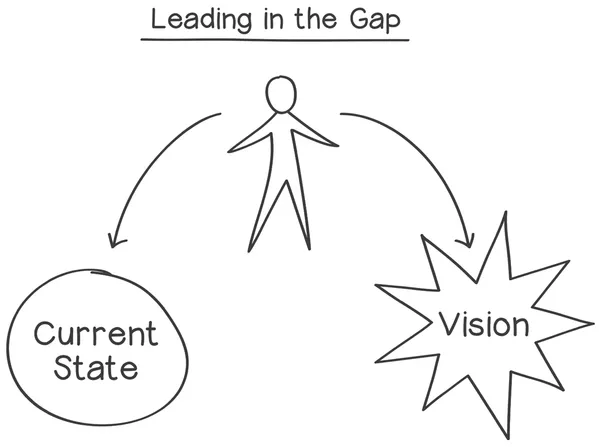
It is common for sustainability leaders to hold a clear a vision of where they would like to be and at the same time understand the current state of their organization’s practices. This gap creates a dynamic tension for action.
Too big of a gap can also prevent action as people sometimes feel that they have too far to go, resulting in avoidance. A change leader acts as a bridge, holding this tension by creating a path so that people can catch the vision and have the courage to begin.
FIGURE 2. Leaders hold tension between the current state and a vision for the future.
People and organizations can become depleted if they see too big a gap between where they are and where they want to be. A change leader can reduce this gap by asking where the organization is currently sustainable and identifying what is already working. Instead of focusing on problems, focus on the possibilities. This energizes people to see that there is already forward movement to build upon.
Leading sustainability efforts is never smooth, and because innovation is a series of iterative steps, you will predictably stumble a few times. It is important to keep ‘falling’ in the direction that you want to go, seeing each successive effort as part of a larger strategic focus. All leaders have had this experience, even if they do not readily talk about it. The most important factor is how you reset your focus and renew your momentum. Acknowledging, learning, and trying again are key actions in leading change in organizations.
New leaders need new skills
At the core of sustainable leadership is the ability to be an agile leader and facilitator of change. Agility requires advanced capabilities in strategy formation and execution in complex, multi-stakeholder environments. The systemic nature of many of these changes calls on sophisticated approaches to leading organizations and the people in them.
You must be able to navigate individual, group, and whole organizational systems to translate ideas and technical expertise into desired actions. Change leadership requires both strategic vision and day-to-day conversations as well as actions that call for a level of personal resilience and agility that can challenge the most seasoned leader.
This book was written to help you develop those capabilities and lead your organization to the change you envision.
![]()
PART 2
Navigational Tools For Leaders
THE PATH TO SUSTAINABILITY CAN BE LONG, full of obstacles and opportunities for missteps, and is often uncharted. In this section, we will provide you with the frameworks and tools successful sustainability leaders use to guide their organizations toward powerful visions for the future.
Beware of benchmarking
There is no one magic path to success. Other organizations’ experiences can provide inspiration and guidance, but in our experience each successful implementation is the result of many choices based on a unique set of conditions.
Leaders use a combination of approaches to create and steer the sustainability initiatives in their organizations. It can be tempting to look for best practices and apply them to your situation because they have led to success elsewhere. However, each organization has its own history, culture and special challenges, and what works for one organization will not necessarily work for another. Sustainability change is most successful when engagement and involvement is catalyzed throughout the organization.
Because of the broad systemic nature of sustainability-focused challenges, it is necessary to go slow to go fast: be willing to take more time to customize and identify unique leverage points in the beginning. We have seen a set of four actions that have framed the approaches of a number of sustainability leaders.
Sense, scout, synthesize, steer
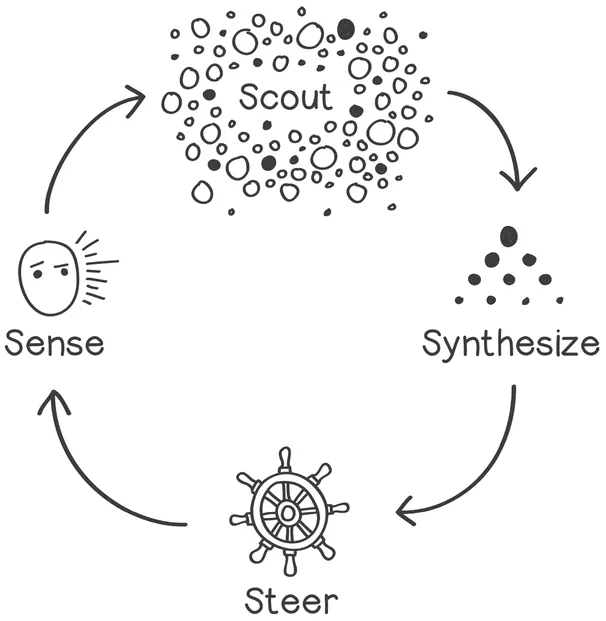
FIGURE 3. Sustainability leaders need to sense, scout, synthesize, and steer.
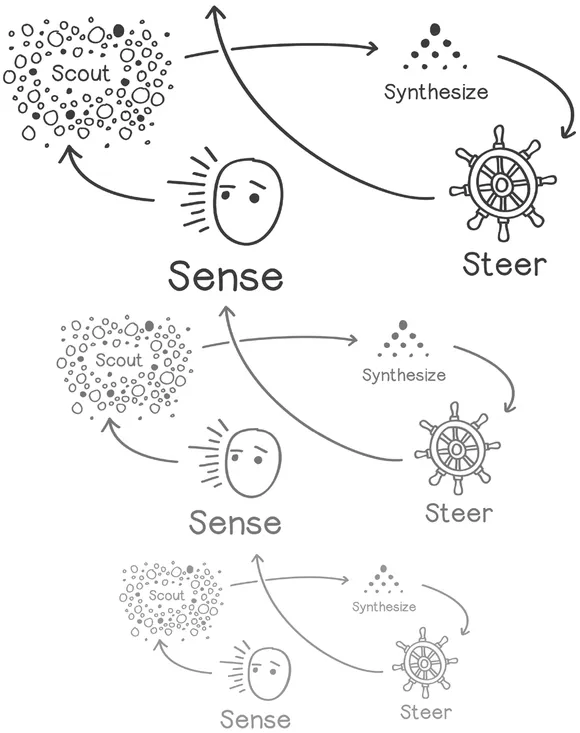
Sustainability leaders take four repeatable navigational actions to create strategy and engage employees and communities to make change and move towards a thriving future. These actions are repeated over and over in the process of designing and implementing change. They can provide a framework for focusing and sequencing your leadership approach, over the course of multiple initiatives. By taking these actions, you will produce fresh engagement and focus, enabling follow-through and implementation to take place.
- Sense: Identify your purpose. Connect your core values to your personal intention to become resilient and establish a foundation for leading change.
- Scout: Look around you. Understand and appreciate the stages of transition, assess organizational and individual readiness, and identify key people and leverage points for change.
- Synthesize: Find patterns and build commitment. Map your change journey, design, test, and evolve approaches with rapid feedback, and engage others with stories of progress.
- Steer: Implement and calibrate. Mobilize action, track progress, encourage feedback, and continue to grow.
These actions are supported by tools and frameworks that are not specific to sustainability. They represent the approach of leaders who use their personal values to engage others in developing and implementing changes that improve performance and increase innovation. These leadership skills are not new but have been gaining validity as an alternative to more traditional tell-and-sell leadership. The most successful leaders in sustainability are using these positive, collaborative approaches to engage all levels of their organizations in continuous change.
FIGURE 3a. These actions are repeated over and over in the process of designing and implementing change.
Sense: Identify your purpose
Welcome to the world of being a change agent. Whether or not you have chosen this role for yourself, change leadership has chosen you. This is an invitation to lean into change, to take initiative for advocating and activating multiple energies to create change. Creating change in your organization means starting with yourself. An organization can only go as far as its leaders: you will only ever be able to create as much change as you can tolerate yourself. It is important to know who you are and why you’re doing what you’re doing. Understanding these things will provide a foundation for you to create lasting change.
Leading sustainability change requires both short-term action and long-term perseverance. There are two clear areas where successful sustainability leaders seem to excel. First, they have the ability to structure and facilitate collaborative engagement with a number of stakeholders. Second, they have the ability to stay the course as both organizational and cultural values shift.
Case Story
Bob Langert, VP of Corporate Social Responsibility at McDonald’s has been with the company for over 30 years. He started out working in logistics and ended up in sustainability leadership by accident. In 1998, he was assigned to a temporary position working on environmental initiatives like phasing out the use of CFCs in McDonald’s packaging. While in this position, he had the epipha...