In addressing the urgent questions raised by climate change, this book provides a comprehensive overview of the anthropology of climate change, guided by a critical political ecological framework. It examines the emergence and slow maturation of the anthropology of climate change, reviews the historic foundations for this work in the archaeology of climate change, and presents three alternative contemporary theoretical perspectives in the anthropology of climate change.
This second edition is fully updated to include the most recent literature published since the first edition in 2014. It also examines a number of new topics, including an analysis of the 2014 American Anthropological Association's Global Climate Change Task Force report, a new case study on responses to climate change in developed societies, and reference to the stance of the Trump administration on climate change.
Not only does this book provide a valuable overview of the field and the key literature, but it also gives researchers and students in Environmental Anthropology, Climate Change, Human Geography, Sociology, and Political Science a novel framework for understanding climate change that emphasizes human socioecological interactions.
Introducing a socioecological model of human action, environmental impact, and mounting vulnerability
Human societies began to make the transition from small foraging or hunting-and-gathering bands to larger horticultural village groupings at least 12,000 years ago, and the transition to comparatively enormous stratified states about 6,000 years thereafter, starting initially in Mesopotamia and continuing somewhat later in Egypt, the Indus Valley, and China, and even a little later in the Americas and sub-Saharan Africa. These transitions have occurred in the context of what geologists call the Holocene, a geological era generally believed to be an interglacial period characterized globally by only minor shifts in climate, such as the Medieval Warm Period (AD 950–1250) and the Little Ice Age (AD 1300–1850). In local environments, however, there is geological and archeological evidence of marked climatic change during the Holocene. Climate change, although primarily driven at the time by natural forces rather than anthropogenic or human-created ones, appears to have played a role in shaping human societies over the centuries, including contributing to the collapse of some ancient civilizations, such as the Classic Maya in the ninth century AD (Kennett et al. 2012), and in the settlement or abandonment of various regions over time. In this sense, climate has always been a significant although often disputed factor influencing life on Earth, including the lifeways and behaviors of humans. For example, evidence suggests that “the climate controlled desiccation and expansion of the Saharan desert since the mid-Holocene may ultimately be considered a motor of Africa’s [cultural] evolution up to modern times” (Kuper and Kröpelin 2006: 807).
Perspectives on the nature of the human/climate nexus, at times reflecting an environmental determinist or climate determinist stance, have passed through three broad phases. In the first, dating to ancient times, the celebrated Greek philosopher Hippocrates wrote a treatise titled “Airs, Waters, Places” in which he attributed cultural or dispositional differences to environmental factors. Similarly, polymath scholar/philosophers such as Ibn Khaldûn, credited by some as the father of the social sciences and historiography, explained the cross-cultural differences of which he was aware in terms of the determinant influence of the local physical environment, including habitat and climate (Gates 1967). By the second decade of the twentieth century, however, the power of environmental determinism as an intellectual current was in decline.
In anthropology, a field that has long grappled with the notion that each habitat presses for the development of a distinctive mode of cultural life or adaptive social pattern, researchers were moved away from determinist thinking under the influence of the detailed and particularist ethnographic focus on individual cases originated by Franz Boas and Bronislaw Malinowsi. At the heart of this turn was the realization that two groups in reasonably similar environments might develop differing and unique responses leading to differing cultural outcomes, or, conversely, that similar cultural traits might develop under divergent climatic and environmental conditions. Consequently, as Dean (2000: 89) indicates, “Scientific perspectives on the relationship of human societies to the natural environment have ranged from doctrinaire environmental determinism to the contention that environment has minimal impact on human societies.” Beginning in the 1950s, with the insightful work of Julian Steward (1955), a new ecological perspective emerged in anthropology that once again began to give serious consideration to the role of the environment as an important influence—although certainly not a narrow and overwhelming determinant one—on human ways of life. In this new approach to the human relationship to the rest of nature, environmental determinism is tempered by an expanded awareness of the extensive impact of human action on other domains of the world. Humans do not adapt to existing environmental niches, they cope with existing challenges and exploit cultural opportunities, while re-shaping other components of the world to address culturally rooted needs and desires.
More recently, within the shadow of Steward, in what has come to be called environmental anthropology, “the [applied] study of the human–environmental relationship [has been] driven largely by environmental concern” about climate change, natural disasters, loss of biological diversity and related issues of sustainability (Shoreman-Ouimet and Kopnina 2011: 1). This same concern, strongly propelled by the seeking of answers to fundamental questions about “who owns the Earth [and who] owns the global atmosphere being polluted by the heat-trapping gases” (Chomsky 2013) and what we are to do meaningfully in a time of consequential global warming, motivates this volume. In answering these questions from the perspective of anthropology, with its core embrace of the rights and dignity of all people on the planet and with its recognition of the significance of human/environment interaction, we arrive at similar conclusions to those of Foster et al. (2010: 107): that “nothing less than an ecological revolution—a fundamental reordering of relations of production and reproduction to generate a more sustainable society—is required to prevent a planetary disaster.” Like other critical social scientists, we believe that anthropology has been somewhat slow in addressing the destructive environmental trends triggered by earlier human actions and significantly magnified by contemporary neoliberal capitalism, especially “the expansion of human populations and consumption habits in the context of industrial and economic development” within the world economic system (Kopnina and Shoreman-Ouimet 2017: 4).
Increasingly, however, some anthropologists have turned their lenses to the issue of contemporary climate change, seeking to ground it both in an understanding of the human/climate interface through time and within the contexts of living communities encountering and responding both to marked changes in their local environments and to the science of climate change and denials of the validity of such science. As the size of this literature has grown at an increasing pace, there is value in consolidating this body of work, assessing its primary features and scope, noting gaps in efforts to date, suggesting a model for thinking about climate change anthropologically, and calling attention to a pathway of needed praxis and change in light of the exigent nature of our assessment.
It is evident to researchers of various disciplines that climate on Earth has never been static. Sixty-five million years ago, for example, when dinosaurs were a dominant life form, much of the planet was tropical, with palm trees growing in what we now call Antarctica and crocodiles living in Greenland. In the contemporary period, however, of far greater importance than the natural sources (e.g., volcanoes, solar variation) that were the primary engines of climate change in the past are those driven by intentional human activities and technologies. For the past 10,000 years, Earth’s overall temperature has been “remarkably mild and stable—nicknamed a ‘sweet spot’ by climate scientist Robert Correll—not increasing or decreasing more than 0.5°C [0.9°F]” (Aitken 2010: 129). Human impact, however, has destabilized Earth’s climate in ways never before believed to be possible. Driven by a global dependence on fossil fuels, the level of carbon dioxide in the atmosphere passed 400 parts per million in 2013, the highest level since the Pleistocene, and it continues a relentless rise, as seen in the record increase of 1.4 percent to 31.6 gigatons of CO2 emissions in 2012. There is now direct observational evidence of atmospheric CO2 levels and surface temperature on Earth (Kahn et al. 2016). As a result of this heating trend, we now face a planetary emergency that demands a sea change in our understandings and actions.
Conceptualizing anthropogenic climate change
At first blush, talking about a distinct anthropological take on climate change, which entails a global set of physical processes, may appear out of character or at least illusive for a social science field like anthropology that made its name based on intensely focused small-scale studies of particular peoples living out varying cultural lives in local settings around the planet. In fact, in the latter part of the twentieth century and continuing since, anthropology has undergone dramatic change as the forces of neoliberal globalization and development have reconfigured human life everywhere. While often carried out, at least in part, in provincial settings, anthropological research today focuses on the consequential engagement of local worlds with global processes and structures. As Eriksen (2001: 2) stresses:
It has been common to regard its traditional focus on small-scale non-industrial societies as a distinguishing feature of anthropology… . However, because of changes in the world and in the discipline itself, this is no longer an accurate description.
Today, anthropologists often study big issues in small places, as well as carrying out multisited studies across multiple physical settings and structural locations in hierarchical social systems. This has entailed the development of approaches for the study of entwined social and environmental/climatic complexity.
Local worlds, we realize, are not made only on the ground, but are reflections of historic and ongoing connections and impacts that occur across levels and as a result of cross-cutting processes like power or dynamic global impacts such as climate change (Wolf 1982). Today, anthropological research is pitched at various scales, and especially at points of intersection and flow between the local and the global or among levels in between. It is in this context that an anthropology of climate change has come into being, stressing “the importance of inserting anthropological arguments into debates on climate change” (Hirsch et al. 2011: 267).
Our model
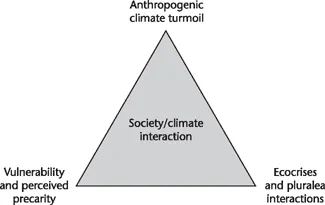
This chapter introduces our human “climate/environment/society” or socioecological framework comprised of three linked concepts—“anthropogenic climate turmoil,” “ecocrisis or pluralea interactions,” and “environmental unpredictability” and the associated concepts of “perceived precarity” and “vulnerability”—that guides our discussion of the human/climate change interface in this volume, as illustrated in Figure 1.1.
FIGURE 1.1Socioecological framework for the anthropological study of climate change
Underlying our model is the recognition that Earth as an ecological system has limits and that human technologies now have the capacity to overtax “planetary boundaries” and “trigger abrupt or irreversible environmental changes that would be deleterious or even catastrophic for human beings” (Rockström et al. 2009). By “planetary boundaries,” Johan Rockström of the Stockholm Resilience Centre at Stockholm University and his multinational team of fellow authors stress the importance of biophysical processes that shape the self-regulating capacities of the planet. This approach draws attention to immutable thresholds and tipping points, the crossing of which, for prolonged periods, can set in motion non-linear changes that put in jeopardy “the safe operating space for humanity” on the planet (Rockström et al. 2009). This understanding builds on the limits-to-growth (LtG) analyses that began in 1972 at the Massachusetts Institute of Technology (Meadows et al. 1972) and have sought, based on repeat reviews of available information, to link the world economy with the state of the environment. This work has involved the development of increasingly sophisticated models of the planetary consequences of unchecked economic and population growth. Although the LtG perspective has been dismissed by advocates of unfettered growth as leading to unsupported doomsday predictions, several years ago Graham Turner (2008), an applied physicist, carefully assessed the past 30 years of lived reality in light of the predictions made in 1972 and in subsequent LtG reports (e.g., Meadows et al. 1992, 2004). He concluded that the expansion of industrial production, the spread of high-tech agriculture, and the resulting generation of expanding quantities of pollution and greenhouse gases are consistent with LtG predictions of ecological, economic, and societal collapse during the twenty-first century. Turner (2008: 38) observes that existing evidence “lends support to the conclusion of the LtG that the global system is on an unsustainable trajectory.” In a subsequent 40-year review of LtG predictions, Turner (2014), concluded that “a challenging lesson of the LtG analysis is that global environmental issues are typically intertwined and should not be treated as isolated challenges.” Moreover, he stresses that:
the alignment of data trends with the LtG dynamics indicates that the early stages of collapse could occur within a decade, or might even be under-way. This suggests, from a rational risk-based perspective, that we have squandered the past decades, and that preparing for a collapsing global system could be even more important than trying to avoid collapse.
Turner 2014: 16
Further, with regard to the growing size and environmental demands of the human population, Giorgio Nebbia (2012: 86) asks the following question:
The population of the world has increased almost fivefold, which has entailed a tenfold increase in the demand for food, energy, metals, space, housing, and water. There has also been a tenfold increase in the number of people living in urban agglomerations. How long can this last?
At first glance, given its ultimate goal of human survival, embedded in the planetary boundaries framework there appears to be some degree of what has been called anthropocentric environmentalism. This term refers to efforts to justify the protection of nature primarily as a necessity of human survival. In its most explicit forms, anthropocentric environmentalism draws a sharp divide between humans and the environment. This distinction has deep roots in mainstream Western thought, from the Judeo-Christian tradition to Cartesian thinking to sectors of contemporary environmentalism, and has led to the development of “binary oppositions [such as] human beings versus animals, and nature versus culture” (Koensler and Papa 2013: 286). As Williams (2003: 5) observes:
It is a deeply rooted myth in the Western psyche and its culture that nature is a passive, harmonious, God-given backdrop against which the drama of human life is played out; the “sound and fury” of human existence contrasting with the notion that “earth abides.”
Within the planetary boundaries model, and within our own perspective as expressed in this book, however, there is keen recognition that nature is not a backdrop to the important events that unfold on the stage of human activity. Rather, there is a multidirectional aspect to the human interaction with the rest of nature based on an ever-ongoing “interrelatedness of human actions and biogeophysical processes” (Dearing 2007: 27). Further, there is recognition of the distortions and dangers of anthropocentrism, no less than those of ethnocentrism, as both these reductionist orientations fail to comprehend broader structures and processes characterized by deep entwinement, be it people with other sectors of nature or the various human ethnocultural groups dispersed around the planet with each other (LeVine and Campbell 1972; Taylor 1986). Uniting critiques of both of these fraught lenses on “people in the world,” we seek to develop a model founded on a view of humans and their cultures as being within and not separate from nature, and an assessment of the ways power, a productivist ethic of endless economic expansion, and social injustice, environmentally expressed and experienced, can push ecological systems beyond the coping capacity of species, including our own. From the standpoint of living systems, human and otherwise, we face a form of destruction from within, a set of circumstances that “can be called, without hyperbole, threatened apocalypse” (Foster et al. 2010: 109). Given the demonstrated ability of life forms to thrive under an extremely wide range of ecological conditions, what is at stake is not life or even the planet, but life as we know it, including the historic life of our species and that of many other faunal and floral inhabitants of Earth.
A starting point for our approach lies in the recognition that while the terms “climate change” and “global warming” are in common use to label the significant climatic changes occurring on Earth in the contemporary period and projected into the future, neither of these terms quite captures what is happening in the world around us. Certainly, climate is changing, but what is important is not change itself, but the distinctive overall trend toward warming. Within this trend, moreover, there are changes, such as ocean acidification and black carbon build-up, which are not quite obvious from the term “climate change.”
Similarly, while “global warming” is the behind-the-scenes engine driving an array of climate changes, it too does not express the erratic nature of what is occurring, nor does it seem to cover the sudden and even more frequent appearance of extreme storms like Hurricane Sandy of 2012 or Typhoon Haiyan in 2013.
Additionally, while human activity, such as massive industrial increases in the release of greenhouse gases, is the engine driving changes in climate patterns, there are a number of important environmental feedback mechanisms—outside of direct human causation—that also are at play. Thus the melting of sea ice by rising planetary temperature exposes dark water (which, unlike ice, absorbs rather than reflects solar energy), increasing the temperature of the oceans. Warming of arctic areas accelerates the release of carbon dioxide from permafrost, adding to the greenhouse blanket. Similarly, heat waves, droughts, and storms impede plant growth, weakening a major safeguard against increases in the level of CO2 in the atmosphere. Plants withdraw from the air a significant amount of the CO2 that is produced through the burning of fossil fuels. Droughts and heat waves, as well as extreme storms that destroy forest biomass, can lead to measurable increases in atmospheric CO2. Additionally, increasing CO2 levels in the atmosphere may create turbulence, especially over the North Atlantic, over which 600 airplane flights occur every day. To get around this turbulence—and save passengers from feeling as though their plane is going to crash—aircraft are having to fly further, using more fuel, and generating more CO2 in an ongoing upward spiral. Many climatic feedback mechanisms are of grave importance because once a threshold is passed triggering their activation, they can drive planetary heating without additional anthropogenic inputs.
Climate turmoil
In light of these challenges, in this book we argue for the altern...
Table of contents
Cover
Half Title
Title Page
Copyright Page
Table of Contents
Acknowledgements
Introduction
1 Climate Turmoil: introducing a socioecological model of human action, environmental impact, and mounting vulnerability
2 The emergence and maturation of the anthropology of climate change
3 The archaeology of climate change
4 Theoretical perspectives in the anthropology of climate change
5 Case studies in the anthropology of climate change
6 Applications of anthropological research on climate change
7 What other social scientists are saying about climate change
8 Conclusion: toward a critical integrated social science of climate change
References
Index
Trusted by 375,005 students
Access to over 1.5 million titles for a fair monthly price.
Study more efficiently using our study tools.
Frequently asked questions
Yes, you can cancel anytime from the Subscription tab in your account settings on the Perlego website. Your subscription will stay active until the end of your current billing period. Learn how to cancel your subscription
No, books cannot be downloaded as external files, such as PDFs, for use outside of Perlego. However, you can download books within the Perlego app for offline reading on mobile or tablet. Learn how to download books offline
Perlego offers two plans: Essential and Complete
Essential is ideal for learners and professionals who enjoy exploring a wide range of subjects. Access the Essential Library with 800,000+ trusted titles and best-sellers across business, personal growth, and the humanities. Includes unlimited reading time and Standard Read Aloud voice.
Complete: Perfect for advanced learners and researchers needing full, unrestricted access. Unlock 1.5M+ books across hundreds of subjects, including academic and specialized titles. The Complete Plan also includes advanced features like Premium Read Aloud and Research Assistant.
Both plans are available with monthly, semester, or annual billing cycles.
We are an online textbook subscription service, where you can get access to an entire online library for less than the price of a single book per month. With over 1.5 million books across 990+ topics, we’ve got you covered! Learn about our mission
Look out for the read-aloud symbol on your next book to see if you can listen to it. The read-aloud tool reads text aloud for you, highlighting the text as it is being read. You can pause it, speed it up and slow it down. Learn more about Read Aloud
Yes! You can use the Perlego app on both iOS and Android devices to read anytime, anywhere — even offline. Perfect for commutes or when you’re on the go. Please note we cannot support devices running on iOS 13 and Android 7 or earlier. Learn more about using the app
Yes, you can access The Anthropology of Climate Change by Hans A. Baer,Merrill Singer in PDF and/or ePUB format, as well as other popular books in Social Sciences & Development Economics. We have over 1.5 million books available in our catalogue for you to explore.