eBook - ePub
Development Planning and School Improvement for Middle Managers
- 256 pages
- English
- ePUB (mobile friendly)
- Available on iOS & Android
eBook - ePub
Development Planning and School Improvement for Middle Managers
About this book
Classroom teachers moving to positions of increased responsibility often have very little formal training for their new role. This book provides guidelines for best practice in the necessary skills for success - planning, management and accountability.
Information
Part I
Foundations
Chapter 1
Middle Management at the Centre of School Improvement
Middle managers play a vital role in school improvement. We use the term ‘middle manager’ to describe all those teachers working in schools who have some kind of management responsibility for a team of staff, or an aspect of the school’s work, below the level of the head teacher and senior management team. The term is only loosely definable and there are many variations in school management structures, both within the UK and across the world. For some, even the head teacher is a manager in a ‘middle’ position between the school governing body, or local authority and the staff.
Much of the literature on educational management, school improvement and school effectiveness (for example, Hopkins et ah, 1994; Fullan, 1991,1992; Reynolds and Cuttance, 1992) has described the importance of head teachers and senior management in improving the school. There has, however, been a relative neglect of the importance of the role of the middle manager. Our experience, working in schools on a number of school development and improvement projects, leads us to believe that this emphasis needs to be reviewed. We see the middle management role as central to the development and improvement of the school. Much of the literature of school improvement seems to portray schools that are collaborative organisations which encourage ‘involvement’ of the whole staff. There are few references to middle managers and departments or teams. Yet schools for older students, in particular, tend to be large organisations, having many departments or subgroupings of staff led by middle managers.
The senior management team and the governors of the school are responsible for the development of the whole school. They develop a strategic plan to ensure that the school is in a sound position for delivering quality education to all pupils both at the present time and for the foreseeable future. While the grand plan works for the whole school and all teachers may be involved in its creation, development and implementation, the departments, subject or year teams are at the core of the large school organisation. Even if whole school development teams are formed from staff working across departmental boundaries, they need eventually to influence the working of the departments if the quality of teaching and learning is to be enhanced.
In this chapter we raise and examine issues of school improvement from a middle management perspective and make a case for middle managers to play a significant role in improving the school.
The case for middle management at the centre of school improvement
A number of factors make it clear that middle managers in large schools are central to school improvement. These include the complexity of the organisation and curriculum, the need for all teams to be fully involved in realising the school vision and in creating the conditions for school improvement.
The size and complexity of large schools
Large primary and secondary schools are complex organisations. A typical UK secondary school may employ 50-70 teaching staff and a further 10-20 support staff of various kinds, including administrative, premises, welfare and classroom support staff. Organisation is often through departments and teams. There will be a range of areas of responsibility within schools and some schools may have several sites. Management responsibilities are, therefore, both devolved and diverse.
The school’s immediate clients are on site every day and all day, at least during term time. Other clients, the parents, visit less frequently, and in some cases not at all. School organisations are rooted in the community in which they are based, both influencing and being influenced by it. This frequently means that a number of middle managers are involved in different ways with responding to client groups.
We believe that the effectiveness of school improvement initiatives is limited if the most appropriate unit of analysis, when talking about educational management, is the whole-school. Many practitioners will realise that the school is often a collection of departments and other groupings. The real work of the school, the delivery of the curriculum, is organised and managed through semi-autonomous departments and teams. By tradition, in many schools, departments, if not teams, have operated fairly independently, led by the head of department. In this context, each department could take an independent stance in the approach to its own area of work or subject. Each department could create its own way of working or culture, its own pattern of relationships and so on.
In the UK however, this independence and isolation has been breaking down over the past decade. Increased accountability through the publication of league tables of examination results, greater publicity about what goes on in individual schools and parental choice of schools has led to increased collective responsibility for the performance of the whole school. Hence, it is no longer good enough to be a successful department in an unsuccessful school. A key responsibility of all middle managers is to work with others, including the senior management team, to make the whole school successful.
Creating a whole curriculum for students
Departments and teams are the units mainly responsible for implementing the school curriculum, teaching, learning and assessment policies. Yet the curriculum is not a collection of individual subjects and areas that can be dealt with in isolation. Many links and connections have to be made by teachers and students. The curriculum is a whole experience for students. Middle managers have a central role in ensuring coherence across the curriculum. The nature of this curriculum in the UK is directed by central government.
For example, in the UK, the Education Reform Act (ERA) of 1988 places a statutory responsibility on schools to provide a broad and balanced curriculum which:
- promotes the spiritual, moral, cultural, mental and physical development of pupils at the school and of society; and
- prepares pupils for the opportunities, responsibilities and experiences of adult life. (ERA Section l(2)(a))
The introduction of the National Curriculum in the UK emphasised the need for ensuring that content was planned as a coherent whole, across different subject areas where there was overlap. There are also cross-curricular themes, dimensions and skills that need to be planned for. The use of information technology (IT) in different subject areas is probably the best example of a cross-curricular theme. The responsibility for ensuring integration of cross-curricular issues into the curriculum falls to middle managers.
Inspection of schools in the UK, under the Office for Standards in Education (OFSTED), focuses on the contribution of departments to:
- the spiritual, moral and cultural development of pupils;
- the development of ‘core skills’ of speaking and listening, reading and writing and the use of IT.
The National Curriculum guidance documents (NCC1990) draw attention to cross-curricular elements including:
- Personal and social development;
- Economic and industrial understanding;
- Careers education and guidance;
- Health education;
- Environmental education;
- Education for citizenship.
Much of the responsibility for ensuring the implementation of school policies in these areas, and others, falls on the middle manager, for example, the implementation of the equal opportunities policy, ensuring access to the curriculum for all pupils irrespective of race and gender and meeting the needs of all levels of ability. The Special Educational Needs Code of Practice also places obligations on middle managers (HMSO, 1994; Capel et al, 1995).
The wholeness of the curriculum provides a rationale for middle managers to work together to negotiate the delivery of the curriculum and to achieve the aims of the school.
Whole-school development planning
The notion of whole-school development planning has grown in the UK following the publication of the DES Document, Planning for School Development (Hargreaves et al, 1989). School development plans are whole-school documents. The school has identified whole-school priorities, targets for action, tasks and timescales and the people responsible for carrying these tasks at a whole-school level. The plan should identify resources for development and possibly also the staff development activities that will support the development.
Ideally, the development plan for the department reflects the whole-school priorities. While some whole-school priorities may not be particularly relevant to some departments, others may be central. Each different department or team has their own development priorities and particular development needs. Many departments and working groups will feel the need to create their own development plan, which may be partly in response to the whole-school plan. Construction of the plan can simply mirror the cycle for the whole school and Chapter 11 gives detailed advice about departmental plans.
The challenge for the middle manager is to work on a number of fronts in the planning process including:
- ensuring that the development process moves from the identification of needs through planning to implementation and evaluation;
- motivating staff through their involvement and interest in the process;
- developing the skills of staff through staff development activities;
- ensuring development actions take place effectively;
- making an impact upon the quality of teaching and learning.
The importance of the middle manager in the development process is clearly illustrated by the outline of development planning (see Chapter 11). The middle manager ought to be contributing to the process of identifying whole-school needs, at the audit stage. A key role is played by the middle manager, in interpreting and translating the whole-school issues into development within the department. The middle manager is in a good position to be able to link the staff development process with school development so that plans impact upon classroom teaching and learning. Our view is that insufficient attention is paid, in the literature, to the role of middle managers in large schools, in development planning.
Schools as social organisations
Ball (1987), Blase and Anderson (1995) and others have drawn attention to the micro-politics of schools. Ball describes ‘baronial’ power structures and Blase and Anderson describe the politics of subordination and empowerment. Clearly, in secondary schools, the heads of departments have traditionally been the power ‘barons’. Being aware of the micro-politics of the school is essential for the middle manager. Middle managers have to defend the department’s interests, yet those with a whole-school view will try to achieve this without damaging others.
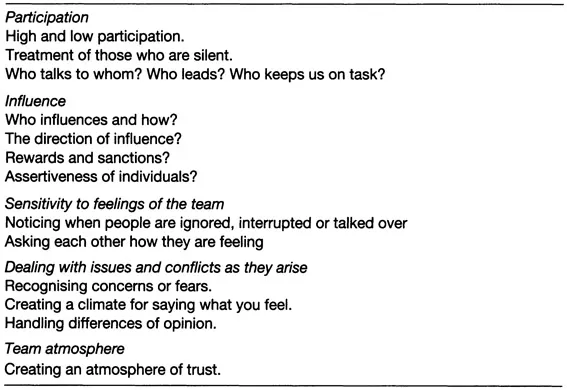
In addition to the exercise of power relationships, the middle manager must consider the interrelationships and group dynamics both within the school and within the department, if efforts for school improvement are to be successful. Cockman et al (1992) describe a number of key ‘process issues’ to do with group effectiveness, including participation, influence, sensitivity to feelings, dealing with issues and handling conflicts (see Table 1.1).
The process issues in Table 1.1 clearly affect the contribution the department can make to whole-school improvement. Process issues are part of the culture and ethos of the school that can enhance or inhibit efforts for school improvement. They operate between managers and also within departments. They affect both the motivation and the performance of teachers. Middle managers by their skills at facilitating staff relationships can create a climate for ‘process’ issues to be worked through.
Developing effective classrooms
Recent work on school improvement has emphasised the need to focus on the teaching and learning in the classroom. This point is made by Hopkins et al (1994) and emphasised in the Improving the Quality of Education for All. Logic suggests that middle managers, often those with responsibilities for areas of the curriculum, are key agents in the development of quality teaching and learning. They are also in a position to create a culture and a set of beliefs and values about classroom life.
Table 1.1 Process issues related to group effectiveness (from Cockman et al., 1992)
The culture of teaching has a major influence over the progress and direction of school improvement. Hargreaves has illustrated how the culture of teaching can be either a major obstacle to improvement or a major force for it.
’What the teacher thinks, what the teacher believes, what the teacher assumes – all these have powerful implications for the change pro...
Table of contents
- Cover
- Title
- Copyright
- Contents
- Preface
- The Contributors
- PART I: FOUNDATIONS
- PART II: WHO YOU ARE IN THE CONTEXT IN WHICH YOU WORK
- PART III: WORKING WITH PEOPLE
- PART IV: TEACHING AND LEARNING
- PART V: MANAGEMENT TASKS
- Appendix: Principles of Effective Learning and Teaching: Queensland Department of Education
- References
- Index
Trusted by 375,005 students
Access to over 1.5 million titles for a fair monthly price.
Study more efficiently using our study tools.
Frequently asked questions
Yes, you can cancel anytime from the Subscription tab in your account settings on the Perlego website. Your subscription will stay active until the end of your current billing period. Learn how to cancel your subscription
No, books cannot be downloaded as external files, such as PDFs, for use outside of Perlego. However, you can download books within the Perlego app for offline reading on mobile or tablet. Learn how to download books offline
Perlego offers two plans: Essential and Complete
- Essential is ideal for learners and professionals who enjoy exploring a wide range of subjects. Access the Essential Library with 800,000+ trusted titles and best-sellers across business, personal growth, and the humanities. Includes unlimited reading time and Standard Read Aloud voice.
- Complete: Perfect for advanced learners and researchers needing full, unrestricted access. Unlock 1.5M+ books across hundreds of subjects, including academic and specialized titles. The Complete Plan also includes advanced features like Premium Read Aloud and Research Assistant.
We are an online textbook subscription service, where you can get access to an entire online library for less than the price of a single book per month. With over 1.5 million books across 990+ topics, we’ve got you covered! Learn about our mission
Look out for the read-aloud symbol on your next book to see if you can listen to it. The read-aloud tool reads text aloud for you, highlighting the text as it is being read. You can pause it, speed it up and slow it down. Learn more about Read Aloud
Yes! You can use the Perlego app on both iOS and Android devices to read anytime, anywhere — even offline. Perfect for commutes or when you’re on the go.
Please note we cannot support devices running on iOS 13 and Android 7 or earlier. Learn more about using the app
Please note we cannot support devices running on iOS 13 and Android 7 or earlier. Learn more about using the app
Yes, you can access Development Planning and School Improvement for Middle Managers by Marilyn Leask,Ian Terrell,Marilyn (Senior Lecturer at De Montfort University Leask,Ian (Senior Lecturer Terrell in PDF and/or ePUB format, as well as other popular books in Education & Education General. We have over 1.5 million books available in our catalogue for you to explore.