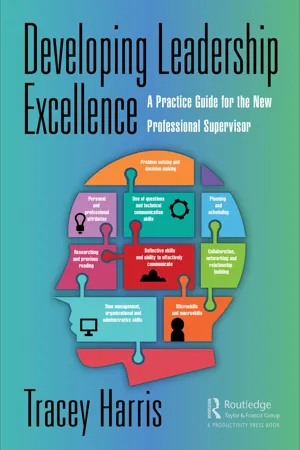
Whilst it is important to use your own knowledge, skills and experience in supervision, it is equally important to understand the range of skills your supervisor has, so these may add value to your own.
Congratulations, you are about to embark on one of the most important professional roles you will have in your career. Now that you are about to become a professional or line management supervisor, it is useful to reflect on what has brought you to this point; what professional experiences you have had that have led here and why you would like to take on this role. You may already be in a leadership role and have found yourself moving into a supervisory role because it is an organisational requirement. You may have applied for a new role as a supervisor, or you may have your own business or private practice and now need to supervise others. Keep these thoughts in mind as you read this book. Over time it will be interesting for you to review your thoughts, see if you think differently and observe how you grow and develop in the role.
Being a professional or line management supervisor in any workplace is a role that brings with it many rewards and some challenges. Whilst there are many rewards, there will be times where you wonder why you took on the role. Why? It is a role that requires a specific set of skills and knowledge to do the job well, so this takes time to develop. It can often feel as though you don’t really have the time to provide supervision given all the other things that are on your plate, but overall it is a wonderful role where you have the opportunity to support your staff to develop and grow in their roles, ensure they feel valued and supported as well as provide them with insight and skills to maintain their role to a high standard.
Your new role is a serious commitment for both you and your supervisee(s) given what supervision is intended to provide. Prior to becoming a supervisor, it is worth talking to another trusted professional supervisor about how they have set up their own supervisory framework, to understand what the highs and lows of the role have been and discuss any tips they can impart to make the role easier. It is always useful to know some of the shortcuts and pitfalls that others have experienced so that you don’t have to reinvent the wheel. It is also important to have a mentor or coach as you commence in the role to guide and support you, as it will help you develop confidence in your supervisory role from the start. One word of caution, though – try to only listen to the constructive and positive things from others. You certainly don’t want to be put off from the start with too many negative experiences or feedback that others may have. This will also ensure that you will do the same for others in the future (O’Donoghue, 2015).
Over time, your new role will influence many aspects of the supervisees’ role. It will change their thinking about particular approaches and aspects of their work, stretch their values and beliefs, enhance their skills and knowledge as well as support their professional well-being. There will be many times where you will impact significantly a supervisee’s professional career. As professional and line management supervisors, we may think we are just doing our job on a daily basis; however, being a supervisor is far more than that. It is a professional role that requires specific skills, knowledge and capabilities. In many workplaces, the supervisor role requires a separate position description demonstrating the important role it plays.
Let’s think back to when you were at school, played a sport, were in a club or had a hobby. There is usually at least one teacher or coach who you may remember the most, someone who knew what to say at the right moment, encouraged you and were there to debrief and talk about things during the tough times. Someone who challenged you and provided feedback to practice a certain skill and think about what you were doing from a particular aspect.
I can remember my first hockey coach, Mrs Cowgill. She coached me from grade one when I was just six years old right through to the end of high school. She was always encouraging us, even when she was firm in her instruction and direction. Mrs Cowgill continued to coach us lovingly when we lost a game. I saw her recently at a restaurant and again she beamed when we greeted each other after not seeing each other for many years. I thanked her for her wisdom and for being such an important part of my life from childhood. Her legacy has carried me through my professional years as the skills and knowledge she gave me and the team have been immeasurable.
Supervision is similar. Over time it can leave a lasting impression on us. Our supervisors are part of our professional journey and are part of our story – just like Mrs Cowgill. Supervision is therefore not just a conversation. It is a professional relationship that journeys with us in our professional role through time. Just like a hockey coach, the supervisor knows how to guide and develop the supervisee, knows how to get the best out of the supervisee, uses the right language to positively challenge and also be there through the tough times. It is a complex and multilayered approach that is dynamic and relational. It is a professional process that can transform the practice and conduct of any employee (Carroll, 2010).
Let’s see how supervision has made a difference to a supervisee:
I have received professional supervision for much of my professional life. I have been qualified in my profession for 15 years and have had internal supervision as a requirement of my role. I have also had external supervision throughout my career. It’s really only been in the last year with my current supervisor that I have come to understand what this ‘thing’ called supervision is all about. I feel like I have awakened for the first time in my career and wonder what I have been doing with my own supervisees for all this time. (Supervisee Sam)
Different Types of Supervision
It is important to have a clear understanding of what supervision is and the different types of supervision that you may provide. You will hear different terms being used to define supervision, such as the following: