- 154 pages
- English
- ePUB (mobile friendly)
- Available on iOS & Android
eBook - ePub
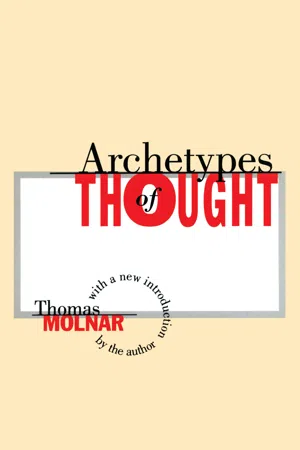
Archetypes of Thought
About this book
In Archetypes of Thought, originally published in 1991 with the title Philosophical Grounds, Thomas Molnar follows seven basic themes of Western philosophical speculation from their development in the earliest times of systematic thought through their evolution through the centuries and civilizations to the present. Some of the themes are origin and its reflection, guilt of being, one and the multiple, the temptation of mechanization, and nocturnal man. The book is neither a chronological treatment of issues nor a list of philosophical schools and movements. Rather, it reaches for the archetypes of philosophical reasoning. Molnar shows the presence of modern themes in the entire history of thinking, traces technology to the first stirrings of rationalism, and evinces modern man's feeling of culpability. Throughout, the soul is perceived as the keeper of God's and man's secret, one which reflects reality and also tries to organize it according to an ontologically implanted rhythm. In his new introduction, Molnar explains and re-examines his reasons for writing the book. While the themes he covers have been widely dealt with in contemporary thought, they are brought together to form an original combination of philosophical concepts. Archetypes of Thought is an intriguing study of the evolution of philosophical thinking. It is essential reading for both students and professionals of philosophy, history, and sociology.
Information
Chapter One
The Original and Its Reflection
Philosophical Grounds
Deep in man’s non-rational strata of being there are what C. G. Jung calls archetypes. Others would call them patterns of approaching and preparing the experience of reality, and others still see them as Platonic ideas embedded in great, fundamental myths. Whatever way we envisage the problem, it appears that man posits – “believes” or “knows” would be here terms too radical – a dual set of archetypes, in conformity with the apprehended duality of the universe, a division in two poles which receive various names. An innate tendency, fed by experience of the world, distinguishes a “superior” and an “inferior” order; when further crystallized, we label them “reality” and “appearance” or “model” and its “copies.” True, a substantial part of old and new thinking consists of speculative, then scientific efforts to abolish these distinctions, to make the two poles collapse into one (Jung calls this the “coincidence of opposites”), to establish proofs that they are the products of a pre-modern, pre-scientific view of the world. Many thinkers indict the immemorial meditation on “high” and “low”, “real” and “appearance”, “numenon” and “phenomenon”, etc., as a remnant of anthropomorphic ways of contemplating the universe. Scientific theories are formulated, and even political systems devised, within which this kind of supposedly archaic thinking would be proven not only meaningless or atavistic, a throw-back on primitive times, but also demonstrably backward, threatening the modern achievements, thus practically criminal. The pattern of thought we are outlining is then often condemned as a product of tribal beliefs handed down through uncritical generations which have refused to test it, not having the method or the will to do so. It is therefore a symptom of mental comfort, a mere prejudice.
Be that as it may, it nevertheless appears that philosophical postulates in general are not products of sheer reasoning and observation, arrived at by mathematical and experimental methods alone. They are, rather, the creations of what for lack of a better word we may call original themes in which it may be impossible to apportion their exact due to arguments, the inner sense (Aristotle), tradition, the lesson of experience, belief, myth-making, and so on. Henri Bergson speaks of the fonction fabulatrice, our tendency to pour basic experiences into the mold of a story. Similarly, we suggest that in order to comprehend the world, we need certain dichotomies arranged quite spontaneously as polarities between which great and significant collective realities are woven into stories or myths, and whose permanent patterns find their way into the fabric of world-religions and philosophical systems.
Yet, we are not speaking of mere transpositions of one original or at least widespread myth or of some initial theme. Examples of such were found, among others, by Mircea Eliade and Joseph Campbell: the flight into Egypt, illustrating the persecution of the young god, like also Osiris and Dionysus; the goddess and her son, the theme of fertility; the crucifiction of Christ, that is the theme of the suffering god; and so on. But even these themes show the existence in mankind’s common network of belief of fundamental motives whose multiple replicas are located in widely varied situations and civilizations. One might say that the original and its replicas, the two orders of reality, one the model the other the copy, constitute a language through which the ontological reality speaks to us, a language as compact as the languages we currently speak are discursive, fragmented. Today’s rationalist prejudice, writes art-philosopher Vladimir Weidlé, acknowledges one language only, as transparent in terms of logic as arithmetics are ... At no time was the poet’s language as radically different from that of common speech in society as it is now.1
It would be a philosophical faux-pas to ask from where does the original originate. The original is a category by itself, it bears the face of the divine, it gives no discursive answers to questions. The original requires interpretations, and in a way its replicas are just that. Less perfect and compact than the original, they reflect it, while their existence depends on their distance from it. Nevertheless, the distance is ever questioned and contested since man must both live in awareness of the original and deny it. We insist on the intact, aloof status of the original, but we also besiege it and devise strategies to compel its self-disclosure. One episode in this never-ending attempt was Moses before the Face of God that he did not get to see, and saw Him only from behind as he heard also the voice coming from the burning bush.2 Another episode of an attempt to force the original until it yields up its secret is that of Oedipus before the Sphinx: having succeeded in solving the riddle, the young man turns the corner only to fall into the trap laid by Fate, the marriage with his mother etc. We find in Sallustius (Concerning the Gods and the Universe, book V) an intellectual effort to come to terms with the enigma. He writes that there are mundane and supramundane gods, those who make the universe and the others who make the superior things such as divine essences, intelligence, the souls. What is this if not the myriadth attempt at understanding the function of the original and the reflections, at distinguishing, according to their origin, between matter and spirit, the secrets of the divine laboratory? When our author writes (book IX) that the Creator also makes gods, angels, and spirits, then instructs us that the space between the first god and us is studded by many intermediary agents, what else does he – or for that matter the Gnostics – do but try to bridge the gap between the original and its reflections?
In other words, the situation with respect to the first basic philosophical theme here examined is something like this. We cannot make sense of the world and of our existence and experiences therein unless we postulate the original, the source and principle (arché) of all, not as a creator, rather as an ontological substratum. For it to be the original, it must be forever and by essence distant, farthest removed, secret, hidden, but nevertheless real, with a reality surpassing everything else. An extremely potent real. We prefer it to be like this way because distance and potency guarantee its status and assures us that it is indeed the limitless in the sight of which the limits of all other things – men or phenomena – make sense, become explicable. Yet, at the same time as we exalt the hiddenness and the mystery of the original and weave stories and mythologies around it the better to approach it through poetry and art – we are busying ourselves to bring it nearer, unveil its Face, make it answer questions. Most of all, we compel it to answer us by way of its reflections which contain, we firmly assume, some of the original’s essence. When the reflections are actually national, tribal, imperial, etc. communities, in other words political replicas of the original, the members (citizens, tribesmen) aim at two objectives. One is the satisfaction derived from situating themselves close to the potent reality, the model; the other is to make sure they can reach the original by means of magic and thus influence it according to their interests and needs. In sum, to make their community safe, powerful, prosperous and lasting.
All pre-modern political communities participated in this history, and also in the area of the original model. The citizens obtained this reassurance through various but strictly laid-out means: the cosmogony told them the story of how the gods were born and how they founded or helped found the community as a replica; the foundation myth exalted it and prescribed the liturgy and the symbolization; the ceremonies repeated the original act; and so on. Only in such a way did their togetherness and common destiny make sense to the citizens, in peace as well as in war.3 Let us make one thing clear: the “original” of the community was counted among the higher orders, and this assumption provided the members with an identity and self-image, without which they would have been a mere savage horde.4 Thus the community survives and “makes sense” as long as it is aware that it constitutes a replica of the original, and as such it is both unique and connected with transcendent reality. Its significant actions are conformed to higher moves from which they derive meaning, justification and legitimacy. At the same time, these grand actions also serve as “messages” of the original, conveying the reassurance that the community, its structure and destiny, are integrated in the real. A contrary message would cause the community to “fall from grace”, to decompose. God would remove his hand, the current would be interrupted, legitimacy would cease.
Thus in spite of the constant and renewed efforts to connect the worldly replica to the original model – a never-finished aspiration – it is implicitly acknowledged that the former is a subject to degradation and degeneracy. Why is this so? How does it happen? Can it be prevented? We enter here one of the central preoccupations of mankind, a vast problematic which, although differently manifesting itself according to times and circumstances, display great similarities. In a way, the question could be phrased in this manner: Why do ideals lose their substance, why the diminution from the initial integrity?
The word “initial”, a concept denoting temporality, is advisedly used since the process of loss is indeed timebound. In this view, time itself is not homogeneous, not a mere milieu in which things take place and to which time remains as it were neutral. But time is not a container filled with objects and events; it is a live being, soaring then declining, and at any rate affecting the course of events and human beings. The anthropological explorer of Central American Indians, Jacques Soustelle, describes the latter’s world-view like this. Far from imagining a stable world of certainty which existed or was created at one time for all, the thinking of Indians finds that man had descended into a fragile universe in which he is subjected to a cyclical becoming. Each of the cycles ends in a dramatic upheaval, and the tragedy will be no less outstanding for our own cycle.5 To be sure, in every civilization there are “counter-measures” taken against decline. In a universe where decline seems inevitable (this is the case of most non-monotheistic cults), political constructs seek to defy the downward rush of time; or architectural monuments attempt to do the same when the builders – “for eternity” – seek to arrest movement by erecting sacralized forms: rectangular, triangular, circular and the combination of these from the Egyptian and Aztek pyramids to medieval Benedictine and other monasteries. They are designed as transpositions of the momentary and elusive into the eternal, through the inherent magical qualities of geometrical configurations, themselves replicas of higher, astral configurations. Titus Burckhardt remarks that one cannot involve oneself in architecture without implicitly dealing with cosmology too.6
The replicas of the original cannot therefore be counted as ipso facto degenerative forms, at least not as long as the original remains intact. In fact, there is an equilibrium between original and replica which remain in tension. Tension and contrast between superior and inferior, immobile and changing, being and becoming, etc. Without these polarities that we find in many philosophical systems the equilibrium would be abolished, and with it the meaning that man finds in the surrounding world of objects and occurrences. The equilibrium is also broken when the original does not remain compact, sacred; for then the replica itself would become the original, but without any reality as a reference. The autonomous community, for that is what we have in mind, is fragile, agitated, and unable to find its identity. The laws are felt to be arbitrary, the citizens’s loyalty becomes brittle, mere subjective ambitions and individual interests prevail.7
There remains the philosophical ground problem: How does the original engender its reflections, although in itself it does not diminish? At all times, the sun and its radiation was taken as an analogy. It was assumed that the mass and brightness of the sun remain the same, while the beneficial actions, light and warmth, are endlessly spent.8 Nature itself behaves somewhat in the same way: always the same through the changes of seasons, while men and animals unceasingly benefit by it, drawing upon its resources. Modern studies of energy (radioactivity, the second law of thermodynamics) and the latest realization of ecological degradation and exhaustion teach us a different lesson, but it is unlikely that sun and nature have modified the image of their inexhaustibility in the popular mind.
To reformulate the question we just asked: Why do the replicas detach themselves from the original? Put otherwise, if the cosmic-divine order is perfect, why do parts of it lean into imperfection? Why do Platonic ideas abandon their abode in the realm of reality, and by a kind of free fall land in the realm of the non-genuine, of falsehood, where the real is seen only “through a glass, darkly?” Why do these ideas accept, through a kind of free will avant la lettre their loss of status in the world of true knowledge and take an inferior status, in mere opinion and error? Plato allows us to surmise that the fall took place because curiosity, in insinuating itself in a so far innocent idea, drives the latter towards novelty. The similarity is remarkable with the Genesis story where the first couple, innocent as created, also succumbed to curiosity which brought about their fall.
The notion of the fall thus entered the philosophical discourse. Let us review what happened. According to Plato at least, little self-contained globes of perfection, the ideas, took a downward course – note the persistence of the theme of up vs down, superior vs inferior – became embedded in matter and underwent punishment for their ontologically, but also epistemologically sinful because self-willed act. It is legitimate to put things in this light, that is to speak of sin, because from Plato to Plotinus the descent of truth into falsehood, of reality into appearance, of knowledge into error was marked not only as an epistemological deviation, also as a moral loss: the descent of the pure, good and innocent into the tainted, the sinful, the evil.9 The whole grandiose conception acquired a central philosophical position in the western world, even after Christianity took the place of Greece in speculation. The figure of Christ is in this respect paradigmatic: he is certainly not an idea lost in descent among men, nor is he a fallen creature. If christian theology had followed pagan wisdom, namely the Platonist line, Christ might have become a principle detached from the Platonic realm of ideas or from the One of Plotinus, and finally reclaim his status by climbing up the ladder of the neo-Platonic hypostases, back to Unity. Christianity, however, was not interested merely in the superior man who acquires his superiority through efforts of intelligence, insight and will. It focused instead on love and charity, thus on a vaster, deeper conception of man. The fall was reinterpreted but the fundamental schema remained: coming down – but sent by the Father! – from the upper realm; not condemned to spend time locked in a body, but, on the contrary, lifting these bodies up to the heavenly Father and salvation; then the Ascent, but not without suffering, not without a price. In the christian story the suffering and the price are built into the divine economy; yet the Greek heritage left its traces, the replica belongs to a lower order than the original, it must do penance for a change of status.10 The two orders, no matter that they are brought into closeness, remain distinct. In this case man does not become God; in fact, he is punished when he tries.
Let us now envisage another response to the question we raised above about the origin and the reflections. The response of Hindu philosophy. The question was: Given the original, why the reflections, and how do the replicas justify coming into their (inferior) existence, an existence which may threaten the original’s integrity? We saw that Greek speculation tormented itself over this problem which it a...
Table of contents
- Cover
- Half Title
- Title Page
- Copyright Page
- Table of Contents
- Dedication Page
- Introduction to the Transaction Edition
- Introduction
- Chapter One The Original and Its Reflection
- Chapter Two The Guilt of Being
- Chapter Three The Substratum
- Chapter Four Rational Man and the Temptation of Mechanization
- Chapter Five Nocturnal Man
- Chapter Six The Cure of History
- Chapter Seven The Oppression of Liberated Man
- Conclusion
- Index
Trusted by 375,005 students
Access to over 1.5 million titles for a fair monthly price.
Study more efficiently using our study tools.
Frequently asked questions
Yes, you can cancel anytime from the Subscription tab in your account settings on the Perlego website. Your subscription will stay active until the end of your current billing period. Learn how to cancel your subscription
No, books cannot be downloaded as external files, such as PDFs, for use outside of Perlego. However, you can download books within the Perlego app for offline reading on mobile or tablet. Learn how to download books offline
Perlego offers two plans: Essential and Complete
- Essential is ideal for learners and professionals who enjoy exploring a wide range of subjects. Access the Essential Library with 800,000+ trusted titles and best-sellers across business, personal growth, and the humanities. Includes unlimited reading time and Standard Read Aloud voice.
- Complete: Perfect for advanced learners and researchers needing full, unrestricted access. Unlock 1.5M+ books across hundreds of subjects, including academic and specialized titles. The Complete Plan also includes advanced features like Premium Read Aloud and Research Assistant.
We are an online textbook subscription service, where you can get access to an entire online library for less than the price of a single book per month. With over 1.5 million books across 990+ topics, we’ve got you covered! Learn about our mission
Look out for the read-aloud symbol on your next book to see if you can listen to it. The read-aloud tool reads text aloud for you, highlighting the text as it is being read. You can pause it, speed it up and slow it down. Learn more about Read Aloud
Yes! You can use the Perlego app on both iOS and Android devices to read anytime, anywhere — even offline. Perfect for commutes or when you’re on the go.
Please note we cannot support devices running on iOS 13 and Android 7 or earlier. Learn more about using the app
Please note we cannot support devices running on iOS 13 and Android 7 or earlier. Learn more about using the app
Yes, you can access Archetypes of Thought by Thomas Molnar in PDF and/or ePUB format, as well as other popular books in Philosophy & Existentialism in Philosophy. We have over 1.5 million books available in our catalogue for you to explore.