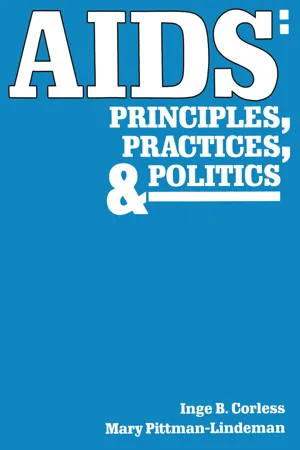
eBook - ePub
AIDS
Principles, Practices, and Politics
- 270 pages
- English
- ePUB (mobile friendly)
- Available on iOS & Android
eBook - ePub
AIDS
Principles, Practices, and Politics
About this book
First published in 1989. Providing a voice of reason in the midst of the controversy, this book looks at the principles, practices and politics surrounding AIDS and includes the Surgeon General's report; sections on AIDS awareness, women and AIDS, advice on choosing therapies, looking at patients and studies around public schools and intravenous drug users.
Information
Chapter 1
The Surgeon General's Report on AIDS
C. EVERETT KOOP
MICHAEL E. SAMUELS
MICHAEL E. SAMUELS
Introduction by Michael E. Samuels, Assistant to the Surgeon General
On February 5, 1986, President Ronald Reagan, in an address to the U.S. Department of Health and Human Services, directed the Surgeon General of the U.S. Public Health Service to prepare a major report to the American people on AIDS. In preparing this report, Surgeon General C. Everett Koop followed two parallel lines of inquiry. He consulted with the top clinical and research experts in the field, many of whom were in the Public Health Service (e.g., Dr. Anthony S. Fauci, Director of the National Institute of Allergy and Infectious Diseases). At the same time he held private meetings with national organizations with specific interests in AIDS to listen to their concerns, share their insights, and build an informal consensus on how to inform the American people about AIDS.
Every group contacted agreed to meet with the Surgeon General and the final report contains insights and contributions from each of them. The groups were: Aids Action Council, National Coalition of Black Lesbians and Gays, National Minority AIDS Council, American Council of Life Insurance, Health Insurance Association of America, Washington Business Group on Health, National Association of Elementary School Principals, National Association of Secondary School Principals, National Association of State Boards of Education, National Education Association, National Parent Teachers Association, American Dental Association, American Hospital Association, American Medical Association, American Nurses Association, American Osteopathic Association, American Red Cross, The National Hemophilia Foundation, American Federation of Teachers, Association of State and Territorial Health Officials, National Association of County Health Officials, United States Conference of Local Health Officers, Southern Baptist Convention, National Council of Churches, Synagogue Council of America, U.S. Catholic Conference, and Service Employees International Union.
Upon completion of the draft report, the Surgeon General had it officially cleared in record time. It was approved unanimously by these individuals or groups, in the following sequence:
Assistant Secretary for Health, Dr. Robert E. Windom
Secretary of Health and Human Services, Dr. Otis R. Bowen
The White House Working Group on Health, Dr. William L. Roper, Chairman
The Domestic Policy Council, Attorney General Edwin Meese, Chairman President Ronald Reagan
On October 22, 1986 Dr. Koop released The Surgeon General's Report on AIDS to the American people. The report described AIDS in layman's terms and indicated that it was not communicated through casual contact. Intimate sexual contact and the sharing of intravenous needles were identified as the principal means of spreading the disease. Citing the fact that there is no vaccine to prevent AIDS and no drug to cure it, the report maintained that our only weapon is education and information to change human behavior and contain any further spread of the disease.
Dr. Koop clearly labeled the disease as a concern to everyone—heterosexual and homosexual, male and female. He also expressed concern about the disproportionate numbers of blacks and Hispanics with AIDS and the plight of children born with AIDS.
The most controversial part of The Surgeon General's Report has been the statement: "Education about AIDS should start in early elementary school and at home so that children can grow up knowing the behavior to avoid to protect themselves from exposure to the AIDS virus. The fact that AIDS is a fatal disease gives the debate on sex education a new dimension that calls for resolution."
The release of The Surgeon General's Report on AIDS on October 22, 1986 was an historic day in the history of the fight against AIDS. The nation's physician called on all Americans to educate ourselves and our children about AIDS, and to adopt the preventive behavior necessary to contain the spread of the AIDS virus. His report set off national, state, and local debates on all aspects of AIDS. These debates appear to have raised the consciousness of the American people. Only time will tell what will be the full impact of the report.
Not content with just preparing and releasing The Surgeon General's Report on AIDS, Dr. Koop took the message directly to the American people via public appearances, radio, television, and the print media. His personal efforts were temporarily halted by back surgery, but began anew in January 1987.
One of the best examples of this effort was Dr. Koop's speech before a Joint Session of the California Legislature on March 5, 1987. Rarely does a state Legislature extend an invitation to an individual to address a joint session. That the California Legislature did so shows their deep concern about AIDS and their willingness to take action. When the history of AIDS is written the pioneering efforts of Californians in many areas will be highlighted.
The Surgeon General's press release which accompanied the Surgeon General's Report on AIDS and the address to the Joint Session of the California State Legislature follow in their entirety. These two statements will give the reader a sense of both the initial phase of the Surgeon General's campaign as well as his later activities, interacting with the forces that shape our public opinion and policy.
Statement* by C. Everett Koop, Surgeon General, U.S. Public Health Service
Ladies and Gentlemen:
Last February, President Reagan asked me to prepare a report to the American people on AIDS. The report is now completed.
In preparing this document, I consulted with the best medical and scientific experts this country can offer inside and outside the Public Health Service. I met with leaders of organizations concerned with health, education, and other aspects of our society to gain their views of the problems associated with AIDS. A list of those organizations is in your press kit. The resulting report contains information that I consider vital to the future health of this nation.
Controversial and sensitive issues are inherent in the subject of AIDS, and these issues are addressed in my report. Value judgments are absent. This is an objective health and medical report, which I would like every adult and adolescent to read. The impact of AIDS on our society is and will continue to be devastating. This epidemic has already claimed the lives of almost 15,000 Americans, and that figure is expected to increase 12-fold by the end of 1991—only five years from now.
Our best scientists are conducting intensive research into drug therapy and vaccine development for AIDS, but as yet we have no cure. Clearly this disease, which strikes men and women, children and adults, people of all races, must be stopped. It is estimated that one and a half million people are now infected with the AIDS virus. These people—the majority of whom are well and have no symptoms of disease—can spread the virus to others.
But new infections can be prevented if we, as individuals, take the responsibility of protecting ourselves and others from exposure to the AIDS virus. AIDS is not spread by casual, nonsexual contact. It is spread by high risk sexual and drug-related behaviors—behaviors that we can choose to avoid. Every person can reduce the risk of exposure to the AIDS virus through preventive measures that are simple, straightforward, and effective. However, if people are to follow these recommended measures—to act responsibly to protect themselves and others—they must be informed about them. That is an obvious statement, but not a simple one. Educating people about AIDS has never been easy.
From the start, this disease has evoked highly emotional and often irrational responses. Much of the reaction could be attributed to fear of the many unknowns surrounding a new and very deadly disease. This was compounded by personal feelings regarding the groups of people primarily af fected— homosexual men and intravenous drug abusers. Rumors and misinformation spread rampantly and became as difficult to combat as the disease itself. It is time to put self-defeating attitudes aside and recognize that we are fighting a disease—not people. We must control the spread of AIDS, and at the same time offer the best we can to care for those who are sick.
We have made some strides in dispelling rumors and educating the public, but until every adult and adolescent is informed and knowledgeable about this disease, our job of educating will not be done. Unfortunately, some people are difficult to reach through traditional education methods, so our efforts must be redoubled. Others erroneously dismiss AIDS as a topic they need not be concerned about. They must be convinced otherwise.
Concerted education efforts must be directed to blacks and Hispanics. While blacks represent only 12 percent of the U.S. population, 25 percent of all people with AIDS are black. Another 12 percent of AIDS patients are Hispanic, while this group comprises only 6 percent of the population. Eighty percent of children with AIDS—8 out of 10—are black or Hispanic. For optimum effectiveness in reaching minority populations, educational programs must be designed specifically for these target groups.
Many people—especially our youth — are not receiving information that is vital to their future health and well-being because of our reticence in dealing with the subjects of sex, sexual practices, and homosexuality. This silence must end. We can no longer afford to sidestep frank, open discussions about sexual practices—homosexual and heterosexual. Education about AIDS should start at an early age so that children can grow up knowing the behaviors to avoid to protect themselves from exposure to the AIDS virus.
One place to begin this education is in our schools. Every school day, more than 47 million students attend 90,000 elementary and secondary schools in this nation. Our schools could provide AIDS education to 90-95 percent of our young people. As parents, educators, and community leaders we must assume our responsibility to educate our young. The need is critical and the price of neglect is high. AIDS education must start at the lowest grade possible as part of any health and hygiene program. There is now no doubt that we need sex education in schools and that it include information on sexual practices that may put our children at risk for AIDS. Teenagers often think themselves immortal, and these young people may be putting themselves at great risk as they begin to explore their own sexuality and perhaps experiment with drugs. The threat of AIDS should be sufficient to permit a sex education curriculum with a heavy emphasis on prevention of AIDS and other sexually transmitted diseases.
School education on AIDS must be reinforced at home. The role of parents as teachers—both in word and in deed—cannot be overestimated. Parents exert perhaps the strongest influence on their youngsters' developing minds, attitudes, and behaviors. We warn our children early about the dangerous consequences of playing with matches or crossing the street before checking for traffic. We have no less a responsibility to guide them in avoiding behaviors that may expose them to AIDS. The sources of danger differ, but the possibe consequences are much more deadly.
Before we can educate our children about AIDS, we must educate ourselves. The first thing we have to understand and acknowledge is that AIDS is no longer the concern of any one segment of society; it is the concern of us all. People who engage in high risk sexual behavior or who inject illicit drugs are risking infection with the AIDS virus and are endangering their lives and the lives of others, including their unborn children.
The Surgeon General's report describes high risk sexual practices between men and between men and women. I want to emphasize two points: First, the risk of infection increases with increased numbers of sexual partners—male or female. Couples who engage in freewheeling casual sex these days are playing a dangerous game. What it boils down to is—unless you know with absolute certainty that your sex partner is not infected with the AIDS virus—through sex or through drug use—you're taking a chance on becoming infected. Conversely, unless you are absolutely certain that you are not carrying the AIDS virus, you must consider the possibility that you can infect others.
Second, the best protection against infection right now—barring abstinence— is use of a condom, A condom should be used during sexual relations, from start to finish, with anyone whom you know or suspect is infected.
I'd like to comment briefly on the issues of mandatory blood testing and of quarantine of infected individuals. Ideas and opinions on how best to control the spread of AIDS vary, and these two issues have generated heated controversy and continuing debate. No one will argue that the AIDS epidemic must be contained, and any public health measure that will effectively help to accomplish this goal should be adopted. Neither quarantine nor mandatory testing for the AIDS antibody will serve that purpose.
Quarantine has no role in the management of AIDS because AIDS is not spread by casual contact. Quarantine should be considered only as a last resort by local authorities, and on a case-by-case basis, in special situations in which someone infected with the AIDS virus knowingly and willingly continues to exposure others to infection through sexual contact or sharing drug equipment.
Compulsory blood testing is unnecessary, unfeasible, and cost prohibitive. Fu...
Table of contents
- Cover
- Half Title
- Title
- Copyright
- Dedication
- Contents
- Contributors
- Foreword
- Acknowledgments
- Introduction
- 1 The Surgeon General's Report on AIDS
- 2 Epidemic Control Measures for AIDS: A Psychosocial and Historical Discussion of Policy Alternatives
- 3 The Treatment of People with AIDS: Psychosocial Considerations
- 4 Development of AIDS Awareness: A Personal History
- 5 Literature and AIDS: The Varieties of Love
- 6 Women with AIDS: Sexual Ethics in an Epidemic
- 7 An Ethics of Compassion, a Language of Division: Working out the AIDS Metaphors
- 8 AIDS Overview
- 9 Treatment Issues in AIDS
- 10 Choosing Therapies
- 11 The New Death among IV Drug Users
- 12 The Patient with AIDS: Care and Concerns
- 13 Children with AIDS
- 14 Public Schools Confront AIDS
- 15 Individual Education Programs for AIDS Control
- 16 The Malignant Metaphor: A Political Thanatology of AIDS
- 17 Impact of the AIDS Epidemic on the Gay Political Agenda
- 18 Creative Acceptance: An Ethics for AIDS
- 19 AIDS: Seventh Rank Absolute
- Index
Trusted by 375,005 students
Access to over 1.5 million titles for a fair monthly price.
Study more efficiently using our study tools.
Frequently asked questions
Yes, you can cancel anytime from the Subscription tab in your account settings on the Perlego website. Your subscription will stay active until the end of your current billing period. Learn how to cancel your subscription
No, books cannot be downloaded as external files, such as PDFs, for use outside of Perlego. However, you can download books within the Perlego app for offline reading on mobile or tablet. Learn how to download books offline
Perlego offers two plans: Essential and Complete
- Essential is ideal for learners and professionals who enjoy exploring a wide range of subjects. Access the Essential Library with 800,000+ trusted titles and best-sellers across business, personal growth, and the humanities. Includes unlimited reading time and Standard Read Aloud voice.
- Complete: Perfect for advanced learners and researchers needing full, unrestricted access. Unlock 1.5M+ books across hundreds of subjects, including academic and specialized titles. The Complete Plan also includes advanced features like Premium Read Aloud and Research Assistant.
We are an online textbook subscription service, where you can get access to an entire online library for less than the price of a single book per month. With over 1.5 million books across 990+ topics, we’ve got you covered! Learn about our mission
Look out for the read-aloud symbol on your next book to see if you can listen to it. The read-aloud tool reads text aloud for you, highlighting the text as it is being read. You can pause it, speed it up and slow it down. Learn more about Read Aloud
Yes! You can use the Perlego app on both iOS and Android devices to read anytime, anywhere — even offline. Perfect for commutes or when you’re on the go.
Please note we cannot support devices running on iOS 13 and Android 7 or earlier. Learn more about using the app
Please note we cannot support devices running on iOS 13 and Android 7 or earlier. Learn more about using the app
Yes, you can access AIDS by Inge B. Corless, Mary Pittman Lindeman, Inge B. Corless,Mary Pittman Lindeman in PDF and/or ePUB format, as well as other popular books in Medicine & AIDS & HIV. We have over 1.5 million books available in our catalogue for you to explore.