- 260 pages
- English
- ePUB (mobile friendly)
- Available on iOS & Android
eBook - ePub
About this book
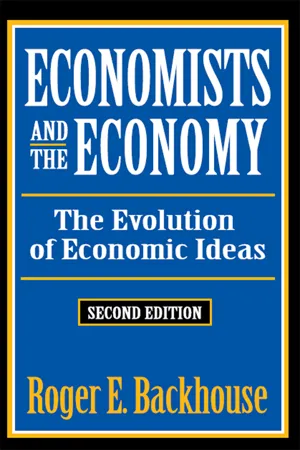
Economists and the Economy seeks to explain how economic theories are formed in response to specific incidents affecting economic events. The work covers both major historical events, such as the English Civil War, the Industrial Revolution, and the Great Depression, and intellectual developments in economic thought. Among the theories examined are neoclassical growth theory and the Harrod-Domar model.
1
Economics and Its Past
1.1 Economics Today
Economics is a peculiar, and frequently misunderstood, subject, its claim to scientific status often being disputed, even by economists. Consider some of the many jokes made about economists.
1. When I consult an economist I want one with only one hand. I’m fed up with “on the one hand this, on the other hand that.…”
2. If you take all the economists in the world and lay them end to end, you still won’t reach a conclusion.
3. A physicist, an engineer and an economist are stranded on a desert island, trying to open a can of beans. The physicist tries opening it with a knife, but fails. The engineer tries hitting the can with a stone. “You’ll get no-where like that,” observes the economist helpfully. “What would you do then?,” they retort. “Well,” says the economist, “assume we have a can-opener, …”
4. At a May Day parade long columns of tanks, guns, missiles, infantry were once followed by rows of people in grey suits. “Who are they?” asked one bystander. “They are economists,” replied another. “You have no idea what damage they can do.”
Economists are held to be unable to agree amongst themselves, or even to make up their own minds; they are prone to irrelevant, abstract reasoning; their forecasts are held, like those of weather forecasters, always to be wrong; and they do immense damage.
In addition to attacks from outsiders there have been some very strong attacks made by economists. The classic such attack is probably that of Wasily Leontief, a major figure in twentieth-century economics. In his Presidential Address to the American Economic Association, in 1970, Leontief claimed that, despite the outward signs of success,
Much of current academic teaching and research has been criticized for its lack of relevance, that is, of immediate practical impact. … The problem is caused not by an inadequate selection of targets, but rather by our inability to hit squarely any one of them. The inadequacy of which I spoke before is caused not by the irrelevance of the practical problems to which present-day economists address their efforts, but by the palpable inadequacy of the scientific means with which they try to solve them.
He went on to argue that this was due to an imbalance in the discipline.
I submit that the consistently indifferent performance in practical applications is in fact a symptom of a fundamental imbalance in the present state of our discipline. The weak and all too slowly growing empirical foundation cannot support the proliferating superstructure of pure, or should I say, speculative economic theory.
After describing the increasing use of intricate mathematics in economics Leontief continued,
To sum up with the words of a recent president of the Econometric Society, “… the achievements of economic theory in the last two decades are both impressive and in many ways beautiful. But it cannot be denied that there is something scandalous in the spectacle of so many people refining the analysis of economic states which they give no reason to suppose will ever, or have ever, come about …. It is an unsatisfactory and slightly dishonest state of affairs.” (Leontief, 1971, pp. 24–26)
Lest it be thought that this is simply the reaction of an applied economist to economic theory, it is worth noting that the president of the Econometric Society quoted by Leontief is Frank Hahn, an economist whose main contributions have been to relatively abstract economic theory.
Disquiet concerning the state of economics, and particularly of economic theory, was at its height in the 1970s, with many commentators speaking of a crisis in the subject. In the 1980s, however, such criticisms became less frequent. There are a number of reasons for this. One is that people ran out of new, critical things to say about economics. The critical movement had, to a certain extent, run out of steam. More important, there was a newfound confidence amongst economists. The severe and unprecedented economic shocks to which the world economy was subjected in the 1970s were one reason for the crisis, and these were not repeated. Even the stock market crash of October 1987 did not challenge economic theory, or disturb the world economy in the same way that the oil shocks of the 1970s did. In microeconomics, theorists moved away from constructing more and more general models towards working with simpler ones. As a result they are now tackling problems that are much more closely related to real-world problems: examining the implications of uncertainty and limited information, for example, opens up vast new areas to economic analysis. In macroeconomics, the assumption of rational expectations provided economists with new techniques for analysing problems, whilst investigations of transactions costs and imperfect competition held out, for the first time, the promise of a satisfactory microeconomic foundation for Keynesian unemployment. In both macro and microeconomcs opportunities for interesting theorizing were opened up on a large scale.
Despite this widespread confidence, however, there is also great unease about the way the subject has developed. To mark its centenary, the editor of the Economic Journal invited a variety of eminent economists to write on “The next 100 years?” In responding to this invitation, many economists chose to question current trends. William J. Baumol argued the movement towards making economists learn more mathematics had been taken too far: other lines of inquiry were being ignored, and even students whose talents lay elsewhere were being forced to demonstrate their mathematical competence. The result, he argued, was “a spate of dissertations that qualify primarily as mathematical (or econometric) exercises whose sole raison d’être seems to be the opportunity they afford to their authors to display whatever facility they can muster in manipulation of the tools of abstraction” (Baumol, 1991, p. 3). He argued that the economics curriculum need to be changed to reduce the emphasis on theory, and to increase the coverage of econometrics and economic history. Milton Friedman complained that the computer revolution had “induced economists to cany reliance on mathematics and econometrics beyond the point of vanishing returns,” and that much mathematical economics was used “to impress rather than to inform” (Friedman, 1991, p. 36). He reminded his readers to Alfred Marshall’s advice concerning the use of mathematics:
(1)Use mathematics as a shorthand language, rather than as an engine of inquiry.
(2)Keep to them till you have done. (3) Translate into English. (4) Then illustrate by examples that are important in real life. (5) Burn in mathematics. (6) If you can’t succeed in 4, burn 3. This last I did often. (Pigou, 1925, p. 427; quoted in Friedman, 1991, p. 37)
Frank Hahn argued that “theorising of the ‘pure’ sort will become both less enjoyable and less and less possible” (Hahn, 1991, p. 47). It was, he claimed, becoming clear that crucial questions could not be answered by the method of postulating axioms and deducing theorems: economists were going to have to resort to simulations based on psychological, sociological and psychological postulates. Edmond Malinvaud, though he conceded that this vision might be unduly pessimistic, wrote of the risk “that the discipline progressively loses touch with real problems, develops on its own into a scholastic and becomes less and less significant for the layman’s concerns” (Malinvaud, 1991, p. 66).
Such doubts, expressed in a very “balanced” way by these economists at the top of the profession, were revealed in much more forceful tones by a survey of graduate students in leading US economics departments (Colander and Klamer, 1987, 1990). This found that graduate students felt very strongly that economics was a game, that understanding techniques was the key to success, and that a thorough knowledge of the economy was unimportant. Though many of them started out in economics because they were concerned with economic policy, their training and their desire to obtain academic jobs transformed them into technique-oriented individuals. As disturbing as the results of their survey was the attitudes revealed in interviews with the students. With the exception of students at Chicago, the interviews revealed a profound degree of cynicism about what they were doing: “The students knew what would get them ahead; they could do it, but for many of them the intellectual excitement of science wasn’t there” (Colander, in Colander and Klamer, 1990, p. 187). These findings were not unexpected.
The lay reader might be shocked by these findings, but most economists won’t be. Our findings were not unexpected. Students feel a lack of reality in what they study because, by design, there is little reality there; the focus on techniques and modeling precludes it. There are such differing views amongs schools because the views are built into the models and techniques the students learn. Students do not learn—and are not meant to learn—to question or to assess these models. The cynicism is a bit more difficult for economists to be complacent about; graduate schools do not plan to instill cynicism, but cynicism is the natural outcome. (Colander, in Colander and Klamer, 1990, pp. 187–88)
How could such a situation arise at a time when the subject, at least outwardly, appears to have been flourishing, not simply in terms of numbers, but in terms of the proliferation of new and exciting theoretical and econometric work? The answer is best sought by considering some examples in detail. Two of the best examples to take are industrial organization and macroeconomics. Industrial organization is a powerful example because it appears to be one of the success stories of modem economics, with the subject having been completely transformed in the last decade. Macroeconomics is important because of the immense resources that have been put into empirical research.
Until the mid 1970s, the theory of industrial organization was, to quote a leading theorist, “not only unsatisfactory, but moribund” (Fisher, 1989, p. 113). The dominant approach was the structure–conduct–performance paradigm, according to which market structure (factors such as concentration, product differentiation, barriers to entry etc.) determined firms’ conduct (price, output and advertising strategies, the extent of competitive or anti-competitive practices, etc.), and this in turn determined performance (growth, profitability, technical progress etc.). There was, however, no hard analytical theory underlying this paradigm, and there was much empirical evidence that was inconsistent with it (it was, for example, difficult to find evidence of any connection between concentration and profitability). The main reason for the absence of any hard theory was that economists had failed to provide a satisfactory theory of oligopoly. Game theory filled this theoretical vacuum by providing, for the first time, a way to analyse oligopoly. Game theory has enabled economists to tackle issues such as predatory pricing, excess capacity, entry deterrence and many other phenomena. The result has been that industrial economics has been transformed: in the eyes of many economists it is one of the great success stories of modem economics.
Franklin Fisher, however, has argued that for all the dazzling technical advances, the application of game theory to industrial economics has taught us very little about the world. The application of game theory has shown that many outcomes are possible, and that the context and experience of the oligopolists are crucial to determining the outcome. But this, Fisher claims, was known before the advent of game theory. Why has game theory had so little impact? Fisher argues that this is because most theoretical work has been with what he calls “exemplifying theory:”
Exemplifying theory does not tell us what must happen. Rather it tells us what can happen. In a good exemplifying-theory paper, the model is stripped bare, with specializing assumptions made so that one can concentrate on the phenomena at issue. (Fisher, 1989, p. 118)
They are stories, telling us what might happen. Such “stripped-down” theories are, of course valuable, for they reveal the possibility of certain phenomena, and they provide explanations that we can understand. Their limitation, of course, is that exemplifying theories do not tell us either what must happen, or how what happens depends on well-defined, measurable variables. To tell us that we need what Fisher calls a “generalizing theory.” Game theory, he argues, has led economists away from considering the detailed context on which any generalizing theory is likely to depend.
One of the main problems with recent developments in game theory, Fisher argues, is that economists have become distracted into analysing problems that are technically interesting, not ones that are relevant in the real world:
There is a strong tendency for even the best practitioners to concentrate on the analytically interesting questions rather than on the ones that really matter for the study of real-life industries. The result is often a perfectly fascinating piece of analysis. But so long as that tendency continues, those analyses will remain merely games economists play. (Fisher, 1989, p. 123)
A similar situation exists in macroeconomics. At one level macroeconomics has seen immense progress in the past two decades. Macroeconomic theories are mathematically more rigorous, they are more closely linked to theories of individual optimizing behaviour, and they provide formal analysis of issues that were previously analysed only in an informal way. In addition, there has been an enormous amount of econometric work, much of it being technically far superior to work that was being undertaken in the 1970s. Advances in econometric theory and, above all, the increased availability of computing power have provided economists with a wealth of new techniques for analysing data and testing economic models. Despite all these advances, however, the view still persists that much theoretical and empirical macroeconomics is no more than game-playing.
In a paper directed against what he calls “The scientific illusion in empirical macroeconomics,” Lawrence Summers (1991) takes as his starting point the observation that, in contrast with what happens in natural science, theorists do not pay much attention to the results of econometric work. Textbooks and surveys of theory rarely cite econometric work, and where they do the references are usual marginal to the main argument. Formal statistical tests, he argues, do not cause economists to change their beliefs about macroeconomic phenomena. Much more influential is informal empirical work.
Now consider two issues where today’s macroeconomics textbooks present a radically different picture than did the macroeconomics textbooks of the 1960s — the long-run neutrality of inflation and the relative importance of monetary and fiscal policies in affecting economic behavior. Changes in opinion about inflation neutrality resulted from theoretical arguments about the implausibility of money illusion that became compelling when inflation increased and unemployment did not decline during the 1970s. Formal statistical tests contributed almost nothing. Surely, A Monetary History of the United States ([Friedman and Schwartz,] 1963) had a greater impact in highlighting the role of money than any particular econometric study or combination of studies. It was not based on a formal model, no structural parameters were estimated, and no sophisticated statistical techniques were employed. Instead, data were presented in a straightforward way, to buttress verbal theoretical arguments, and emphasis was placed on natural experiments in assessing directions of causality. (Summers, 1991, p. 130)
Summers surveys a series of articles from the literature on macroeconomics and finance, concluding “it is new information not new technique that leads to new insights in empirical economics” (Summers, 1991, p. 143). Where empirical regularities are influential, he claims, they are sufficiently clear cut that formal techniques are not necessary to perceive them. The “natural experiments” we find in history (for example, evidence on how central banks have behaved in various historical episodes) are more important than formal econometric analysis. Such econometric work, he argues, “creates an art form for others to admire and emulate but provides us with little new knowledge” (Summers, 1991, p. 143).
Thomas Mayer argues makes a similar point in a book entitled Truth versus Precision in Economics (forthcoming). He takes issue with the intellectual hierarchy which places formal theory on top, and empirical economics on the bottom. Because formal theorising carries such great prestige, what Mayer terms “empirical-science theory” (theory that is concerned with explaining past observations and predicting future ones) has suffered. Emprical-science economists have felt obliged to present their work as though it satisfies standards of rigour which are inappropriate, and which it is incapable of meeting. What has happened is that, as McCloskey (1991) has put it, economists have adopted the values of the math department, not the physics department.
The classic statement of such an attitude was provided by Gerard Debreu in his Presidential Address to the American Economic Association. He drew a contrast between physics and economics:
physics did not completely surrendur to the embrace of mathematics and to its inherent compulsion towards logical rigor. The experimental results and the factual observations that are at the basis of physics, and which provide a constant check on its theoretical constructions, occasionally led its bold reasonings to violate knowingly the canons of mathematical deduction.
In these directions, economic theory could not follow the role model offered by physical theory… Being denied a sufficiently secure experimental base,economic theory has to adhere to the rules of logical discourse and must renounce the facility of internal inconsistency.. (Debreu, 1991, p. 2)
He has given up the hope that economics can be an empirically based science, with the result that all that is left is formal, mathematical analysis: what many would term game-playing.
How has such a situation arisen? One explanation is clearly the entry into economics of some brilliant mathematicians who discovered that economic theory provided a source of intellectual puzzles waiting to be solved. The outstanding example was undoubtedly John von Neumann, who wrote an influential paper on the existence of equilibrium in the 1930s, and helped develop the theory of games in the early 1940s. The result was a series of what Debreu has called “dazzling mathematical developme...
Table of contents
- Cover
- Half Title
- Title Page
- Copyright Page
- Table of Contents
- List of Figures and Tables
- Preface to the Second Edition
- Preface to the First Edition
- Historiographic Introduction
- 1. Economics and Its Past
- 2. Growth and Development
- 3. The Regulation of Trade and Industry
- 4. Money and Inflation
- 5. Employment and Economic Fluctuations
- 6. The Theory of a Market Economy
- 7. The Discipline of Economics
- A Note on the Literature
- Bibliography
- Index
Trusted by 375,005 students
Access to over 1.5 million titles for a fair monthly price.
Study more efficiently using our study tools.
Frequently asked questions
Yes, you can cancel anytime from the Subscription tab in your account settings on the Perlego website. Your subscription will stay active until the end of your current billing period. Learn how to cancel your subscription
No, books cannot be downloaded as external files, such as PDFs, for use outside of Perlego. However, you can download books within the Perlego app for offline reading on mobile or tablet. Learn how to download books offline
Perlego offers two plans: Essential and Complete
- Essential is ideal for learners and professionals who enjoy exploring a wide range of subjects. Access the Essential Library with 800,000+ trusted titles and best-sellers across business, personal growth, and the humanities. Includes unlimited reading time and Standard Read Aloud voice.
- Complete: Perfect for advanced learners and researchers needing full, unrestricted access. Unlock 1.5M+ books across hundreds of subjects, including academic and specialized titles. The Complete Plan also includes advanced features like Premium Read Aloud and Research Assistant.
We are an online textbook subscription service, where you can get access to an entire online library for less than the price of a single book per month. With over 1.5 million books across 990+ topics, we’ve got you covered! Learn about our mission
Look out for the read-aloud symbol on your next book to see if you can listen to it. The read-aloud tool reads text aloud for you, highlighting the text as it is being read. You can pause it, speed it up and slow it down. Learn more about Read Aloud
Yes! You can use the Perlego app on both iOS and Android devices to read anytime, anywhere — even offline. Perfect for commutes or when you’re on the go.
Please note we cannot support devices running on iOS 13 and Android 7 or earlier. Learn more about using the app
Please note we cannot support devices running on iOS 13 and Android 7 or earlier. Learn more about using the app
Yes, you can access Economists and the Economy by William J. Barber in PDF and/or ePUB format, as well as other popular books in Economics & Development Economics. We have over 1.5 million books available in our catalogue for you to explore.