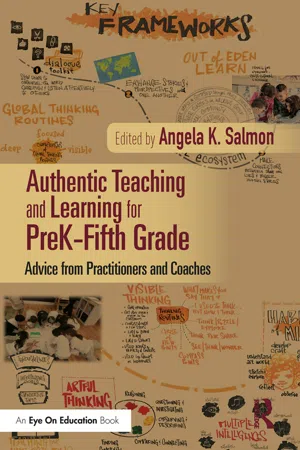
Authentic Teaching and Learning for PreK–Fifth Grade provides examples of pedagogical approaches to enhance rich curriculums based around frameworks such as Teaching for Understanding, Making Thinking and Learning Visible, Artful Thinking, and Out of Eden Learn. You will learn about real classrooms that have successfully transformed cutting-edge ideas from these different frameworks into powerful learning experiences. A highly practical resource based on Harvard's Project Zero ideas, this book shares how research findings have been complemented and implemented in the field, and will teach you how to apply best practices that lead to meaningful and authentic learning experiences in the classroom that promote Habits of Mind.
In a fast-growing technology era, when information is available at the click of a finger, educators are challenged to prepare students for jobs that do not yet exist. As Perkins (2014) said, we are educating students for the unknown. Educators confront dilemmas that need immediate and thoughtful attention. Is education providing students with tools to thrive in the 21st century? The strong emphasis on standardized testing directs teachers to teach to the standards and minimizes the importance of thinking and learning. Policy makers, administrators, teachers and parents should always keep in mind that students are the center of education and provide them with opportunities to become independent learners. Although standards are needed to mark the destination that students need to reach and schools need to be accountable, the learning journey should meet the students’ learning needs. Robinson and Aronica (2015) pointed out that while education systems around the world are being reformed, many of these reforms are being driven by political and commercial interests that misunderstand how real people learn and how great schools actually work. The ideas that the contributing authors share in this book are linked not to any political or commercial venture but to powerful ideas that bring people together to re-think what matters in schools and our role in contributing to a better future for our students.
This book is an invitation for scholars, practitioners and policy makers to find solutions to current problems in education. Initiatives such as the Illuminating Standards Project (2016), for example, are trying to engage educators in creating authentic learning experiences for their students. They try to enculturate good thinking that will meet Common Core Standards with integrity, depth and imagination; use standards to open up and enrich curriculum, rather than narrow and constrain it; and raise the level of our understanding of standards and our dialogue about them. Authentic learning takes place when learners are cognitively engaged in a meaningful and functional curriculum relevant to their lives.
This chapter compiles the frameworks that have led the different contributors of this book to design provocative questions and thoughtful experiences or performances on topics that are worth learning and lifeworthy. Students should have opportunities to find and solve problems, make predictions, take perspective, explain and apply knowledge to new situations. The different frameworks are research-based approaches developed by Project Zero researchers at Harvard Graduate School of Education (HGSE) and adjusted and implemented to different settings by this book’s contributing authors, who are actively involved with Project Zero’s ideas. Most of them had been faculty members with the Project Zero Classroom and Future of Learning summer institutes at the Harvard Graduate School of Education. The chapter also connects Costa’s (2001) Habits of Mind with Project Zero’s ideas.
This book aims to present the aforementioned frameworks in action, drawing from classroom experiences where higher order thinking in children is understood, supported and sustained to empower teachers to unleash the potential of their students. When teachers cognitively engage learners and uncover their thinking, they capture those critical moments when thinking is taking place (Ritchhart, Turner, & Hadar, 2009).
The Purpose of Education
Early in the 20th century, Dewey (1933) attempted to focus North America’s attention on the importance of thinking in education. As with language, adults are responsible for nurturing children’s thinking; unfortunately, thinking is a critical element thinly represented in schools today and, certainly, in my own education. There is a consensus among scholars (Costa, 2001; Perkins, 2001; Fogarty, 2001) that thinking is teachable and learnable. A growing body of evidence supports the efficacy of deliberately nurturing children’s thinking abilities and encouraging their understanding of what thinking is (Perkins, 1992; Ritchhart, Turner, & Hadar, 2009; Salmon & Lucas, 2011; Costa, 2001).
Perkins (2016) invited educators to think about critical questions in education: What’s worth learning (lifeworthy) in school? What does a big understanding (or big question) need to be lifeready? What kinds of teaching and learning make it lifeready? For Perkins, children build understanding through thinking.
Twenty-first-century teachers are challenged to help their students develop critical and creative thinking, collaboration and communication skills to solve problems and to foster resilience and a growth mindset. Dweck’s (2010) research demonstrates that people’s basic abilities can be developed through dedication and hard work—brains and talent are just the starting point. A growing mindset is a call to help students become metacognitive and intentional in their learning. This view creates a joy in learning so that as students are intrinsically motivated to explore the world, they accept different points of view and learn from mistakes. This is how students develop resilience, a skill that will help them face problems effectively. In this way, students may contribute to both their own understanding and also to ours. It is powerful to engage children in inquiry-based learning, in which teachers and students ask questions that provoke curiosity and imagination and that do not necessarily have immediate answers. Virtually all great people have had these qualities: inventors and creators are intellectually curious.
Emotions play another important role in students’ learning. Learners find connections with topics when they are cognitively and emotionally engaged. Neuroscientist Immmordino-Yang (2011) points out that recent advances in the neuroscience of emotions highlight connections between cognitive and emotional functions that have the potential to revolutionize our understanding of learning in the context of schools. Thus, the contributing authors share experiences that emotionally and cognitively engage children in deep and authentic learning.
Intentional Teaching
In order to be thoughtful and intentional in our teaching, we should ask ourselves, “What do we expect from the children that we teach?” Ritchhart (2015) always addressed this question: Who are our students becoming as thinkers and learners as a result of their time with us?
Our actions respond to our expectations and our vision. As Sarason (1993) pointed out, every culture defines how people within it operate. A school is not just a building containing classrooms, teachers and students who operate according to state and local district policies. It is also a “culture” and, as such, it affects people in ways that they acknowledge as well as ways that are hidden from the consciousness.
It is common for people to teac...
Table of contents
Cover
Title
Copyright
Contents
Meet the Editor
Contributors
Foreword
Acknowledgements
1 Frameworks That Promote Authentic Learning
2 If I Would Have Learned This Way!
3 Same and Different: An Out of Eden Learn Experience (Kindergarten)
4 Using Technology to Create a Thoughtful Classroom
5 Order in the Court!
6 Learning for Change
7 Image to Inference in Informational Text: Reasoning With Evidence in 5th Grade Social Studies
8 Shifting Teaching and Learning Paradigms in the Process of Listening and Reflecting
9 How to Develop Understanding Through Reflection and Collaboration in an Online Environment
Trusted by 375,005 students
Access to over 1.5 million titles for a fair monthly price.
Study more efficiently using our study tools.
Frequently asked questions
Yes, you can cancel anytime from the Subscription tab in your account settings on the Perlego website. Your subscription will stay active until the end of your current billing period. Learn how to cancel your subscription
No, books cannot be downloaded as external files, such as PDFs, for use outside of Perlego. However, you can download books within the Perlego app for offline reading on mobile or tablet. Learn how to download books offline
Perlego offers two plans: Essential and Complete
Essential is ideal for learners and professionals who enjoy exploring a wide range of subjects. Access the Essential Library with 800,000+ trusted titles and best-sellers across business, personal growth, and the humanities. Includes unlimited reading time and Standard Read Aloud voice.
Complete: Perfect for advanced learners and researchers needing full, unrestricted access. Unlock 1.5M+ books across hundreds of subjects, including academic and specialized titles. The Complete Plan also includes advanced features like Premium Read Aloud and Research Assistant.
Both plans are available with monthly, semester, or annual billing cycles.
We are an online textbook subscription service, where you can get access to an entire online library for less than the price of a single book per month. With over 1.5 million books across 990+ topics, we’ve got you covered! Learn about our mission
Look out for the read-aloud symbol on your next book to see if you can listen to it. The read-aloud tool reads text aloud for you, highlighting the text as it is being read. You can pause it, speed it up and slow it down. Learn more about Read Aloud
Yes! You can use the Perlego app on both iOS and Android devices to read anytime, anywhere — even offline. Perfect for commutes or when you’re on the go. Please note we cannot support devices running on iOS 13 and Android 7 or earlier. Learn more about using the app
Yes, you can access Authentic Teaching and Learning for PreK–Fifth Grade by Angela K. Salmon in PDF and/or ePUB format, as well as other popular books in Education & Education General. We have over 1.5 million books available in our catalogue for you to explore.