![]()
1
Create a Culture of Engagement
Raising student achievement needs to be the persuasive school climate—it needs to be alive everywhere for everyone.
—Lois Frank
Student engagement is the new “big idea” for educators across the country—unless students are engaged they can't learn, and when students don't learn, they can't succeed. Nor will they generate the performance scores schools need to meet district, state, and federal student-performance goals. As important as student engagement has become, however, some educators think it involves nothing more than getting students to sit up straight, look attentive, and work compliantly on assignments. Savvy teachers and principals know that authentic engagement requires far more than playing the role of “model” student.
Authentic Engagement
In classrooms where student engagement is nurtured, students don't sit passively waiting for academic content to be spoon-fed, and they don't work in isolation on paper-and-pencil tasks. Engaged students are enthusiastically answering probing questions posed by skillful teachers—and generating questions of their own; collaboratively working with peers on intriguing projects; or intensely researching and then debating contemporary societal concerns. In other words, appropriately engaged students are highly involved in and responsive to the teaching process and yield ample clues as to the depth of their learning.
What does student engagement have to do with a book about teacher engagement? The characteristics that typify high-quality student engagement hold true for instructional staff—teachers who sit attentively at faculty meetings and complete reports on time may not be highly engaged professionally. We need to look for richer indicators such as teachers demonstrating—through words, actions, and results—a passion for teaching, a commitment to helping every student learn, and an intense desire to perfect performance (McEwan, 2002).
Surprisingly, although education is a dynamic profession offering trail-blazing research, innovative instructional trends, and fresh career opportunities around every corner, there is no shortage of disengaged teachers. Some are worn out from the constant demands that education presents or overwhelmed by personal challenges, such as failing health or family instability. Other disengaged teachers, however, are perfectly capable but coasting or, even worse, only marginally competent. Whatever the reasons, disengaged teachers stop growing professionally, become a drag on colleagues striving to improve, and are far less effective in the classroom (McEwan, 2005). Sadly, it has also been my experience that the classrooms of minimally engaged teachers contain a disturbing number of minimally engaged students.
The Attributes of Engagement
What exactly does “engage” mean? Merriam-Webster's provides a myriad of multifaceted definitions, but my favorite is simple and cuts to the core: “Engage: To take part” (2008, p. 413). Engaged teachers “take part” by teaming with fellow faculty members striving to improve and demonstrating attitudes, beliefs, and actions that strengthen not only their own effectiveness but that of their colleagues. These salient teacher qualities are captured in The Nine Characteristics of High-Performing Schools (NCHPS), a well-researched summation of effective school practices (Shannon & Bylsma, 2007).
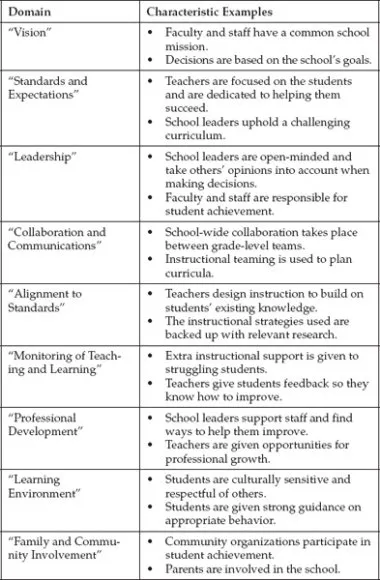
The NCHPS authors grouped the characteristics associated with high-performing schools under nine domains, which are outlined in Figure 1.1 along with a few examples of the pertinent characteristics.
The NCHPS report includes “The School Staff Survey of School Characteristics,” which my teachers completed shortly before our school received state recognition for being in the top 5 percent of improving schools. The characteristics covered by the school staff survey are rated by respondents using the following numerical scale:
Figure 1.1 High-Performing School Domains
Source: Shannon & Bylsma (2007, pp.135–137).
0 = No basis to judge
1 = Don't agree at all
2 = Agree slightly
3 = Agree moderately
4 = Agree mostly
5 = Agree completely
At my school, twenty-four certificated staff members—a mix of classroom teachers and specialists—participated in the survey, yielding a possible point total of 120 for each of sixty characteristics. The survey results revealed far more than I had anticipated, since the survey tapped into not only the performance attributes of my school but also the professional characteristics of my teachers.
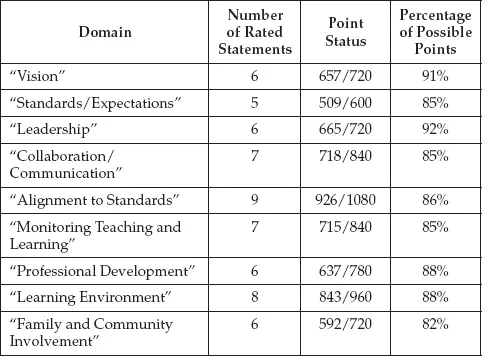
The survey covers all the NCHPS domains, and the results verify that those requiring high teacher involvement—one through eight—are strong. The ratings range from 85 to 92 percent (Figure 1.2). What's more, the ratings for leadership (92 percent) and vision (91 percent), which correlate with strong staff involvement, are exceptionally high. All told, the ratings confirm that a culture of engagement has begun to solidify.
A work environment that fosters teacher engagement is at the heart of school success. In The Six Secrets of Change, Fullan identifies qualities that typify healthy school cultures: school leaders are open, ethical, and approachable; teachers feel valued; there is a shared sense of purpose; staff possesses the knowledge and skills needed to fulfill the school's mission; professional learning is ongoing; and the organization learns from its successes and failures (2008).
Interestingly, at my school, the characteristics in the school staff survey that best align with Fullan's school success attributes are among the most highly rated—the percentage of possible points range between 90 and 97, as shown in Figure 1.3 (page 6).
In sum, my teachers’ evaluation of our school performance characteristics affirmed Fullan's observations—in effective schools, teachers understand the core mission, are highly engaged in efforts to drive up student achievement, and grow professionally.
Practitioners in Action
Every principal would love to see strong staff engagement, but that is not always the case. During the thirty-four years that I have been a principal—leading diverse faculties at nine different schools—I have unfortunately encountered my fair share of disengaged teachers. What are the barriers to powerful professional participation?
Figure 1.2 Overview of Domain Results
Source: Shannon & Bylsma (2007, pp.135–137).
To gain some insights, I tracked down Lois Frank, an exceptionally talented education consultant who works as a student and school success leadership coach for the Washington Improvement and Implementation Network. Lois provides technical assistance to school districts struggling to improve student performance. She helps administrators and teachers “analyze systems and structures, create a culture focused on improving student achievement, and develop an ongoing, reflective, data driven process” (West & Frank, 2010, p. 19). Lois's day-to-day job is a complex one that includes coaching superintendents who are striving to shore up district-wide improvement efforts, energizing work-weary pr...