- 256 pages
- English
- ePUB (mobile friendly)
- Available on iOS & Android
eBook - ePub
About this book
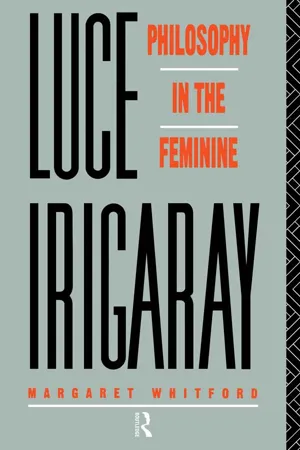
An ideal introduction to Igigaray's whole corpus, which includes previously untranslated texts.
Information
Chapter 1
Feminism and Utopia
Un discours peut empoisonner, entourer, cerner, emprisonner ou libérer, guérir, nourrir, feconder. (Parler n'est jamais neutre)
A discourse may poison, surround, encircle, imprison or liberate, heal, nourish, fertilize.
There is no mistaking the urgency of the issues which Irigaray is raising. Feminists turn to her work eagerly and as often turn away again in frustration and disappointment. Interpretations of Irigaray which try to pin down and/or fix her meaning have often been quite dismissive: Janet Sayers calls her a biological essentialist (1982: 131; see also 1986: 42–8); Lynne Segal calls her a ‘psychic essentialist’ (1987: 132); Toril Moi thinks that she is making the mistake of trying to give a definition of ‘the feminine’ (1985: 148); for Monique Plaza, Irigaray is an anti-feminist who echoes patriarchy's recuperation of feminist subversion (1978).
Irigaray faces a dilemma which could be defined as follows: on the one hand, as Moi forcefully points out, ‘it still remains politically essential for feminists to defend women as women in order to counteract the patriarchal oppression that precisely defines women as women’ (1985: 13), so to that extent it is necessary to define a female identity or specificity; on the other hand, how does one define female specificity without getting locked once again inside the patriarchal metaphysical framework one was trying to escape from? It seems to me that readers of Irigaray are looking for some kind of solution to this dilemma, hoping that she can provide a way out, and so are searching for some statement, some ‘theory of woman’ that somehow evades the snares and pitfalls of other such theories. But Irigaray herself writes: ‘For the elaboration of a theory of woman, men, I think, suffice’ (TS: 123; CS: 122); ‘Speaking (as) woman is not speaking of woman. It is not a matter of producing a discourse of which woman would be the object or the subject’ (TS: 135; CS: 133); ‘But there is simply no way I can give you an account of “speaking (as) woman”: it is spoken, but not in meta-language’ (TS: 144; CS: 141). Irigaray does not intend to tell us what ‘woman’ is: this is something which women still have to create and invent collectively. What she sets out to do in her work is to expose the foundations of patriarchy and in particular to show it at work in what has traditionally been taken to be the high discourse of universality and reason: philosophy. In the process, the conception of what philosophy consists of (or should consist of) is profoundly shaken. For Irigaray is investigating the passional foundations of reason.
More or less simultaneously, her work is presented as both accessible and inaccessible (and either way, it comes under fire). On the one hand, she has been assimilated, along with Kristeva and Cixous, under the heading of écriture fé minine (women's writing or sometimes ‘writing the body’). This strand of Anglo-American criticism tends to make her work sound like little more than a heroic and inspiring but ultimately rather Utopian manifesto. Against this view, one needs to point out that in fact her work is steeped in the history of philosophy from the pre-Socratics to the post-structuralists. To read Speculum, for example, we really need to know not only Freud but also, among others, Plato, Aristotle, Kant, Hegel, Derrida. To read Ethique de la différence sexuelle, one needs to know the Greeks, Descartes, Spinoza, Kant, Hegel. She has written a whole book as a dialogue with Nietzsche, another one as a dialogue with Heidegger, and has also engaged with contemporaries: Lacan, of course, but also Derrida, Merleau-Ponty, and Levinas. She is working primarily in philosophy, but she is also a psychoanalyst; to understand what she means by speaking ‘as a woman’, one needs to take the psychoanalytic dimension of her work seriously. The fact that she is, or has been, a practising psychoanalyst seems to me not merely an incidental feature of her curriculum vitae, but as essential to understanding her work as it has been recognized to be in the case of Lacan. And she has also done research in linguistics: her first book was a study of the disintegration of communicative ability in men and women hospitalized with a diagnosis of senile dementia, and her work at the Centre National de Recherches Scientifiques in Paris has been linguistic research, initially on the language of the mentally ill, latterly on sexual difference in language. After Ethique de la différence sexuelle, she has become more and more involved in empirical research projects, designed to show the ways in which language is gendered beyond our conscious volition (see for example the special issue of Langages, ‘Le Sexe Linguistique’ (1987), edited by Irigaray).
Ironically, however, some of those who do recognize this erudite background reproach her for it, as Eleanor Kuykendall points out:
The first question for a political analysis of Irigaray's psychologic and mythic proposals for matriarchy is whether it is elitist, hence in its very form an undercutting of a feminist politics, separating women from one another by class… Simone de Beauvoir, for example,… has suggested that écriture féminine is an inappropriate way to do feminist political work, which would be more effectively accomplished by using everyone's language, ordinary language… I found no one, up until a year after its publication, who had been able to read Amante marine, with its complex literary allusions…. What, then, is the political force of a writing style inaccessible to all but those highly trained academically? (1984: 269–70)1
This critique raises the question of Irigaray's relation to feminism and feminist politics.
The complexity of her work is nicely illustrated by the fact that whereas for some women, her work provides a celebration of femininity (Kuykendall 1984; Suleiman 1986), however problematic, for others she falls into the trap of victimology,2 and fatally ends up presenting woman as innocent and untainted by any trace of phallocentric culture (Berg 1982: 18); for others again, she may not even deserve the name of feminist (Plaza 1978). It's possible that some of the range of views ascribed to her are largely preoccupations of the ascribers; the opacity of her texts elicits a considerable degree of projection and imaginary identification, or aggressive rejection. My own view is that it is a mistake to attribute to Irigaray a static notion of ‘woman’ or ‘femininity’ – whether it is woman as essence, woman as morally pure victim, woman as outside history, woman as closer to the imaginary, and so on. Where, then, does Irigaray stand in relation to feminism?
French women theoreticians are reluctant to adopt a label with so many metaphysical implications (see also Chapter 6). ‘Woman’ is a concept implicated in the male/female oppositions of patriarchal metaphysics. The relation of women to ‘woman’ is precisely what needs to be rearticulated, and there is a danger of co-option or collusion with what one is trying to undermine, if one accepts a designation that is linked to an assumption of essence that was challenged as early as 1949 by Simone de Beauvoir in The Second Sex when she wrote: ‘One is not born a woman, one becomes one.’ Irigaray has a further reason for having reservations about the term ‘feminism’: ‘It is the word by which the social system designates the struggle of women. I am completely willing to abandon this word, namely because it is formed on the same model as the other great words of the culture that oppress us’ (WWT: 233). But she goes on to say that to criticize ‘feminism’ is likewise an equivocal gesture; what needs to be done is to reclaim the term and redefine what one means by feminism: ‘the struggles of women’ and their ‘plural and polymorphous character’ (ibid, and cf. TS: 164, GS: 158–9). So I am going to use the term to describe her work, because I believe that she is committed to women's struggles, and that this is the adjective which best expresses that commitment, whatever its misuse and misapplications.
Her relations with the women's movement have not always been easy, as so often happens when a woman attains a certain visibility, and is then taken by academia or the media to be a kind of spokeswoman. Since women have so often been silenced by those who purported to speak in their name and define them, it has been a principle of ‘second-wave’ feminism that one does not speak for others, and in particular not for ‘women’ as a group. So there has been some uneasiness about the political positionality of Irigaray's discourse: where is she speaking from? Who is she speaking for? (see Felman 1975; Plaza 1978). The marginal position which she has assumed – maintaining her independence from any specific women's group or political orthodoxy, while remaining committed to the ideals and aims of the women's movement – has not always made her popular, and although she has received a lot of support and recognition internationally, she has also been bitterly attacked in her own country. She has suggested a theoretical account of these attacks (see Chapter 4), locating their source not purely in individual or group hostilities and rivalries, but in the patriarchal symbolic order and, at the same time, trying to theorize the conditions for an entre-femmes, or a sociality among and between women. The danger for women, she suggests, is that of falling back into ‘a language and a social organisation which exile and exclude us’ (CE: 39). It is clear that she does not have much time for the attempt to ‘reverse the order of things’ (TS: 33; CS: 32), to simply reverse the balance of power between men and women. What she is concerned with is to promote and encourage the development of a social form specific to women. Separatism, while not a long-term goal – since ultimately she desires a world in which women and men can live together without oppression – can be an effective short-term strategy, imperative even, for some women (see EQ: 435). And certainly an entre-femmes is a necessary, though not sufficient, condition for the creation of female identity and subjectivity. Women need to learn to love themselves and each other as an indispensable step towards autonomy (TS: 164; CS: 159).
She does not recommend that women enter the political arena as it at present exists (see TS: 165; CS: 159–60), although again she accepts that there can be a strategic necessity (see WWT: 235). The danger is always that in accepting the terms of the system currently in force, women will become ‘men’. Fighting for equal wages and equal rights, against discrimination, the fight for equality, is in the end subordinate for her to the much bigger struggle which is to ‘challenge the foundation of our social and cultural order’ (TS: 165; CS: 160). Whatever equality means, it doesn't mean becoming like men.3 Here she rejoins the feminist mainstream, for few feminists would now regard equal rights as an adequate goal.4 It would be very easy to misread this position; the problem of a feminism of difference is that women's difference has always in practice been used against them. In fact, Irigaray suggests that we need to distinguish between struggle and critique on the one hand, and the long-term vision on the other. The local struggles are important, even essential, but to lose sight of that larger objective would mean that women become assimilated to the world of men and then have nothing to contribute is women (as is made clear by the problems inherent in applying classical liberal theory to women). At the local level it is often necessary to fight on the teriain of human rights rather than women's rights.5 Irigaray is not dictating or even suggesting what strategies any particular women or group of women should adopt (TS: 166–7; CS: 161). Her scepticism about equal rights is not a matter of contesting equal rights per se; as she points out in Speculum, equal rights or their approximation may be a necessary condition for the larger question of sexual difference to be raised at all.6
To intervene as a woman, then, in the discourse of philosophy, is Irigaray's initial aim, and the one which I am going to discuss in this study. It seems to me that this aim is an explicitly feminist stance. In particular, Irigaray diverges sharply from a certain kind of postmodernist feminism in her insistence on struggle.7
Feminist philosophy is political and committed; it explicitly desires change (see Griffiths and Whitford 1988), but to provide a blueprint in advance, explaining exactly what the nature of those changes will be, is to fall back into completely traditional methods of philosophy, as Moira Gatens (1986) shows. Gatens points out that ethical and political philosophy in the past depended essentially on a notion of what a human being was: ‘In other words, the kind of social and political organisation and the ethical and legal principles that are to govern that organisation are deduced from what a human being is thought to be, what its needs, desires, capabilities and limitations are’ (1986: 27). First you start with the definition of the human being, then you move towards the definition of the kind of society in which this human being would ideally live. This is what Rousseau did, for example; in the Discourse on the Origins of Inequality he began by defining the essential needs of the human being as freedom, self-sufficiency and independence, its essential emotions a kind of basic self-love or survival instinct (amour de soi) and compassion and pity for others. He then tried to show how society as we know it is the product of an inevitable degeneration in the course of which the fundamental human being had become unrecognizable and distorted. In his subsequent works (The Social Contract, Emile, The New Héloïse) he made various (incompatible and contradictory) attempts to create in imagination a society in which the human being, as originally defined, might be happy.8 However, modern theory is pushing feminism towards the notion that the subject, the human being, is socially constructed. Not that biology, for example, is not one of the parameters or constraints on this process of construction, but that human beings have no essential self; they are created in the process of socialization, and that there is therefore no ideal society. So a certain feminist utopianism, the attempt to define the future ideal society, comes into conflict with the theory that we are the sort of persons we are because society has largely (or at least significantly) made us that way. If a human being is at least partly a social product, then to project our current version of ourselves into the future would be to arrest change, to see the future as an alternative version of the past. Such a future would be closed to the possibility of new social or ethical forms still to be invented. Irigaray warns against projecting too far ahead, writing definitive programmes for the future (E: 16; TS: 124; CS: 123). In response to an interviewer, she replied:
In this question, I hear a desire to anticipate and codify the future, rather than to work here and now to construct it. To concern oneself in the present about the future certainly does not consist in programming it in advance but in trying to bring it into existence…. Your remarks seem to assume… that the future will be no more than the past.9
Each moment of change brings about a new situation, which requires a new response, and in the process the meanings attached to ‘man’ and ‘woman’ can begin to alter significantly. What this means in terms of feminist philosophy is that it is not static; it is not an attempt to arrive at a final once-for-all truth, beyond patriarchy, but is a continuous process of critical engagement. It is necessary to stress this dynamic aspect, because Irigaray has so often been seen as having a deterministic theory of woman.
There are two main readings of Irigaray that have been current in Britain. The first is that she is a biological essentialist, that she is proclaiming a biologically given femininity, in which biology in some unclear fashion simply constitutes ‘femininity’. Very briefly, the charge of biological essentialism assumes that Irigaray posits an unmediated causal relation between biological sex and sexual identity, leaving out completely the imaginary dimension, in which sexual identity may be related in an unstable and shifting way to the anatomical body, or the symbolic, linguistic dimension, in which sexual identity may be constructed. Further, biological essentialism, in the form in which it is usually attributed to Irigaray, is a deterministic and often simplistic thesis which makes change impossible to explain. The second reading is the Lacanian account of Irigaray as a ‘psychic essentialist’, a term coined by Lynne Segal (1987: 132). The Lacanian re...
Table of contents
- Cover Page
- Half Title page
- Title Page
- Copyright Page
- Contents
- Acknowledgements
- Abbreviations
- Introductory remarks
- Chapter 1 Feminism and Utopia
- Section I Psychoanalysis
- Section II Philosophy
- Notes
- Bibliography
- Index
Trusted by 375,005 students
Access to over 1.5 million titles for a fair monthly price.
Study more efficiently using our study tools.
Frequently asked questions
Yes, you can cancel anytime from the Subscription tab in your account settings on the Perlego website. Your subscription will stay active until the end of your current billing period. Learn how to cancel your subscription
No, books cannot be downloaded as external files, such as PDFs, for use outside of Perlego. However, you can download books within the Perlego app for offline reading on mobile or tablet. Learn how to download books offline
Perlego offers two plans: Essential and Complete
- Essential is ideal for learners and professionals who enjoy exploring a wide range of subjects. Access the Essential Library with 800,000+ trusted titles and best-sellers across business, personal growth, and the humanities. Includes unlimited reading time and Standard Read Aloud voice.
- Complete: Perfect for advanced learners and researchers needing full, unrestricted access. Unlock 1.5M+ books across hundreds of subjects, including academic and specialized titles. The Complete Plan also includes advanced features like Premium Read Aloud and Research Assistant.
We are an online textbook subscription service, where you can get access to an entire online library for less than the price of a single book per month. With over 1.5 million books across 990+ topics, we’ve got you covered! Learn about our mission
Look out for the read-aloud symbol on your next book to see if you can listen to it. The read-aloud tool reads text aloud for you, highlighting the text as it is being read. You can pause it, speed it up and slow it down. Learn more about Read Aloud
Yes! You can use the Perlego app on both iOS and Android devices to read anytime, anywhere — even offline. Perfect for commutes or when you’re on the go.
Please note we cannot support devices running on iOS 13 and Android 7 or earlier. Learn more about using the app
Please note we cannot support devices running on iOS 13 and Android 7 or earlier. Learn more about using the app
Yes, you can access Luce Irigaray by Margaret Whitford in PDF and/or ePUB format, as well as other popular books in Philosophy & Ethics & Moral Philosophy. We have over 1.5 million books available in our catalogue for you to explore.