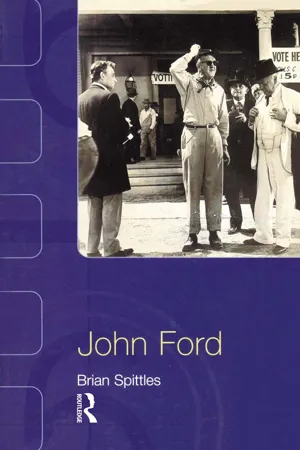
John Ford is a monumental figure in Hollywood and world cinema. Throughout his long and varied career spanning the silent and sound era, he produced nearly 150 films of which Iron Horse (1924), Stagecoach (1939), The Grapes of Wrath (1940), How Green Was My Valley (1941), The Searchers (1956) and The Man Who Shot Liberty Valance (1962) are classics of cinema. Ford was also an influential figure in developing, and extending Hollywood's traditions. Stylistically Ford was instrumental in developing new camera techniques, atmospheric lighting and diverse narrative devices. Thematically, long before it became conventional wisdom, Ford was exploring issues that concern us today, such as gender, race, the treatment of ethnic minorities and social outcasts, the nature of history and the relationship of myth and reality. For all these reasons, John Ford the man and his films reward thought and study, both for the general reader and the academic student. Ford's pictures express the world in which they were made, and have contributed to making what Hollywood is today. This book illustrates the excitement, importance, influence, creativity, deviousness and complexity of the man and his films.
John Ford, more than most Hollywood directors, chose as much as possible to work with the same people regularly. This is most evident in the case of actors, who are very public figures. John Wayne, for instance, first appeared for Ford as an extra in Hangman’s House, and eventually went on to become his main star actor from Stagecoach until Donovan’s Reef (1963). George O’Brien covered a full forty years, from starring in The Iron Horse to appearing in Cheyenne Autumn. Harry Carey was followed by his son – Harry Jr, also known as Dobe – forging a connection that lasted almost fifty years. A Ford film unit was like a family, with many familiar faces from one production to another. Some of the regulars were in fact family. Brother Francis had character roles in a number of films, right up to The Sun Shines Bright (1953) a year before his death. Another brother, Edward O’Fearna, and a brother-in-law, Wingate Smith, were employed by Ford throughout his career, and son-in-law Ken Curtis became a regular performer as actor, and sometimes singer, as in his role as the hapless Charlie McCorry in The Searchers.
Like many families the units were not always harmonious. There are many anecdotes of Ford’s tyranny and, on occasions, of his coldness, such as his response to Frank Bakers praise of Francis Ford’s camera work quoted in the previous chapter. Also, between his initial work with Ford and fame in Stagecoach,
Ford suddenly refused to talk to [John] Wayne for three years … Wayne’s sin was making The Big Trail with Raoul Walsh. The great silence began then, the kind of exile Ford’s actors came to expect when Ford was not recognized as the proper determiner of their careers.
(Wills,1999, pp.68–9)
Although Mary Astor thought ‘John Ford’s sets … always felt “good”’ (Astor, 1973, p. 48), James Cagney was clearly uncomfortable on them. His summary of the experience of working for Ford was blunt: ‘there is one word that sums up Jack Ford … “malice”!’ (McCabe, 1998, p. 271).
Nevertheless, many people, not only performers, were willing to work for Ford time and again. Albin Krebs has observed that Ford used the same cameramen, assistant directors, costume designers, grips and electricians in picture after picture’ (Mew York Times, 1 September 1973), and he did have a reputation for knowing his production crews – which is not a ubiquitous talent among directors. Harry Carey Jr described to Anderson a typical situation on a Ford set:
‘people weren’t all uptight He was a terrific disciplinarian, but he was never mean to anyone on the crew. He knew every one of their names, and how many children they had, everyone, even up to the guy who swept up the cigar butts. He knew all of them, and he’d never be mean to any of the crew. He’d only be mean to actors -and sometimes the cameraman.’
(Anderson,1999, p.215)
Members of a team who know how other people work are able to shortcut some of the processes and lines of communication. This can be very important in a business as complex as film-making, creating efficiency. Ford was, on the whole, a relatively fast operator. In the very early days he could turn out a two-reeler in a week, and even a film as striking as the 129 minutes long The Grapes of Wrath was primarily shot in forty-three days – preproduction and editing, of course, have also to be taken into account when working out the exact time it takes to make a picture. Nevertheless, that is quick shooting. A little earlier, for instance, William Wyler – using the same leading man, Henry Fonda – took at least twice as long, from October 1937 until the end of January 1938, to shoot the much shorter Jezebel (94 minutes). The efficiency that equates speed with quality might be measured in this case by the fact that The Grapes of Wrath won seven Oscar nominations, and was awarded the coveted statuette for Best Director and Best Supporting Actress – Jane Darwell for her role as Ma Joad.
Ford liked working quickly. Generally, he did not, as some directors do, put his actors through repeated rehearsals, preferring instead spontaneity in performance. Run through, set up, shoot was his preferred style – with everyone knowing their job and trusting the other people involved. There were, though, famous arguments with actors. For example, during the filming of Henry Fonda s last role with Ford in Mister Roberts (1955), the director lost his temper to such an extent that he actually punched the actor. That quarrel was over broad issues of interpretation. Fonda had been playing the eponymous role in the theatre for seven years and thought Ford’s conception of the comedy was wrong:
‘I didn’t like the kind of roughhouse humour that Pappy [Ford] was bringing to it… [he] shot it all wrong. He didn’t know the timing. He didn’t know where the laughs were and how long to wait for them to die down. He had them all talking at once, throwing one line in on top of another. When I said something he just handed me the script and said, “Here, you wanna direct?” … suddenly he rose up out of the chair and threw a big haymaker at me and POW, hit me right in the jaw. It knocked me over backwards.’
(Ford,1998, p.268)
Adapting a stage play to the screen is always fraught with problems, and that is especially true of comedy. The audiences are likely to be of a different make-up, and the theatrical actor can time lines in response to a specific audience’s reactions, whereas the film is made cold. If a director leaves a pause for a laugh that does not arise, the film begins to look pedestrian, although Fonda’s argument that too many jokes quickly choke one another and create incoherence is also valid. In the event Ford suffered a serious gall-bladder problem during the course of filming and was replaced by Mervyn LeRoy.
Although this dispute between Ford and Fonda was somewhat extreme in its outcome, the director was well known for bullying performances from actors. The instance of the goading of Wayne on the set of They Were Expendable has already been mentioned, and during every movie at least one actor, sometimes several, were subjected to particular humiliation. A case in point is Harry Carey Jr’s first movie, 3 Godfathers (1948). Throughout the shooting Ford swore at the young actor, kicked him, implied that he was a mas-turbator and subjected Carey to the physical torment of leaving him for half an hour in the 100 degree heat of Death Valley. It was a deep-end introduction to acting, physically and emotionally distressing, but it drew a good performance from an inexperienced player and the two continued to work together on many other films.
Some directors work by putting their actors through several takes, then selecting at the editing stage. Ford preferred, when possible – not withstanding his bullying of actors – to cut in the camera rather than rely on editing or editors. Although Ford did some of his own editing, that task became a Hollywood specialism, and in any case he suffered from studio interference on occasions and would not necessarily trust a picture to other hands if it could be avoided. Ford became a one-take director whenever he could – both to get a spontaneous performance and to allow only a minimum of scope to studio editors. Gallagher has argued: ‘Many directors shot fifteen or twenty times more footage than ended up in the picture, whereas Ford’s ratio was about
’ (Gallagher, 1986, pp. 117–18). Randy Roberts and James S. Olson concur on this matter, observing that Ford ‘seldom needed more than one or two takes. Probably no other major director made movies that wasted less film or needed less editing (Roberts and Olson, 1995, p. 155). These factors were made possible partly by his creation of a kind of repertory company. Ford’s Stock Company, as it was known, was a strong feature of the way he worked.
Actors, however, are only the public face of films, and generally do not contribute to a picture’s creation beyond their own roles. An exception to this was the older Harry Carey’s working relationship with Ford, around 1917 to 1919, when the experienced actor was able to teach the young director a good deal about the business. A film, however, is a collaborative venture. Writers, cameramen, producers, composers, designers can all contribute to the overall conception of the work in hand.
As with actors there were writers with whom he preferred to collaborate. A common Hollywood system that emerged during Ford’s time was for a writer to create a script for a producer, who passed it on to a director. However, that system had not developed when Ford began directing, and in the early days the credited scenarist was often George Hively. But perhaps the first truly important writer with whom Ford worked was Dudley Nichols, in the early days of the talkies. They worked together, on and off, from Men Without Women (1930) through to The Fugitive. Some critics find the earlier 1930s films among the least impressive of Ford’s achievements, a view reflected in this comment by Gallagher, a not unperceptive viewer: ‘The Ford-Nichols movies were characterized by literary pretense, theatrical values, and heavy Germanic stylization’ (Gallagher, 1986, p. 465) When Nichols started writing he had only recently arrived in Hollywood from a successful career as a journalist and critic in New York. That experience, and the effect that such films as Murnau’s Nosferatu (1922) and Sunrise (1927) had on Ford (see Chapter 2), helps to explain the look of the first films, and Nichols has been gracious in acknowledging his debt to Ford in the collaboration. Influences were reciprocal, and those circumstances created a good atmosphere for Ford’s imagination.
Whatever the shortcomings of their first picture together Nichols provided Ford with challenges and admired the way the director met them during shooting in 1929: ‘I told Ford I feared I would imagine and write scenes which could not be photographed. “You write it”, he said, “and I’ll get it on film.” Well, he did’ (Anderson, 1999, p. 238). Nichols gave two illustrations of what at the time were daring and imaginative feats:
‘They believed long dolly shots could not be made with the sound camera. He did it – one long shot down a whole street, with men carrying microphones on fishpoles overhead … Even put the camera in a glass box and took it on a dive on the submarine. It is old hat now. Not then.’
(Anderson, 1999, p.238)
In addition to the technical innovations that Nichols pushed Ford to risk, the pair went on to make several films that became classics for their overall conception and production. The Informer was nominated for six Oscars, and actually won four, including Best Director for Ford and Best Screenplay for Nichols. The ground-breaking Stagecoach was another product of the Ford-Nichols collaboration. Nichols’ summary of working in Hollywood reveals just how good a director Ford was:
‘I had very unhappy experiences with other directors, who worked by rote, whose minds were vulgar and unimaginative… Ford was a great man for a writer to be associated with, and I have nothing but gratitude for the many things I learned from him … we formed a fruitful collaboration.’
(Anderson, 1999, pp.238–41)
It was precisely the collaboration that stimulated Ford: the fact of the writer understanding that the camera interpreted the page rather than simply recorded it, as the cameras of the ‘rote’ directors did.
Although Ford was credited as co-writer on some of his pictures he was not a writer in any strict sense. Roberts and Olson have suggested one reason why Ford worked so well with some writers and not so fruitfully with others: ‘He regarded scripts as general outlines, not stone tablets. He cut lines, added lines, combined lines’ (Roberts and Olson, 1995, p. 154). Mostly he liked to pare scripts down, to keep dialogue to a minimum. The editor, and aspiring director, Robert Parrish recalled Ford’s advice to him on directing actors: ‘Don’t let them talk unless they have something to say’ (Parrish, 1976, p. 143). James Stewart praised Ford for being ‘visual… for never hesitating to discard reams of dialogue if that was what was required to make a picture work’ (Dewey, 1998, p. 3).
There are writers who fight that kind of action to the last ditch, creating an uncooperative atmosphere before shooting or on the set. Phoebe and Henry Ephron, for instance, credited with the writing on their one film with Ford – What Price Glory? – actually walked out on the production, which is generally thought to be one of Ford’s least successful. The argument was not solely about the script – they also reacted against what they saw as Ford’s overbearing manner – but the point is that the director needed people who could put up with that. It was those people who became the collaborators, the Stock Company. Those scenarists did not necessarily like Ford’s irascibility and unpredictability, but recognized that his attitudes to them and their work were part of the collaborative experience: a creative tension. It stimulated Ford to create some of his best work.
Nichols accepted this. Comparing the published script of Stagecoach with the film, Garry Wills has noted: ‘Ford made many departures from the script in filming, and the order of some sequences was altered in the editing’ (Wills, 1999, p. 330). One example of how Ford changed Nichols’ script concerns Ringo’s first appearance. The reason he holds up the stage is that his horse has gone lame, and Nichols, following a literal line of thinking, wrote the horse into the shot. Ford, considering the horse a distraction from the crucial initial impact of John Wayne as Ringo, dispensed with it. The dialogue very briefly gives the necessary narrative information, and the literal-minded viewer might ask, what happens to the horse? The answer is it simply doesn’t matter. Indeed, if the horse had remained on screen, the question would have become even more insistent. The impact of Wayne/Ringo and the forward thrust of the narrative carry most cinema audiences beyond such questions.
Nichols helped to induct another writer, Lamar Trotti, into the Ford fraternity. Nichols has described how he undertook to teach Trotti how to write film scripts. For instance, they co-wrote on Ford’s vehicles for Will Rogers (sometimes referred to as ‘Fox folksies’), such as Judge Priest (1934) and Steamboat Round the Bend (1935). Trotti’s only solo writing credit on a Ford film was Young Mr Lincoln, a rather curious fact, since the subject matter was very dear to the director’s heart. Ford thought of himself as somet...
Table of contents
Cover
Half Title
On Directors Series
Title Page
Copyright Page
Dedication
Table of Contents
Publisher's acknowledgements
Acknowledgements
Selected filmography
Background
1 Ford's film family
2 Ford as auteur
3 Generically challenged
4 The greatest storyteller
5 Conservative or subversive
6 Entertainer or ideologue
7 Unconscious racist
8 Patriarchy or matriarchy
Further reading
Bibliography
Index
Trusted by 375,005 students
Access to over 1.5 million titles for a fair monthly price.
Study more efficiently using our study tools.
Frequently asked questions
Yes, you can cancel anytime from the Subscription tab in your account settings on the Perlego website. Your subscription will stay active until the end of your current billing period. Learn how to cancel your subscription
No, books cannot be downloaded as external files, such as PDFs, for use outside of Perlego. However, you can download books within the Perlego app for offline reading on mobile or tablet. Learn how to download books offline
Perlego offers two plans: Essential and Complete
Essential is ideal for learners and professionals who enjoy exploring a wide range of subjects. Access the Essential Library with 800,000+ trusted titles and best-sellers across business, personal growth, and the humanities. Includes unlimited reading time and Standard Read Aloud voice.
Complete: Perfect for advanced learners and researchers needing full, unrestricted access. Unlock 1.5M+ books across hundreds of subjects, including academic and specialized titles. The Complete Plan also includes advanced features like Premium Read Aloud and Research Assistant.
Both plans are available with monthly, semester, or annual billing cycles.
We are an online textbook subscription service, where you can get access to an entire online library for less than the price of a single book per month. With over 1.5 million books across 990+ topics, we’ve got you covered! Learn about our mission
Look out for the read-aloud symbol on your next book to see if you can listen to it. The read-aloud tool reads text aloud for you, highlighting the text as it is being read. You can pause it, speed it up and slow it down. Learn more about Read Aloud
Yes! You can use the Perlego app on both iOS and Android devices to read anytime, anywhere — even offline. Perfect for commutes or when you’re on the go. Please note we cannot support devices running on iOS 13 and Android 7 or earlier. Learn more about using the app
Yes, you can access John Ford by Brian Spittles in PDF and/or ePUB format, as well as other popular books in Media & Performing Arts & Film & Video. We have over 1.5 million books available in our catalogue for you to explore.