![]()
Chapter 1
Introduction
Opening remarks
In the closing moments of his final almost impenetrable work, Joyce asks a question that many of his readers over the years must have thought about him, ‘Is there one who understands me?’ (FW 627:15). There will always be a doubt about Finnegans Wake, but to some extent the complaint also resonates against his work as a whole. For Joyce, both as a man and as a writer, is a puzzle, and he has been so for what is now several generations of readers round the world. Joyce half-knew he would be a puzzle and to some extent he was responsible for his fate, for, as he once remarked about Ulysses, ‘I’ve put in so many enigmas and puzzles that it will keep the professors busy for centuries arguing over what I meant, and that’s the only way of insuring one’s immortality’ (Ellmann, 1982, 521). The enigma, though, prompted worldwide interest, for as John Banville noted, writing in the New York Times on the centenary of Bloomsday in June 2004, ‘Ulysses remains one of the most talked about and least read works of world literature.’ Banville’s conjunction is instructive. Joyce, who knew how to insure and ensure his immortality, is the most talked about and least read modern author, as enigmatic today as he was when he first came to the world’s notice in the years around the Great War.
This book begins with the enigma that is Joyce and to some extent it ends with the enigma that is Joyce. But, in the light of 40 years reading Joyce and 30 years teaching him, it’s also a journey in which I try to make sense of this enigma. He began for me as a dilemma at a Catholic junior seminary when my alter ego Donagh McDonagh, a classmate who was one day my senior, alerted me, with glee in his eyes, to A Portrait of the Artist as a Young Man: ‘Read that and tell me what you think.’ I didn’t read it at the time, for I suspected it would be too close to my experience, and, moreover, I had no intention of listening to a renegade while inside the sacred confines of the Church. From that moment on, though, I sensed I had an appointment with destiny, but I put the enigma on one side until I was beyond
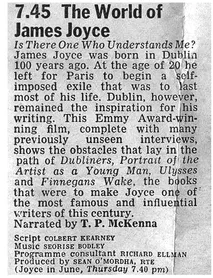
Christmas 1982 listing in Radio Times of one of the best documentary films on Joyce: Is There One Who Understands Me?
adolescence and beyond the immediate circle of his influence. Joyce for me, then, was a writer to return to, but all of us come to him with our own expectations and varying states of readiness. This book is a journey, and part of that journey is about beginnings and imagining what it was like for me beginning to read Joyce and putting myself in the shoes of those embarking on a similar journey today.
Reading Joyce is not for everyone, and nor should it be, but, for those who develop an interest, the habit can be forming and even last a lifetime. For many readers, Joyce is often embarked upon as a matter of obligation or as part of a high-school or undergraduate programme. This book is written to convey something of the pleasure in reading Joyce, and it is informed therefore by a spirit of humour and appreciation. It issues from a belief that the reader new to Joyce needs a certain amount of guidance, but not an excessive amount. I look to the reader, therefore, who appreciates a challenge and who, long after the prompt books have been put down, will continue reading ‘the porcupine of authors’, as his biographer Richard Ellmann once called him (Ellmann, 1982, 6). Indeed, the reader I have in mind is sceptical of reading books with ‘notes’ in the title and is looking for a critical engagement with a writer who is so highly regarded. Not ‘this means that’ but ‘Why should I read this at all?’ and ‘How does any of this connect with my life?’ and ‘Please tell me things but make it interesting.’
Fabulous Voyager: James Joyce’s ‘Ulysses’ is the title of a much-admired study by Richard Kain (1947), and what the author stresses throughout is that it is the reader who is the ‘fabulous voyager’. I think that’s right. The central person in my book is not me or James Joyce, or the voyages of Joyce’s characters or the flight of his imagination, but the reader. It is the reader who is on a journey, and the journey being offered is to my mind a fabulous one; fabulous meaning great, beautiful, exquisite; fabulous also meaning made-up, a fable, an extraordinary narrative. Both meanings are in evidence here but it is the second one that is most suggestive, for what Joyce offers his reader is something unimaginably realistic and for that very reason fabulous. Begin here and recall this moment when you come to the end of the voyage, for, more than most writers, reading Joyce is an unbelievably fabulous experience and you can’t be sure where that experience will end.
Most books, be they a collection of stories about a neglected colonial city at the turn of the twentieth century or a work of literary criticism, have a story behind them. This one is no different. In 2005 the Acquisitions Editor for Literature at Longman, Philip Langeskov, contacted me asking if I would consider writing a book on Joyce that would be both educational and informative and at the same time come with a personal stamp on it. I thought, with my previous books on Joyce for Yale University Press and Continuum, I had done enough on the great man, and I wasn’t sure I had anything new to say. Philip persisted. Had I read W.G. Sebald’s The Rings of Saturn (1998) or Janet Malcolm’s Reading Chekhov: A Critical Journey (2001)? Flattery works with most of us, but this was distinctly heady company. Sebald’s work is very special and he is a great storyteller. One minute we are in a parish church in Suffolk, the next in the early modern period with new immigrants from the Low Countries, and, then, in one fell swoop, we are looking up at the sky watching German bombers menacingly overhead. The arts of war and peace brought into alignment, and all from a central European perspective. I couldn’t get anywhere close to that, I told Philip. My experience is simply too limited to carry so much weight. He persisted.
What about Janet Malcolm, then? She had undertaken a journey to the places associated with Anton Chekhov’s short stories, and she makes much of her conversations with her tour guide and the possibility of touching and recuperating the Russian writer through association. This, too, is a very special book, partly because it is so beautifully written and partly because Janet Malcolm is so intelligent when it comes to human psychology. The insights I have, I told Philip, are more pedestrian, so anything I would tackle would, again, of necessity be limited. What I did do, however, on a more practical level, just in case, was return to Dublin and Paris and take some more photographs of places connected with Joyce, and some of these appear here for the first time, adding to the texture and by implication the argument of my book as a whole.
I was tired. For 15 years and more I had been producing books without a break in an unsupportive university environment. Philip didn’t give up. For some years he had been keen to publish a book that would rescue Joyce from his reputation as a difficult writer. As he rightly insisted to me, ‘Isn’t it odd that Joyce often turns up at the head of lists of both the most influential books and the books least likely to be read. There’s something a bit funny about that, isn’t there?’ On two occasions in 2006 he came up to York and bought me lunch. How could I refuse? I started writing but had to wait for some months before I could settle on the right tone or discern a sufficiently clear line. Stepping outside the conventional boundaries of writing is never easy, but I’ve always been keen on trying something different. Philip wanted a book where the images were integrated, rather than juxtaposed, with the text. Again, another challenge, which could only be seen as successful, if at all, in retrospect. So, I would need to allow time at the end for polishing and ensuring a happy mix of caption and narrative flow.
That’s how the book you have in your hands began. I am quite certain there wouldn’t be a book if it weren’t for the persistence of an editor at a large educational publishers. The story’s worth recounting because it helps to set the scene for what’s to come. I took the view that if discursiveness wasn’t to become a burden for the reader, then I had to ensure a familiar structure based on Joyce’s fictional texts. Not everything in a book of discovery should be subject to discovery. Hence there are four chapters on Dubliners, one on A Portrait of the Artist as a Young Man, three on Ulysses, and a final chapter on Finnegans Wake. Throughout, I also include references to Joyce’s other writings, such as his play Exiles and his poetry, but my attention is focused on those texts which constitute the Joyce canon and which, with the exception of Finnegans Wake, regularly appear on course lists.
I begin with a biographical chapter on Joyce at 22 and the year of 1904 when, with the entry of his future partner into his life and the printing of the first stories of Dubliners, the world began to change significantly for him. Joyce the man and Joyce the writer – what was he like and what distinguishes his writing? I devote quite a lot of energy in the first part of this book to this question in the belief that orientation and first impressions tell us not all we need to know but a surprising amount of potentially useful information. The complex relationship between Joyce the man and Joyce the writer is touched on throughout this book, but I thought it would be helpful to spend time at the beginning reflecting on that moment when a line was being drawn between his past and his future.
With that complex relationship in mind I also include a brief section below on ‘Snapshots of Joyce’ as a way of introducing how Joyce has sometimes been portrayed by visual artists and how such images also inform our impressions of him and therefore our reading of him. In a final section on ‘Home, sweet home’ I explore places associated with Joyce, places where he can still be felt, and the meaning that exile had for him. As the references to ‘Dublin 1904, Trieste 1914’ at the end of A Portrait of the Artist as a Young Man, and to ‘Trieste, Zurich, Paris, 1914–1921’ at the end of Ulysses remind us, Joyce was an exile whose thoughts from abroad were dominated by the meaning of home, places in-between, and times past.
There is a variety of material on display in this book, but all of it is designed to intrigue or entice or encourage. The illustrations are built into the text and can be enjoyed for themselves or mulled over at leisure. It’s a big book, but I have tried to break up the text in ways that enhance the argument and reading experience. It’s also a critical journey in that it deals with my journey as a critic reading Joyce over four decades. How has my reading of Joyce changed? What do I get out of reading him? How have the students I have taught over the years responded to his writings? It’s a personal book, therefore, with personal narratives interspersed throughout with critical and contextual comments. I wrap my personal narratives inside the covers of this book to insist on my involvement with Joyce and how this arises from more than simply a concern with writing. After ten books, I feel I can now come clean and say what I wanted to say all along. It’s never quite like that of course, but, given the demise of critical monographs, there’s something to be said for trying to take criticism into areas that might prove more attractive for today’s reader.
The Introduction to my Cork Reader (2001) includes some remarks on my Irish background, and there are further personal reflections in Joyce and Company (2006) on my Catholic education as well as on visits to universities in the German Democratic Republic in the 1980s. Here in this book I recall attending an American Wake in the mid-1950s in the west of Ireland as well as other moments that suggest something of a common culture I (and others) share with Joyce. His Catholic upbringing will be readily appreciated by most Catholic readers, whether or not they are Irish. My upbringing was slightly more intense in that I spent my teenage years in seminaries, first in Sussex and then in Surrey. I reflect more on that experience and how it impacts on my interpretation of A Portrait. But I launch my personal story with experiences at university in the hope that this might establish a rapport with my reader. Chapter 2, in a section I have called ‘At 22’, begins with what it was like for me going to university in the north of England in the 1960s. Other experiences include teaching in adult education, in a community college in Northern California, and with the British Council in Madrid when I was a newly qualified graduate – all this material, tied to the Joycean yoke, surfaces in this book of many words.
Difficulty and delay
The things I like about Joyce will become apparent as we go along, but let me at the outset offer a couple of pointers or signposts. The issue of difficulty means that we have to spend time attending to detailed textual matters. The word I see I’m fond of in this book is ‘delay’. Joyce encourages us to delay on words and phrases, on grammar and punctuation, and on meaning. As it happens, many first-time readers encounter difficulty not head-on but indirectly, when they arrive at the end of a story in Dubliners and are puzzled: ‘Is that it? Have I missed something? Why is such writing considered special?’ If you read for meaning you can miss a lot, but if you don’t catch the meaning you can also miss a lot. It would be nice if this wasn’t the case and the Joycean mood music was different, but, as I say, we are obliged to delay and spend time reflecting. I have deliberately delayed in the early part of this book on individual stories of Dubliners to ensure the reader new to Joyce gets on the right track and doesn’t miss things.
Some of the best readers of Joyce are those whose first language is not English, for, repeatedly, they have to delay over a word or a phrase that for native speakers presents no immediate problem and is often glossed over. I enjoy perusing translations of Joyce’s...