There seems to be an abundance of "factual" information regarding alcoholism; what causes it, who is most susceptible, how it affects its victims, and how it should be treated. However, a definitive source of data supporting -- or refuting -- the numerous and diverse positions was never available. Thus, the goal of the author is to provide professionals with a solid understanding as to which "factual" statements about alcoholism are actually supported with evidence, and some of the empirically validated ways to proceed with treatment.
Major methods of treatment are reviewed, and empirically based approaches are compared and contrasted with one another. Different and sometimes new focal points are explored, such as the disease concept of alcoholism, family members of alcoholics, personality characteristics, and effects of alcoholism exclusive to women. Also notable is the nearly unprecedented look into the impact of alcohol on all types of mood and behavior, rather than just on aggression -- a topic long since exhausted. A comprehensive review of literature, complemented with critiques of research, this two-volume set is a thorough, informative source of reference for anyone who seeks to further their knowledge of this often misunderstood, yet unfortunately all too common phenomenon.
eBook - ePub
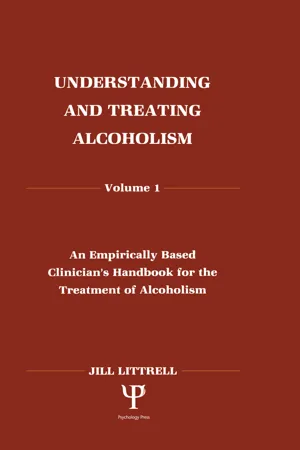
Understanding and Treating Alcoholism
Volume I: An Empirically Based Clinician's Handbook for the Treatment of Alcoholism:volume Ii: Biological, Psychological, and Social Aspects of Alcohol Consumption and Abuse
- 408 pages
- English
- ePUB (mobile friendly)
- Available on iOS & Android
eBook - ePub
Understanding and Treating Alcoholism
Volume I: An Empirically Based Clinician's Handbook for the Treatment of Alcoholism:volume Ii: Biological, Psychological, and Social Aspects of Alcohol Consumption and Abuse
About this book
Trusted by 375,005 students
Access to over 1.5 million titles for a fair monthly price.
Study more efficiently using our study tools.
Information
I
The Treatment of Alcoholism
Introduction
The section on the treatment of alcoholism is divided into 5 chapters. The first chapter discusses the views of self-help groups and treatment providers with an AA orientation. The first half of the first chapter offers a discussion of the 1946 and 1952 research reports of Jellinek, which verbalized the frame of reference that had been the informal conceptual basis for Alcoholics Anonymous (AA). The stages of alcoholism, and the types of alcoholics, that Jellinek identified, are discussed in detail. The pivotal role of denial in AA thinking is explained, along with other assumptions, including the links between addiction, craving, and loss of control. Recent embellishments on theory provided by professionals with an AA orientation are presented. These ideas include cross addiction to other chemicals, dry drunks, personality traits descriptive of alcoholics, and progression of the disease during periods of sobriety.
The second half of the first chapter examines research pertinent to the ideas advanced in AA. On the basis of numerous studies it is possible to estimate what percentage of untreated alcoholics will recover through abstinence, what percentage will achieve control drinking, and what percentage will die of the disease without having achieved sobriety. In addition to information on what happens to alcoholics over a lifetime, research has addressed whether there are reliable stages in the process of alcoholism. Research has also addressed the issue of the drugs for which the concern regarding cross addiction is justified; the conditions under which alcoholics and others deny, and whether alcoholics are different in that respect; as well as questions pertinent to craving and loss of control. The chapter ends with a discussion of the impact of the disease concept and how it has affected the way in which society at large sanctions and perceives deviant drinking.
The second and third chapters concern treatment. The second chapter outlines characteristic AA oriented treatment. Vernon Johnson has verbalized much of this material, and so is frequently quoted, as are other treatment providers who have been influential in AA based treatment. In addition, the influence of the Hazelden treatment center in Minnesota is represented in the summary of the AA approach. The AA steps, recommended interventions, and how group therapy is conducted, are all covered. In addition, the manner in which relapse prevention in AA based treatment is addressed, is explained.
The second half of chapter 2 compares the AA model with the treatment models advanced by empirically based clinicians such as William Miller and Alan Marlatt. AA’s reliance on commitment to maintain sobriety is contrasted with Marlatt’s emphasis on the teaching of skills for relapse prevention. The sources of motivation that are tapped by the respective models are discussed and contrasted. The ways in which the models differ in the emphases on, and roles played by, the patient’s belief in self efficacy are discussed. There is also brief coverage of differences between the two models in willingness to work with clients who continue to drink, and exploration of differences in the role of the therapist in each model.
Chapter 3 presents a fuller description of empirically based treatment. This chapter draws heavily upon the work of Alan Marlatt presented in his book on relapse prevention. Empirical findings are presented regarding common precipitants to relapse. There is a presentation of the attitude and personality factors (e.g., feelings of self-efficacy, willingness to self-reinforce, expectations concerning the effects from drinking), which differentiate alcoholics who achieve extensive periods of sobriety from those who do not. After presentation of empirical findings concerning common relapse precipitants and relevant personality issues, a discussion of empirically based treatment is offered. Techniques for enhancing feelings of self-efficacy, building coping skills, incorporating self-reinforcement, changing life style, changing positive attitudes toward drinking, and avoiding abstinence violation syndrome, are all included, along with a discussion of which behaviors to self monitor. Consideration is given to differences between the type of alcoholic for whom strengthening feelings of self efficacy is useful, as compared to those for whom reliance on external forces is more efficacious. Treating alcoholics who are continually relapsing presents a problem for group therapy in any model. A discussion of how to handle this type of patient is presented.
The fourth chapter concerns the overarching theme of the many attempts to identify and measure personality traits that are characteristic of, or predictive of, or in some way relevant to, alcoholism. It includes the attempts to define different types of alcoholics, and is specifically concerned with attempts to develop measures for the many personality categories and typologies. The chapter begins with a discussion of personality characteristics that are descriptive of alcoholics. The literature on personality traits is vast and no attempt was made to be exhaustive. A decision was made to limit discussion to (a) those traits that have emerged in the research on children of alcoholics which might constitute part of the temperament precursor to alcoholism and (b) those traits that have generated a body of literature because of their potential importance for treatment. The traits discussed include boredom susceptibility, differences in autonomic nervous system responding, depression, potential for suicide, locus of control, and scale elevations observed on the Minnesota Multiphasic Personality Inventory (MMPI).
There are many ways in which alcoholics might be categorized into types. One particular method for dividing alcoholics is on the basis of demographics: sex, age, and socioeconomic status. Most of the research on alcoholism has been done on gainfully employed males with an average age of 45. This population is therefore heavily represented in the literature reviewed throughout this text. Consequently, consideration of characteristics and other facts that are unique to other alcoholic populations have to be reviewed. That kind of information, specifically on the topics of female alcoholism, geriatric alcoholics, and skid row alcoholics, is covered in this chapter.
In addition to the use of demographics for providing meaningful ways to categorize alcoholics, others have proffered other typologies which might relate to differential treatment outcomes, differential efficacy given various types of treatments, and differential etiological roots. One obvious way in which alcoholics can be distinguished is the pattern of their drinking. Some of the findings investigating differences between bingers and steady state drinkers are discussed. Another way of categorizing alcoholics has been to separate them according to whether their alcoholism was preceded by another major psychiatric disorder. Some of the findings from the literature differentiating alcoholics according to the presence and type of primary psychiatric disorder are discussed. Finally, the responses of alcoholics to the MMPI have also been used to generate types of alcoholics. Some of the major findings from this endeavor are reported.
The discussion of tests and measures in alcoholism is divided according to the purpose of the instrument. Some instruments have been developed to discriminate alcoholics from the general population. Scales specific to this purpose have been constructed. Others have attempted to build scales from the pool of items constituting the MMPI, for the purpose of distinguishing alcoholics from normals or psychiatric patients. In this chapter, some of the more popular methods for identifying alcoholics are discussed. Included in the discussion are the Michigan Alcohol Screening Test, the CAGE, scales from the MMPI including an extensive discussion of the Mac Andrew scale, and physiological tests.
Tests that measure specific syndromes associated with alcoholism have also been constructed. Two measures have been developed to help the clinician examine the pattern of an alcoholic’s drinking. Both the Comprehensive Drinking Profile and the Alcohol Use Inventory provide the clinician with information about an individual’s unique pattern of drinking and cluster of problems that have developed as a result of the drinking. The Severity of Alcohol Dependence Scale and the Alcohol Dependence Scale assess the extremity of physical dependence on alcohol. The authors of the latter scale recommend its use for identifying patients for whom an abstinence rather than a control drinking goal is most appropriate. Measures similar to the internal/external locus of control have been developed to assess an alcoholic’s subjective sense of control over areas in life related to drinking. Two such instruments are discussed. At the end of the chapter several measures that have been developed to identify children of alcoholics are examined.
Chapter 5 considers the outcome literature, beginning with a focus on AA based treatment. The results of three studies in which there was random assignment to AA or a control group are reviewed. Empirical findings from other studies regarding the percentage of treated alcoholics that can be expected to maintain an AA affiliation after treatment are discussed. The literature examining the personality characteristics that distinguish AA affiliates from other alcoholics is also considered.
The same chapter also discusses the differentiating characteristics of alcoholics who seek treatment vs. those who do not. Using material from a number of follow-up studies, the chapter offers expectations for the percentage of clients who can be predicted to be abstinent, control drinking, and relapsed, given a short-term follow-up interval (2 to 4 years). There are a number of studies that empirically examined the issue of whether treatment adds anything (in terms of effectiveness) to simple advice to stop drinking. The results of these studies are also discussed.
In the latter half of the fifth chapter more fine grained questions regarding outcome are examined. Statistics on expectations for drop out rates are provided. The characteristics of patients most likely to drop out of treatment are reviewed. Studies in which procedures for attenuating drop out rates were tested are discussed. The question of whether inpatient vs. outpatient therapy is more effective is explored and the question of group vs. individual therapy is examined. Outcome findings regarding length of treatment are explored. The question of which treatment modalities are preferred by alcoholics is examined. The efficacy of forced treatment is considered. Outcome data on whether matching type of treatment to type of alcoholic improves outcome is presented. Findings relating to aftercare are discussed. Questions regarding aftercare include: the expected percentage who will participate in aftercare, whether aftercare participation is associated with better outcome, procedures that increase aftercare attendance. The topic of patient characteristics (e.g., age, sex, depression, antisocial personality, social stability, cognitive capacity) that are associated with better or worse outcome is considered. Finally, the topic of whether remission of alcoholism correlates with improved functioning in other life arenas is discussed.
1
The AA Perspective
The early mental health reformer and signer of the Constitution, Benjamin Rush, proffered the hypothesis that alcoholism is a disease. Other doctors throughout the 19th century also advanced the disease perspective (Baumohl & Room, 1987). In the 20th century psychiatrists and psychoanalysts generated hypotheses regarding the psychodynamic origins of alcoholism. The contemporary world of alcoholism, however, is dominated by the AA perspective and the teachings and contributions of M. E. Jellinek, a 20th century epidemiologist. Most of those currently working in traditional treatment centers regard the teaching of AA as doctrine. As scientists began investigating alcoholism, many familiarized themselves with AA beliefs. AA assumptions provided the hypotheses for empirical investigation. Jellinek, who developed many of AA’s tenets, began his own research in the area by analyzing questionnaires which had been written and responded to by AA members.
AA was founded in 1935 by Bill Wilson, a stock broker, and Robert Smith, an M.D. Both were alcoholics. Bill Wilson had been involved in the Oxford movement, a group of religiously inspired sober alcoholics seeking to reform drinking alcoholics. AA established the tradition of alcoholics staying sober through social support, discussion with each other, and through faith in a Higher Power. The formal AA tenets and program emerged gradually, beginning with Jellinek’s verbalizations, but developed further in the course of informal discussions (Baumohl & Room, 1987). Since Jellinek, additional concepts and procedures have been added to what is now considered to be traditional AA based treatment. This is the approach currently offered in most treatment centers.
The AA Point of View
This chapter begins with an overview of the beliefs advanced in traditional alcohol treatment centers. The assumptions adopted by Jellinek inspired a good deal of research on alcoholism, most of which has been conducted by psychiatrists, psychologists, and a few social workers, beginning in the 1970s. As a result there is now data available to critically examine most of the assumptions of AA thinking. Each of the assumptions will be examined in light of the findings of empirical research. By the end of the discussion, the reader should have a sense of which AA beliefs have been more or less supported. Empirical research has not only allowed the field to evaluate AA thinking, but has provided a reservoir of information regarding the contention that there is a common course of development for the disease of alcoholism. Relevant information on this topic is also presented. This chapter ends with a discussion of the impact of one of the basic axioms of Alcoholics Anonymous, viz. that alcoholism is a disease. The social implications of this conceptualization are examined.
The Contributions of Jellinek
Jellinek is known for his typology of alcoholism, for division of the modal temporal course of alcoholism into stages, and for the notion that once particular pathognomonic conditions are established, the alcoholic is committed to an inexorable progression. The empirical support for Jellinek’s notions rest on analysis of responses to two questionnaires. The analysis of the first questionnaire was reported in 1946. Results of the second questionnaire were reported in 1952.
The 1946 Stages
Jellinek did not develop the first questionnaire. Rather, he was commissioned to analyze the responses to a questionnaire that had been developed and administered by AA. The questionnaire had been completed by 158 members of AA, a response rate of 10% of the potential sample. The questionnaire requested that respondents report the age at which particular events had occurred in their lives. Many of the items contained jargon phrases such as “loss of control” and “hitting bottom,” reflecting a subjective interpretation of events consistent with the assumptions that AA espouses to be true of alcoholics. Jellinek’s purpose in analyzing his data was to empirically define a sequence of events that would describe the progression of alcoholism.
The AA belief system suggested that the events in an alcoholic’s drinking life would conform to a sequence rather than occurring in random order. To determine temporal ordering, Jellinek analyzed the first questionnaire by computing correlations between responses to items. According to Jellinek’s reasoning, a large correlation signified that events occurred in a consistent sequence. Jellinek’s correlations were high (.7 or greater). He thus concluded that there is a dependable sequence of stages in alcoholism. In examining the data, Jellinek selected events that he believed might be construed as signaling the initiation of a stage. Harbinger events were chosen such that most individuals ex...
Table of contents
- Cover Page
- Half Title page
- Title Page
- Copyright Page
- Contents
- Preface
- Dedication
- I The Treatment of Alcoholism
- Part II The Family (Characteristics and Treatment)
- Appendix A Federal Regulations Pertaining to Confidentiality in Alcohol and Drug Treatment Programs
- Appendix B Marital Communications Skit
- Appendix C Topics Which Might Be Covered in a Group Comprised of Alcoholics
- Appendix D Intake Interview Forms
- Author Index
- Subject Index
Frequently asked questions
Yes, you can cancel anytime from the Subscription tab in your account settings on the Perlego website. Your subscription will stay active until the end of your current billing period. Learn how to cancel your subscription
No, books cannot be downloaded as external files, such as PDFs, for use outside of Perlego. However, you can download books within the Perlego app for offline reading on mobile or tablet. Learn how to download books offline
Perlego offers two plans: Essential and Complete
- Essential is ideal for learners and professionals who enjoy exploring a wide range of subjects. Access the Essential Library with 800,000+ trusted titles and best-sellers across business, personal growth, and the humanities. Includes unlimited reading time and Standard Read Aloud voice.
- Complete: Perfect for advanced learners and researchers needing full, unrestricted access. Unlock 1.5M+ books across hundreds of subjects, including academic and specialized titles. The Complete Plan also includes advanced features like Premium Read Aloud and Research Assistant.
We are an online textbook subscription service, where you can get access to an entire online library for less than the price of a single book per month. With over 1.5 million books across 990+ topics, we’ve got you covered! Learn about our mission
Look out for the read-aloud symbol on your next book to see if you can listen to it. The read-aloud tool reads text aloud for you, highlighting the text as it is being read. You can pause it, speed it up and slow it down. Learn more about Read Aloud
Yes! You can use the Perlego app on both iOS and Android devices to read anytime, anywhere — even offline. Perfect for commutes or when you’re on the go.
Please note we cannot support devices running on iOS 13 and Android 7 or earlier. Learn more about using the app
Please note we cannot support devices running on iOS 13 and Android 7 or earlier. Learn more about using the app
Yes, you can access Understanding and Treating Alcoholism by Jill Littrell in PDF and/or ePUB format, as well as other popular books in Psychology & History & Theory in Psychology. We have over 1.5 million books available in our catalogue for you to explore.