Based on the thesis that individuals develop not in isolation, but in a direction consistent with both personal needs and the needs of the surrounding environment, this volume concentrates on the development of adults in their careers within organizations. The organizational and individual perspectives offered provide practical guidance and examples for human resource development specialists to use in the evaluation of their current career development programs and the design of new ones. Key issues receiving prime attention include the necessity of reward systems to the success of any career development program, career transitions, and five critical career development research areas.
eBook - ePub
Contemporary Career Development Issues
- 196 pages
- English
- ePUB (mobile friendly)
- Available on iOS & Android
eBook - ePub
Contemporary Career Development Issues
About this book
Information
1
Issues in the Management of Careers
Space & Defense Sector, TRW
To not invest in career planning and career development of managers is equivalent to planning to go out of business.
The purpose of this book is to establish a link between those who study career issues and career development and those who are responsible for managing career programs in large, complex organizations. To achieve this goal, it is important to recognize that the nature and degree of interest in this topic varies considerably for members of each of these two groups. On the one hand, researchers and scholars may attempt to make important contributions to the general knowledge by emphasizing theory and empirical study. Alternatively, decision makers and policy formulators are frequently more practically oriented and seek answers about what to do, or what to implement, regardless of the availability (or existence) of supporting theory.
Consistent with the foregoing, this book focuses on three principal areas of concern: theory, research, and practice. Furthermore, an effective understanding of the career area requires strength in each area. Good theory is needed to foster sound research; sound research is needed to enhance theory; both are instrumental to the development of sound practice. The book itself is divided into seven chapters. To provide the reader with the appropriate frame of reference, this chapter focuses on defining key terms such as career, career development, career planning, and career management. Next, organization, or macrolevel concerns related to career management are discussed.
In succeeding chapters, the focus of each section becomes increasingly individual, or “micro,” in orientation until the completion of chapter 6, dealing with career planning and decision making. The final chapter deals with summary statements regarding each of the three focal areas of concern. Because of this organizational flow, each chapter necessarily links to subsequent portions of the book. Occasionally, the reader will feel that topics overlap to some degree. When such overlap occurs, it is intentional because of the need to stress integration between what are often viewed as disparate areas within the career literature. Also, the reader is cautioned to keep in mind that what might appear to be the same program to some may in fact elicit quite a different viewpoint, dependent on the perspective of the viewer. For example, becoming plateaued in a work situation usually means quite different things when evaluated by policy planners in the affected organization or by the individual involved. In Peter’s (1988) bestseller, Thriving on Chaos, he described a turbulent competitive environment of work. The 20 biggest deals of 1989, reported in The Wall Street Journal (Hilder, 1990), show that leverage-buy-outs and organizational restructuring have radically changed careers. To the organization a “downsized” work force is leaner, healthier—to the individual the situation means loss of promotion opportunity, less certainty about job security, all independent of his or her actual work performance.
Chapter 1 begins the introduction of careers in organizations by discussing some key terms. It becomes readily apparent that the study of careers has benefited from multiple theoretic approaches, but nothing close to a definitive statement has yet been made. However, by tying managerial careers to the concept of “choice,” insights regarding the process of career development and behaviors encountered at different career stages are obtained. Furthermore, an accurate understanding of such insights is essential for those charged with developing policies and implementing career management decisions. In particular, the study of careers in the Department of Defense (DOD) is currently of great interest, both to the individual officers who serve in the various branches of the armed forces and to those in the DOD hierarchy who must develop policies and institute practices that govern and guide career development. A workshop was orchestrated at which leading academians and private industry practitioners came together with Army, Navy, and Air Force personnel and career managers to understand better career issues. Such interest intensifies with the realization that forces relating to statute and law (e.g., promotion policies, total force strength) often intervene to make certain career “choices” more attractive to the individual, but at the expense of total organization effectiveness. Because of the enormity and complexity of this problem, we should establish early what is meant by the term career.
Theoretical Definitions
Since the 1960s, much has been written about the topic of careers in organizations, resulting in numerous definitions of the term career. Unfortunately, however, no universally accepted definition has emerged from these many years of study. Several definitions to the notion of career are presented in this chapter, each reflecting, or emphasizing, a somewhat different aspect of a total definition. Given the focus of this book, each definition included has as its theme a theoretical connection to the process of career development.
Four basic definitions for the term career have been advanced, each thought to contribute uniquely to a comprehensive understanding, and each generally accepted (Hall, 1976). The first of these establishes the importance of “career as advancement.” More specifically, a career represents a sequence of promotions and other moves in a work-related hierarchy during the course of a person’s work life. Noteworthy in this aspect of the definition is the recognition that advancement can include lateral assignment to positions of enhanced responsibility or visibility within a particular organizational setting as well as moves to either better locations or organizations.
At the heart of this aspect of a definition of career is the assumption that upward mobility occupies a central position in what constitutes career success (Hall, 1976). In short, most of us place some value on advancement. Up is good; becoming plateaued or downward movement were generally viewed with disfavor. Within the military, where assignments and reassignments are written and published as “orders,” and all recognition tied to advancement (e.g., promotions, selection for training awards, command selection) are published for all members of the organization to view, career advancement can readily be measured in terms of real or potential for upward mobility. Such an emphasis is not singularly restricted to the military establishment; many large corporations regularly publish the names of individuals who have met the requirements for advancement in position. At General Electric, persons selected to attend the month-long management programs at the internal institute, fondly called “Crotonville,” signal that the majority of the participants have been screened and coded for “hi-pot” advancement in the organization (Adams, 1989a). Although these publications are explicitly designed to provide reward through recognition for achievement and potential, they also help to promote the concept of upward mobility. This particular topic is developed more fully in chapters 2 and 4 from both primarily organizational and individual vantage points.
Second, careers are also viewed as tied to a profession. Certain occupants have a built-in advancement potential, others do not. Jobs within occupational groupings that do not generally lead to advancement or to a long-term series of related positions are frequently viewed as not constituting a career. This type of “professional” orientation to a definition of career includes an important criterion for success in that regular movements from one status to another within an occupational category frequently occur and that members of the occupation understand the pattern (Hall, 1976). This orientation is particularly appropriate in the military services where members openly display symbols designed to identify specific paths associated with career movement (e.g., aviator wings, submarine and surface warfare devices, green leadership tabs), although not necessarily restricted to military organization (e.g., airlines, police and fire departments). This aspect of the career definition is expanded more fully in chapter 4.
Third, a career is frequently viewed as a lifelong sequence of jobs. All people who work acquire work histories, and thus have careers. It is particularly important to note that no value judgment is made about either the type of occupation or the direction of movement that occurs. In this context, career is a more neutral, less value-laden term. Clearly, adherents to this aspect of the career definition value highly individual perceptions of the career rather than organizational expectations. Most agree that careers consist of at least two, separate parts. The first component is associated with the person’s sequence of jobs which, in sum, constitute the objective career. Equally important, however, are individual evaluations and perceptions regarding how those objective work assignments combine to produce one’s subjective career (Berlew & Hall, 1966; Hall, 1976). In chapter 6, concepts and issues related to career planning and decision making address this individual process more fully.
Finally, careers have been described as lifelong sequences of role-related experiences. Against this highly subjective standard, careers are viewed as individual representations of personal experiences within the job sequences referred to earlier. More specifically, the individual’s perceptions of job activities, and the accompanying changes in aspirations, satisfaction, and self-concept derived from work and nonwork areas of a person’s life contribute to this aspect of the definition. From this rather broad position, it is possible to view careers as a life process (Hall, 1976), which also incorporates as part of the process, aspects of involvement outside of work—roles that occupy significant amounts of time for most people (e.g., spouse, parent, community leader).
Each role can apply to a person regardless of either status or compensation. Within the Army, attention recently focused on demonstrating senior military leaders’ concern for the special problems associated with family roles in military life. With the U.S. Army, there is a pre-command course to prepare leaders for battalion and brigade-level responsibilities. This organization also recognizes the role strain that command places on spouses. Thus, they have included spouses in a pre-command program. At General Electric, the executive education program designed for general managers had a spouse component module to raise the issues of family roles and ethical values (Adams, 1989a). The advent of the Navy’s Family Service Centers are similarly associated with increased awareness of multiple roles that individuals must fill, and the conflict that frequently evolves from those competing role requirements. The final chapter of this book develops this theme more fully by identifying future research needs.
It should be clear that the four conceptual definitions presented here do not go together “hand-in-glove.” Each perspective weighs differently some important aspect of work: the objective pattern of the career, the subjective experiences and judgments of individuals in response to objective patterns, and most globally, how a career might be extended beyond the scope of work alone to include almost any social category. Obviously, the concept of a career has meaning to both the individual job holders who are in pursuit of their careers, as well as to policymakers within the organizations human resource hierarchy who create developmental career paths for job holders to follow throughout their work lives. Less obvious, and in some ways more important, is our understanding of how and where individual and organizational career perceptions and expectations overlap, and the implications such overlap has for both individual and organizational effectiveness.
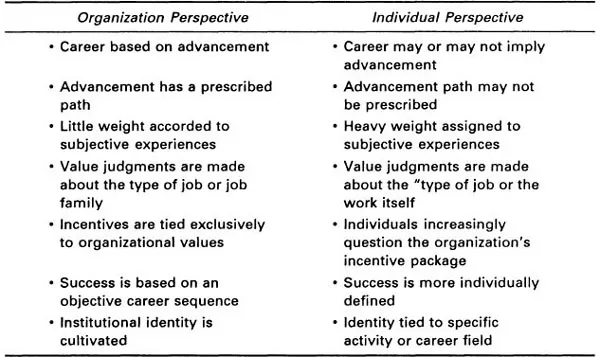
From the dichotomies contrasted in Table 1.1 it is easy to see that views on careers are likely different, dependent on vantage point. In addition, the extent to which any given individual will likely identify with one extreme or another of any posted contrasts requires additional information concerning career stage and development. Thus, to foster positive career development within the military, or any large organization, requires a focus on the interaction between the individual and the referent organization throughout the career. The content of the interaction should change as different career issues become relevant at different points in the career.
Table 1.1 Organizational and Individual Perspectives on Common Career Concepts
Individual-Organization Career Interactions
To best understand the interaction between the individual and the organization regarding the career, several different elements must be understood and viewed together (Schein, 1978). In a global sense, the individual and the organization exist within a society or culture that contribute to definitions of occupations, criteria for success, and expected or normative paths through life. In addition, culture, through its value system, influences the organization and the individual in more discrete ways as well. For example, statements regarding what is considered a good career, appropriate work, a good place to work, or an appropriate level of ambition in a given situation are frequently influenced by cultural values. For example, within the cultures of the Western industrialized world, working as a physician or surgeon excepting arguably obstetrics, would be valued as a good career affording status, financial rewards, and strong sense of self-worth. However, within the Soviet Union, the majority of physicians are women and the pay and status rewards are not valued as greatly as in the West. It will be interesting to see if the changing geopolitical situation in the Eastern block will change this cultural value. In essence, our cultural value system strongly affects our shared (i.e., individual and organizational) definition of career success.
Adopting this developmental perspective is not without problems. One of the dilemmas that immediately surfaces is that although the values surrounding definitions of work and a career are changing, the human resources hierarchy in most large organizations employ static values that are assumed to be valid among all organizational members. In the military services in particular, both organizations and individuals are influenced directly through various personnel policies and regulations, incentives (e.g., command assignments which enhance promotion opportunities), and through disincentives (e.g., remote assignments, frequent deployments). The intrusiveness of such influences suggests the need for congruence between system needs, career policies, and individual member needs. Because the career needs of its members do in fact change in response to changed social values, the military services must be prepared to take new and different steps where personnel policies are considered. For example, the individual at work, regardless of organizational referent, typically attends to occupational and educational opportunities, balancing career concerns with increasingly important concerns for family, self-development, and a lifestyle that has long-range viability. As more women enter the work force as full-time employees, both husbands and wives will be required to give increasing attention to managing “dual-career” families (Adams, 1985a, 1985b; Adams & Prince, 1984; Rapoport & Rapoport, (1985).
Schein (1978) noted that as individuals become affected, so must organizations. Unfortunately, there is no set of “matching processes” that brings the individual and the organization together ideally, into what should be a mutually profitable relationship. Recruitment, selection, training, job assignment, performance appraisal, and promotion would be better viewed as matching processes, not processes or events that are solely the prerogative of the organization in fulfilling its own needs. Thus, a recurring theme throughout this volume is that the way ...
Table of contents
- Cover
- Half Title
- Title Page
- Copyright Page
- Dedication
- Table of Contents
- About the Authors
- Foreword
- Preface
- 1. Issues in the Management of Careers
- 2. Meshing Corporate and Career Development Strategies
- 3. A Strategic Appraisal of Organizational Rewards
- 4. Career Patterns: Mobility, Specialization, and Related Career Issues
- 5. Career Transitions in Changing Times
- 6. Career Decision Making
- 7. Twenty Questions: Research Needed to Advance the Field of Careers
- Author Index
- Subject Index
Trusted by 375,005 students
Access to over 1.5 million titles for a fair monthly price.
Study more efficiently using our study tools.
Frequently asked questions
Yes, you can cancel anytime from the Subscription tab in your account settings on the Perlego website. Your subscription will stay active until the end of your current billing period. Learn how to cancel your subscription
No, books cannot be downloaded as external files, such as PDFs, for use outside of Perlego. However, you can download books within the Perlego app for offline reading on mobile or tablet. Learn how to download books offline
Perlego offers two plans: Essential and Complete
- Essential is ideal for learners and professionals who enjoy exploring a wide range of subjects. Access the Essential Library with 800,000+ trusted titles and best-sellers across business, personal growth, and the humanities. Includes unlimited reading time and Standard Read Aloud voice.
- Complete: Perfect for advanced learners and researchers needing full, unrestricted access. Unlock 1.5M+ books across hundreds of subjects, including academic and specialized titles. The Complete Plan also includes advanced features like Premium Read Aloud and Research Assistant.
We are an online textbook subscription service, where you can get access to an entire online library for less than the price of a single book per month. With over 1.5 million books across 990+ topics, we’ve got you covered! Learn about our mission
Look out for the read-aloud symbol on your next book to see if you can listen to it. The read-aloud tool reads text aloud for you, highlighting the text as it is being read. You can pause it, speed it up and slow it down. Learn more about Read Aloud
Yes! You can use the Perlego app on both iOS and Android devices to read anytime, anywhere — even offline. Perfect for commutes or when you’re on the go.
Please note we cannot support devices running on iOS 13 and Android 7 or earlier. Learn more about using the app
Please note we cannot support devices running on iOS 13 and Android 7 or earlier. Learn more about using the app
Yes, you can access Contemporary Career Development Issues by Robert F. Morrison, Jerome Adams, Robert F. Morrison,Jerome Adams in PDF and/or ePUB format, as well as other popular books in Psychology & History & Theory in Psychology. We have over 1.5 million books available in our catalogue for you to explore.