This outstanding book contains inspiring stories of late 20th century women who broke new ground in psychological knowledge and its applications. The lives and careers of 53 women are examined within social and historical contexts using three levels of analysis--the individual, the group, and the universal.
The thoughtful autobiographies and the perceptive, integrative analyses increase understanding of the personal and professional development of these women, provide insights into their patterns of achievement, and illuminate new ways of thinking about and perceiving women.
This extraordinary book is a valuable resource for libraries and researchers, provides knowledge and inspiration for a wide range of readers, and is an excellent supplementary text for courses in the psychology of women, history of psychology, lifespan development, career development, and women's studies.
eBook - ePub
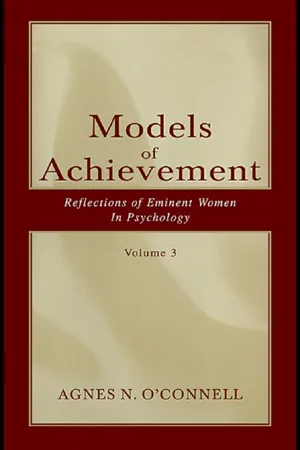
Models of Achievement
Reflections of Eminent Women in Psychology, Volume 3
- 456 pages
- English
- ePUB (mobile friendly)
- Available on iOS & Android
eBook - ePub
About this book
Information
Publisher
Psychology PressYear
2013Print ISBN
9780805835571
9780805835564
Edition
1eBook ISBN
9781135659202
PART I
GENERAL INTRODUCTION
CHAPTER 1
Agnes N.O’Connell
Partners in Progress: Illuminating a New Vision of Women in Psychology
Agnes N.O’Connell
The purpose of Models of Achievement: Reflections of Eminent Women in Psychology is to present a new way of thinking about, and looking at, women—as partners in the evolution and progress of the field. This new conceptualization and vision can be brought into sharp focus by preserving and illuminating the often unacknowledged and undervalued accomplishments of women in the field. The major growth of psychology in America occurred in the 20th century, but from the very beginning of the field in the 19th century, women have been partners in its progress. A full picture of the generation of knowledge in the field requires the realization that the fundamental contributions of women psychologists are interwoven with the evolution of psychology. In the early years of the discipline, women often were silent partners, lacking recognition for their noteworthy contributions. As the years passed, women’s diverse and excellent contributions became more and more difficult to ignore. Recognition increased—first as subordinate or junior partners then more and more as equal partners. At the beginning of the 21st century, although women have made substantial and significant contribu-tions, recognition as full partners in the complex evolution and progression of the field has yet to be acknowledged.
The autobiographies and analyses contained in these volumes provide an important knowledge base for the study of the historical evolution of psychology and the study of women’s lives in the 20th century. They respond to the historical neglect of women’s lives and contributions and give these remarkable women the opportunity to define and interpret their experiences in their own words. From these autobiographies and accomplishments, a new concept and vision of women in psychology materializes. Simultaneously, illuminating a new vision of women in psychology sheds light on vital role models of achievement.
Although the number of women psychologists in the field is increasing, there are still too few in senior positions. Tenured full professors in graduate and undergraduate departments continue to be predominantly men (76%), whereas untenured lecturers continue to be women (81%) (APA Research Office, 1999a, 1999c). According to the Task Force on the Changing Gender Composition of Psychology (Pion, et al., 1996), a shift in the gender composition of the field will occur in this third millennium. When that shift occurs, it is likely that tenure and seniority for many more women will not be far behind. Until that transition, strong role models of achievement and knowledge of eminent women’s lives and careers can help alleviate the isolation of women professionals who may feel that they are competing alone against insurmountable odds (O’Connell et al., 1978). According to Elizabeth Douvan (1974), for a young woman to see her own aspirations realized in other women’s lives can be a crucial support at times of stress when she might otherwise decide that her aspirations are too difficult to attain. Wisdom and inspiration are contained in the lives and careers of these eminent women and in the varied combinations of perseverance, determination, resourcefulness, dedication, humility, humor, and achievement apparent in their autobiographies.
In Models of Achievement, Volume 3, the new way of thinking and envisioning women is shaped by women old enough to have achieved eminence but generally younger than the women whose autobiographies are contained in the earlier two volumes. In comparison to the earlier volumes (O’Connell & Russo, 1983, 1988), 18 of the 19 women in this volume were born between 1932 and 1950 and earned their doctorates between 1959 and 1979; 12 of the 17 women in the second volume were born between 1915 and 1936 and earned their doctorates between 1942 and 1967; 13 of the 17 women in the first volume were born between 1897 and 1913 and earned their doctorates between 1917 and 1939.
Distinctive criteria for choosing the women in this volume include outstanding and unusual contributions to various areas of psychology and society in the 20th century and the strong potential for continuing to make such contributions in the 21 st. Other defining criteria include a sustained record of achievement over a significant period of time, achievement that has withstood the clarifying filter of time; being a pioneer, an innovator, a leader, or an expert. These are women of great creative achievement whose lives do not follow the beaten path. They are women whose indomitable spirit makes the pursuit of challenge and achievement possible in the face of discrimination, humiliation, trivialization, and other barriers.
Their families of origin range from wealthy and professional to poor and disadvantaged. The women have experienced sexism, racism, poverty, exclusion, and issues of acculturation in their educational and professional pursuits and in their daily lives. These barriers were overcome with courage, resilience, and grace. Obstacles did not keep them from making extraordinary contributions in academe, industry, and government. Their work in theory, research, or practice and in traditional, emerging, or innovative areas reaches the highest standards of excellence. These women are scholars, researchers, clinicians, leaders, educators, activists, policymakers, and so much more. Their personal lives embody a cross-section of lifestyles in the 20th and early 21st centuries; they are single, married and childless, married with children, single parents, and grandmothers.
They are multidimensional in purposes and goals and certainly in charge of their lives. Each is unique in her definition of fulfillment and the specific configuration of her choices, but each possesses the remarkable strength, talent, resiliency, and flexibility to influence as well as be influenced by her surroundings.
Historical and cultural events shaped the availability and content of opportunities for these women. The affluence that followed World War I was followed by deprivation during the Great Depression. World War II brought educational and employment opportunities for women, but its aftermath brought professional retrenchment. It was not until the civil rights and women’s movements of the 1960s and 1970s that new breakthroughs were made, and women in psychology were instrumental in forging them. In the last quarter of the 20th century, women made major strides in education. In 1976, women earned 32.8% of PhD doctorates in psychology; that percentage reached 66.6% by 1997 (APA Research Office, 1999b; Keita, Houston, Wisnieski, & Cameron, 1999). The impact of these strides and the gains of the 1960s and the 1970s are particularly evident in the autobiographies presented in this volume. With the growth of the field, women enjoyed improved occupational participation, yet decades after the resurgence of the women’s movement, equality of access and opportunity is yet to be realized (Pion et al., 1996).
Since its formation in 1892, nine women have achieved the distinction of serving as APA president, two since the mid 1990s: Dorothy Cantor (1996) and Norine G.Johnson (2001). Their autobiographies are contained in this volume. In the 1970s and 1980s, five women achieved this distinction: Anne Anastasi (1972), Leona E.Tyler (1973), Florence L.Denmark (1980), Janet Taylor Spence (1984), and Bonnie R.Strickland (1987). Their autobiographies are contained in Volume 2 of Models of Achievement (O’Connell & Russo, 1988); Spence also wrote the Foreword for the present volume. The two women who served as APA president in the early 20th century were Mary Whiton Calkins (1905) and Margaret Floy Washburn (1921). Their biographies are contained in Eminent Women in Psychology (O’Connell & Russo, 1980) and more extensively in Women in Psychology: A Bio-Bibliographic Sourcebook (O’Connell & Russo, 1990).
In contrast to the few women presidents in APA’s long history, 6 of the first 11 presidents of the American Psychological Society (APS), established in 1988, were women: Janet Spence (1988–1989), Marilynn Brewer (1993– 1995), Sandra Scarr (1996–1997), Kay Deaux (1997–1998), Elizabeth Loftus (1998–1999), and Elizabeth Capaldi (1999–2000) (American Psychological Society, 1999). The autobiographies of Scarr and Deaux are contained in this volume. Spence has the unique distinction of serving both the APA and the APS as president. In academe, few women have served as university presidents; the autobiographies of two of them, Judith E.N.Albino and Frances Degen Horowitz, are in this volume.
The women whose autobiographies are in this volume have made multiple contributions in too many areas of psychology to identify here, but some highlights illustrate the richness of the contents of the material that follows. These eminent women have been instrumental in developing new areas in psychology, illuminating controversial areas, and advancing existing areas. Patricia Bricklin was a pioneer in media psychology; Frances Culbertson in international psychology; Linda Bartoshuk in the study of psychophysics of the sense of taste; Lillian Comas-Díaz, Pamela Trotman Reid, and Diane Willis in the study of minority populations; Albino in health psychology; Elaine Hatfield in the study of love, equity theory, and emotional contagion. Patricia Keith-Spiegel was instrumental in developing a code of ethics for psychologists. The research of Diane Halpern, Janet Hyde, and Scarr shed light on the nature/nurture debate. Bricklin, Cantor, Comas-Díaz, Culbertson, Johnson, Keith-Spiegel, and Willis have advanced clinical, counseling, and school psychology; Halpern and Margaret Matlin, cognitive psychology; Jeanne Brooks-Gunn, Cantor, Culbertson, Horowitz, Johnson, Phyllis Katz, Reid, Scarr, and Willis, developmental psychology; Albino, Bartoshuk, Deaux, Hyde, Matlin, and Willis, experimental psychology; Albino, Brooks-Gunn, Cantor, Comas-Díaz, Deaux, Hyde, Johnson, Katz, Keith-Spiegel, Matlin, and Reid, the psychology of women and gender issues; Hyde, psychometrics; Bartoshuk and Matlin, sensation and perception; Deaux, Hatfield, and Katz, social psychology; and Albino, Bricklin, Cantor, Horowitz, Johnson, Keith-Spiegel, and Willis, techniques of assessment, evaluation, and training.
It is clear that a new way of thinking about and per ceiving women encourages equality of access, opportunity, and recognition. The concept and perception of women as partners in progress, as exemplars, as fully functioning, competent, capable contributors to psychology and to society illustrated in these volumes are crucial for a future marked by equality, excellence, and progress.
These autobiographies provide an incentive for achieving these goals now and in the future. To clarify the context and contents of these autobiographies, this book employs three levels of analysis: the universal for all women; the group for women in psychology (and by extension for other professional women); and the individual for a particular person. The universal level is presented in an overview chapter on the historical and social context of the 20th century, the context for women, and the context for women and the field of psychology. The group level is presented in a chapter examining similarities and differences in the lives and careers of the 19 eminent women; further comparisons are made between the women in this volume and the 34 eminent women in the two earlier volumes to delineate transhistoric and time-specific trends and patterns. The distinguished women themselves present the individual level in their autobiographies.
The autobiographies in these volumes provide a history of the development of psychology through the lens of women who contributed to its progress in the 20th century as well as a history of the development of their lives and careers.
The autobiographies and analyses are a source of knowledge, wisdom, and inspiration for men and women and for the field of psychology. It is hoped that these volumes will be the catalyst for a revolution of concept and vision, a new way of thinking about and looking at women in psychology and in society, and a new conceptualization, perception, and recognition of women as partners in progress across time.
REFERENCES
American Psychological Society. (1999). Board of Directors 1999–2000. [Online]. Available: http//www.psychologicalscience.org/about_board.htlm.
APA Research Office. (1999a). Data on education and employment-Doctorate (gender and rank) [Online]. Available: http://research.apa.org/doc14.html.
APA Research Office. (1999b). Data on education and employment—Doctorate (tenureandgender) [Online] Available: http://research.apa.org/doc15.html.
APA Research Office. (1999c). Demographic shtfts in psychology [Online] Available: http://research.apa.org/gen1.html
Douvan, E. (1974). The role of models in women’s professional development. Psychology of Women Quarterly, 1, 5–20.
Keita, G.P., Houston, S., Wisnieski, & Cameron, L., (1999). Women in the American Psychological Association. Washington, DC: American Psychological Association.
O’Connell, A.N., Alpert, J., Richardson, M.S., Rotter, N., Ruble, D.N., & Unger, R.K. (1978). Gender-specific barriers to research in psychology: Report of the Task Force on Women Doing Research—APA Division 35 Journal Supplement Abstract Service: Catalog of Selected Docaments in Psychology (MS No. 1753) 8.
O’Connell, A.N., & Russo, N.E. (Eds.) (1980). Eminent women in psychology: Models of achievement [Special issue]. Psychology of Women Quarterly, 5(1).
O’Connell, A.N., & Russo, N.F.(Eds.) (1983). Models of achievement: Reflections of eminent women in psychology. New York: Columbia University Press.
O’Connell, A.N., & Russo, N.E. (Eds.) (1988). Models of achievement: Reflections of eminent women in psychology (Vol. 2). Hillsdale,NJ: Hillsdale, NJ: Lawrence Erlbaum Associates..
O’Connell, A.N., & Russo, N.F. (Eds.) (1990). Women in psychology: A bio-bibliographic sourcebook. Westport, CT: Greenwood..
Pion, G.M., Mednick, M.T., Astin, H.S., Hall, C.I., Kenkel, M.B., Keita, G.E., Kohout, J.L., & Kelleher, J.C., (1996). The shifting gender composition of psychology. American Psychologist, 51, 509–528.
PART II
HISTORICAL AND SOCIAL CONTEXTS
CHAPTER 2
Agnes N.O’Connell
A Century of Contrasts: Historical and Social Contexts of the 20th Century
Agnes N.O’Connell
THE 20TH CENTURY: A PANORAMIC VIEW
A new century and a new millennium call for looking forward to the possibilities of the future and for building on t...
Table of contents
- Cover
- Half Title
- Full Title
- Copyright
- Contents
- Reviewers and Affiliations
- Foreword
- Preface
- PART I General Introduction
- PART II Historical and Social Contexts
- PART III Autobiographical Perspectives
- PART IV Achievement Patterns in the 20th Century
- Index
Trusted by 375,005 students
Access to over 1.5 million titles for a fair monthly price.
Study more efficiently using our study tools.
Frequently asked questions
Yes, you can cancel anytime from the Subscription tab in your account settings on the Perlego website. Your subscription will stay active until the end of your current billing period. Learn how to cancel your subscription
No, books cannot be downloaded as external files, such as PDFs, for use outside of Perlego. However, you can download books within the Perlego app for offline reading on mobile or tablet. Learn how to download books offline
Perlego offers two plans: Essential and Complete
- Essential is ideal for learners and professionals who enjoy exploring a wide range of subjects. Access the Essential Library with 800,000+ trusted titles and best-sellers across business, personal growth, and the humanities. Includes unlimited reading time and Standard Read Aloud voice.
- Complete: Perfect for advanced learners and researchers needing full, unrestricted access. Unlock 1.5M+ books across hundreds of subjects, including academic and specialized titles. The Complete Plan also includes advanced features like Premium Read Aloud and Research Assistant.
We are an online textbook subscription service, where you can get access to an entire online library for less than the price of a single book per month. With over 1.5 million books across 990+ topics, we’ve got you covered! Learn about our mission
Look out for the read-aloud symbol on your next book to see if you can listen to it. The read-aloud tool reads text aloud for you, highlighting the text as it is being read. You can pause it, speed it up and slow it down. Learn more about Read Aloud
Yes! You can use the Perlego app on both iOS and Android devices to read anytime, anywhere — even offline. Perfect for commutes or when you’re on the go.
Please note we cannot support devices running on iOS 13 and Android 7 or earlier. Learn more about using the app
Please note we cannot support devices running on iOS 13 and Android 7 or earlier. Learn more about using the app
Yes, you can access Models of Achievement by Agnes N. O'Connell in PDF and/or ePUB format, as well as other popular books in Psychology & History & Theory in Psychology. We have over 1.5 million books available in our catalogue for you to explore.