![]()
Peter Zellner
Streamlines of Desire, Performative Techniques, Endless Deviation, Beauty and Open Play in the Evan Douglis Studio
Clement Greenberg declared in 1962: Contemporary art criticism is absurd not only because of its rhetoric, its language, and its solecisms of language. It is also absurd because of its repetitiousness…. Every step in the evolution of [M]odernist art has been hailed, or condemned, as a revolutionary break with the past, and in each instance only the passing of a little time has refuted this claim. Yet this hardly deters anybody, and the epochs of art succeed one another faster than ever.1
While a similar crisis might be identified in a good deal of writing on architecture over the last decade—focused as it has been on the perpetual revolutions enabled by various technologies, conscientiously reiterated French theory, and the newness of yet another avant-garde—there is much in the teaching, writing, and work of Evan Douglis to suggest a vector of research and production that represents an authentic budding of another new architecture.
Unlike many contemporaries engaged in the project of manufacturing novelty, contemporaneity, and a panoply of special effects, Douglis has evolved a body of teaching that is simultaneously revolutionary and repetitive, radical and systematic, novel and old school. What has emerged out of the very exacting series of studios he conducted at Columbia’s GSAPP during the late 1990s and early 2000s, later at SCI-Arc, Buffalo University, the City College of New York, and, most recently, at the Pratt Institute School of Architecture (where Douglis is Chair of the Undergraduate Architecture program), is a deep taxonomy of morphological innovation that, encouragingly, can also be read within a genealogy of now historical avant-garde practices.
Aligned with a critical material and exhibition practice, his pedagogy has doggedly pursued the discovery of new topological blends and typological/formal mixes via a set of variable but consistent performative techniques which have been obsessively catalogued and classified by his students. As this essay will set out, these riffs on the intertwined themes of performative technique, deviant modular systems, material suppleness, beauty, and play characterize the Douglis studio as an important pedagogical effort within a larger discourse of critical experimentation and formal innovation.
Performative Techniques and Novel Topological Blends
Evan Douglis guides his students through a rigorous series of self-contained and linked pedagogical routines that assign material and performative values to processes of mathematically-derived abstraction. He has called these routines a string of notational loops that describe analogical propositions, intended to elicit specific material performances and indexical architectural effects. Douglis’ students typically begin the semester by studying and diagramming natural and/or artificial migrational systems such as animal population movements, the territorial transmission of dialects, disease vectors, or the genesis of musical forms across cultures and eras. Although the initial drawings produced at this stage of the studio tend to be representational rather than generative, the analysis incites an obsession with mutational, systemic morphogenesis that erupts in later investigations. The compulsion to build, track, and modulate deviant material organizations is a hallmark of his teaching.
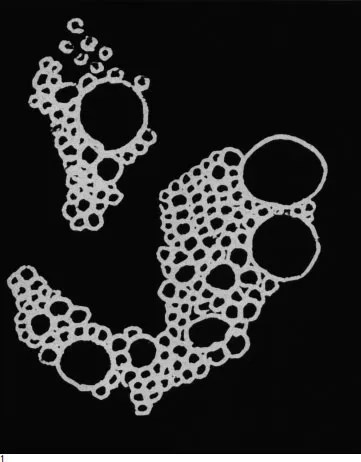
1 Nuclear Space
Sketch by Frederick Kiesler. Manifeste du Corealisme Architecture d’aujourd’hui Paris, 1949. © Austrian Frederick and Lillian Kiesler Private Foundation, Vienna
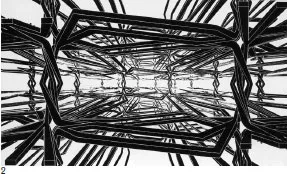
2 Konrad Wachsmann perspective of a structure built with a single standard structural element. IIT Institute of Design, 1953. © Judith Wachsmann; courtesy Stiftung Archiv der Akademie der Künste, Berlin, Konrad-Wachsmann-Archiv, P-Box 7/4
Historically and most specifically within the studios Douglis led at Columbia during the early 2000s, the second stage of the studio involved the development of remarkable digital drawing systems. Working within the two-dimensional space of Adobe Illustrator, his students invented figural growth systems that transformed a linear emblematic outline from a two-dimensional profile into a deep three-dimensional topological surface. The drawings that emerged from this exercise were extraordinarily filigreed. To eyes familiar with Maya’s smoothed forms or lightscapes generated in 3D Studio Max, the true depth gained by the use of a two-dimensional drawing tool is perplexing, yet recognizable. More recently an entirely new body of work has emerged through the use of new tools and techniques that operate in a similar manner conceptually yet offer a different means of examining material practices. With tools such as Processing—an open source programming language—and RhinoScripts—essentially strings of commands which automate repetitive tasks—Douglis has moved what were analog techniques for conducting digital computation into a fully digital and thus highly responsive and flexible emergent territory of indexed production.
The third phase of Douglis’ pre-Processing and Scripting instruction revealed the studio’s most specific material training—the dynamic manipulation of flat rubber sheet foam into seemingly liquid, highly supple topological systems. Cutting 3/32-inch thick sheets of rubber foam into 3-inch squares, students produced a series of architectonic finger exercises that gave rise to a rich vocabulary of new topological blends and typological-formal mixes. Gridded with three-square or four-square patterns of dots, the sheetlets underwent various transformations. As the dots were sequentially repositioned and fixed with adhesive to new locations along the two-dimensional surface, three-dimensional figures emerged like pliant and softly folded origami figures. These strange offspring of the gridded sheetlets resembled tropical flowers, wonton dumplings, deep-sea creatures, farfalle pasta (more literally: butterflies), or reproductive organs. The products were finally pinned to black foamcore and labeled like exotic insects. They were simultaneously beautiful and grotesque.
Developed serially through slight variations in deformative technique, the sheetlets evolved into families of topological surfaces, like closely related species. Each individual membrane was studied and eventually indexed as both a singular building unit and later as an aggregate in a larger modulated field. In the final stage of the pre-Processing studios, the individual units were fused to form scalar, deviant, and supple modular systems enmeshed with program and site. The total membrane was taxonomized and re-qualified as a planning logic tied to systems of scalar growth. Specific material properties and intended performative objectives were then networked to induce what Douglis terms “sentient expressions,” …tracked changes in dimension, climatic adjustment, and a range of mater...