Research on metaphor has been dominated by Aristotelian questions of processes in metaphor understanding. Although this area is important, it leaves unasked Platonic questions of how structures of the mind affect such processes. Moreover, there has been relatively little work on how metaphors affect human behavior. Although there are numerous postdictive or speculative accounts of the power of metaphors to affect human behavior in particular areas, such as clinical or political arenas, empirical verification of these accounts has been sparse.
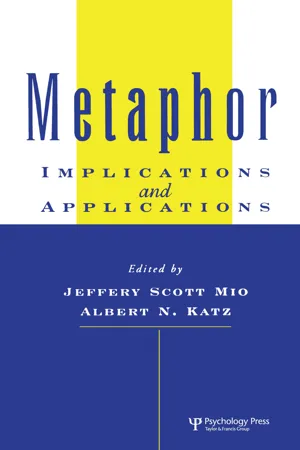
To fill this void, the editors have compiled this work dedicated to empirical examination of how metaphors affect human behavior and understanding. The book is divided into four sections: metaphor and pragmatics, clinical uses of metaphor, metaphor and politics, and other applications of metaphor. Chapters contained within these sections attempt to merge Aristotelian questions with Platonic ones.
- 276 pages
- English
- ePUB (mobile friendly)
- Available on iOS & Android
eBook - ePub
About this book
Information
I
Pragmatics of Metaphor
1
On Interpreting Statements as Metaphor or Irony: Contextual Heuristics and Cognitive Consequences
Albert N. Katz
University of Western Ontario
University of Western Ontario
Introduction
In this chapter I will be discussing sentences such as:
- (1) "The Siamese cat is the prince of beasts."
- (2) "Albert Katz is the Barry Bonds of his hockey team."
Because a cat is not a prince, and I am not Barry Bonds, these sentences can be considered as proportional or analogical metaphor. To date, the major problem of study for cognitive scientists has been in determining how the meaning of a vehicle concept, "prince" for instance, can be stretched so as to apply to an unconventional topic, in this case the concept "Siamese cat" (see Katz, 1992; Martin, 1992).
I would like to address two additional problems for cognitive scientists. First, how does the recipient of a figurative sentence recognize that it is a metaphor (or irony, hyperbole, or any other trope)? The answer that I propose is that recognition is based on inferring speaker intent, and that this process is mediated by a set of heuristics.
The second problem has to do with the cognitive consequences of deciding that the utterance was intended to be taken as metaphor (or irony, or hyperbole, etc.). By cognitive consequence I emphasize the role of comprehension for the structure of conceptual knowledge about the terms in the sentence and subsequent memory of that sentence. For instance, one prevalent argument is that the act of metaphorizing identifies or creates a similarity relation between two concepts. That is, once we recognize that the sentence is a metaphor we perform operations that will permit us to understand how a prince is similar to a cat (see for instance Glucksberg & Keysar, 1990; Katz, 1992). It has long been recognized in the cognition literature that similarity acts to enhance recall for unrelated items, such as obtains with the topic and vehicle of metaphor, (e.g. Begg, 1978). Consequently one might expect that recognition of the sentence as a metaphor should lead to facilitated memory. However a given sentence often can be understood in different ways. Sentences (1) and (2) for instance could be understood as irony. I argue that the mnemonic consequences of deriving an ironic interpretation should differ from those obtained from deriving metaphoric intent from the exact same sentence.
On the Recognition of Metaphor and Irony
In much of experimental psycholinguistics, our ability to comprehend sentences is studied in a decontextualized manner. That is, the participant is presented a sentence, and asked to make a judgment on it. In essence, the participant is provided none of the contextual background about the conditions under which the sentence is uttered. Studies of this type have been used to give hints about some of the sentential characteristics that may predispose a comprehender to treat a sentence as a metaphor. For instance, Katz, Paivio, Marschark, and Clark (1988) found that people will treat sentences of the form "An A is a B" as metaphor when the vehicle (but not the topic) is concrete and easy to image, the sentence is rated as comprehensible and not anomalous, and the topic and vehicle are semantically related. One could argue that participants will attempt a metaphoric reading of a sentence when it does not have an obvious interpretation and also meets the conditions just outlined (see Pollio, this volume).
Analyses based on decontextualized sentences are limited, however, and ignore the ecology in which we encounter and produce figurative language In everyday life, a speaker will utter figurative language in a conversational or environmental context and will employ such language in order to meet some communication goal. Consider again sentences (1) and (2). The default interpretation may be as a metaphor, and the cognitive consequence is to emphasize the similarity of a "Siamese cat" to salient characteristics of "princes," or of "Katz" to a category exemplified by "Barry Bonds." However, with little effort, one can envision contexts in which the intended meaning and cognitive consequences are quite different, for instance when (2) is uttered after Katz falls down while on a breakaway. In effect, under these conditions, the speaker uttering (2) may be making the sarcastic argument that Katz is like Bonds—NOT. That is, recognition of the ironic intent should have the cognitive consequence of undercutting the similarity "Katz" and "Bonds."
So how do we know if sentence (1) or (2) is intended as metaphor or as irony? In the ecology in which metaphor or irony is uttered, the context will provide cues as to the speaker's intent. I discuss this in more detail later. When a given sentence is presented out-of-context, such as (1) or (2), contextual cues are not readily available, yet people have little difficulty in rating such items along a set of dimensions, including degree of metaphoricity and metaphor goodness (see Katz et al., 1988). Kreuz (this volume) argues that the same is true for ironic sentences and outlines some of the characteristics of a sentence that invite ironic interpretation, for instance exaggeration (e.g., "Joe sure is the best friend a person can have").
I assume that the out-of-context sentences presented in experiments are, at least in part, understood by participants as the result of an active process so that they attempt to construct contexts in which the sentences would meet Gricean principles of communication, such as being relevant and informative. (In effect the recipient would be asking himself or herself: When does someone use exaggeration like this?).
I would argue further that some utterances are conventionally understood in their figurative sense, rather than their literal sense. This certainly is true of familiar metaphor ("My car is a lemon "), proverbs ("The grass is greener on the other side of the fence"), and idioms ("kick the bucket"). I argue that something akin also is found with ironic usage. Presumably, for a familiar trope, the context in which it would be employed is automatically engaged or easier to construct than would be the case for a less familiar trope. In essence, I would argue that out-of-context sentences are not really contextually free; rather, the context is internal and based on our experiences with linguistic usages and conventions. Thus for familiar items presented out-of-context, one may easily mentally construct a metaphoric or ironic context and ratings of metaphoricity or the like will depend in part on these constructed contexts.
The Role Played by Context
In everyday life, sentences are not presented out of context but rather emerge in an ongoing discourse, and are based on knowledge shared by speaker and listener, writer and reader. In this section I discuss some of the functions played by context in inviting ironic or metaphoric interpretation.
Discourse and Communication Goals. One can argue that the communication goals of metaphor and of irony are quite different from one another and that the context may provide sufficient information about the reasons that a speaker or writer used the linguistic form that he or she did. Winner (1988), for instance, argued that although both irony and metaphor are devices for signaling the presence of new information, they function to serve different goals. With metaphor the aim is to "illuminate" new content, that is, metaphor is employed to convey information about the topic under discussion. With irony the aim is evaluative, that is, it is employed to convey the speaker's beliefs or feelings about the topic.
A simple variant of this position could hold that the communication goals of metaphor and irony are so distinct that sufficient context as to the "informative" or "evaluative" nature of the communication would make the metaphoric or ironic intent of the speaker obvious. That is, the context might set up something akin to a schema (either content or evaluative-based) that serves to limit the interpretation given an ambiguous sentence. I argue that there might...
Table of contents
- Cover
- Half Title
- Title
- Copyright
- Dedication
- Contents
- Preface
- PART I: PRAGMATICS OF METAPHOR
- PART II: METAPHORS IN CLINICAL SETTINGS
- PART III: METAPHORS AND POLITICS
- PART IV: THE METAPHORS OF EVERYDAY LIFE
- Author Index
- Subject Index
Trusted by 375,005 students
Access to over 1.5 million titles for a fair monthly price.
Study more efficiently using our study tools.
Frequently asked questions
Yes, you can cancel anytime from the Subscription tab in your account settings on the Perlego website. Your subscription will stay active until the end of your current billing period. Learn how to cancel your subscription
No, books cannot be downloaded as external files, such as PDFs, for use outside of Perlego. However, you can download books within the Perlego app for offline reading on mobile or tablet. Learn how to download books offline
We are an online textbook subscription service, where you can get access to an entire online library for less than the price of a single book per month. With over 1.5 million books across 990+ topics, we’ve got you covered! Learn about our mission
Look out for the read-aloud symbol on your next book to see if you can listen to it. The read-aloud tool reads text aloud for you, highlighting the text as it is being read. You can pause it, speed it up and slow it down. Learn more about Read Aloud
Yes! You can use the Perlego app on both iOS and Android devices to read anytime, anywhere — even offline. Perfect for commutes or when you’re on the go.
Please note we cannot support devices running on iOS 13 and Android 7 or earlier. Learn more about using the app
Please note we cannot support devices running on iOS 13 and Android 7 or earlier. Learn more about using the app
Yes, you can access Metaphor by Jeffery S. Mio,Albert N. Katz in PDF and/or ePUB format, as well as other popular books in Personal Development & International Relations. We have over 1.5 million books available in our catalogue for you to explore.