eBook - ePub
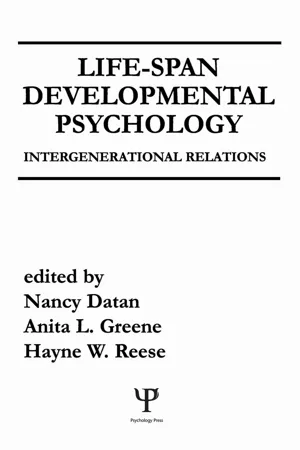
Life-span Developmental Psychology
Intergenerational Relations
- 296 pages
- English
- ePUB (mobile friendly)
- Available on iOS & Android
eBook - ePub
About this book
First published in 1986. This volume contains the papers presented at the ninth biennial West Virginia University conference on life-span development. The conference was held in Morgantown on May 10-12, 1984, and the topic was designated as Intergenerational Networks: Families in Context.
Information
Integenerational Relations and Change
4
Family and Community Networks in Appalachia
Dean Rodeheaver
University of Wisconsin - Green Bay
Jeanne L. Thomas
University of Wisconsin-Parkside
University of Wisconsin - Green Bay
Jeanne L. Thomas
University of Wisconsin-Parkside
Family and Community Networks in Appalachia
This chapter began as an exchange of the authors' experiences in conducting exploratory research in Appalachia, as well as of impressions of Appalachian culture. A common theme emerged from this exchange. In the studies described here, respondents related experiences in intergenerational networks that reflected both stability and change across generations. The same themes were apparent in considering Appalachia: although the region has changed — particularly within the last century—there are enduring cultural features. In this chapter, a survey of these regional historical changes and constant cultural themes provides a context for discussion of two studies of West Virginia elders and their family and community networks.
Historical Foundations of the Culture
Those who write about the current ethos of Southern Appalachia suggest that we consider the character of the people who first saw the mountains as a refuge (Weller, 1965). One term useful in describing these individuals is rejection: "Instead of the hymn-singing pilgrim, we must start with the cynical, the penniless, the resentful and the angry" (Caudill, 1962, p. 6). Among the early mountaineers was a group of people who recognized no authority other than individual force and who sought a place where equal status would be ascribed to all. Rejection was their philosophy of life: organized religion, they claimed, elevated some to a status claiming to be nearer to God than others; government provided justification for the authority of one group over another; education was a means of achieving superiority. The mountains offered freedom from existing authority, sufficient opportunity for subsistence living, and isolation from all but one's kin or clan.
The isolation of the mountaineer was relatively complete, except for an excursion to fight in the Civil War, until early in the 20th century. The 20th century has brought enormous change to Appalachia; the most relevant areas of change are economic diversification and improved transportation systems.
At the turn of the century, more than half of West Virginia's population were farmers. However, just three decades later, the rural farm population was only 25.9% of the state's total (Ambler & Summers, 1965). During this period, the lumbering, railroading, and mining industries entered the region and grew in importance. Workers frequently divided their time and efforts between farming and industry or abandoned farming altogether for industry (Ambler & Summers, 1965).
However, the exposure of the mountain folk to the outside world through state industry paradoxically perpetuated isolation. The miners not only were the employees of coal companies based outside the state, but also were the wards of these companies. The company provided homes, stores, doctors, schools, funerals, and money (scrip) that was useless outside the camp. The residents of these early coal camps, consequently, found few incentives to venture elsewhere. Simultaneously, the wealth generated by mining was transported by the coal companies over the state line; neither the tax structure nor the export of coal enriched the state in any way.
It was also at this time that ventures between mountain communities and outside the mountains became easier. The 20th century also brought progress in the state's transportation network. At the turn of the century, West Virginia was arrested in the dirt road stage of its transportation history: "the state road bureau . . . said that the roads of West Virginia were the worst in the United States . . . they were then largely clouds of dust in the summer and streams of mud in the winter" (Ambler & Summers, 1965, p. 332). As the number of automobiles in the state increased, there was corresponding pressure for highway improvement. This pressure found expression in 1917 with the codification of laws and the creation of administrative bodies providing for road construction, improvement, and maintenance. The state road commission was created, and successive gasoline taxes were levied, with the eventual result that West Virginia could boast of far more adequate east-west and north-south routes, as well as interstate highways and a state turnpike, by mid-century (Ambler & Summers, 1965; Weller, 1965).
Changes in West Virginia early in the 20th century affected the social and economic context of individual life primarily in two ways. First, there was increasing diversity of lifestyle, as farming became a less predominant source of income. Second, there was the potential for decreased social isolation, as more and more individuals and communities were linked through relatively modern roadways. Although this history of the region is far from complete, it demonstrates some of the forces at work in creating the traits characteristic of the Appalachian. Considering historical change in West Virginia provides only part of the context for our discussion, however; consideration of cultural stabilities is equally important.
Cultural Themes
There have been several recent portraits of Appalachia and Appalachians; this discussion is based on Henry Caudill's Night Comes to the Cumberlands (1962), Jack Weller's Yesterday's People (1965), and Kai Erikson's Everything in its Path (1976). All note similar outstanding themes of the Appalachian culture and regional character, and emphasize similar inherent contradictions. Erikson labels these contradictions "axes of variation". In describing the axes of variation, Erikson explains that:
. . . the identifying motifs of a culture are not just the core values to which people pay homage, but also the lines of point and counterpoint along which they diverge. . . . the forms of contrast experienced by a particular people are one of the identifying motifs of their culture, and if one wants to understand how any given culture works, one should inquire into its characteristic counterpoints as well as its central values. . . .
(pp. 82-83)
Erikson (1976) identified five axes of variation. The first is a tension between love and tradition and respect for personal liberty; in this context Erikson views the Appalachian as at once accepting restriction, as tradition is embraced, and resisting limitations as individual freedom is lauded. The second axis of variation is a contrast between self-assertion and resignation, or ambivalence between activity and submission. Third, the Appalachian is both self-centered and group centered; in other words, the mountaineer is oriented both toward individual concerns and toward a group that provides a sense of self, of security, and of belongingness. Fourth, there is a contrast between ability and disability in Appalachian culture; the people display the physical hardiness necessary for survival in the mountains, but they are also fearful of illness and physical vulnerability.
Erikson (1976) viewed the fifth axis of variation as the most important. This axis is between a sense of independence and a need for dependence. He states:
If one were to count the adjectives that appear most frequently in books and articles on the mountain character, the winner by quite a margin would be "individualistic." According to those sources, the people of the mountains are, above all else, free and independent spirits. . . . When one says that a people are independent, one is saying that they are free to do essentially as they please. This presumes, of course, that what "they please" is generated by sources from within and not molded by forces from without. Yet it is no easy matter to distinguish the inner will from the outer demand, and this particularly the case when one is discussing the people of the mountains. . . .
(pp. 88-90)
Other descriptions (Caudill, 1962; Weller, 1965) of the outstanding characteristics of the Appalachian people include, essentially, the same paradoxical traits and tendencies (i.e., individualism, traditionalism, fatalism, seeking action, apprehension, and person orientation).
This was the character of the inhabitants of the southern Appalachians until the 1960s, when they were discovered by the War on Poverty. There followed a period of attempted community organization and educational reform, as well as in-migration (Caudill, 1976b). How has the regional character been altered since the "rediscovery" of the mountains? After evaluating changes in the Kentucky highlands, Caudill (1976a) suggested that changes have been few, stating that "we of the hills have in truth retreated from great possibilities and rejected great challenges" (p. 43).
We suggest that Caudill's (1976a, 1976b) observations about the lack of far-reaching change in Appalachia since the 1960s imply yet another contradiction in the Appalachian character. There is a tension between success in avoiding modernization and profound failure in realizing possibilities that might benefit offspring. Few Appalachians with exposure to the outside world can escape the feeling of having been passed by, and few Appalachians lack exposure to the world outside the mountains. Weller (1965) notes, for example, that "television brings [the Appalachian] face to face with modern American culture . . . both he and his children spend hours watching and unknowingly absorbing the ideas and values piped into his very front room" (p. 135). With the sense of missed opportunity, however, remains pride and love for cultural traditions; Weller (1965) also asserts that "in a great many ways [the Appalachian] is perfectly happy with his culture; it expresses his goals and desires quite adequately . . ." (p. 144).
In addition to describing the character of the Appalachian individual, scholars have discussed the nature of the Appalachian family (Erikson, 1976; Weller, 1965), We consider Appalachian family functioning in more detail later; however, we would like to make two general comments. First, Appalachian families are characterized by extreme closeness and belongingness, in the context of a strong sense of interdependence. Weller (1965) notes that "the mountain family is a close one, not because of shared activities, but because of emotional dependence" (p. 59). Erikson (1976) agrees, stating that the Appalachian "has invested so much in the family and is so reliant upon it for protection and support that he often does not have the personal resources to join in emotional partnerships with others" (p. 91). In addition, both Weller (1965) and Erikson (1976) stress that, together with closeness and interdependence, conflict avoidance typifies mountain families.
The remainder of this chapter describes the findings of two independent studies of the aged in West Virginia. In both studies, research participants' descriptions of their interactions with members of other generations reflected many of these cultural themes, as well as the impact of regional historical change. We do not claim that the characteristics of intergenerational relations reflecting Appalachian cultural themes and historical processes are unique to Appalachian intergenerational networks; the same or similar characteristics may well be found in a variety of cultures. Nonetheless, these respondents' awareness and expression of these features may have been fostered by congruence with Appalachian cultural themes. Two complementary Appalachian intergenerational networks are described: intergenerational relations within the context of the family, based on Thomas's research (Thomas, 1982, 1984; Thomas & Datan, 1982, 1983a, 1983b, 1985), and intergenerational networks functioning in the community, based on Rodeheaver's research (Rodeheaver, 1982, 1985).
Intergenerational Family Networks
The Families
This discussion of Appalachian intergenerational family networks is based on a qualitative study of change over time in grandparenting experience (Thomas, 1982, 1985; Thomas & Datan, 1982, 1983a, 1983b, 1985) designed to identify areas of perceived change and stability in grandparents' relationships with their children. Nineteen grandparents participated in this study. All were residents of two small cities in West Virginia. Five of the six grandfathers and eight of the 13 grandmothers were long-time residents of the region and were descendants of families who had lived in Appalachia for several generations. Discussion of the intergenerational networks refers to the perceptions of these 13 grandparents. The grandparents ranged in age from 52 to 78. All had at least two grandchildren; 11 had grandchildren living in their own community, and the remaining grandparents had grandchildren living within 3 hours' automobile travel.
The grandparents' educational backgrounds ranged from completion of eighth grade through completion of graduate coursework; 11 had at least a high school education, and the grandfathers' educational levels exceeded those of the grandmothers. Three of the grandmothers were working outside the home: one was a teacher, one an office manager, and one a private household worker. The remaining grandmothers described themselves as full-time homemakers. The married grandmothers' husbands worked as physicians, business owners or managers, or manual tradesmen. All of the grandfathers were retired; one had retired during the month prior to the interview, and the rest had been retired for several years. The grand...
Table of contents
- Cover
- Title
- Copyright
- Contents
- List of Contributors
- Preface
- Acknowledgments
- Theoretical and Methodological Issues
- Intergenerational Relations and Change
- Salutogenic and Pathogenic Processes
- Author Index
- Subject Index
Trusted by 375,005 students
Access to over 1.5 million titles for a fair monthly price.
Study more efficiently using our study tools.
Frequently asked questions
Yes, you can cancel anytime from the Subscription tab in your account settings on the Perlego website. Your subscription will stay active until the end of your current billing period. Learn how to cancel your subscription
No, books cannot be downloaded as external files, such as PDFs, for use outside of Perlego. However, you can download books within the Perlego app for offline reading on mobile or tablet. Learn how to download books offline
Perlego offers two plans: Essential and Complete
- Essential is ideal for learners and professionals who enjoy exploring a wide range of subjects. Access the Essential Library with 800,000+ trusted titles and best-sellers across business, personal growth, and the humanities. Includes unlimited reading time and Standard Read Aloud voice.
- Complete: Perfect for advanced learners and researchers needing full, unrestricted access. Unlock 1.5M+ books across hundreds of subjects, including academic and specialized titles. The Complete Plan also includes advanced features like Premium Read Aloud and Research Assistant.
We are an online textbook subscription service, where you can get access to an entire online library for less than the price of a single book per month. With over 1.5 million books across 990+ topics, we’ve got you covered! Learn about our mission
Look out for the read-aloud symbol on your next book to see if you can listen to it. The read-aloud tool reads text aloud for you, highlighting the text as it is being read. You can pause it, speed it up and slow it down. Learn more about Read Aloud
Yes! You can use the Perlego app on both iOS and Android devices to read anytime, anywhere — even offline. Perfect for commutes or when you’re on the go.
Please note we cannot support devices running on iOS 13 and Android 7 or earlier. Learn more about using the app
Please note we cannot support devices running on iOS 13 and Android 7 or earlier. Learn more about using the app
Yes, you can access Life-span Developmental Psychology by N. Datan,A. L. Greene,H. W. Reese in PDF and/or ePUB format, as well as other popular books in Psychology & Developmental Psychology. We have over 1.5 million books available in our catalogue for you to explore.