This volume integrates past clinical findings with the latest research on cerebral asymmetry in order to identify why humans process information in different ways. A must for anyone who wants to understand human cognitive nature further, specifically the reasons why we are "wired" a certain way and whether these cortical circuits are flexible enough to be altered, this book presents the most up-to-date information on hemispheric differences within normal and clinical populations. Its focus on sex, handedness, and developmental differences is critical to the derivation of a better perspective on how future research should be conducted in this expanding science.
Iaccino begins by explaining basic brain structures and types of cognitive styles assigned to each hemisphere. He then details studies involving various clinical populations -- psychophysiological, split-brain, dyslexic, and psychotic -- to support the claim that the two hemispheres are different, morphologically and functionally speaking. Applying this clinical research to the more normal population, the author uncovers striking cortical variations between the sexes and between the handedness groups, along with developmental changes which occur as a function of time. Finally, he provides a detailed summary of the previous chapters and highlights where asymmetrical research may be headed in the future.
eBook - ePub
Left Brain - Right Brain Differences
Inquiries, Evidence, and New Approaches
- 296 pages
- English
- ePUB (mobile friendly)
- Available on iOS & Android
eBook - ePub
About this book
Information
Publisher
Psychology PressYear
2014Print ISBN
9780805813418
9780805813401
Edition
1eBook ISBN
9781317781332
PART ONE INTRODUCTION TO CEREBRAL ASYMMETRIES
Part I is designed to acquaint the reader with the topic of cerebral asymmetries in several stages. Chapter 1 highlights the morphological and functional left—right asymmetries associated with the human brain. Chapter 2 discusses the degree to which these asymmetries are unique to the human being via cross-species comparisons. Finally, chapter 3 explores the two types of cognitive styles (sequential vs. holistic processing) in relation to the respective left and right cerebral hemispheres. Through these initial chapters, it is hoped that the reader will become proficient enough with asymmetries to master the more advanced parts contained within the text.
1 Are Brain Symmetries A Common Misconception?
DOI: 10.4324/9781315806709-1
In its most literal definition, asymmetry refers to the concepts of not well balanced, unevenly proportioned, or unequally represented. Most of the world can be described according to this asymmetrical imbalance.
Cultural Asymmetries
Many cultures have employed an asymmetrical type of organization to dichotomize reality into polar opposites, with the sacred, warm, good, and male linked to a right perspective; and the profane, cold, dark, and female associated with a left (or more sinister) orientation (Bradshaw & Nettleton, 1983). Even in the Christian tenet of salvation, according to Bradshaw and Nettleton, the blessed will sit at God's right hand. However, the cursed will continue to remain at their left-sided, or sinful, orientation to the Creator.
Architecture, like religious belief, is an expression of the culture's dichotomized view of life. In Eastern traditions, the dome construction pervades and highlights the Gestalt expansiveness (or right mode) of knowledge, which has no beginning or end. However, Western societies have more focused buildings (i.e., spiral towers) pointing upward to the heavens; these structures symbolize the orderly, finite, and more rational left side of knowledge (Ashbrook, 1988).
Body Asymmetries
When examining the microcosm of society, the human being, symmetry appears to be only skin deep. Beneath the surface, a number of paired organs, bones, and other structures have shown small, yet consistent, left-right asymmetries in size and shape. For instance, the male right testicle is usually larger and higher than its left counterpart (McManus, 1976). The female breasts show such variations as well. When it comes to disease states, investigations have yielded even more compelling evidence. Many diseases apparently strike one side of the human body more frequently than the other. For example, left-sided tumors are reported more often in various bilateral organs such as the breast, kidney, ovary, testis, and nasal cavity (Robin & Shortridge, 1979).
Handedness Differences
One very pronounced asymmetry is in hand dominance. Hand dominance is the ability to use one hand over the other across a large range of manual activities (e.g., unscrewing a jar, writing with a pencil, and throwing a baseball). We are predominantly a right-handed species: Cross-cultural studies average the incidence of right-hand use to be approximately 90% in comparison with the 7–8% figure frequently reported for left-hand use. Based on a number of reports, it also appears that right- and left-handed asymmetries have remained relatively stable over time (Coren & Porac, 1977).
Control of hand dominance is governed by the two cerebral hemispheres. For right-handers, the left hemisphere takes control over the right via the contralateral (or crossed-over) nerve pathways leading to the right side of the body. More numerous motor fibers have been identified in this pathway system, signifying its importance to right-handed dominance. For left-handers, the ipsilateral (or same-sided) pathway sometimes takes charge over the contralateral, suggesting that the left brain mainly regulates human hand preference (Springer & Deutsch, 1989).
Eye, Ear, and Foot Differences
Left—right asymmetries seem to be the strongest for handedness, followed by footedness, eyedness, and earedness, respectively. A large-scale study conducted by Coren and Porac (1981) revealed that many humans use the right foot over the left across a number of tasks (e.g., kicking a ball or grasping a small object with the toes). Even 17-day-old infants move the right leg forward before the left. If anything, the left foot is used as a support, whereas the manual activities are engaged in by the right (Peters & Petrie, 1979).
With respect to eye preferences, humans typically align their sight with the right eye when tracking an object, even when both eyes are kept open. The image from the left eye apparently is suppressed so that a double image of the target is not perceived (Porac & Coren, 1976). The weakest of all body side preferences involves the ears. Auditory acuity rarely seems to be dependent on the ear-side tested, as assessed in a variety of threshold experiments (Coren & Porac, 1981).
Morphological Brain Asymmetries
At first glance, each cerebral hemisphere looks like the mirror image of the other, both anatomically and structurally. For a number of decades, a symmetrical brain organization was assumed, with the left hemisphere basically controlling the right 50% of the body and the right hemisphere governing the remaining left 50%. However, as indicated with handedness, the left brain apparently is in charge in a majority of cases, regardless of the body side. Therefore, the cerebral hemispheres should be examined in greater detail to determine if any morphological (i.e., physical) asymmetries exist along with suggested functional ones.
Sylvian Fissure Asymmetries
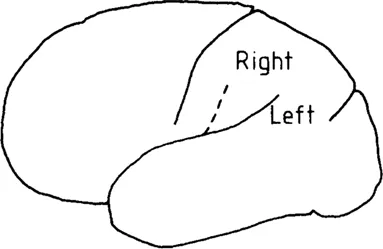
The sylvian fissure, a major lateral groove separating the temporal and parietal lobes of the brain, is generally longer on the left side (Rubens, 1977). This fissure also continues farther along horizontally before terminating, typically at a lower level in the left brain (refer to Fig. 1.1). The higher termination point of the right sylvian fissure is usually apparent by the fourth month in the fetal brain (LeMay & Culebras, 1972).
Temporal Planum Asymmetries
Cerebral differences also have been found with the temporal planum, a language-related area that includes much of the Wernicke region and through which the sylvian fissure passes. Recent studies have shown that the left temporal planum is larger than the right in a majority of cases, and is evident as early as the 31st week of gestation (Chi, Dooling, & Gilles, 1977). In particular, the superior portion of the superior temporal gyrus seems to be the most affected part of the left temporal planum.
Another area close in proximity to the planum, the parietal operculum, is also larger on the left side in cases where planum asymmetries have been reported (LeMay & Culebras, 1972). In addition, microscopic-level research has indicated more pronounced cell layers in the temporal lobe close to the vicinity of the left temporal planum (Galaburda, Sanides, & Geschwind, 1978).
Prefrontal Asymmetries
With respect to the brain's prefrontal regions, the left areas (especially Broca's motor-speech area) apparently are smaller than the right areas. Anatomists have speculated that hemispheric folding may be greater in these left prefrontal regions, suggesting that the total cortical surface may still be larger in this particular hemisphere (Wada, Clarke, & Hamm, 1975).
Fetal brain evidence would further support this claim. Right-hemispheric folding proceeds much earlier, by as much as 2 weeks ahead of the left. Eventually, the slower developing left-hemisphere areas attain a greater complexity of organization either by an increase in size and/or more intricate cortical foldings (Galaburda, 1984). The reported left-right asymmetries shown in the prefrontal regions, as well as the sylvian fissure and temporal planum, all involve brain areas mediating language functions in humans.
Venous System Asymmetries
Specific vein locations also have been mapped to identify possible morphologic asymmetries between the hemispheres. The major vein in the left hemisphere (i.e., the Vein of Labbe) lies very close to the language areas, whereas the predominant vein in the right hemisphere (i.e., the Vein of Trolard) traverses the superoparietal region, a location involved with nonverbal spatial processing (Hochberg & LeMay, 1975).
However, left-right asymmetries in blood flow have demonstrated some inconsistent results. At times, greater pressure is reported in the left frontal and precentral regions (Springer & Deutsch, 1989). In contrast, more current and intensive studies have indicated stronger right-sided pressure, especially when subjects are engaged in attention-demanding tasks (Deutsch, Papanicolaou, Bourbon, & Eisenberg, 1987). To compound the issue, hemispheric changes in blood flow seem to be largely dependent on which hand is tested in these tasks, with left-hand movement increasing the flow in the right hemisphere's motor region, and, correspondingly, right-hand movement slightly elevating the flow in the left hemisphere area (Halsey, Blaunstein, Wilson, & Wills, 1979). One conclusion certainly can be derived from these complex findings: Blood flow does not appear to be symmetrically distributed between the two cortical sides.
Gross Brain Asymmetries
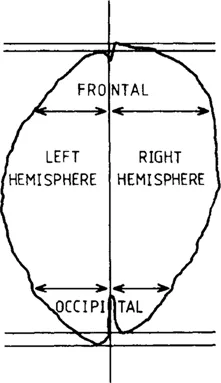
If one examines the entire brain configuration, a nonsymmetrical shape between the hemispheres is clearly evident. The right hemisphere's frontal and central regions are wider, with the frontal pole generally extending beyond the left (Fig. 1.2). In contrast, the left hemisphere's anteroparietal and posterooccipital regions are larger, with the occipital pole protruding more posteriorly than its right counterpart (Chui & Damasio, 1980). The wider right frontal and left occipital lobes give the human brain a counterclockwise torque appearance. These gross asymmetries (particularly in the left hemisphere) are shown in fetal as well as neonatal brains (LeMay & Geschwind, 1978).
Functional Brain Asymmetries
Based on the aforementioned distinctions, the question arises: Are left—right morphologic asymmetries related to the more functional asymmetries historically associated with the hemispheres (i.e., linguistic processing on the left side and spatial processing on the right)? Some researchers have concluded that the correlation between the morphologic and functional asymmetries is a strong one, especially when linguistic functions are considered (Walker, 1980). Their reasoning is that many of the structures reported to be larger (and/or more folded) on the left side are mainly responsible for language control and its comprehension. The next section reviews the specific functions traditionally linked with each hemisphere, keeping in mind that lateralization in function might have a physical base in the human brain.
Left Hemisphere: Language Functions
Clinical studies have shown that patients with cerebral lesions in the left hemisphere experience a wide variety of language disorders or aphasias, from articulation to comprehension deficits. Recent evidence by Zurif (1980) suggested that certain language dysfunctions, such as Broca's aphasia, involve not only articulation problems but comprehension ones as well, indicating that certain sites in the left brain regulate more than one linguistic function. It could be that such regions (e.g., Broca and Wernicke's) encompass wider cortical areas than previously supposed. Thus, the left hemisphere might contain an extensive number of neural tracts and structures associated with linguistic inputs (Dimond, 1980).
Research work with normal subjects also has demonstrated some consistent findings with language-related stimul...
Table of contents
- Cover
- Half Title Page
- Title Page
- Copyright Page
- Dedication
- Table of Contents
- Preface
- Part One Introduction to Cerebral Asymmetries
- Part Two Clinical Evidence for Cerebral Asymmetries
- Part Three Evidence for Cerebral Asymmetries in Normal Subjects
- Part Four New Approaches to and Concluding Comments on Cerebral Asymmetries
- References
- Author Index
- Subject Index
Trusted by 375,005 students
Access to over 1.5 million titles for a fair monthly price.
Study more efficiently using our study tools.
Frequently asked questions
Yes, you can cancel anytime from the Subscription tab in your account settings on the Perlego website. Your subscription will stay active until the end of your current billing period. Learn how to cancel your subscription
No, books cannot be downloaded as external files, such as PDFs, for use outside of Perlego. However, you can download books within the Perlego app for offline reading on mobile or tablet. Learn how to download books offline
Perlego offers two plans: Essential and Complete
- Essential is ideal for learners and professionals who enjoy exploring a wide range of subjects. Access the Essential Library with 800,000+ trusted titles and best-sellers across business, personal growth, and the humanities. Includes unlimited reading time and Standard Read Aloud voice.
- Complete: Perfect for advanced learners and researchers needing full, unrestricted access. Unlock 1.5M+ books across hundreds of subjects, including academic and specialized titles. The Complete Plan also includes advanced features like Premium Read Aloud and Research Assistant.
We are an online textbook subscription service, where you can get access to an entire online library for less than the price of a single book per month. With over 1.5 million books across 990+ topics, we’ve got you covered! Learn about our mission
Look out for the read-aloud symbol on your next book to see if you can listen to it. The read-aloud tool reads text aloud for you, highlighting the text as it is being read. You can pause it, speed it up and slow it down. Learn more about Read Aloud
Yes! You can use the Perlego app on both iOS and Android devices to read anytime, anywhere — even offline. Perfect for commutes or when you’re on the go.
Please note we cannot support devices running on iOS 13 and Android 7 or earlier. Learn more about using the app
Please note we cannot support devices running on iOS 13 and Android 7 or earlier. Learn more about using the app
Yes, you can access Left Brain - Right Brain Differences by James F. Iaccino in PDF and/or ePUB format, as well as other popular books in Psychology & Cognitive Neuroscience & Neuropsychology. We have over 1.5 million books available in our catalogue for you to explore.