![]()
Part I
STRATEGIES
![]()
1
Introduction
This section examines a selection of strategies for designing very low energy housing towards the goal of sustainability.
The challenge is to balance strategies, each of a very different nature, to fit the personal values and priorities of the home-owner or investor. Clearly a high priority is given to drastically reducing the amount of non-renewable energy a building needs, while at the same time improving comfort. If a building is to be promoted as ecological, then obviously there are other factors in addition to energy to address and the time horizon has to be extended to the lifetime of the construction.
To systematically weigh plusses and minuses, methodologies have been developed. Such multicriteria decision tools can also be applied to housing design. It is important to assure quality control from design through construction in the ongoing decision process. Compromises can be cumulative so that good intentions at the beginning of a project are not fulfilled when the building is completed.
Decisions in the planning process should also be made with an awareness of the housing market being targeted. Achieving a market breakthrough for a new product takes specialized skills – and very low energy, ecological and sustainable housing is a new product,. This know-how is not part of the normal formal education of architects, engineers or building physicists.
Many other topics exist regarding sustainable housing design. The topics and strategies presented here represent the work done by the experts within the time and budget of this international project.
![]()
2
Energy
2.1 Introduction
Joachim Morhenne
This section examines a selection of strategies for designing very low energy housing towards the goal of achieving sustainability.
The first set of strategies address energy. The objective of the first energy strategy is simple: need as little as possible to provide comfort. Energy not needed is the most ecological energy, so first priority goes to conservation. The energy still needed, after building a highly insulated tight envelope and recovering heat otherwise lost, should ideally be provided from renewable energy sources. Accordingly, the next strategies are targeted at maximizing the use of ‘free’ energy: passive solar gains, daylight and active solar thermal systems. These sources can cover all remaining demand but it is more economical to cover the last small fraction by conventional means as efficiently as possible.
Strategies aimed at low ecological impact have to address the energy and materials flow throughout the lifetime of the housing. Two approaches to quantifying this impact are the cumulative energy demand analysis and life-cycle analysis. ‘Sustainability’ is a broader topic that has to be considered, and which encompasses social, economic and energy impacts. A chapter is also included which examines ‘architecture’ in this broader context.
Low energy, ecological elements must be affordable and from the experience of the projects analysed during the production of this book, we see that these qualities cost more than design where decisions were made based on a short-term perspective. Here we examine which aspects of high-performance design added most to the additional costs and offer an outlook on cost developments based on observed trends.
It is quickly apparent that there are many strategies to choose from. Strategies may require actions which contradict other strategies and, in any case, the budget can hardly finance the application of all strategies. Decisions must be made as to which strategies will be given priority. To help in this decision process two approaches are reviewed: multi-criteria decision-making and total quality assessment.
Finally, this ‘wonder housing’ must be marketable. Here, experts offer insights from their experience building and marketing sustainable housing, which approaches are most effective and which arguments have little influence on buyers. Marketing is both a science and an art!
Following these strategies selectively, given the constraints and opportunities of a specific project, increases the likelihood of succeeding in building and selling low energy, ecological, affordable housing – the goal of this book.
2.2 Conserving energy
| DESIGN ADVICE |
| Minimal insulation values: | U-envelope 0.15 W/m2K (walls and roof) (insulation between 25–40 cm thick) |
| U-windows 0.8 W/m2K (average frame + glass) g-value > 0.50 |
| (triple glazing with two low-e coatings and noble gas) |
| Thermal bridges: | ψ ≤ 0.01 W/mK |
| Air tightness: | < 0.6 air changes per hour by 50 Pa |
| Ventilation air: | 30 m3/person |
| Heat exchanger efficiency: | > 0.75 |
| Electric/m3 ventilation air: | ≤ 0.4 W/m3 air |
Source: Feist et al (2005)
The goal of consuming very little energy to provide superior comfort can be achieved by two basic approaches:
| 1 | conservation; and |
| 2 | use of low or non-emissions resources. |
An analysis of built projects demonstrates that both strategies can achieve these goals, but each has limitations. This section will examine the potential and limitations of the conservation path.
Conservation strategies must reduce the energy needed to offset transmission and infiltration losses, supply and temper ventilation air, produce hot water and run technical systems (fans, pumps and controllers). Because the planner has little control over the occupants’ selections of household appliances over the building lifetime, this end use is not addressed here.
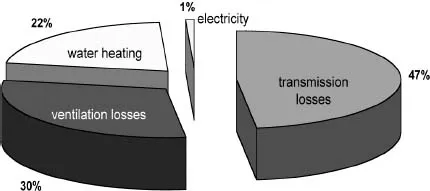
The proportion of these four principle end uses of energy for conventional housing per building codes is shown in Figure 2.2.1
Opportunities to conserve energy lost along these paths include:
- reducing the demand;
- increasing the efficiency of devices; and
- recovering otherwise lost heat.
Source: Joachim Morhenne
Figure 2.2.1 Energy losses of a row house (reference building in temperate climate)
Which opportunity makes the most sense for which end use varies by end use. Reducing demand is appropriate for reducing transmission losses, but not the first priority for reducing ventilation losses or producing hot water. The minimum air change rate in dwellings is dictated by human and hygienic requirements and cannot be dramatically reduced. Nor can the planner dictate a reduction in hot water use by occupants. For these end uses, recovering heat has a high priority. In the case of electrical consumption for technical systems, the main conservation approach is to specify more efficient devices and reduce the work load imposed on the devices.
2.2.1 Reducing transmission losses
Transmission losses can be drastically reduced by:
- improving the building's insulation;
- using active insulation (transparent insulation materials, or TIM) to compensate envelope heat losses by passive solar gains;
- interrupting thermal bridges across constructions; and
- making the building form more compact to reduce the amount of envelope heat losses for the enclosed heated volume (area-to-volume ratio, or A/V).
The effectiveness of TIM, for example, is affected by building orientation, shading and internal gains. Thermal bridges become more pronounced as the overall insulation level is increased. An interesting fact is that tr...