![]()
What this chapter will teach you
What is the difference between sensation and perception?
How many different kinds of sensory receptor do humans possess?
How can hair cells signal sound and body position?
How are the chemical components of gases, liquids, and solids detected?
How many different kinds of photoreceptor does the eye contain?
What sensory receptors signal pain?
Introduction
How do you survive in an environment full of challenges, including other creatures (predators, prey, fellow humans) and physical hazards (precipices, water, rock-falls, to name but a few)? The first step is to acquire information about them, as rapidly and as accurately as possible. This is the task of the human sensory systems. The information can take many forms, such as tiny vibrations in air pressure from animal calls or sudden impacts, volatile chemical substances from food sources, and electromagnetic radiation from the sun. So the human senses are extremely versatile and exquisitely sensitive. Continuous sensory input is so important to us that individuals deprived of external stimulation become severely disoriented and report vivid hallucinations, delusions, and distortions of body image. Prisoners held in the dark report seeing lights that appear out of the darkness in strange shifting forms (‘prisoner’s cinema’). Similar hallucinations have been reported by pilots flying through the dark for several hours. Sensory deprivation is so unpleasant and disorienting that it has been a widely used procedure during the interrogation of prisoners for many years (see reviews in Zubek, 1964; Sireteanu et al., 2008).
This book is an introduction to the science of human sensation and perception. Sensations are the elementary experiences evoked by sensory stimulation, such as the sourness of lemon juice, the loud-ness of a whistle, or the sharpness of a pin-prick. These primitive sensations combine to create perceptions of organized, meaningful objects and events. For example, while viewing a sports event on television the visual system senses the fleeting changes in color and lightness on the screen, and the auditory system senses the complex fluctuations in loudness, pitch, and timbre emanating from the audio speaker. You may be aware, for instance, of how green is the grass on the sports field. From this mass of sensations you construct elaborate perceptions of the event, the athletes, and their actions.
Key Terms
Sensation. An elementary experience evoked by stimulation of a sense organ, such as brightness, loudness, or saltiness.
Perception. A complex, meaningful experience of an external event or object, created from a combination of many different sensations.
Later in the book you will read about how perceptions are constructed from sensations, but the first step in your exploration of sensation and perception is to understand how sensations arise initially. How many different kinds of physical phenomena in the environment can you sense? In other words, how many different sensory systems do you have? Most people would probably say ‘five’. These are the senses defined by your visible external sense organs; seeing with the eyes, hearing with the ears, smelling with the nose, tasting with the mouth, and touching with the skin. There are in fact other, more rigorous ways to count the number of sensory systems that humans possess based on the characteristics of the nervous system, and none of them produces the answer five. The first way to answer the question is to examine the different specialized receptor systems that the body uses to detect sensory stimuli.
Key Term
Nervous system. The complex network of nerve cells that controls all bodily functions; the central nervous system (CNS) comprises the brain and spinal cord; the peripheral nervous system lies outside the brain and spinal cord, and includes sensory neurons, motor neurons, and their nerve fibers.
Transduction
The nervous system is basically a device for processing information. Some of this information comes from the brain’s memory stores, and some of it comes from the external environment. In this sense the nervous system is much like a typical personal computer. The computer’s brain, its central processing unit (CPU), processes data that are stored in its memory or entered by the user with a keyboard, mouse, or some other interface device. Information is passed between the computer’s components using electrical signals that mostly travel along thin copper wires. When you press a key or click a mouse button, for instance, mechanical switch closure causes a small electrical signal to be sent from that component to the CPU, which then acts on the input to, say, display a specific character on the screen. The nervous system also passes information between its components using electrical signals, which are generated by special brain cells called neurons.
However, in the case of the nervous system the process that initiates a signal about the external environment is much more complicated than a simple switch closure. Physical phenomena in the external environment can take many forms, as you read earlier: electromagnetic energy, air pressure fluctuation, volatile chemicals, mechanical force from contact with an external agent or object. All of these phenomena offer information that may have a bearing on well-being and survival, whether in identifying a food source or as an early warning of danger. In order to make use of this information, whatever form it takes, the system must convert it into an electrical signal that can be processed and interpreted by the brain. The brain must be able to infer the character of the external event from the signal, such as the particular spatial distribution of a light pattern, the direction of a sudden impact, the chemical composition of a volatile substance, or the level of threat offered by a mechanical force. The process of converting external energy into electrical nerve impulses is called transduction, and it is achieved by a specialized class of neuron called sensory receptors. Clearly different forms of external energy require different kinds of sensory receptor. The human sensory systems possess just four different kinds of sensory receptor, known as mechanoreceptors, chemoreceptors, photoreceptors, and nociceptors.
Key Terms
Transduction. The conversion of environmental energy into neural signals by sensory receptor cells.
Sensory receptor. A specialized nerve cell that transduces environmental energy into an electrical signal.
Key Concept
Neuron
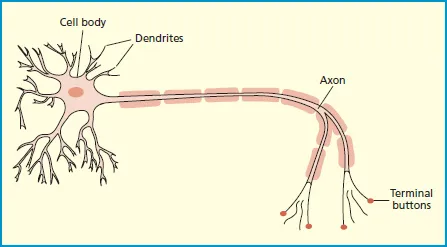
Brain cells come in two types, neurons and glial cells. Neurons (also called nerve cells) are specialized for sending electrical signals, while glial cells provide support and maintenance for neurons. The main components of a neuron, shown in Figure 1.1, are the cell body, dendrites, and axon. The cell body contains the nerve cell’s DNA, and is responsible for making energy and disposing of waste. The dendrites have a branched tree-like structure, and receive electrical signals from other neurons. The axon (sometimes called a nerve fiber) forms a long, fine filament. Its job is to carry the neuron’s own electrical signal from the cell body to the terminals at the end of the axon, which transmit the signal to the dendrites of other neurons. The signals themselves are brief electrical impulses or ‘action potentials’ (also called spikes) that propagate along axons rather like a spark traveling along a lit fuse.
Figure 1.1 The main components of a neuron. The cell body contains the cell’s DNA, and manages energy resources; the dendrites receive signals from other cells; the axon propagates an electrical signal to the cell’s terminal buttons, where they make contact with the dendrites of other cells.
The junctions between the axon terminals of one cell and dendrites of another are called synapses. When an action potential arrives at the axon’s terminals it causes special chemicals called neurotransmitters to be released across the synapse. These transmitters can excite a neighboring cell or inhibit it, and the likelihood that a cell will produce its own action potential depends on the relative amount of excitatory and inhibitory signals it receives from other cells at its dendrites. Axons can carr...