- 196 pages
- English
- ePUB (mobile friendly)
- Available on iOS & Android
eBook - ePub
About this book
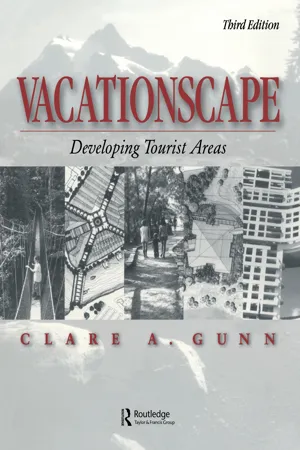
The third edition of this classic volume integrates the idea of balancing tourism with protection of the resources upon which it depends. The text stresses the role of the community, identifies potential pitfalls, and raises issues of developmental ethics. It includes topics such as environmental impact, sustainability, and ecotourism. Special emphasis is given to the growing need for business to implement environmental protection and ecological integrity as an essential part of economic development. The book is filled with many sketches, functional diagrams, and photographs.
Information
Chapter 1
Tourism: Positive and Negative
A most difficult lesson of tourism development today concerns the recognition that tourism has both dark and bright sides. Today the greatest wave of land development worldwide is aimed at tourism. As travel demand increases, nations, provinces, and communities look to tourism for economic progress, even salvation. It is reported to be the largest component of world trade, employing over 212 million people, one in nine workers. It now represents more than 10 percent of all global wages and is expected to continue its expansive growth (World Travel & Tourism Council 1995).
When tourism is not planned and developed so that it avoids, or at least reduces, its negative impact, it does exact some costs. Following is a sketch of significant issues that can become pitfalls if not considered at the very beginning of tourism development. Most of the difficulties are attributable to a lack of understanding and planning at the outset. Historical review suggests that poor preparedness is the greatest cause of negative impact.
Host-Guest Relationships
Today, neither the distribution nor the degree of tourism development occurs equally around the world. Some destinations have reached saturation, whereas others have not been visited by anyone. Even those areas with extensive physical development for masses of tourists seldom have well documented histories of why or how their tourist development occurred. Seldom do these destinations have sophisticated organizations or policies to manage tourism. Even where concerted planning and management have taken place, technological transfer to other regions has been weak and erratic. In spite of the many studies and treatises, mostly on promotion, the question of how to develop tourism seems to remain a mystery. Areas newly exposed to visitors frequently are ill-prepared to receive them, especially when they come in massive numbers. One can speculate on the many reasons for this great gap between hosts and guests, but experience suggests a few major factors.
Perhaps foremost is the lack of understanding of tourism by residents at the local development level. It is often thought of as the business of someone else or merely ignored completely. Past economic development usually has not provided the training or experience to give the local people any insight into the realm of tourism. Most development in the world grew from ancient food gathering and hunting into other economic foundations such as agriculture, mining, forestry, and fishing (Bronowski 1973). Technical and practical information about such activities was well known locally and dominated all social and economic life. Other than receiving guests in their homes, local people had no experience with the concept of tourism. The potentially great complexity and deep penetration of the many tourism tentacles into a community were unknown.
Tourism development grows from external intrusions rather than from local generations. Geographer Pearce (1989) has cited Miossec's model (1977) as perhaps the most lucid geographical description of tourism development (Figure 1-1). It reveals a progression from tourism's infancy, with just a resort or two, through maturity of greater saturation. It also identifies changes in transportation, tourist behavior, and the attitudes of decision makers and local populations. Pearce applied this model to Mediterranean tourism and found that the sequence of stages held for that area. This model emphasizes the dynamics of tourism, the changes in both hosts and guests, and the consequent impacts at each stage. Others, such as Butler (1980), have modeled tourism development in different stages: exploration, involvement, development, consolidation, stagnation, and rejuvenation or decline.
Although these models explain tourism's evolution, they are not useful for local tourism planning. Typically, development came from foreign investors who saw opportunities, purchased land, and proceeded with development without input from local residents. Only a few

Figure 1-1. Growth of tourism development. A model of typical changes with growth of resorts, transportation, tourist behavior, and host reception (Pearce 1989, p. 17).
local landowners and public officials were typically in on the deal. Occasionally, a few local people saw opportunities for providing services to visitors and established facilities. Generally no comprehensive involvement took place to give everyone understanding of the advantages and potential disadvantages of tourism development. Nor were the locals given any say in decisions. As a result, they often faced environmental degradation, traffic congestion, economic and social disruption, and other ills from mass unplanned tourism development. Unfortunately, this pattern of evolvement is standard today.
Because tourism development occurred somewhat differently in cities than in rural areas, small towns, and primitive areas, it is useful to examine the sequence of development for each. From this examination of the past, tourism planners may learn to avoid development pitfalls and to visualize new and better approaches.
Cities
Cities throughout the world were created primarily as physical centers of life where work, play, trade, and social exchange could take place more effectively than in the hinterland. As such, they also became centers of culture, education, and worship. Physical development of land for cities was an expression not only of needed functions but also of the desire for beauty, repose, and pleasure.
For self-interest, citizens created a great many amenities that became a fundamental part of urban fabric, such as:
architecture, building patterns, landscape features;
public spaces, plazas, streetscapes, gathering places;
opportunities for people-watching;
places of street entertainment;
parks, gardens, recreation areas;
zoos, aquariums, museums;
theaters, places for entertainment, storytelling venues;
farmers' markets;
shopping areas;
sidewalk cafes, street vendors;
cultural and historic sites, commemorative places;
festivals, craft displays, ethnic customs; and sculpture, art.
These places were often given further support from several sources. In many nations, park, recreation, literary, scientific, and historic societies rallied behind the protection and management of these amenities as early as the eighteenth and nineteenth centuries (Ashworth and Tunbridge 1990). This support occurred especially in urban centers such as London, Berlin, and Paris. Later, local and national legislative measures gave further protection and advancement to these amenities, primarily as a citizen good.
Other features became essential parts of cities. All transportation termini (air, land, water) were established at cities. Internal transportation was provided by vehicles and systems—first horse-drawn coaches and then taxis, personal cars, buses, mass transit, and rental cars. Food, automobile, and travel services were built in cities. Health and safety services evolved there—doctors, dentists, emergency care, hospitals. Public services such as police, public water and waste systems, and fire protection were provided in cities. Housing, schools, universities, churches, and auditoriums were founded there. All these physical developments were created for the use of local residents and supported by their tax monies.
Local pride and loyalty to cities and small towns must not be overlooked as a social fundamental throughout history. Essential to citizens of cities in many parts of the world today are the elements that provide opportunities for assembly, interaction, and even emotional attachment to place, especially in areas of more stable populations. In a mobile country such as the United States, this fervent support and even defense of local place is less evident. In western Europe, on the other hand, following the devastation of many cities in World War II, the remaining population did not flee from their homes but immediately began rebuilding (Lennard and Leonard 1995). The very first effort was to restore the meaning of community life. As everywhere, when threats to the fundamental character of cities occurred, the potential loss to human stability and continuity became real.
Then came tourism, an onslaught of outsiders. Travel marketers, both inside and outside the cities, began to extol their urban features. Hordes of visitors came, often a thousand times the local population. Generally, cities were ill-prepared for this invasion. Those originally responsible for the development and management of the amenities had no part in inviting so many of these visitors to their sites. Those who fanned the flames of advertising and other forms of promotion had no part in the decision-making process within destinations. The local citizens who were affected by masses of tourists likewise had no voice in decision making. Thus appeared a great gap between those who induced travel and those responsible for managing amenities in destination cities.
Rural Areas and Small Towns
The gap between those promoting travel and those who lived in and managed lands has often been greater in rural areas and small towns than in cities. These lands were often under control of government agencies, private firms, and local citizens who were involved not with tourism but with mining, forestry, agriculture, or extensive parkland and preserve activities. The interests of the small town administrations and citizenry were focused predominantly on the activities surrounding these uses of the land. Often included within their extensive lands were rivers, lakes, waterfalls, valleys, hills, mountains, deserts, and wildlife habitats, and sometimes aboriginal or prehistoric sites. For rural and small town dwellers, these amenities were traditionally theirs.
Then came volumes of visitors seeking the recreational and cultural values these resources could offer. Hundreds of thousands, even millions of visitors began to come each year to participate in activities such as the following: camping, nature study; hunting, fishing; hiking, walking, backpacking; mountain climbing, mountain biking, skiing; rafting, boating, swimming; photography; resorting, vacation home use, condo use; ghost town visits, small town historic visits; and dude ranching.
Even less prepared than cities were these resource areas, their leaders, and residents. Seldom did they have in place the needed zoning statutes, plans, planning officials, or controls to avoid catastrophic results. The hordes of visitor populations from cities generally held personal lifestyles and interests quite different from those of rural residents. Visitors invaded lands and resources that for generations had been considered solely the turf of locals. Often, the administrative offices that governed these extensive lands were located long distances away, making access and political influence by locals extremely difficult. Certainly the local vocational interests and traditions were much in contrast to those of the visitors. As a consequence, many local resources in rural areas were either destroyed or badly damaged.
Nonindustrialized Areas
In undeveloped regions of the world, many people still live on subsistence agriculture and by barter rather than in a money economy. In many areas they occupy lands abundant in fish, wildlife, and forests. Land and natural resources are essential parts of their lives. Over many generations, many customs, crafts, and worship rituals have become essential parts of their cultures.
Because of the abundance of exotic animals, rare cultural customs, and often spectacular scenic beauty, in recent decades tourists have begun to invade such areas. Despite language barriers and primitive food and sanitation standards, tourists have begun to trample the environment, slaughter the wildlife excessively for trophies, and impose on the privacy of native peoples.
Again, the management and control of resources by local or national governments have often been lacking. Safari tours in Africa, for example, became so intensive an intrusion that the very wildlife that was the area's major attraction was severely threatened.
Consequences
In all these situations (cities, rural areas and small towns, undeveloped regions) there is ample evidence of tourism's erosiveness. Further examination shows that such damage is preventable—but not without new understandings, planning policies, and actions. As it continues to spiral upward, tourism continues to consume vast acreages in ways that make the land very difficult to reclaim. New resorts, new airports, new roads, and new shops, casinos, and hotels demand the very best of available land resources. Although tourism may not make as drastic nor as permanent an impact on land as do mining and other extractive industries, its effects are real and worthy of consideration everywhere that continued growth is contemplated. Equally vulnerable are all categories of places—cities, rural areas and small towns, and developing nations.
Physical Resource Degradation
Increasingly, the negative impacts of tourism on the physical environment are being recognized and dealt with in a constructive manner. Wight (1994} has cited many instances in which commercial lodging and food service businesses are becoming more environmentally friendly. Although a moral obligation may provide one motive, probably much stronger motives are the demands by consumers and cost savings to developers. For example, by implementing conservation measures, Italy's Hotel Ariston increased its occupancy by 15 percent, and the Boston Park Plaza Hotel increased its business by $750,000 a year. The Royal Connaught Hotel in Hamilton, Ontario, saved $33,113 annually by replacing conventional lights with compact fluorescents. Prince Edward Hotel in Charlottetown, Prince Edward Island, reduced fuel consumption by 97,000 liters in one year by installing a water source heat pump (Wight 1994). Generally, the conservation measures being implemented by tourist service businesses can be classified into recycled and reduced waste, conservation of energy and water, improved air quality, or more selective purchases of products. There are many other instances of tourism development that are actually enhancing local environments by diverting some business profits toward support of nearby park and natural resource areas, such as ecotours.
But, at the same time, natural resources, the very foundations for tourism, are being eroded as never before. Especially damaging is water pollution, because clean water is essential to so many tourist activities. A few examples illustrate the seriousness of water contamination, not only by tourism but by industrial and municipal waste: More than 2.5 billion gallons of untreated waste is flushed annually into Narragansett Bay, Rhode Island (Brancatelli 1995). In 1995, 9,942 volunteers for the Center for Marine Conservation collected 361,000 pounds of debris along 147 miles of the Texas Gulf Coast (1995 International Coastal Cleanup, 1996, 1). This is not merely an American problem; it is worldwide. Resort hotel sewage often flows untreated into the recreational waters at its doors, threatening the health of all tourists who swim and fish there.
Some observers are concerned about the ability of tourism to completely change the character of cities. Selzano (1991) has cited the case of tourists to Venice, where more than six million visitors a year descend upon a city of only eighty thousand inhabitants. As a result, tourism activities have pushed out local businesses such as shoemakers, plumbers, bakers, butchers, milliners, and haberdashers that formerly served the residents; tourist-type shops have replaced them. The mayor, Antonio Casellati (1991), is of the opinion that numbers of tourists must be restricted, especially on a site-to-site basis. He turned ...
Table of contents
- Cover
- Half Title
- Title
- Copyright
- Contents
- Foreword
- Preface
- 1. Tourism: Positive and Negative
- 2. Politics and Ethics
- 3. Tourism Function: Demand
- 4. Tourism Function: Supply
- 5. Attractions: First Power
- 6. Destination Development
- 7. Spatial Patterns
- 8. Techniques, Processes, and Guides
- 9. Conclusions and Principles
- 10. Gallery of Examples
- Bibliography
- Appendix A: A Code of Ethics for Tourists
- Appendix B: Code of Ethics and Guidelines for Sustainable Tourism
- Index
Trusted by 375,005 students
Access to over 1.5 million titles for a fair monthly price.
Study more efficiently using our study tools.
Frequently asked questions
Yes, you can cancel anytime from the Subscription tab in your account settings on the Perlego website. Your subscription will stay active until the end of your current billing period. Learn how to cancel your subscription
No, books cannot be downloaded as external files, such as PDFs, for use outside of Perlego. However, you can download books within the Perlego app for offline reading on mobile or tablet. Learn how to download books offline
Perlego offers two plans: Essential and Complete
- Essential is ideal for learners and professionals who enjoy exploring a wide range of subjects. Access the Essential Library with 800,000+ trusted titles and best-sellers across business, personal growth, and the humanities. Includes unlimited reading time and Standard Read Aloud voice.
- Complete: Perfect for advanced learners and researchers needing full, unrestricted access. Unlock 1.5M+ books across hundreds of subjects, including academic and specialized titles. The Complete Plan also includes advanced features like Premium Read Aloud and Research Assistant.
We are an online textbook subscription service, where you can get access to an entire online library for less than the price of a single book per month. With over 1.5 million books across 990+ topics, we’ve got you covered! Learn about our mission
Look out for the read-aloud symbol on your next book to see if you can listen to it. The read-aloud tool reads text aloud for you, highlighting the text as it is being read. You can pause it, speed it up and slow it down. Learn more about Read Aloud
Yes! You can use the Perlego app on both iOS and Android devices to read anytime, anywhere — even offline. Perfect for commutes or when you’re on the go.
Please note we cannot support devices running on iOS 13 and Android 7 or earlier. Learn more about using the app
Please note we cannot support devices running on iOS 13 and Android 7 or earlier. Learn more about using the app
Yes, you can access Vacationscape by Clare A. Gunn in PDF and/or ePUB format, as well as other popular books in Biological Sciences & Environmental Science. We have over 1.5 million books available in our catalogue for you to explore.